
How AI and Neural Interfaces Are Making Bionic Limbs Feel Human
Recent breakthroughs in artificial intelligence and novel surgical techniques are transforming prosthetic limbs from exhausting mechanical tools into intuitive, feeling extensions of the human body.
By Factlen Editorial Team
- Neuro-Robotics Researchers
- Focused on closing the feedback loop between the human nervous system and robotic hardware.
- Prosthetic Users & Advocates
- Prioritize daily reliability, comfort, and the psychological feeling of wholeness.
- Accessibility & Commercial Developers
- Focused on scaling these breakthroughs so they are affordable and durable in the real world.
What's not represented
- · Health Insurance Providers
- · Physical Rehabilitation Therapists
Why this matters
For decades, amputees have had to choose between simple, functional hooks or advanced robotic limbs that are mentally exhausting to operate. By integrating AI to handle micro-movements and rewiring nerves to restore a sense of touch, the robotics industry is finally crossing the threshold from building 'tools' to restoring true human capability.
Key points
- Nearly half of all amputees abandon advanced prosthetics due to the intense cognitive burden of operating them.
- New 'shared control' systems use AI to handle the micro-adjustments of grasping, drastically reducing mental fatigue.
- Optical proximity sensors allow bionic fingertips to 'see' and anticipate objects before touching them.
- MIT's osseointegration anchors robotic legs directly into the femur, eliminating uncomfortable wearable sockets.
- Novel surgical techniques reconnect severed muscles, allowing the brain to receive natural sensory feedback from the robotic limb.
- Users of these neural-integrated limbs report a profound sense of 'embodiment,' feeling the device is part of their own body.
For the millions of people living with limb amputations, the promise of the 'bionic future' has often felt like a frustrating mirage. While modern prosthetic hands and legs look like marvels of engineering, operating them in the real world is a vastly different story. Traditional advanced prosthetics are essentially dumb machines that require intense, conscious micromanagement from the user.[6]
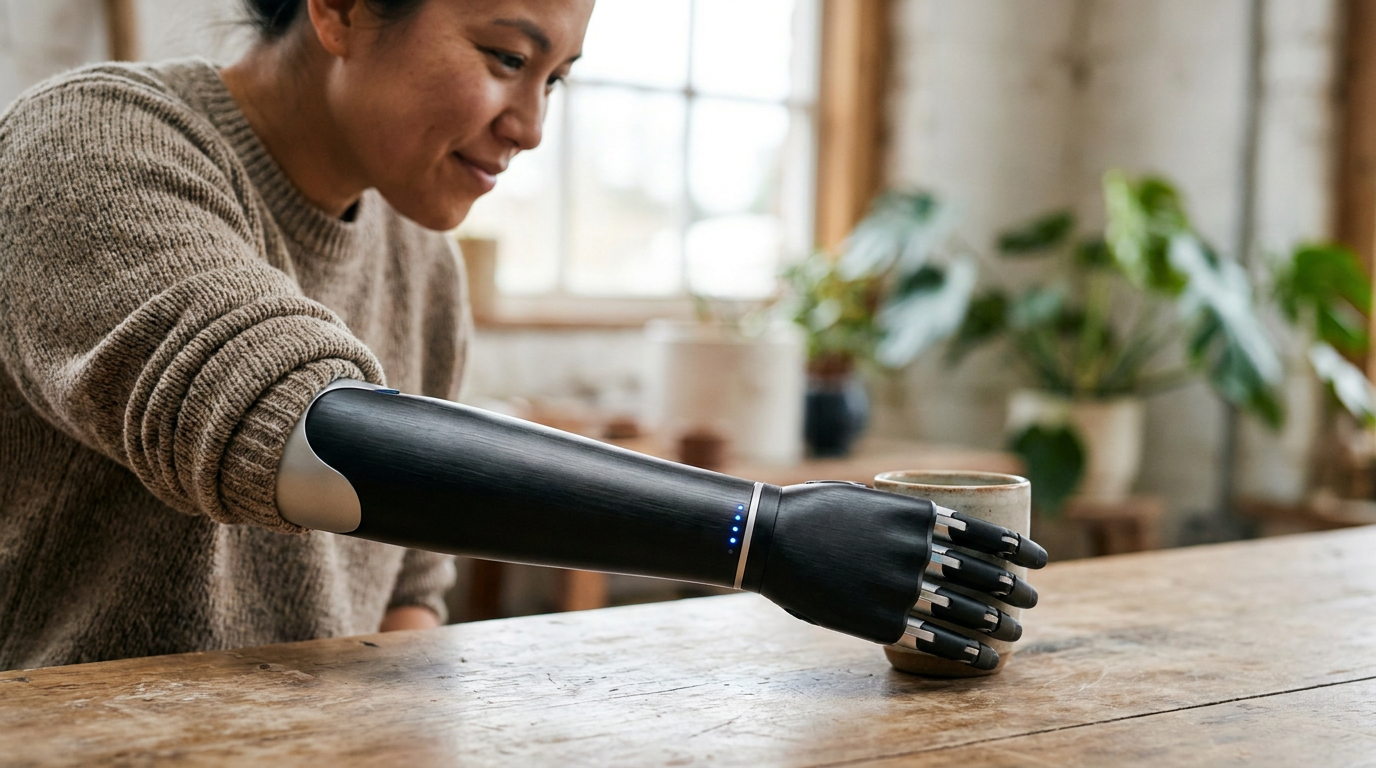
To pick up a glass of water with a standard myoelectric arm, a user must consciously flex specific residual muscles to trigger a pre-programmed grip, visually monitor the hand to ensure it does not crush the glass, and maintain that unnatural mental focus until the glass is set down. This cognitive burden is exhausting.[3][4]
The mental strain and physical discomfort of these devices lead to a staggering statistic: nearly half of all users eventually abandon their advanced prostheses, opting instead for simpler, older technologies or nothing at all. The bottleneck has not been the motors or the batteries, but the communication barrier between the human brain and the robotic hardware.[3][4]
That barrier is now collapsing. A wave of recent breakthroughs from institutions like the University of Utah and the Massachusetts Institute of Technology has fundamentally altered the trajectory of neuroprosthetics. By introducing artificial intelligence into the limb itself and pioneering new ways to wire machinery directly into the human nervous system, researchers are finally closing the loop.[1][4][6]
At the University of Utah's NeuroRobotics Lab, engineers tackled the cognitive load problem by introducing a concept known as 'shared control.' Instead of forcing the human to dictate every millimeter of finger movement, they embedded an artificial neural network directly into a commercial prosthetic hand.[3][4]

Under this shared system, the human user provides the high-level intention—such as reaching for a delicate cotton ball—while the onboard AI handles the complex physics of the grasp. The AI calculates exactly how much pressure is needed and precisely where each robotic finger should land, executing the fine-motor control autonomously.[3][4]
To make this possible, the Utah team outfitted the bionic fingertips with advanced pressure sensors and optical proximity detectors. The prosthetic hand can literally 'see' and anticipate an object before making physical contact, much like a natural human hand instinctively prepares its shape before grabbing a door handle.[3][4]

The results of this AI integration have been striking. Users report that they no longer have to 'fight' the device to achieve a stable grasp. By offloading the micro-adjustments to a machine learning algorithm, the mental fatigue of using a bionic arm plummets, allowing users to perform everyday tasks with an automatic ease they thought was lost forever.[3][4]
Users report that they no longer have to 'fight' the device to achieve a stable grasp.
While AI is solving the cognitive puzzle for upper limbs, a different kind of revolution is happening for lower-limb amputees. For decades, the standard method of attaching a prosthetic leg has been a wearable socket that fits over the residual limb. Sockets are notoriously uncomfortable, prone to chafing, and incapable of articulating like a natural joint.[2][6]
Researchers at MIT have bypassed the socket entirely with a groundbreaking system called the osseointegrated mechanoneural prosthesis (OMP). Rather than strapping the leg on, surgeons anchor a titanium rod directly into the user's femur bone. This creates a stable, skeletal attachment that allows for superior load-bearing and mechanical control.[1][2]
But the true magic of the MIT system lies in the nerves. During the amputation, surgeons perform a novel procedure called an agonist-antagonist myoneural interface (AMI). They meticulously reconnect severed muscle pairs in the residual thigh so that when one muscle contracts, the other stretches—exactly as they do in a biological leg.[1][2]

Electrodes attached to these reconnected muscles transfer data through 16 wires into the titanium implant, feeding signals to a robotic controller. When the user simply thinks about walking, the sensors detect the neural impulse and the bionic knee flexes in real time.[1][2]
Crucially, this communication is a two-way street. As the robotic knee moves, it physically stretches the reconnected muscles in the thigh. Those muscles then send natural sensory feedback up the spinal cord to the brain, telling the user exactly where their bionic leg is in space without them having to look down at it.[1][2]
This closed neural loop triggers a profound psychological phenomenon known as 'embodiment.' In clinical trials, users of the MIT bionic leg reported a deep sense of agency, stating that the device ceased to feel like a sophisticated external tool and genuinely began to feel like a part of their own physical body.[1][2]
As these technologies mature, the commercial landscape is shifting rapidly. Manufacturers are moving away from rigid, heavy metal components toward flexible silicones and compliant joints that can withstand the impacts of daily life. The goal is to build hardware that is as resilient and forgiving as human tissue.[5][6]

Market analysts note that the proliferation of AI-powered limbs with sensory feedback is driving widespread adoption, moving these devices out of niche academic trials and into scalable production. The integration of machine learning is proving to be the catalyst that makes advanced restorative hardware commercially viable.[5]
Yet, the final hurdle remains accessibility. The most advanced bionic hand in the world is of little use if it costs as much as a luxury car. Industry advocates and startups are increasingly emphasizing that true innovation must include affordability, pushing for manufacturing efficiencies that can bring these life-changing devices to the broader public.[6]
We are entering an era where the line between biology and machinery is blurring in the most restorative way possible. By teaching algorithms to handle the heavy lifting of motor control and rewiring the human body to speak directly to titanium, science is giving amputees their independence—and their sense of touch—back.[6]
How we got here
2019
Early neuroprosthetic research begins demonstrating the potential of shared human-robot control for greater dexterity.
2024
MIT researchers successfully restore natural walking gaits in below-the-knee amputees using the AMI surgical technique.
July 2025
MIT unveils a bionic knee for above-the-knee amputees that integrates directly into bone and muscle tissue.
December 2025
The University of Utah's NeuroRobotics Lab announces a breakthrough in AI-assisted shared control for bionic hands.
Early 2026
Commercial adoption accelerates as robotics companies integrate flexible, AI-powered bionic hands into both human prosthetics and humanoid robots.
Viewpoints in depth
Neuro-Robotics Researchers
Focused on closing the feedback loop between the human nervous system and robotic hardware.
For engineers and neuroscientists, the ultimate goal is seamless integration. They argue that the bottleneck in prosthetics is no longer mechanical strength, but communication. By developing AI that can interpret vague muscle signals and surgical techniques that preserve nerve pathways, this camp believes we can completely eliminate the cognitive barrier between a user's intention and a robot's action.
Prosthetic Users & Advocates
Prioritize daily reliability, comfort, and the psychological feeling of wholeness.
While users appreciate technological marvels, their primary concerns are often practical: Does the socket chafe? Is the hand too heavy? Does it require exhausting mental focus to hold a cup of coffee? For this group, the true breakthrough of AI and neural integration isn't just dexterity—it's the phenomenon of 'embodiment,' where the limb stops feeling like a cumbersome tool and starts feeling like a natural part of their body.
Accessibility & Commercial Developers
Focused on scaling these breakthroughs so they are affordable and durable in the real world.
Industry analysts and accessibility advocates warn that high-tech solutions are meaningless if they remain confined to elite laboratories. This camp emphasizes the need for durable materials like silicone over rigid metals, and pushes for manufacturing efficiencies that can bring the cost of AI-powered limbs down to a level where insurance and public health systems can cover them for the average amputee.
What we don't know
- How quickly public and private health insurance providers will update their policies to cover the high costs of AI-integrated prosthetics.
- The long-term durability and infection risks associated with osseointegrated titanium implants over decades of use.
- Whether fully non-invasive brain-computer interfaces will eventually replace the need for surgical muscle reconnection.
Key terms
- Neuroprosthetics
- Artificial devices that connect directly to the nervous system to restore lost motor or sensory functions.
- Osseointegration
- A surgical procedure that anchors a prosthetic device directly into a patient's bone, eliminating the need for a traditional socket.
- Agonist-antagonist myoneural interface (AMI)
- A surgical technique that reconnects opposing muscle pairs to preserve natural neural communication between the limb and the brain.
- Embodiment
- The psychological sensation where a user perceives an artificial limb as a natural extension of their own physical body.
- Surface electromyography (sEMG)
- A technique that uses sensors placed on the skin to detect electrical activity generated by underlying muscles.
Frequently asked
What is a shared control system in prosthetics?
It is a setup where the human user provides the high-level intention to move, while an onboard AI handles the precise, micro-adjustments of the robotic fingers.
How does osseointegration work?
Instead of fitting a limb into a wearable socket, a titanium rod is surgically anchored directly into the user's bone, providing a stable, skeletal connection.
What is the AMI surgical procedure?
The agonist-antagonist myoneural interface (AMI) reconnects severed muscle pairs during amputation, allowing them to send natural sensory feedback to the brain when a bionic limb moves.
Why do people abandon traditional prosthetics?
Many users find them heavy, uncomfortable, and mentally exhausting to operate, as they require intense focus to trigger specific pre-programmed movements.
Sources
Source coverage
6 outlets
3 viewpoints surfaced






[1]MIT NewsNeuro-Robotics Researchers
A bionic knee integrated into tissue can restore natural movement
Read on MIT News →[2]ExtremeTechProsthetic Users & Advocates
MIT's Bionic Leg Connects Directly to the Nervous System
Read on ExtremeTech →[3]Futura SciencesNeuro-Robotics Researchers
This bionic hand hands control to AI and changes users' lives: a decisive breakthrough
Read on Futura Sciences →[4]EvrimagaciNeuro-Robotics Researchers
University of Utah's NeuroRobotics Lab enhanced a commercial prosthetic hand with custom fingertips and AI
Read on Evrimagaci →[5]TechSci ResearchAccessibility & Commercial Developers
The Proliferation of AI-Powered Bionic Limbs with Sensory Feedback
Read on TechSci Research →[6]Factlen Editorial TeamAccessibility & Commercial Developers
Synthesis by Factlen editorial team
Read on Factlen Editorial Team →

More in ai
See all 5 stories →Protein Engineering
Open-Source AI Breakthrough Accelerates Plastic-Degrading Enzyme Design
8 sources
EU AI Act
EU Parliament Votes to Delay AI Act's High-Risk Compliance Deadlines to 2027
8 sources

Small Language Models
The Enterprise AI Shift: Why Small Language Models Are Replacing Massive LLMs in 2026
8 sources
Every angle. Every day.
Get ai stories with full source coverage and perspective breakdowns delivered to your inbox.