
Evidence Pack: Does Crowdsourced Fact-Checking Actually Stop Misinformation?
Peer-reviewed studies reveal that decentralized systems like Community Notes match expert accuracy and slash engagement with false posts, though speed remains a critical bottleneck.
By Factlen Editorial Team

- Decentralized Moderation Advocates
- Supporters who view crowdsourcing as a democratic alternative to platform censorship.
- Platform Trust Researchers
- Academics who emphasize the empirical limitations of the system, particularly regarding speed.
- Media Literacy Experts
- Educators who see crowdsourcing as a stepping stone to better critical thinking.
What's not represented
- · Users whose accurate posts were unfairly flagged by coordinated mobs
- · Professional fact-checkers who lost their platform contracts due to the shift toward crowdsourcing
Why this matters
As social media platforms shift away from centralized censorship, understanding whether crowdsourced context actually works is crucial for the future of digital literacy. If successful, this model proves that decentralized, democratic tools can effectively neutralize misinformation without silencing free expression.
Key points
- Crowdsourced fact-checking systems allow everyday users to append context to misleading posts.
- Studies show the aggregated judgments of 10 to 15 laypeople match the accuracy of professional fact-checkers.
- Attaching a crowdsourced note significantly reduces engagement, dropping reposts by 46% and likes by 44%.
- A bridging algorithm ensures notes are only displayed if users from opposing political viewpoints agree they are helpful.
- The primary vulnerability of the system is speed; notes that take 48 hours to appear fail to stop initial viral spread.
- Platforms are exploring AI-human hybrid models to draft notes instantly and accelerate the consensus process.
For years, the battle against online misinformation relied on a centralized playbook: hire professional fact-checkers, flag false content, and delete the worst offenders. But the sheer volume of the internet made this approach mathematically impossible to scale.
In response, a radical experiment in decentralized moderation emerged. Pioneered by X (formerly Twitter) as "Community Notes" and recently adopted by Meta and YouTube, crowdsourced fact-checking allows everyday users to append contextual corrections directly beneath misleading posts.
The premise sounds risky—trusting the internet to police the internet. Critics initially warned it would devolve into partisan mob rule. However, a growing body of peer-reviewed evidence from top universities suggests the exact opposite: crowdsourced context is not only highly accurate, but it actively changes user behavior.
The first major claim tested by researchers was accuracy. Can laypeople actually match the rigor of professional fact-checkers? According to researchers at the MIT Sloan School of Management, the answer is a definitive yes.[2]
The MIT study found that the aggregated judgments of just 10 to 15 regular users correlated as strongly with professional fact-checkers as the professionals correlated with each other. By relying on the "wisdom of the crowd," platforms can evaluate claims at a fraction of the cost and time of traditional methods.[2]

This accuracy holds up even in highly technical domains. A study published in JAMA by UC San Diego researchers analyzed Community Notes applied to complex health posts. They found that an overwhelming 97.5% of the notes were entirely accurate, with nearly half citing highly credible primary sources like peer-reviewed journals.[3]
But accuracy means little if the corrections do not change behavior. A landmark study from the University of Washington tracked 40,000 posts to measure the causal impact of attaching a crowdsourced note.[1]
The results were stark. Once a note was attached, engagement with the misleading post plummeted. Reposts dropped by 46%, and likes fell by 44%. The note effectively broke the "diffusion cascade," preventing the false information from spreading beyond the original poster's immediate follower network.[1]

"We found that Community Notes significantly change the way information spreads through a network," noted Martin Saveski, the study's senior author. Users who were socially distant from the original poster were much less likely to interact with the content once they saw the appended context.[1]
"We found that Community Notes significantly change the way information spreads through a network," noted Martin Saveski, the study's senior author.
Crucially, crowdsourced notes appear to bypass the partisan defensiveness that often plagues traditional fact-checking. A study by the Oxford Internet Institute found that while misinformation itself is shared disproportionately across political divides, the notes system remains remarkably neutral.[4]
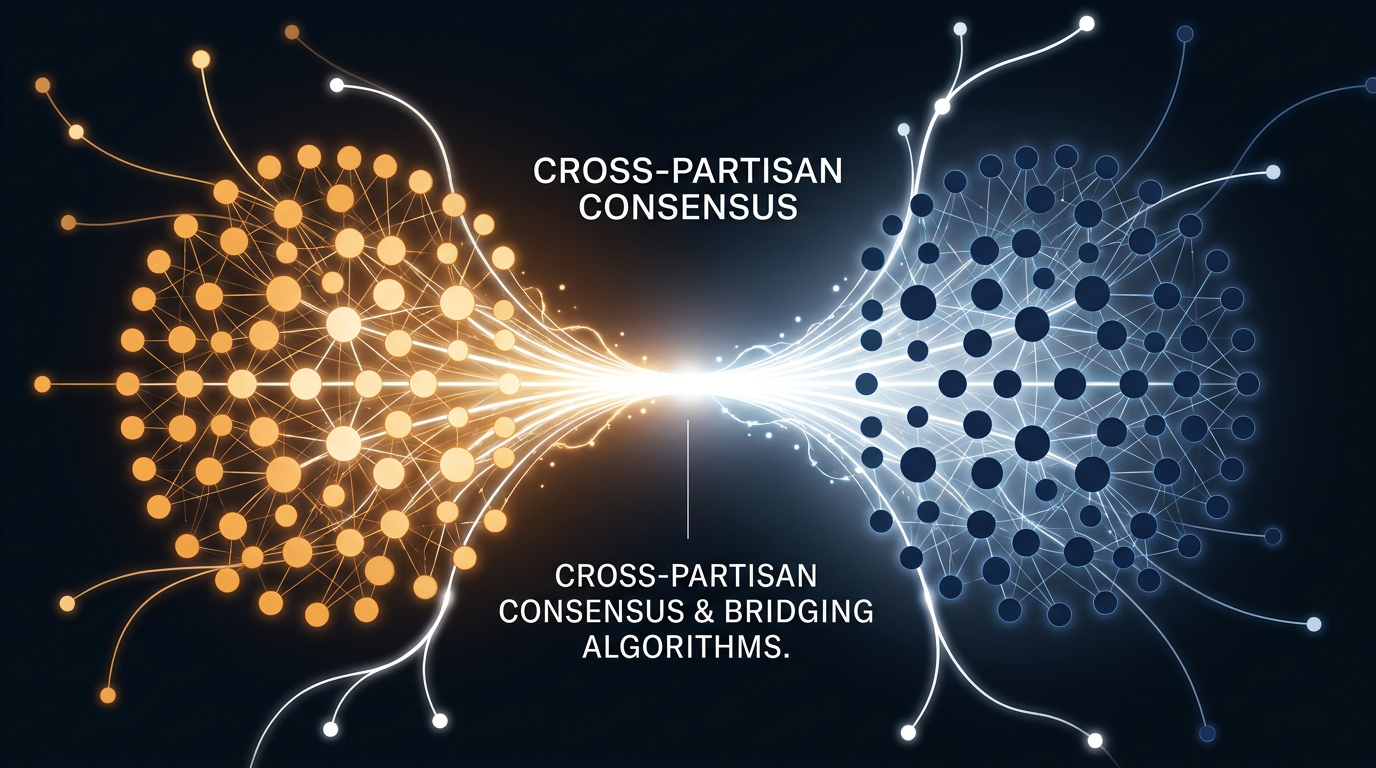
This neutrality is enforced by a "bridging algorithm." For a note to become visible to the public, it must be rated as helpful by users who historically disagree on other topics. If only one political faction upvotes a note, it remains hidden.
Research published in PLOS ONE confirms that this consensus-building approach works. The study found that users across the political spectrum perceived text-based community notes as significantly more trustworthy than simple, context-free "Misinformation" warning labels applied by platform administrators.[5]
Despite these successes, the evidence pack reveals one critical vulnerability: speed. The University of Washington study highlighted that misinformation goes viral rapidly, and crowdsourced notes often arrive too late to mitigate the initial damage.[1]
If a note takes 48 hours to achieve the cross-partisan consensus required to appear, it has almost no effect on the post's overall virality. The crowd is accurate, but the consensus mechanism is inherently slower than a viral algorithm.[1]

To solve this bottleneck, platforms are beginning to experiment with human-AI collaboration. Pilot programs are testing the use of large language models to instantly propose context drafts, which human contributors then vote on.
Early data suggests an optimal ratio of AI screening to human verification. This hybrid approach aims to reduce the response time from hours to minutes, catching viral falsehoods before they escape their initial network cluster.
Ultimately, the success of crowdsourced fact-checking represents a philosophical shift in content moderation. Rather than censoring misleading content—which often breeds resentment and conspiracy theories—platforms are fostering a learning environment.

Stanford University researchers have long advocated for teaching "lateral reading"—the practice of opening new tabs to verify a source's credibility. Crowdsourced notes essentially automate this process, doing the lateral reading for the user and placing the evidence directly in their feed.[6]
By providing transparent context and credible sources alongside contentious posts, these systems empower users to discern fact from fiction for themselves. It treats the audience as capable citizens rather than passive consumers.
While it will not completely replace the need for professional journalists and expert investigators, crowdsourced fact-checking has proven to be a highly effective, scalable tool. The evidence is clear: when given the right structure, the internet can actually help clean itself up.[7]
How we got here
January 2021
Twitter launches Birdwatch, a pilot program for crowdsourced fact-checking.
November 2022
Birdwatch is rebranded as Community Notes and made a central feature of the platform.
April 2024
UC San Diego publishes research confirming the high accuracy of notes on complex health topics.
Early 2025
Meta and YouTube begin rolling out their own versions of crowdsourced contextual notes.
September 2025
University of Washington study quantifies the massive drop in engagement when notes are attached.
Viewpoints in depth
Decentralized Moderation Advocates
Supporters who view crowdsourcing as a democratic alternative to platform censorship.
This camp argues that traditional content moderation—where centralized trust and safety teams delete posts or ban users—breeds resentment and fuels conspiracy theories. By contrast, crowdsourced notes leave the original content intact but append vital context. Advocates point to data showing that this approach preserves free expression while actively teaching users how to evaluate claims, ultimately creating a more resilient and digitally literate user base.
Platform Trust Researchers
Academics who emphasize the empirical limitations of the system, particularly regarding speed.
While acknowledging the high accuracy of crowdsourced notes, this group focuses on the mechanics of virality. Because the system requires a cross-partisan consensus to display a note, controversial posts can circulate unchecked for days while users debate the wording of a correction. Researchers warn that if a note takes 48 hours to appear, the misinformation has already achieved its maximum reach, making the intervention practically useless for fast-moving breaking news.
Media Literacy Experts
Educators who see crowdsourcing as a stepping stone to better critical thinking.
For this camp, the value of crowdsourced fact-checking isn't just in correcting a single false post, but in modeling good investigative behavior. By showing users the 'lateral reading' process—linking to primary sources and explaining why a claim is misleading—these notes train the public to be more skeptical. However, they caution that crowds cannot replace professional journalists when it comes to investigating complex, novel, or deeply hidden corruption.
What we don't know
- Whether AI-generated drafts will introduce new biases into the crowdsourced voting process.
- How effective these systems are in non-English languages and regions with smaller user bases.
- If bad actors will eventually find ways to coordinate and manipulate the bridging algorithms.
Key terms
- Bridging Algorithm
- A recommendation system that only displays a fact-check if users who typically disagree politically both rate it as helpful.
- Lateral Reading
- The practice of verifying information by opening new tabs to check a source's credibility, rather than trusting the original page.
- Diffusion Cascade
- The pattern and speed at which a piece of content spreads through a social network via shares and reposts.
- Wisdom of the Crowd
- The theory that the collective opinion of a diverse group of individuals is often as accurate as, or better than, that of a single expert.
Frequently asked
What is crowdsourced fact-checking?
It is a decentralized moderation system where regular social media users propose, vote on, and attach contextual corrections to potentially misleading posts.
Do people just vote for their political side?
No. The system uses a bridging algorithm that requires consensus from users with historically opposing viewpoints before a note is made public.
Is it replacing professional fact-checkers?
While platforms are leaning heavily into crowdsourcing for scale, researchers emphasize that experts and crowds work best as complementary systems.
Does it actually stop misinformation?
Yes. Studies show that attaching a note drops reposts by 46%, though the system struggles to act fast enough to stop the initial viral spike.
Sources
Source coverage
7 outlets
3 viewpoints surfaced







[1]University of WashingtonPlatform Trust Researchers
Community Notes reduce engagement with false posts, but speed is key
Read on University of Washington →[2]MIT SloanDecentralized Moderation Advocates
Crowdsourced fact-checking can work about as effectively as using professional fact-checkers
Read on MIT Sloan →[3]UC San DiegoDecentralized Moderation Advocates
X's Community Notes Help Counter COVID-19 Misinformation
Read on UC San Diego →[4]Oxford Internet InstitutePlatform Trust Researchers
New research reveals partisan differences in sharing of misinformation on X
Read on Oxford Internet Institute →[5]PLOS ONEMedia Literacy Experts
Trust the crowd: Crowdsourced fact-checking is as effective at reducing confidence in misinformation as expert fact-checking
Read on PLOS ONE →[6]Stanford UniversityMedia Literacy Experts
Stanford scholars observe 'experts' to see how they evaluate the credibility of information online
Read on Stanford University →[7]Factlen Editorial TeamDecentralized Moderation Advocates
Synthesis by Factlen editorial team
Read on Factlen Editorial Team →

More in news politics
See all 5 stories →Information Ecosystem
The Evidence Behind Bridging Algorithms: How Decentralized Fact-Checking is Actually Working
7 sources
US-Iran Deal
How the Fragile US-Iran Peace Deal Could Unravel Over Lebanon
8 sources

Lebanon Border
Israel Limits Lebanon Actions to Salvage US-Iran Deal, but Refuses to Withdraw
7 sources

Every angle. Every day.
Get news politics stories with full source coverage and perspective breakdowns delivered to your inbox.