
How ActivityPub is Quietly Tearing Down Social Media's Walled Gardens
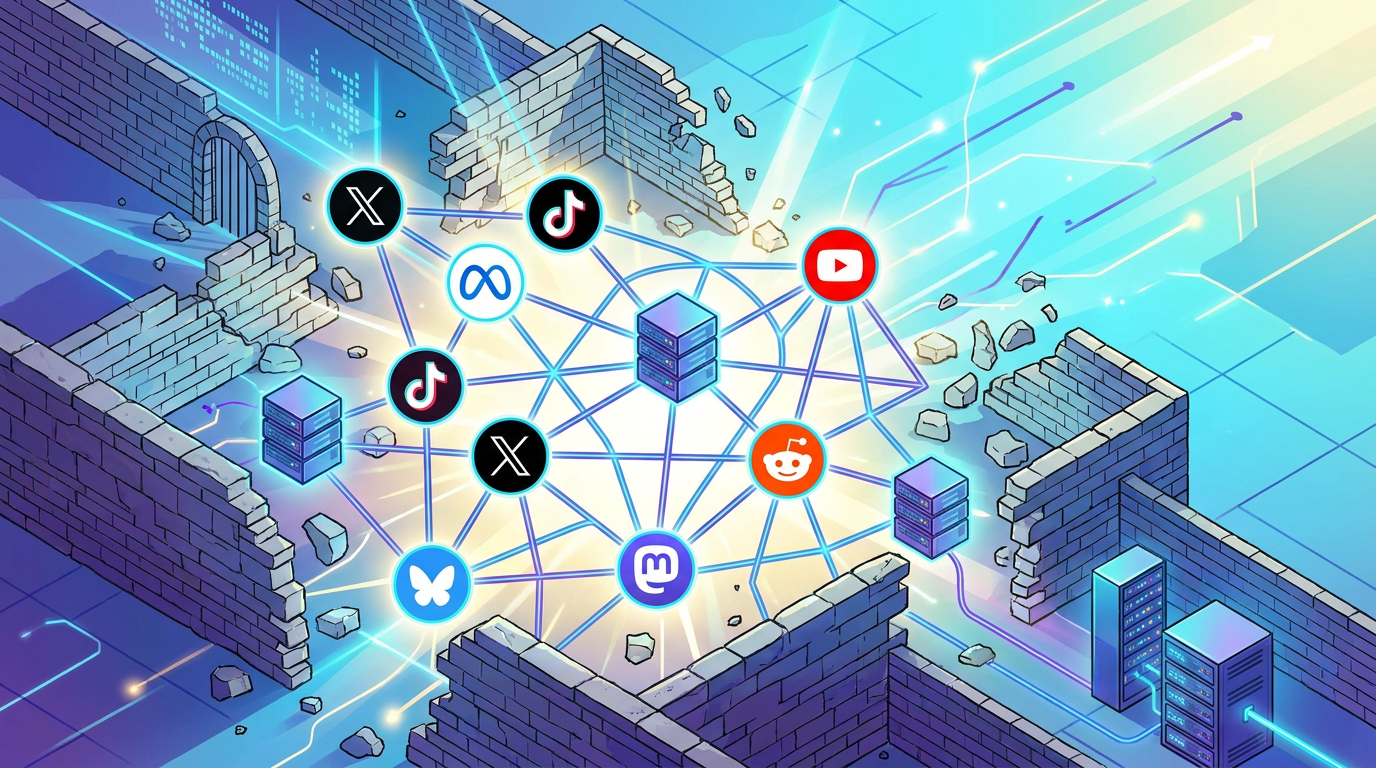
A decentralized protocol is transforming social media to work more like email, allowing users on Threads, Mastodon, and independent blogs to interact seamlessly.
By Factlen Editorial Team
- Open Web Advocates
- Argue that social media must be decentralized, user-controlled, and free from corporate algorithms.
- Commercial Integrators
- Believe interoperability expands audience reach and provides a hedge against closed ecosystems.
- Independent Analysts
- Focus on the technical realities, adoption metrics, and the friction of bridging closed and open networks.
What's not represented
- · Regulators monitoring decentralized networks
- · Advertisers adapting to federated reach
Why this matters
For the first time in a decade, users and creators are gaining the ability to own their digital audiences and move between platforms without losing their connections, breaking the monopoly of algorithmic walled gardens.
Key points
- ActivityPub is an open protocol that allows different social media platforms to communicate, much like email.
- The Fediverse is a growing network of decentralized servers, with Mastodon serving as its nonprofit backbone.
- Meta's Threads has integrated ActivityPub, allowing its 400 million users to opt into cross-platform sharing.
- Publishing platforms like Ghost and Flipboard are adopting the protocol, turning independent blogs into native social accounts.
The era of being locked into a single social media platform is quietly ending. For a decade, users have been trapped in walled gardens—if you wanted to talk to someone on Twitter, you had to be on Twitter, and if you wanted to comment on an Instagram post, you needed a Meta account.
But in 2026, a fundamental shift is taking root across the internet, driven by a technology called ActivityPub. It is transforming social media into something that functions much more like email, prioritizing user control over corporate lock-in.[7]
The concept is known as the "Fediverse"—a portmanteau of "federated" and "universe." Instead of one company controlling the servers, the algorithm, and the moderation, the Fediverse is a network of thousands of independent servers that all speak the exact same digital language.[7]
To understand ActivityPub, think about how email works. A person using Gmail can easily send a message to a colleague using Microsoft Outlook or a custom company domain. They don't need to be on the same service to communicate; the underlying protocol handles the translation invisibly.[6]

ActivityPub applies this exact principle to social networking. It provides a standardized server-to-server and client-to-server protocol. A user on one platform can follow, like, and reply to a user on a completely different platform, seamlessly bridging isolated communities.[6]
The backbone of this movement has long been Mastodon, a decentralized microblogging platform that surged in popularity during the turbulent social media shifts of 2022 and 2023. By 2026, Mastodon boasts an estimated 10 to 15 million accounts across hundreds of independent servers.[5]
Mastodon operates as a nonprofit, entirely free of advertising and algorithmic timelines. Its growth has been sustained by niche communities—academics, tech professionals, and privacy advocates—who value strict instance-based moderation and digital autonomy over viral reach.[5]
Mastodon operates as a nonprofit, entirely free of advertising and algorithmic timelines.
The most significant catalyst for the Fediverse's mainstream adoption, however, came from an unlikely source: Meta. When Meta launched Threads in 2023, CEO Mark Zuckerberg and Instagram head Adam Mosseri promised eventual ActivityPub support, a surprising move for a company famous for its closed ecosystems.[4]
By 2026, that promise has materialized into a massive, albeit partial, bridge. Threads, which now commands over 400 million monthly active users, allows its users to opt into Fediverse sharing directly from their account settings.[4]

This means a post authored on Threads can seamlessly appear in the feeds of Mastodon users, and replies from the Fediverse flow back into the Threads app. It represents the first time a trillion-dollar tech giant has opened its walled garden to a decentralized protocol.[4]
Beyond traditional social networks, major publishing platforms are adopting ActivityPub to give creators direct ownership of their audiences. Ghost, a popular open-source publishing platform, has integrated the protocol directly into its core software.[2]
Ghost's founder, John O'Nolan, has framed this as a return to the early, open web. With ActivityPub enabled, a Ghost blog essentially becomes a native social media account. Readers on Mastodon or Threads can follow a blog directly from their timelines, and the author can publish short-form notes that federate across the entire network.[2]
Flipboard has also leaned heavily into the Fediverse, allowing its users to curate magazines that pull in federated content and enabling users across the open web to follow Flipboard creators without needing a separate app.[3]
The practical magic of this interoperability is becoming undeniable for digital media. When tech publication The Verge tested a federated "quickpost," the message simultaneously populated Mastodon feeds, the Threads Fediverse tab, and Bluesky, with replies routing back to the original article.[1]

As David Pierce of The Verge noted, the ability to post in one place and reach audiences across multiple distinct platforms proves that "the open social future rocks." It turns the protocol into a powerful, unified publishing workflow.[1]
For creators and everyday users, this shift offers profound digital sovereignty. You are no longer beholden to a single algorithm's whims or a billionaire's policy changes. If a platform degrades, you can move your audience to a new server without losing your connections.[7]
While challenges remain—particularly around cross-server moderation and the sheer technical friction of bridging massive corporate networks with grassroots servers—the momentum is irreversible. The internet is slowly but surely remembering how to be open, and the walls between our digital communities are finally coming down.[7]
How we got here
2016
Mastodon launches, providing an early decentralized alternative to Twitter.
2018
The W3C officially publishes ActivityPub as a recommended web standard.
July 2023
Meta launches Threads and promises eventual ActivityPub integration.
March 2024
Threads begins allowing users to opt into Fediverse sharing.
2026
Major publishing platforms like Ghost and Flipboard fully integrate ActivityPub, turning blogs into social accounts.
Viewpoints in depth
Open Web Advocates
Argue that social media must be decentralized and free from corporate algorithms.
For pioneers of the decentralized web, ActivityPub is the antidote to the 'enshittification' of modern platforms. Advocates argue that social media should function as public infrastructure, much like email or the web itself. By decentralizing control, users are protected from sudden policy shifts, aggressive algorithmic manipulation, and the whims of billionaire owners. They prioritize strict privacy, ad-free environments, and community-led moderation over massive scale.
Commercial Integrators
Believe interoperability expands audience reach and provides a hedge against closed ecosystems.
Major tech platforms and publishing tools view the Fediverse through a pragmatic lens. For Meta, integrating Threads with ActivityPub is a strategic move to position itself as the 'open' alternative to competitors like X, while still retaining hundreds of millions of users within its own app. For publishing platforms like Ghost and Flipboard, federation is a powerful distribution tool. It allows creators to push their content to a wider audience without forcing readers to create new accounts, effectively turning every blog into a native social media presence.
Independent Analysts
Focus on the technical realities and the friction of bridging closed and open networks.
Industry observers note that while the protocol works flawlessly in theory, the reality of merging a 400-million-user corporate giant with a grassroots network of independent servers is messy. Analysts point out that true two-way federation is still a work in progress, and the cultural clash between anti-corporate Mastodon instances and Meta's commercial ecosystem remains unresolved. Furthermore, they caution that mainstream users still find the concept of 'instances' and 'federation' confusing, meaning the technology must become invisible—like RSS for podcasts—before it achieves total ubiquity.
What we don't know
- Whether Meta will ever implement full, frictionless two-way federation for all Threads users, or keep it as a niche opt-in feature.
- How independent, volunteer-run servers will handle the moderation and hosting costs of massive traffic influxes from corporate platforms.
- If mainstream consumers will ever understand the concept of the Fediverse, or if the technology will simply fade into the invisible background of the internet.
Key terms
- ActivityPub
- An open, decentralized social networking protocol that allows different platforms to communicate with each other.
- Fediverse
- A portmanteau of 'federated' and 'universe,' referring to the collection of independent social networks that interoperate using ActivityPub.
- Instance
- An independent server in the Fediverse that hosts its own community, rules, and user accounts.
- Interoperability
- The ability of different computer systems or software to exchange and make use of information seamlessly.
Frequently asked
Do I need to download a new app to use the Fediverse?
Not necessarily. If you use Threads, Flipboard, or follow a Ghost blog, you are already interacting with platforms that support Fediverse integration. You can also download dedicated apps like Mastodon.
If I use Threads, is my data automatically shared everywhere?
No. On Threads, Fediverse sharing is an opt-in feature. You must actively choose to make your public profile and posts visible to other federated platforms.
Can I move my followers if I change platforms?
Yes. One of the core benefits of the Fediverse is that your identity and follower graph are not locked to a single company. You can migrate your account to a different server while keeping your audience.
Sources
Source coverage
7 outlets
3 viewpoints surfaced







[1]The VergeOpen Web Advocates
The open social future rocks: How ActivityPub is changing the internet
Read on The Verge →[2]GhostOpen Web Advocates
Ghost is adopting ActivityPub to bring back the open web
Read on Ghost →[3]FlipboardCommercial Integrators
Flipboard and the Fediverse: A new era of digital sovereignty
Read on Flipboard →[4]MetaCommercial Integrators
Update on Threads' Fediverse Integration
Read on Meta →[5]MastodonOpen Web Advocates
Mastodon 2026: Growth and the decentralized web
Read on Mastodon →[6]ButtondownCommercial Integrators
What ActivityPub success looks like
Read on Buttondown →[7]Factlen Editorial TeamIndependent Analysts
Synthesis by Factlen editorial team
Read on Factlen Editorial Team →




Every angle. Every day.
Get technology stories with full source coverage and perspective breakdowns delivered to your inbox.