
Keir Starmer Expected to Resign as UK Prime Minister Amid Labour Mutiny
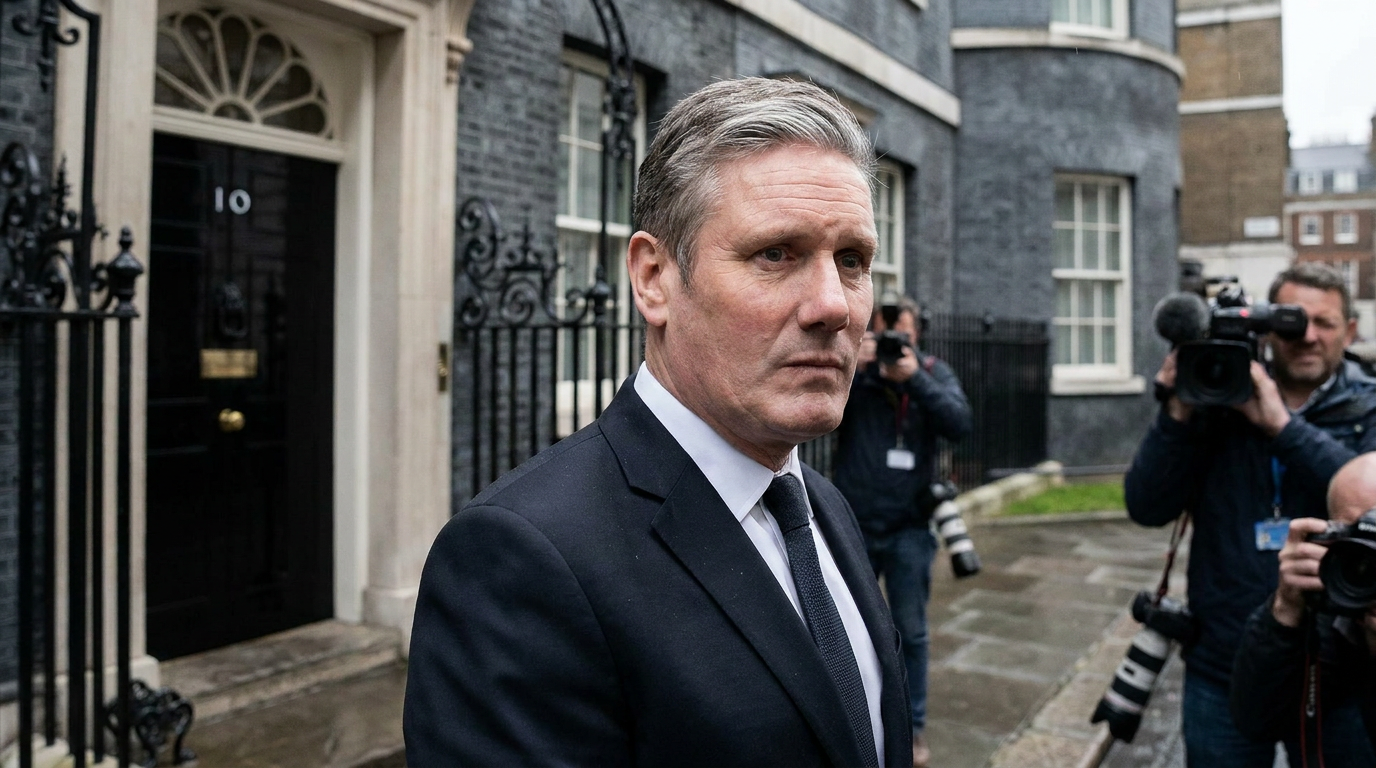
UK Prime Minister Keir Starmer is reportedly preparing to step down on Monday following an unprecedented rebellion by Labour MPs. The crisis paves the way for Andy Burnham to launch a formal leadership challenge after his decisive return to Parliament.
By Factlen Editorial Team
- Burnham Camp & Allies
- Emphasize the overwhelming parliamentary support for a change in leadership and a new economic direction.
- Anti-Establishment Critics
- Frame the Labour infighting as a symptom of a broader political failure to improve living standards and public services.
- Government Loyalists
- Argue that the Prime Minister is carefully weighing his constitutional duty to govern against the political realities of the mutiny.
What's not represented
- · International allies concerned about UK stability
- · Financial markets reacting to potential fiscal policy shifts
Why this matters
The abrupt resignation of a Prime Minister just two years after a landslide victory throws the UK government into a sudden transition. For citizens and global markets, this leadership change signals a likely shift in British economic policy, regional investment, and the broader stability of the nation's institutions.
Key points
- Keir Starmer is expected to announce his resignation as UK Prime Minister on Monday following a massive rebellion by Labour MPs.
- The crisis was triggered by Andy Burnham's decisive by-election victory in Makerfield, which returned him to Parliament.
- Over 100 Labour MPs have publicly demanded Starmer's exit, with Burnham's camp claiming the private backing of around 200 MPs.
- Burnham is heavily favored to succeed Starmer, potentially without a protracted leadership contest.
- If Starmer resigns, the UK will inaugurate its seventh Prime Minister in just over a decade.
Keir Starmer is expected to resign as UK Prime Minister on Monday, bowing to overwhelming pressure from Labour MPs following Andy Burnham's decisive by-election victory in Makerfield. The anticipated departure marks a stunning collapse of authority for a leader who secured a landslide general election victory just two years ago.[1][2]
The immediate catalyst for the crisis was Burnham's return to Westminster. Winning the Makerfield by-election with a 9,000-vote majority over Reform UK, the former Greater Manchester Mayor secured the parliamentary foothold required to launch a formal leadership challenge against the sitting Prime Minister.[3][4]
The scale of the mutiny is unprecedented for a Prime Minister so early in his term. Over 100 Labour MPs—roughly a quarter of the parliamentary party—have publicly demanded Starmer set a timetable for his departure, citing a collapse in public trust and a failure to deliver on core campaign promises.[2][4]

Behind the scenes, the rebellion is even larger. Burnham's camp claims the private backing of around 200 MPs, representing roughly half of Labour's parliamentary presence. This overwhelming support raises the prospect of a "coronation," allowing Burnham to take over as Labour leader and Prime Minister without a protracted or bitter contest.[1]
While Starmer previously insisted he would fight any challenge, his stance appears to have softened over the weekend. Business Secretary Peter Kyle noted on Sunday that the Prime Minister is spending his time at Chequers "making time to reflect on the political realities," a strong signal that Downing Street recognizes the parliamentary arithmetic is no longer tenable.[1][5]
While Starmer previously insisted he would fight any challenge, his stance appears to have softened over the weekend.
Starmer's tenure has been heavily criticized from within his own ranks. A series of policy U-turns and a perceived failure to deliver rapid improvements to living standards have caused his approval ratings to plummet, leaving backbenchers fearful of a voter backlash at the next general election.[2]
The 56-year-old Burnham used his victory address to promise a "new path" for the country. He has heavily emphasized regional investment, a focus on the North of England, and a sharp break from the current administration's strict economic orthodoxy, framing himself as the candidate of tangible change.[3][4]

A change in leadership would likely trigger significant Cabinet shakeups. Reports indicate that if Burnham assumes power, he plans to sack Chancellor Rachel Reeves, whose fiscal policies his advisers believe do not represent a sufficient change of direction for a restless electorate.[6]
While Burnham has the clear momentum, he is not the only potential candidate waiting in the wings. Former Health Minister Wes Streeting has also signaled a willingness to challenge Starmer, though the sheer scale of Burnham's parliamentary support may preempt a wider field from emerging.[2][3]
If Starmer resigns, the UK will inaugurate its seventh Prime Minister in just over a decade. This staggering rate of turnover reflects deep-seated structural challenges, voter volatility, and widespread anger at successive governments' failures to improve public services.[2]

Outside the Labour Party, populist factions are capitalizing on the chaos. Reform UK, despite losing the Makerfield by-election by a wide margin, has framed the Labour infighting as further proof that the traditional political establishment cannot govern effectively, using the crisis to bolster their anti-establishment narrative.[4]
How we got here
July 2024
Keir Starmer leads the Labour Party to a landslide general election victory.
Early 2026
Starmer's approval ratings drop sharply amid policy U-turns and economic stagnation.
June 18, 2026
Andy Burnham wins the Makerfield by-election, returning to Parliament and gaining a platform to challenge Starmer.
June 19, 2026
Over 100 Labour MPs publicly demand Starmer set a timetable for his resignation.
June 21, 2026
Starmer spends the weekend at Chequers reflecting on his position ahead of an expected resignation announcement.
Viewpoints in depth
Burnham's Coalition
The faction pushing for a change in leadership argues that Labour must abandon its current economic orthodoxy.
Supporters of Andy Burnham argue that Keir Starmer's administration has failed to deliver the tangible improvements to living standards promised in the 2024 general election. By emphasizing regional investment and a departure from the strict fiscal rules championed by Chancellor Rachel Reeves, Burnham's camp believes they can win back voters who have grown disillusioned with the political establishment. They view Burnham's massive by-election victory as a clear mandate for this new direction.
The Loyalists' Dilemma
Allies of Keir Starmer emphasize the importance of stability and the mandate won in the 2024 general election.
Those still backing the Prime Minister, or at least urging caution, argue that changing leaders mid-term projects chaos and undermines the government's ability to execute long-term policy. They point to the landslide victory Starmer secured just two years ago as a mandate that should not be discarded due to short-term polling dips. However, as the mutiny has grown to encompass roughly half the parliamentary party, even staunch loyalists are beginning to acknowledge the political reality that governing without the confidence of the House is impossible.
Populist Observers
Right-wing and anti-establishment figures view the crisis as validation of their critiques against mainstream parties.
For parties like Reform UK, the Labour infighting is a strategic gift. They argue that the rapid turnover of Prime Ministers—potentially seven in a decade—proves that the traditional Westminster establishment is fundamentally broken. By highlighting Labour's policy U-turns and internal divisions, populist critics aim to attract voters who feel alienated by both major parties, framing the leadership crisis not just as a Labour problem, but as a systemic failure of the British political class.
What we don't know
- Whether Keir Starmer will attempt to negotiate a delayed departure or resign immediately.
- If former Health Minister Wes Streeting or other candidates will mount a formal challenge against Andy Burnham.
- How financial markets will react to the potential sacking of Chancellor Rachel Reeves and a shift in economic policy.
Key terms
- By-election
- An election held to fill a political office that has become vacant between regularly scheduled general elections.
- Parliamentary Labour Party (PLP)
- The group comprising all elected Labour Members of Parliament, who play a decisive role in leadership challenges.
- Chequers
- The official country residence of the sitting Prime Minister of the United Kingdom, often used for private deliberations.
- Chancellor of the Exchequer
- The government's chief financial minister, responsible for economic policy and the national budget.
Frequently asked
Why is Keir Starmer expected to resign?
Starmer is facing an unprecedented rebellion from his own MPs following plummeting approval ratings, policy U-turns, and a failure to rapidly improve living standards.
How did Andy Burnham re-enter Parliament?
The former Greater Manchester Mayor won a by-election in the Makerfield constituency, giving him the parliamentary seat required to launch a formal leadership challenge.
Will there be a general election?
Not necessarily. The governing Labour Party can elect a new leader, who would then assume the role of Prime Minister without triggering a nationwide general election.
Who else might run for Labour leader?
Former Health Minister Wes Streeting has indicated he might run, though Burnham is currently viewed as the overwhelming favorite with the backing of roughly half the parliamentary party.
Sources
Source coverage
6 outlets
3 viewpoints surfaced






[1]The GuardianBurnham Camp & Allies
Keir Starmer expected to announce departure as prime minister on Monday
Read on The Guardian →[2]The HinduGovernment Loyalists
Starmer expected to resign on Monday and set out a timetable for his departure
Read on The Hindu →[3]Jerusalem PostAnti-Establishment Critics
Keir Starmer expected to resign as UK prime minister following pressure from rival Andy Burnham
Read on Jerusalem Post →[4]Talk TVAnti-Establishment Critics
Keir Starmer is facing a full-blown Labour mutiny
Read on Talk TV →[5]Sky NewsGovernment Loyalists
Peter Kyle: PM reflecting on political realities
Read on Sky News →[6]The TimesBurnham Camp & Allies
Burnham would sack finance minister Rachel Reeves
Read on The Times →

More in news politics
See all 6 stories →Iran Peace Talks
U.S. and Iranian Delegations Open High-Stakes Peace Talks in Switzerland
6 sources
Transit Strike
LIRR Unions Ratify Contract Securing 15% Raises, Officially Ending Historic Strike Threat
6 sources
US-Iran War
U.S. and Iranian Delegations Open High-Stakes Peace Talks in Switzerland
6 sources
US-Iran Conflict
U.S. and Iran Open High-Stakes Peace Talks in Switzerland to Halt 114-Day War
7 sources
Every angle. Every day.
Get news politics stories with full source coverage and perspective breakdowns delivered to your inbox.