
Printed Artificial Neurons Successfully Communicate With Living Brain Cells
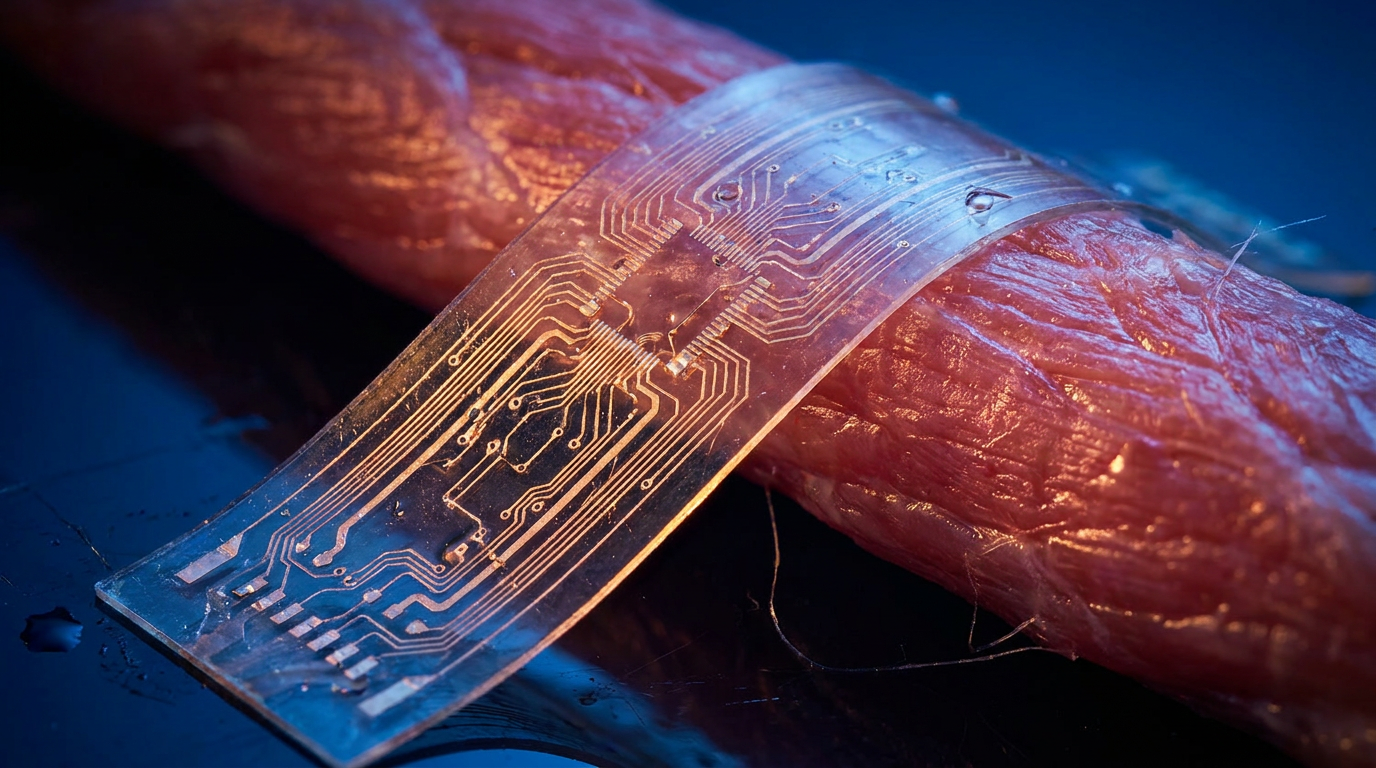
Engineers have developed flexible, 3D-printed artificial neurons capable of generating electrical signals that activate living biological brain tissue. The breakthrough paves the way for advanced neuroprosthetics and highly energy-efficient AI hardware.
By Factlen Editorial Team
- Bioelectronic & Medical Researchers
- Medical experts view the breakthrough as a foundational step toward seamless neuroprosthetics.
- AI Hardware & Energy Efficiency Advocates
- Technologists emphasize the critical need for brain-inspired hardware to curb AI's soaring energy demands.
- Materials Scientists
- Engineers highlight the innovative use of flexible nanomaterials over rigid silicon.
What's not represented
- · Ethicists on brain-machine interfaces
- · Commercial semiconductor manufacturers
Why this matters
This milestone bridges the gap between synthetic electronics and biological nervous systems. It brings us closer to medical implants that can seamlessly restore lost sensory or motor functions, while also offering a blueprint for AI hardware that consumes a fraction of the electricity used by today's data centers.
Key points
- Northwestern University engineers have developed 3D-printed artificial neurons that successfully communicate with living brain tissue.
- The devices use flexible polymers and specialized electronic inks rather than rigid silicon, making them highly biocompatible.
- In laboratory tests, the artificial neurons generated electrical spikes that reliably activated biological neurons in mouse cerebellum slices.
- The breakthrough offers a dual promise: advancing medical neuroprosthetics and paving the way for ultra-efficient, brain-inspired AI hardware.
Engineers at Northwestern University have achieved a major milestone in bioelectronics by developing 3D-printed artificial neurons that can directly communicate with living brain cells. Unlike traditional electronic components that merely simulate neural activity in isolation, these flexible devices generate electrical signals realistic enough to trigger measurable responses in biological tissue. The breakthrough, published in the journal Nature Nanotechnology, represents a significant leap toward bridging the gap between synthetic hardware and the human nervous system.[1][2][4][5]
For decades, researchers have attempted to build "neuromorphic" chips that mimic the spiking behavior of biological brains. However, a fundamental mismatch has persisted between the two paradigms. Contemporary computing relies on billions of identical, rigid silicon transistors that remain fixed once manufactured. The biological brain, by contrast, is a heterogeneous, dynamic, and three-dimensional network of specialized cells. Because traditional artificial neurons behave in a highly uniform way, neuromorphic chips often require millions of components to achieve even basic functionality.[1][3][4][7]
To overcome these limitations, the Northwestern team, led by materials science professor Mark C. Hersam, abandoned rigid silicon in favor of soft, printable materials. The researchers utilized aerosol jet printing to deposit specialized electronic inks onto flexible polymer substrates. These inks were formulated from nanoscale flakes of molybdenum disulfide—which acts as a semiconductor—and graphene, which serves as an electrical conductor. The resulting devices can bend and flex, making them far more compatible with biological tissue than traditional computer chips.[1][4][5][6][7]

The critical breakthrough in the neurons' signaling capability came from an unconventional manufacturing decision. Typically, scientists burn off the stabilizing polymer used in electronic inks because it can interfere with the flow of electrical current. Instead, Hersam's team chose to leave the polymer partially intact. When electrical current passes through the device, it drives further localized decomposition of the polymer, creating narrow pathways that produce sudden, neuron-like electrical responses.[1][4][6][7]
The critical breakthrough in the neurons' signaling capability came from an unconventional manufacturing decision.
This deliberate imperfection transformed the devices from simple electronic switches into sophisticated signaling engines. Rather than generating simple, one-off pulses, the printed neurons can produce a rich diversity of complex patterns, including single spikes, continuous firing, and bursts of activity. The devices proved highly robust, capable of generating spikes at frequencies up to 20 kilohertz and remaining stable for more than one million operational cycles.[1][6]
To verify that these synthetic signals could truly interface with biology, the engineering team collaborated with Northwestern neurobiology professor Indira M. Raman. The researchers connected the artificial neurons to slices of mouse cerebellum and fired electrical spikes into the tissue. The results were definitive: the biological neurons fired in direct response to the synthetic signals, confirming that the artificial spikes possessed the correct timing, duration, and shape to activate real neural circuits.[1][2][3][4][7]
The implications for medicine and neuroprosthetics are profound. By demonstrating a new level of biocompatibility, the technology opens the door to advanced brain-machine interfaces that could seamlessly integrate with the human nervous system. Future medical implants built on this foundation could help restore lost sensory or motor functions—such as hearing, vision, or movement—by communicating directly with the brain in its own electrical language.[1][2][5]
Beyond healthcare, the breakthrough offers a highly anticipated blueprint for the future of artificial intelligence hardware. Modern AI models require massive data centers that consume extraordinary amounts of electricity, creating a looming power-consumption crisis for the tech industry. The human brain, however, is estimated to be five orders of magnitude—or 100,000 times—more energy-efficient than a standard digital computer.[1][3][5][6]

By successfully replicating the precise way biological neurons encode and transmit information, the Northwestern team has laid the groundwork for computing architectures that operate on a fraction of the power used by today's systems. If scaled successfully, these printed, brain-inspired components could allow next-generation AI hardware to handle increasingly complex operations without the unsustainable energy demands of current silicon-based infrastructure.[1][2][4][6]
How we got here
1980s
The concept of neuromorphic engineering is first introduced by Carver Mead, aiming to mimic neural architectures in silicon.
2010s
Major tech companies release early neuromorphic chips, but they rely on rigid silicon and struggle to match biological efficiency.
April 2026
Northwestern University researchers publish their breakthrough in Nature Nanotechnology, detailing printed neurons that communicate with living tissue.
June 2026
The scientific community widely recognizes the achievement as a dual milestone for both bioelectronic medicine and energy-efficient AI hardware.
Viewpoints in depth
Bioelectronic & Medical Researchers
Medical experts view the breakthrough as a foundational step toward seamless neuroprosthetics.
For researchers focused on bioelectronics, the most significant aspect of the Northwestern study is the successful in vitro communication between synthetic and living tissue. Traditional implants often struggle with biocompatibility and signal mismatch, leading to degraded performance over time. By matching the exact temporal range and spike shape of biological neurons, these printed devices could eventually serve as direct translators for the nervous system, offering new hope for patients with spinal cord injuries or sensory loss.
AI Hardware & Energy Efficiency Advocates
Technologists emphasize the critical need for brain-inspired hardware to curb AI's soaring energy demands.
As artificial intelligence models grow exponentially larger, the energy required to train and run them on traditional silicon GPUs is becoming unsustainable. Hardware advocates point out that the human brain performs incredibly complex reasoning using roughly 20 watts of power. By adopting the heterogeneous, spiking architecture of biological neurons, future neuromorphic chips built with this printing technique could drastically reduce the carbon footprint of data centers and enable powerful AI processing on low-power mobile devices.
Materials Scientists
Engineers highlight the innovative use of flexible nanomaterials over rigid silicon.
From a materials science perspective, the triumph lies in the departure from standard semiconductor manufacturing. Silicon is rigid, uniform, and requires billion-dollar fabrication facilities. The Northwestern team utilized low-cost aerosol jet printing with graphene and molybdenum disulfide inks on flexible polymers. Furthermore, their decision to partially retain the stabilizing polymer—traditionally viewed as an impurity—demonstrates how embracing material imperfections can unlock the dynamic, non-linear electrical behaviors required to mimic biology.
What we don't know
- How the printed artificial neurons will perform over years or decades when implanted in a living organism.
- Whether the aerosol jet printing manufacturing process can be scaled up to produce the billions of interconnected neurons required for advanced AI systems.
Key terms
- Neuromorphic computing
- A method of computer engineering in which elements of a computer are modeled after systems in the human brain and nervous system.
- Neuroprosthetics
- Devices that connect to the nervous system to restore lost functions, such as hearing, vision, or movement.
- Molybdenum disulfide
- A nanomaterial that acts as a semiconductor, used in this study to help formulate the electronic ink for the artificial neurons.
- Aerosol jet printing
- A manufacturing technique that uses a fine mist to deposit electronic inks onto various surfaces, allowing for the creation of flexible, printed electronics.
- Spiking neural network
- A type of artificial neural network that more closely mimics natural neural networks by transmitting information through discrete electrical spikes.
Frequently asked
Can these artificial neurons be implanted in humans today?
Not yet. While the devices successfully activated living mouse brain tissue in a laboratory setting, extensive long-term safety and biocompatibility testing in living organisms is required before human trials can begin.
How does this help artificial intelligence?
Current AI runs on silicon chips that consume massive amounts of electricity. Because these artificial neurons mimic the highly energy-efficient signaling of the biological brain, they could eventually be used to build AI hardware that uses a fraction of the power.
Why are flexible materials important for this technology?
The human brain is soft and dynamic, whereas traditional computer chips are rigid. Flexible, printed electronics are much less likely to damage biological tissue and can better integrate with the physical structure of the nervous system.
Sources
Source coverage
7 outlets
3 viewpoints surfaced







[1]Northwestern University NewsBioelectronic & Medical Researchers
Printed neurons communicate with living brain cells
Read on Northwestern University News →[2]SciTechDailyBioelectronic & Medical Researchers
Scientists Print Artificial Neurons That Can Talk to the Brain
Read on SciTechDaily →[3]Singularity HubAI Hardware & Energy Efficiency Advocates
Printed Neurons That Mimic Brain Cells Could Slash AI's Energy Bill
Read on Singularity Hub →[4]VoxelMattersMaterials Scientists
Northwestern University researchers print artificial neurons that communicate with living brain cells
Read on VoxelMatters →[5]Neuroscience NewsBioelectronic & Medical Researchers
Printed Artificial Neurons Communicate With Biological Brain
Read on Neuroscience News →[6]The Brighter Side NewsAI Hardware & Energy Efficiency Advocates
Printed artificial neurons can communicate with living brain cells
Read on The Brighter Side News →[7]Futura SciencesMaterials Scientists
New artificial neurons can fire in a remarkably realistic way
Read on Futura Sciences →


Every angle. Every day.
Get ai stories with full source coverage and perspective breakdowns delivered to your inbox.