
How SpaceX's $1.77 Trillion IPO Is Forcing Index Funds to Buy
SpaceX's record-breaking public debut has triggered a mechanical wave of forced buying across the stock market. Here is how index inclusion rules will put the aerospace giant into millions of retirement accounts.
By Factlen Editorial Team
- Passive Index Mechanics
- Focuses on the rules-based algorithms that force index funds to buy stocks regardless of their fundamental valuation.
- Valuation Skeptics
- Argues that the massive valuation prices in a flawless future, exposing passive investors to significant downside risk.
- Market Democratization Advocates
- Celebrates the IPO and index inclusion as a victory for everyday retail investors who have historically been locked out of mega-cap growth.
What's not represented
- · Active Fund Managers
- · Space Industry Competitors
Why this matters
Even if you never actively purchase a single share of SpaceX, the mechanical rules of passive index funds mean the aerospace giant is about to become a permanent fixture in your 401(k) and broader retirement portfolio.
Key points
- SpaceX's $1.77 trillion IPO is triggering a massive wave of forced buying from passive index funds.
- Nasdaq and FTSE Russell altered their rules to fast-track the aerospace giant into their benchmarks.
- The S&P 500 rejected fast-track inclusion, meaning S&P trackers will not buy SpaceX until at least 2027.
- Because only 4% to 5% of shares are publicly traded, SpaceX's initial index footprint will be relatively small.
- As insider lock-up periods expire over the next year, the public float will grow, forcing index funds to buy more shares.
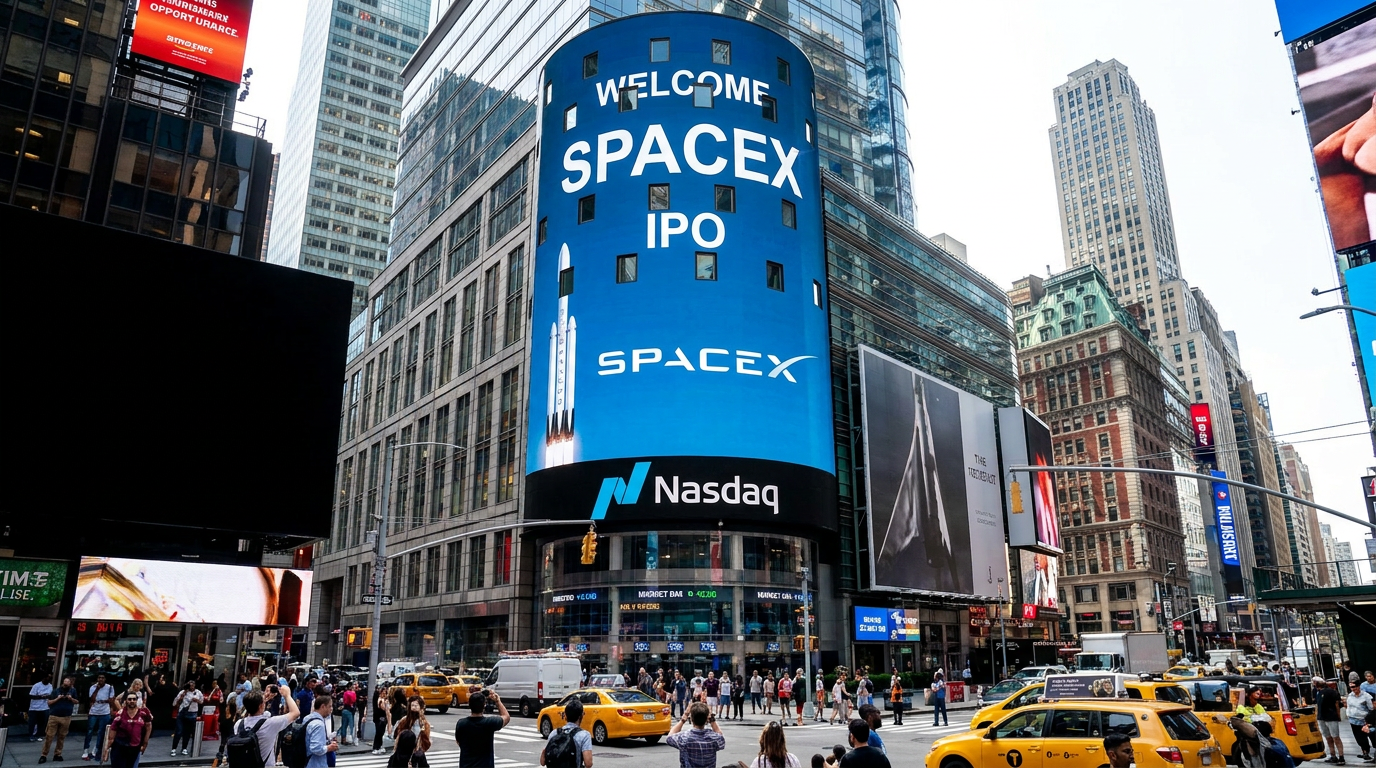
When SpaceX debuted on the Nasdaq on June 12, 2026, it rewrote the financial record books. Pricing at $135 per share, the aerospace behemoth raised $75 billion and secured a $1.77 trillion valuation, instantly becoming the largest initial public offering in history. By the time the closing bell rang, retail enthusiasm had driven the stock up 19%, pushing its market capitalization past the $2 trillion mark. But the initial frenzy of day traders and retail investors was merely the opening act. The true financial earthquake is quietly waiting in the wings, driven not by human emotion, but by the cold, mechanical rules of passive index funds.[1][2][3][6][7]
In the modern financial ecosystem, the most powerful buyers do not care about a company’s vision, its rockets, or its profitability. They are passive exchange-traded funds (ETFs) and mutual funds that exist solely to replicate market indexes like the Nasdaq-100 and the Russell 1000. When an index provider adds a new stock to its benchmark, every fund tracking that index is legally obligated to buy it. This mechanism, known as forced buying, creates a synchronized wave of demand that operates entirely independently of traditional valuation metrics.[1][4][5][6]
Historically, newly public companies had to wait months or even years to earn their way into these elite benchmarks. But SpaceX is too massive to ignore. Recognizing that a $2 trillion company cannot be left out of a benchmark claiming to represent the broad market, index providers like Nasdaq and FTSE Russell rewrote their eligibility rules. Nasdaq altered its bylaws to allow mega-cap companies to enter the Nasdaq-100 just 15 trading days after their IPO, while the Center for Research in Security Prices (CRSP) adjusted its policies to allow entry in just five days.[3][4][6][7]

The result is a looming wall of institutional capital. In the coming weeks, passive funds will be forced to absorb billions of dollars of SpaceX stock. To make room for the aerospace giant, these funds will have to sell fractional amounts of every other company in their portfolios, from Apple to Nvidia, triggering a massive, invisible rebalancing across the global equity market. For everyday investors, this means that anyone holding a standard tech ETF or a broad-market retirement fund will soon become a SpaceX shareholder, whether they actively chose to buy the stock or not.[1][2][4][6]
However, there is one major holdout in the index ecosystem: the S&P 500. Despite intense industry pressure, S&P Dow Jones Indices refused to waive its strict inclusion criteria. To enter the S&P 500, a company must trade publicly for at least 12 months and demonstrate four consecutive quarters of GAAP profitability. Because SpaceX reported a $4.9 billion net loss in 2025—driven by heavy investments in its Starship program and orbital data centers—the company will remain locked out of the world’s most famous index until at least mid-2027.[3][5][6][7]
This divergence between index providers creates a fascinating split in the broader equity market. Investors holding Nasdaq-tracking funds or broad total-market ETFs will gain immediate, automatic exposure to SpaceX’s volatile early trading days, riding the momentum of the aerospace giant from the very beginning. Conversely, those whose retirement accounts are parked exclusively in S&P 500 index funds will be forced to sit on the sidelines for at least a year. This mechanical delay highlights the hidden complexities of passive investing, where the specific, often opaque rulebook of an index provider ultimately dictates an investor's exposure to generational technology shifts.[5][8]
This divergence between index providers creates a fascinating split in the broader equity market.
Even for the indexes that are fast-tracking SpaceX, the immediate buying wave will be tempered by a crucial metric: the free float. While SpaceX boasts a total valuation near $2 trillion, Elon Musk, company insiders, and early venture capitalists hold the vast majority of the equity. Only about 4% to 5% of the company’s shares were actually sold to the public during the IPO. Because modern indexes are float-adjusted, they only weight companies based on the shares available to trade.[5][6][7]

Consequently, SpaceX’s initial footprint in the market will be surprisingly modest. In the Nasdaq-100, the company is expected to debut with a weighting of roughly 0.50% to 0.70%. A retail investor with $10,000 parked in a Nasdaq-100 index fund will effectively own just $60 worth of SpaceX. This float-adjusted reality acts as a shock absorber, preventing a low-supply stock from completely dominating the indexes and destabilizing the broader market.[2][5][8]
But that footprint is programmed to grow. Like all IPOs, SpaceX is subject to lock-up periods that prevent insiders from immediately dumping their shares. Early private investors face a 180-day lock-up, while Musk and top executives are restricted for 366 days. As these lock-ups expire over the next year, insiders will begin selling their stakes into the public market. Every time they do, SpaceX’s free float will increase.[4][5][7]
This creates a relentless, slow-drip catalyst for the stock. As the float expands, index providers will recalculate SpaceX’s weight upward, triggering new rounds of forced buying from passive funds. Wall Street analysts refer to this as a structural tailwind: a predictable, mechanical source of demand that will support the stock price for years, entirely divorced from the company’s quarterly earnings or rocket launch schedules.[4][6][8]

For valuation skeptics, this blind, rules-based buying is a cause for concern. At its IPO price, SpaceX traded at roughly 94 times its trailing revenue. Financial fundamentalists argue that the $1.77 trillion valuation already prices in a flawless execution of unproven technologies, leaving little room for error. By forcing index funds to buy in at these astronomical multiples, critics argue that the market plumbing is exposing everyday retirement accounts to venture-capital levels of risk.[2][3]
Yet, for market democratization advocates, the SpaceX IPO represents a structural victory. For the past decade, the most lucrative growth phases of technology companies have been hoarded in private markets, accessible only to accredited investors and elite venture capital firms. By going public and entering broad market indexes, SpaceX is finally allowing ordinary workers to participate in the space economy. Even if the valuation is steep, distributing the ownership of a generational company across millions of 401(k)s ensures that the broader public shares in the economic upside of the future.[2][4][8]
Ultimately, the SpaceX IPO is not just a story about reusable rockets, satellite internet, or orbital data centers. It is a masterclass in modern market plumbing. As trillions of dollars increasingly flow into passive investment vehicles, the power to allocate capital has shifted from human stock-pickers to the algorithmic rulebooks of index providers. Whether SpaceX ultimately justifies its historic valuation or stumbles under the weight of its own ambition, its rapid integration into the global index ecosystem guarantees that the financial future of the company is now permanently intertwined with the retirement savings of the American public.[8]
How we got here
December 2025
Elon Musk officially confirms that SpaceX will pursue an initial public offering after years of keeping the company private.
May 20, 2026
SpaceX files its S-1 prospectus, revealing $18.7 billion in annual revenue alongside ambitious plans for orbital data centers.
June 4, 2026
S&P Dow Jones Indices rejects a proposal to fast-track mega-cap IPOs, ensuring SpaceX will not enter the S&P 500 until at least 2027.
June 12, 2026
SpaceX debuts on the Nasdaq at $135 per share, raising $75 billion in the largest IPO in financial history.
Late June 2026
Major index providers, including FTSE Russell and CRSP, begin executing 'fast entry' rules to add SpaceX to their benchmarks.
Viewpoints in depth
Passive Index Mechanics
Focuses on the rules-based algorithms that force index funds to buy stocks regardless of their fundamental valuation.
This perspective views the market as a plumbing system. When a company as massive as SpaceX goes public, index providers like Nasdaq and FTSE Russell are pressured to include it quickly so their benchmarks accurately reflect the economy. The result is a mechanical, price-insensitive wave of buying. Analysts in this camp emphasize that index funds do not evaluate whether SpaceX is worth $1.77 trillion; they simply execute the mathematical requirements of their prospectuses, creating a synchronized liquidity event.
Valuation Skeptics
Argues that the massive valuation prices in a flawless future, exposing passive investors to significant downside risk.
Financial fundamentalists point to SpaceX's $18.7 billion in 2025 revenue against a $4.9 billion net loss, noting that only the Starlink division is currently profitable. At nearly 100 times trailing revenue, they argue the $1.77 trillion valuation requires perfect execution of unproven initiatives, like orbital data centers and the Starship program. This camp worries that fast-tracking such a speculative, capital-intensive company into broad market indexes forces everyday retirement accounts to absorb venture-capital levels of risk.
Market Democratization Advocates
Celebrates the IPO and index inclusion as a victory for everyday retail investors who have historically been locked out of mega-cap growth.
For the past decade, the most lucrative growth phases of technology companies have occurred in private markets, accessible only to accredited investors and venture capital firms. This perspective argues that SpaceX's public debut—and its rapid inclusion in mutual funds and ETFs—finally allows ordinary workers to participate in the space economy. Even if the valuation is steep, advocates argue that distributing ownership of a generational company across millions of 401(k)s is a fundamental win for American capitalism.
What we don't know
- How the market will absorb the massive influx of SpaceX shares once the 180-day and 366-day insider lock-up periods expire.
- Whether SpaceX can achieve the GAAP profitability required to eventually secure inclusion in the S&P 500 by mid-2027.
- How much capital will be drained from other mega-cap technology stocks as index funds sell them to make room for SpaceX.
Key terms
- Free Float
- The portion of a company's shares that are actively available to be traded by the public, excluding locked-up shares held by insiders.
- Index Inclusion
- The process by which a stock is officially added to a market benchmark, forcing all passive funds that track it to purchase the stock.
- Lock-up Period
- A predetermined window of time after an IPO during which company insiders and early investors are legally prohibited from selling their shares.
- Passive Fund
- An investment vehicle, like an ETF, that automatically buys a basket of stocks to mirror a specific index rather than relying on a human manager.
- Float-Adjusted Market Capitalization
- A valuation metric that calculates a company's size based only on the shares available to the public, rather than the total number of shares in existence.
Frequently asked
Why did SpaceX go public now?
SpaceX raised $75 billion in its June 2026 IPO to fund capital-intensive long-term projects, including the expansion of the Starlink network and orbital AI infrastructure.
When will SpaceX be added to the S&P 500?
The earliest SpaceX can join the S&P 500 is June 2027, as the index requires a company to trade for 12 months and demonstrate GAAP profitability.
Will index funds buy the whole company at once?
No. Index funds only buy based on the 'free float'—the shares actually available to trade. Because only 4% to 5% of shares are public, its initial index weight will be small.
What happens when the insider lock-up expires?
As early investors and employees sell their shares over the next year, the public float will increase, triggering index funds to automatically buy more shares.
Sources
Source coverage
8 outlets
3 viewpoints surfaced








[1]MarketWatchPassive Index Mechanics
The initial SpaceX frenzy is cooling off — but a new wave of cash is waiting to strike
Read on MarketWatch →[2]The Washington PostMarket Democratization Advocates
The SpaceX IPO has a bright side. It points to what is working in American capitalism.
Read on The Washington Post →[3]BoardroomValuation Skeptics
SpaceX just pulled off the largest IPO in market history. Now Wall Street has to figure out if any of it makes sense.
Read on Boardroom →[4]MorningstarPassive Index Mechanics
Why SpaceX is coming to your Super Fund
Read on Morningstar →[5]Hargreaves LansdownPassive Index Mechanics
SpaceX's record IPO could reshape indices
Read on Hargreaves Lansdown →[6]SpotGammaPassive Index Mechanics
SpaceX Index Inclusion Mechanics
Read on SpotGamma →[7]WikipediaPassive Index Mechanics
Initial public offering of SpaceX
Read on Wikipedia →[8]Factlen Editorial TeamMarket Democratization Advocates
Synthesis by Factlen editorial team
Read on Factlen Editorial Team →


Every angle. Every day.
Get finance stories with full source coverage and perspective breakdowns delivered to your inbox.