
U.S. and Iran Open High-Stakes Talks in Switzerland as Strait of Hormuz Remains Closed
Vice President JD Vance and Iranian officials have arrived in Switzerland to negotiate a permanent end to hostilities, even as Tehran's renewed closure of the Strait of Hormuz threatens the fragile ceasefire.
By Factlen Editorial Team
- U.S. Administration
- Prioritizes dismantling Iran's nuclear program and stabilizing the region while threatening economic consequences if talks fail.
- Iranian Leadership
- Demands the lifting of sanctions and ties the security of the Strait of Hormuz to the cessation of Israeli military actions in Lebanon.
- International Mediators
- Focuses on keeping both sides at the negotiating table to prevent a broader regional conflict and economic fallout.
What's not represented
- · Global Shipping Companies
- · European Energy Importers
- · Lebanese Civilians
Why this matters
The Strait of Hormuz is a critical artery for global energy markets, transiting a fifth of the world's traded oil. A failure in these 60-day sprint negotiations could trigger massive spikes in global energy prices and reignite a direct military conflict between the U.S. and Iran.
Key points
- Vice President JD Vance is leading the U.S. delegation in Switzerland for talks with Iranian officials.
- The negotiations aim to build on a 14-point interim agreement signed last week to end the nearly four-month war.
- Iran's Islamic Revolutionary Guard Corps declared the Strait of Hormuz closed on Saturday, citing Israeli strikes in Lebanon.
- U.S. Central Command disputes the closure, stating that commercial vessels continue to transit the waterway.
- President Trump threatened to impose U.S. tolls on the Strait if a final deal is not reached within 60 days.
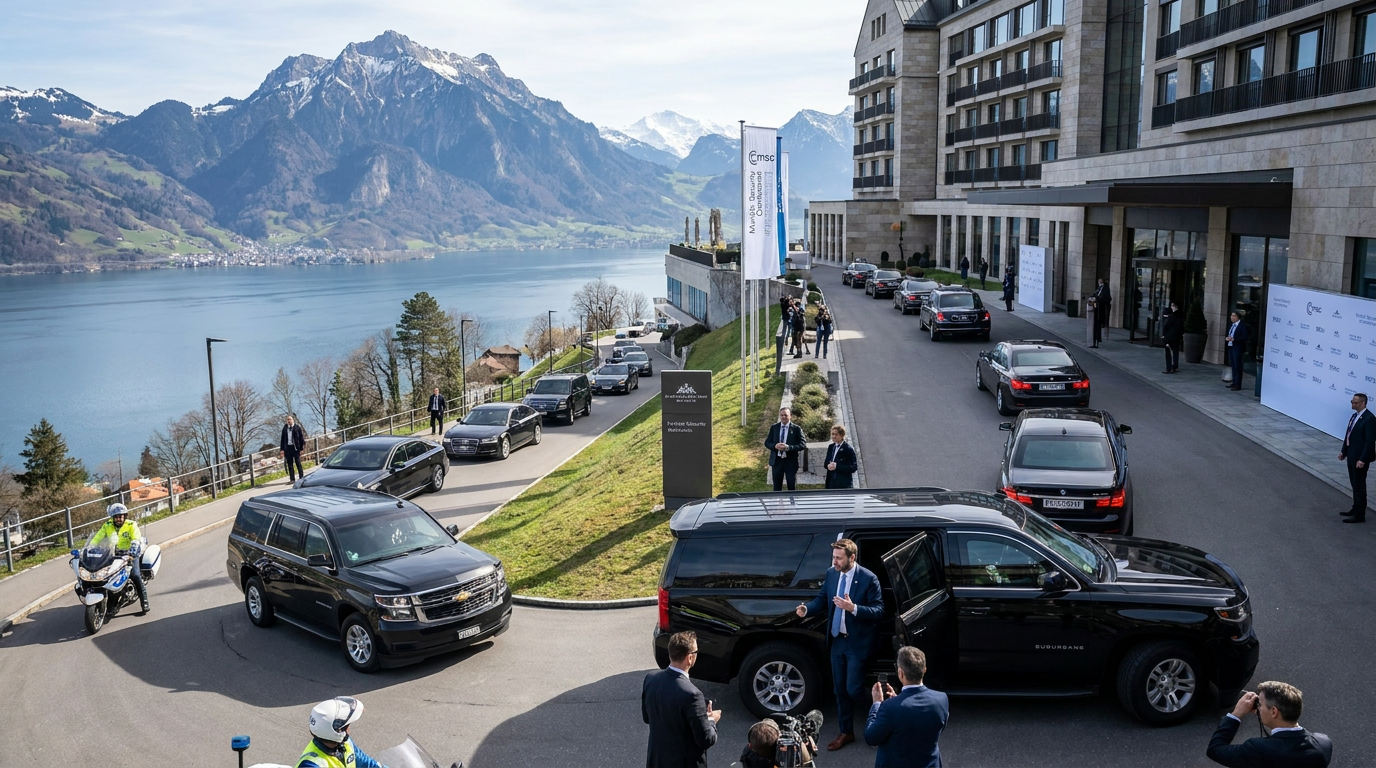
- Mediators from Qatar and Pakistan are participating in the talks at the Bürgenstock Resort.
High-stakes diplomatic negotiations to permanently end the nearly four-month war between the United States and Iran are officially underway in Switzerland, marking a critical juncture in global geopolitics. Vice President JD Vance and a senior Iranian delegation arrived at the picturesque Bürgenstock Resort on Sunday morning, kicking off a tense 60-day sprint to finalize a fragile interim peace agreement. The arrival of the delegations represents a significant diplomatic breakthrough after days of uncertainty, during which escalating violence in the Middle East threatened to derail the talks before they even began. The negotiations are expected to test the durability of the recent ceasefire and determine whether the two nations can transition from active military conflict to a sustainable political settlement.[1][2]
The talks, heavily mediated by international partners including Pakistan and Qatar, aim to build upon a comprehensive 14-point memorandum of understanding signed last week by U.S. President Donald Trump and Iranian President Masoud Pezeshkian. That framework successfully paused a devastating conflict that originally erupted in late February following joint U.S.-Israeli military strikes on Iranian territory. The interim agreement established a strict two-month window for negotiators to hammer out the highly technical details of a permanent resolution, covering everything from nuclear enrichment limits to the unfreezing of Iranian state assets. Both sides have acknowledged that the path to a final signature will be fraught with political and logistical hurdles.[3][4]
The diplomatic push is already facing severe stress tests on the ground. Just hours before the delegations landed in Europe, Iran’s Islamic Revolutionary Guard Corps announced it was unilaterally closing the Strait of Hormuz to all maritime traffic, sending shockwaves through international markets. Tehran justified the sudden closure by accusing the United States and Israel of violating the core terms of the ceasefire. Specifically, Iranian officials pointed to renewed Israeli military strikes against Hezbollah targets in southern Lebanon, which reportedly killed dozens of people over the weekend and threatened to ignite a broader regional conflagration.[1][3][5]

The operational status of the vital waterway, which typically handles approximately 20 percent of the world’s traded oil and natural gas, remains highly contested and a source of intense anxiety. While Iranian state media broadcast stern warnings for all commercial vessels to stay away from the area, U.S. Central Command forcefully disputed the closure. American military officials reported that 55 merchant ships, carrying more than 17 million barrels of oil, successfully transited the strait on Saturday under the watchful eye of U.S. naval forces, insisting that the flow of global commerce would not be interrupted by Iranian declarations.[1][6]
President Trump responded to the Iranian declaration with a stark and unconventional warning of his own. In a social media post published over the weekend, he threatened to levy unprecedented U.S. tolls on commercial vessels passing through the Strait of Hormuz if a final peace deal is not reached within the 60-day window. Trump stated that the proposed fees would serve as financial compensation for "services rendered as the Guardian Angel to the countries of the Middle East," injecting a new layer of economic brinkmanship into the already delicate negotiations in Switzerland.[4][6]
President Trump responded to the Iranian declaration with a stark and unconventional warning of his own.
Vice President Vance, speaking to reporters before departing Joint Base Andrews in Maryland, acknowledged the immense friction surrounding the talks but maintained a strict focus on the administration's core objectives. He stated that the U.S. delegation hopes to make concrete, verifiable progress on dismantling Iran's nuclear program while simultaneously addressing the deteriorating ceasefire conditions in Lebanon. Vance emphasized that stabilizing the Lebanese border is crucial for the broader peace effort, effectively adding the Israel-Hezbollah conflict to the formal agenda despite neither party being present at the Bürgenstock Resort.[2][3][6]
The nuclear component of the negotiations is particularly complex and remains the highest priority for the American delegation. The U.S. is demanding that Iran immediately dilute its existing stockpile of highly enriched uranium, much of which is believed to be buried deep beneath nuclear facilities that were heavily targeted during the U.S. bombing campaign earlier this year. Ensuring verifiable compliance on this front, likely through aggressive international inspections, is a non-negotiable pillar for the Trump administration as it seeks to permanently neutralize Tehran's nuclear capabilities.[2][6]

Iran’s delegation, led by Parliament Speaker Mohammad Bagher Ghalibaf and Foreign Minister Abbas Araghchi, arrived in Switzerland with a distinctly different set of immediate priorities. The prominent inclusion of senior officials from Iran's central bank and oil ministry signals Tehran's intense focus on securing the rapid lifting of U.S. economic sanctions. The Iranian government is demanding the immediate unfreezing of billions of dollars in overseas assets, which was promised as part of the interim deal, framing economic relief as a prerequisite for any concessions on their nuclear infrastructure.[2][4]
Iranian Foreign Ministry officials have publicly warned that the entire memorandum of understanding will be jeopardized if the United States fails to uphold its commitments, specifically tying the security of the broader agreement to the cessation of hostilities in Lebanon. This explicit linkage has forced U.S. negotiators into a difficult position, requiring them to treat the Israel-Hezbollah conflict as an urgent agenda item in Switzerland. Iranian negotiators are using their leverage over the Strait of Hormuz to pressure Washington into reining in Israeli military operations, complicating the bilateral dynamic.[3][4][5]
The presence of high-level international mediators at the resort underscores the global anxiety surrounding the negotiations and the catastrophic potential of a diplomatic failure. Pakistani Prime Minister Shehbaz Sharif and Army Chief Field Marshal Asim Munir traveled to Switzerland to help facilitate the discussions, working closely alongside Qatari diplomats who have served as crucial backchannels throughout the four-month war. These mediating nations are tasked with keeping both sides at the table, bridging the massive trust deficit, and preventing minor infractions from collapsing the entire peace framework.[2][4][6]

Global energy markets are watching the developments at the Bürgenstock Resort with deep apprehension. The initial outbreak of the war in February sent oil prices soaring, and any collapse of the current talks—especially when combined with a sustained, physical closure of the Strait of Hormuz—could trigger massive economic disruptions worldwide. Energy analysts warn that a failure to secure the waterway could push oil prices well above $100 per barrel, exacerbating global inflation and threatening supply chains that are only just beginning to stabilize.[1][5]
Vice President Vance is expected to remain in Switzerland for only a day or two to formally launch the diplomatic track and establish the baseline demands. Following his departure, the grueling work of hammering out the technical details of the nuclear restrictions and the mechanics of sanctions relief will fall to U.S. special envoys Jared Kushner and Steve Witkoff. These envoys are already on the ground, preparing for weeks of intense, closed-door negotiations as the 60-day clock continues to tick down toward the final deadline.[2][6]
How we got here
Feb 28, 2026
War begins following joint U.S.-Israeli military strikes on Iranian territory.
Mid-June 2026
President Trump and Iranian President Masoud Pezeshkian sign a 14-point interim agreement to halt hostilities.
June 20, 2026
Iran declares the Strait of Hormuz closed, citing ceasefire violations in Lebanon.
June 21, 2026
U.S. and Iranian delegations arrive in Switzerland to begin technical negotiations.
Viewpoints in depth
U.S. Administration's view
Prioritizes permanently dismantling Iran's nuclear capabilities and stabilizing the region.
U.S. officials view the 60-day negotiation window as a strict mechanism to enforce verifiable restrictions on Iran's nuclear program. The primary objective is to ensure the dilution of highly enriched uranium and prevent the rebuilding of nuclear facilities targeted in recent strikes. The administration is willing to use severe economic threats, including imposing unprecedented tolls on the Strait of Hormuz, to ensure compliance.
Iranian Leadership's view
Demands immediate sanctions relief and ties regional security to Israeli military actions.
Tehran approaches the talks with a focus on economic recovery, demanding the unfreezing of overseas assets and the lifting of oil export sanctions as promised in the interim deal. Iranian officials view the ongoing Israeli strikes in Lebanon as a direct violation of the broader ceasefire framework, using their leverage over the Strait of Hormuz to pressure the U.S. into reining in its ally.
Global Energy Markets' view
Deeply concerned about the economic fallout of a failed peace process.
Energy analysts and international shipping companies are closely monitoring the conflicting reports regarding the Strait of Hormuz. Because the waterway handles a fifth of the world's traded oil, any sustained closure or the imposition of unilateral tolls could trigger massive price spikes, exacerbating global inflation and disrupting supply chains.
What we don't know
- Whether the U.S. and Iran can successfully finalize a permanent agreement within the strict 60-day window.
- How the ongoing conflict between Israel and Hezbollah in Lebanon will impact the broader negotiations in Switzerland.
- If Iran will attempt to physically intercept commercial vessels in the Strait of Hormuz despite the presence of U.S. military forces.
Key terms
- Strait of Hormuz
- A vital waterway between the Persian Gulf and the Gulf of Oman, through which approximately 20 percent of the world's traded oil passes.
- Interim Agreement
- A temporary 14-point memorandum of understanding signed by the U.S. and Iran to halt hostilities and establish a 60-day window for final negotiations.
- Highly Enriched Uranium
- Uranium that has been processed to a level suitable for use in nuclear weapons, a central focus of the U.S. negotiation strategy.
Frequently asked
Why are the U.S. and Iran negotiating in Switzerland?
The two nations are holding talks at the Bürgenstock Resort to finalize a permanent end to their nearly four-month war, building on a recently signed interim agreement.
Is the Strait of Hormuz actually closed?
Iran's Islamic Revolutionary Guard Corps declared it closed, but U.S. Central Command reported that dozens of commercial vessels successfully transited the waterway on Saturday.
What is the 60-day sprint?
It is the timeframe established by the interim agreement for U.S. and Iranian negotiators to finalize the technical details of a permanent peace deal and nuclear restrictions.
Sources
Source coverage
6 outlets
3 viewpoints surfaced






[1]ReutersInternational Mediators
US VP Vance arrives in Switzerland for peace talks with Iran
Read on Reuters →[2]The GuardianIranian Leadership
US-Iran talks in Switzerland to get under way as strait of Hormuz remains closed
Read on The Guardian →[3]CBS NewsU.S. Administration
Vance heads to Switzerland Saturday to begin negotiations with Iran
Read on CBS News →[4]PBSInternational Mediators
U.S. and Iran to talk Sunday in Switzerland as Tehran says it closed Strait of Hormuz again
Read on PBS →[5]Al JazeeraIranian Leadership
Lebanon to top the agenda as US and Iran to hold talks in Switzerland
Read on Al Jazeera →[6]Associated PressU.S. Administration
US Vice President JD Vance arrived in Switzerland for peace talks with Iran
Read on Associated Press →
More in news politics
See all 5 stories →Transgender Healthcare
FTC and Four States Sue WPATH Over Pediatric Gender-Affirming Care Guidelines
6 sources
Peace Talks
U.S. and Iran Begin High-Stakes Peace Talks in Switzerland Amid Strait of Hormuz Standoff
7 sources
Education Policy
Fact-Checking Universal School Meals: What the Evidence Says About Grades, Health, and Costs
8 sources

Every angle. Every day.
Get news politics stories with full source coverage and perspective breakdowns delivered to your inbox.