
OLED vs. Mini-LED: The 2026 Television Technology Comparison
As television technology advances in 2026, buyers face a stark choice between the perfect black levels of self-emissive OLEDs and the overwhelming, sustained brightness of Mini-LED displays.
By Factlen Editorial Team
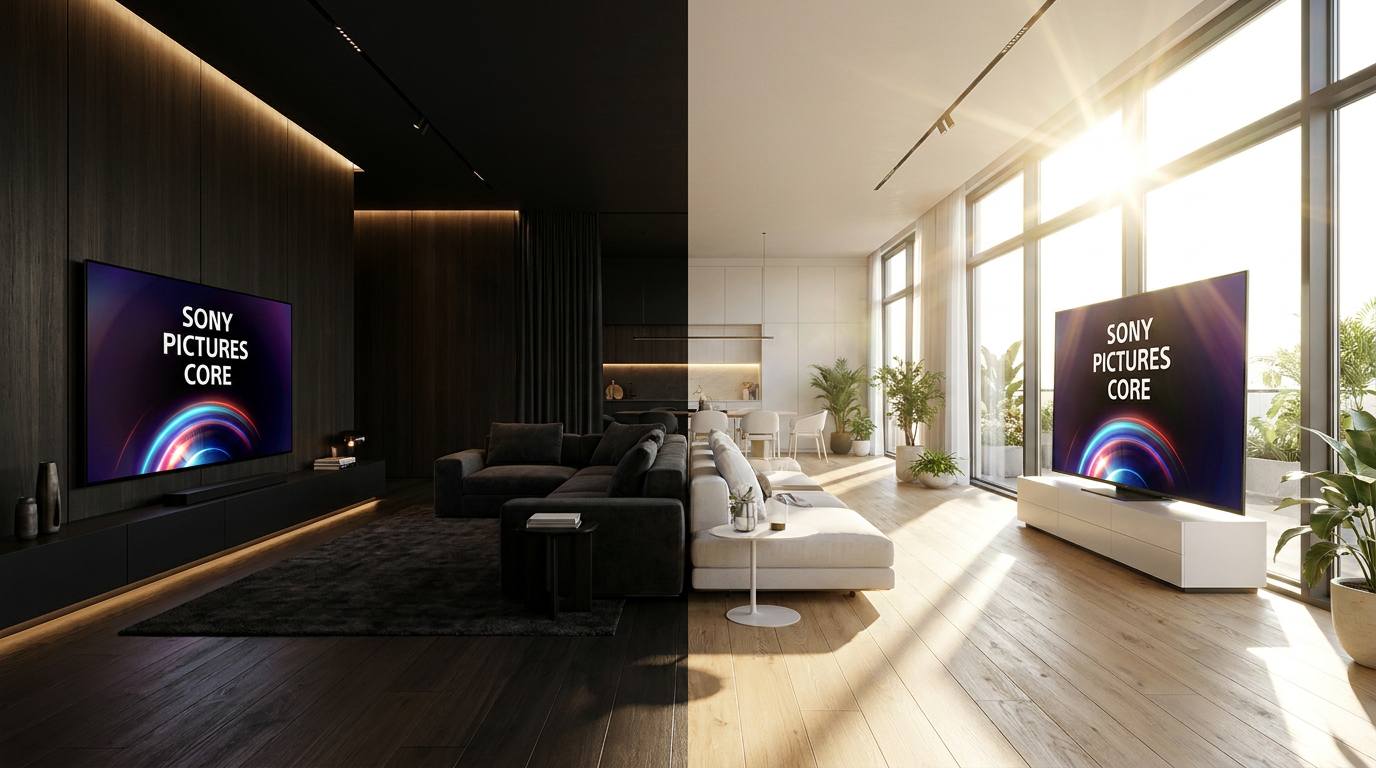
- OLED Purists
- Advocates for absolute picture precision, infinite contrast, and zero motion blur.
- Bright-Room Pragmatists
- Champions of sustained brightness, durability, and large-screen value.
- Technical Analysts
- Experts focused on the underlying physics, power draw, and panel longevity.
What's not represented
- · Budget LCD Buyers
- · Projector Enthusiasts
Why this matters
Choosing the wrong television technology in 2026 can mean fighting glare in a sunlit room or suffering through distracting halos in a dark home theater. Understanding the physical trade-offs between self-emissive pixels and advanced backlights ensures buyers get the right screen for their specific environment and budget.
Key points
- OLED panels control light at the individual pixel level, allowing for perfect black levels and a mathematically infinite contrast ratio.
- Mini-LED televisions utilize thousands of inorganic diodes and local dimming zones to achieve massive, sustained full-screen brightness.
- OLED remains the superior choice for dark-room home theaters and competitive gamers who require near-instant pixel response times.
- Mini-LED scales more affordably to massive screen sizes and easily overpowers ambient glare in sunlit living rooms without triggering dimming algorithms.
The era of settling for a basic, washed-out LCD television is officially over. As consumers look to upgrade their living rooms and home theaters in 2026, they are no longer choosing between "good" and "bad" screens, but rather between two radically different, highly advanced engineering frameworks. The premium television market has fractured into a fierce duopoly: OLED and Mini-LED. Each technology promises stunning 4K and 8K resolutions, vibrant High Dynamic Range (HDR) colors, and blazing-fast gaming features. Yet, beneath the glass, they operate on completely opposing principles of physics, making the choice deeply dependent on where and how the screen will be used.
To understand the trade-offs, one must first look at how each panel generates light. OLED, which stands for Organic Light-Emitting Diode, relies on carbon-based organic molecules. In an OLED display, there is no backlight; every single pixel generates its own light and color independently. Mini-LED, conversely, is the ultimate evolution of the traditional liquid crystal display. It uses a matrix of thousands of tiny, inorganic blue gallium-nitride diodes positioned behind the screen. These diodes push massive amounts of light through a quantum-dot color layer and a liquid crystal matrix that shapes the final image.[1][7]
The most compelling argument for OLED remains its absolute mastery of contrast. Because an OLED panel controls light at the individual pixel level, it can execute a command that no backlit TV can match: it can turn a pixel completely off. When an OLED pixel is deactivated, it emits exactly 0.0000 nits of light, creating a mathematically infinite contrast ratio. Reviewers and display purists consistently highlight this capability as the holy grail for cinematic viewing, ensuring that the black bars on widescreen movies remain pitch black and starfields pop without any distracting background haze.[1][7]
However, the physics of organic materials introduce a significant limitation: heat. Because organic pixels degrade rapidly when subjected to sustained high voltage, OLED televisions employ a hardcoded safety protocol known as the Auto Brightness Limiter (ABL). While modern Tandem OLED panels can hit impressive peak brightness levels of up to 2,000 nits for tiny highlights—like a spark or a flashlight beam—they cannot sustain that brightness across the entire screen. If a viewer switches to a bright snowy landscape or a sunlit hockey game, the ABL aggressively dims the entire panel to protect the organic compounds from overheating.[1][6][7]

This thermal ceiling is exactly where Mini-LED builds its strongest case. Unburdened by organic degradation, Mini-LED panels are engineered for unapologetic, sustained brightness. Flagship 2026 models from manufacturers like Sony and TCL are pushing the boundaries of illumination, with some sets boasting up to 10,000 nits of peak brightness. More importantly, a Mini-LED TV can sustain high brightness across the entire screen indefinitely. For a bright, open-concept living room flooded with afternoon sunlight, Mini-LED easily overpowers ambient glare without ever triggering a dimming algorithm.[2][7]
The primary drawback of Mini-LED technology is a visual artifact known as blooming. To mimic the deep blacks of OLED, a Mini-LED TV dynamically turns off specific clusters of its backlight—known as local dimming zones—behind dark areas of the screen. Top-tier 2026 models feature upwards of 20,000 independent dimming zones. Yet, because the TV has over 8 million pixels and only 20,000 zones, the backlight cannot be perfectly precise. When a bright object, such as a white subtitle, appears on a pitch-black background, the backlight zone illuminating the text often bleeds into the surrounding dark pixels, creating a faint, glowing halo.[2][5]

The primary drawback of Mini-LED technology is a visual artifact known as blooming.
Beyond movies and television, the gaming community has distinct priorities that further divide the two technologies. OLED holds a massive advantage in motion clarity. Because the self-emissive pixels can change states almost instantaneously, OLED panels boast gray-to-gray response times as low as 0.03 milliseconds. This near-zero transition time means that fast-moving objects in competitive shooters or racing simulators remain razor-sharp, completely eliminating the motion blur that inherently plagues liquid crystal displays. For esports enthusiasts, this instantaneous response provides a tangible competitive edge.[5]
Conversely, Mini-LED presents a compelling counter-argument for gamers concerned with longevity and static elements. While OLED manufacturers have implemented aggressive pixel-shifting and logo-dimming software to mitigate the risk of permanent image retention—commonly known as burn-in—the risk is never truly zero for users who leave static heads-up displays, minimaps, or news tickers on the screen for thousands of hours. Mini-LED's inorganic structure is entirely immune to burn-in, offering absolute peace of mind for heavy gamers and users who treat their TV as an all-day background monitor.[1][5]
The final, and often most decisive, factor in the OLED versus Mini-LED debate is the price-to-size scaling curve. Manufacturing flawless, massive sheets of organic material remains incredibly expensive. While 55-inch and 65-inch OLEDs have reached mainstream pricing, stepping up to an 83-inch or 97-inch OLED requires an exponential leap in budget, often costing tens of thousands of dollars. Mini-LED technology, rooted in established LCD manufacturing processes, scales far more efficiently. Buyers seeking a massive 85-inch, 98-inch, or even 115-inch screen will find Mini-LED options that deliver overwhelming cinematic scale at a fraction of the cost of a comparable OLED.[2][3]

Ultimately, neither technology claims a universal victory; each is a specialized tool engineered to conquer a specific physical environment. OLED fits perfectly when the primary use case is a light-controlled, dedicated home theater. It is the undisputed champion for cinephiles who prioritize absolute contrast, perfect shadow detail, and pixel-level precision over sheer luminance. It is also the superior choice for competitive gamers who demand the absolute lowest pixel transition times and zero motion blur, provided they vary their content enough to avoid image retention.[2][4]
Conversely, OLED does not fit well when the television is placed in a sun-drenched room with massive windows. The ambient light will crush the perfect black levels, and the aggressive Auto Brightness Limiter will leave daytime sports and news broadcasts looking noticeably dim. It is also a poor fit for commercial environments, sports bars, or users who demand an ultra-massive screen but are constrained by a strict budget, as the cost of organic panels skyrockets at larger dimensions.[1][6]
Mini-LED fits perfectly when the television serves as the centerpiece of a bright, multi-use living space. It thrives in environments where sustained, full-screen brightness is required to punch through daytime glare without compromising the image. It is the ideal choice for sports fans hosting daytime watch parties, gamers who want absolute immunity from burn-in, and buyers seeking the maximum HDR impact and screen size per dollar spent, making it the ultimate crowd-pleaser. With its robust inorganic construction, it easily handles the rigors of all-day broadcasting, ensuring that dynamic content always looks vibrant and engaging regardless of the ambient lighting conditions.[3][6]
However, Mini-LED does not fit well when the buyer is a dark-room purist who is highly sensitive to backlight blooming. Even the most advanced local dimming algorithms cannot entirely eliminate the faint halos around subtitles and starfields in a pitch-black room. For those who watch moody, high-contrast cinema in the dark, the lack of pixel-level light control will always remain a visible compromise compared to the mathematical perfection of a self-emissive display.[2][5]
How we got here
2013
The first large-screen consumer OLED TVs hit the market, introducing perfect black levels but struggling with low peak brightness.
2019
Mini-LED technology begins appearing in premium consumer televisions, offering a high-brightness alternative to traditional LCDs.
2022
Quantum Dot OLED (QD-OLED) is introduced, combining the perfect blacks of OLED with improved color brightness.
2026
Flagship Mini-LEDs surpass 20,000 dimming zones and 10,000 nits of peak brightness, while Tandem OLED panels push organic brightness to new limits.
Viewpoints in depth
OLED Purists
Advocates for absolute picture precision, infinite contrast, and zero motion blur.
For cinephiles and competitive gamers, the conversation begins and ends with pixel-level control. This camp argues that no amount of backlight dimming zones can replicate the mathematical perfection of a pixel turning completely off. They point to the 0.03-millisecond response times and the complete absence of blooming around subtitles as the ultimate proof that self-emissive technology remains the gold standard for critical viewing in controlled lighting.
Bright-Room Pragmatists
Champions of sustained brightness, durability, and large-screen value.
This perspective emphasizes real-world viewing conditions over dark-room perfection. Pragmatists argue that most people watch TV in living rooms with windows, lamps, and ambient light, where OLED's perfect blacks are crushed by glare and its brightness is throttled by safety limiters. By pushing thousands of nits across the entire screen without fear of burn-in, Mini-LED provides a punchier, more versatile experience that scales affordably to massive 85-inch and 100-inch sizes.
Technical Analysts
Experts focused on the underlying physics, power draw, and panel longevity.
Analysts view the debate through the lens of material science. They note that OLED's reliance on carbon-based organic molecules inherently limits its thermal headroom, requiring aggressive power management to prevent degradation. Conversely, they highlight Mini-LED's use of inorganic gallium-nitride diodes as a brute-force engineering triumph, though they acknowledge that the complex liquid crystal matrix still struggles to match OLED's energy efficiency during dark, cinematic scenes.
What we don't know
- How quickly the manufacturing costs of massive 97-inch and larger OLED panels will drop to compete with ultra-large Mini-LEDs.
- Whether emerging micro-LED technology will eventually merge the benefits of both panels into a single, affordable consumer product before the end of the decade.
Key terms
- Auto Brightness Limiter (ABL)
- A safety protocol in OLED TVs that automatically dims the screen when a large portion of the image is bright, preventing the organic pixels from overheating.
- Local Dimming Zones
- Clusters of LEDs behind an LCD screen that can independently dim or turn off to improve contrast in dark areas of the picture.
- Quantum Dot
- A microscopic nanocrystal layer used in both QD-OLED and Mini-LED TVs to produce highly saturated, pure colors when struck by light.
- Gray-to-Gray Response Time
- The fraction of a millisecond it takes for a pixel to change from one shade of gray to another, dictating motion clarity.
Frequently asked
Will an OLED TV suffer from burn-in?
While organic materials can degrade over time, 2026 OLEDs feature advanced thermal management and pixel-shifting algorithms that make burn-in highly unlikely for varied, everyday viewing.
What is Mini-LED blooming?
Blooming is a faint halo of light visible around bright objects on dark backgrounds, caused by the backlight zones being larger than the individual pixels they illuminate.
Which TV is better for a bright living room?
Mini-LED is the superior choice for bright rooms, as it can sustain massive full-screen brightness to overpower sunlight without triggering the dimming algorithms used by OLEDs.
Do I need a 144Hz refresh rate?
For watching movies and TV shows, no. However, PC and console gamers benefit significantly from 144Hz or higher for smoother motion and lower input lag.
Sources
Source coverage
7 outlets
3 viewpoints surfaced







[1]TechStoryTechnical Analysts
A deep structural analysis of OLED vs Mini LED display technology
Read on TechStory →[2]RTINGSOLED Purists
The 5 Best Mini LED TVs - Summer 2026
Read on RTINGS →[3]What Hi-Fi?Bright-Room Pragmatists
Best Mini LED TVs 2026: top models tested by our experts
Read on What Hi-Fi? →[4]PCMagBright-Room Pragmatists
The Best TVs for 2026
Read on PCMag →[5]KTC PlayOLED Purists
Workflow Friction Comparison: OLED vs Mini-LED
Read on KTC Play →[6]Data Wire SolutionsBright-Room Pragmatists
Best TVs for 2026: 10 OLED and Mini-LED Picks by Room, Brightness, and Install Reality
Read on Data Wire Solutions →[7]EcoPicksGoTechnical Analysts
OLED vs Mini LED TVs: 2026 Buyer's Guide
Read on EcoPicksGo →
Every angle. Every day.
Get shopping stories with full source coverage and perspective breakdowns delivered to your inbox.