
How Handheld Gaming PCs Replaced the Desktop in 2026
Advances in APU silicon, unified memory, and massive battery capacities have transformed handheld gaming PCs from niche experiments into primary gaming platforms.
By Factlen Editorial Team
- Seamless Experience Advocates
- Prioritize console-like simplicity, battery efficiency, and OLED displays over raw computing power.
- Maximum Performance Seekers
- Value the flexibility of Windows 11, high TDP limits, and compatibility with all game launchers and anti-cheat software.
- Silicon Engineers
- Focus on the architectural battle between AMD and Intel to maximize performance-per-watt in constrained thermal envelopes.
What's not represented
- · Indie Game Developers
- · Traditional Console Manufacturers
Why this matters
Handheld gaming PCs have fundamentally transformed how and where people can play high-fidelity games, untethering players from expensive desktop setups. Understanding the underlying technology helps consumers navigate a rapidly expanding, high-cost market to find the right balance of battery life, performance, and software flexibility.
Key points
- Handheld gaming PCs have evolved into primary gaming devices capable of running modern AAA titles.
- APUs combine the CPU and GPU onto a single chip, drastically improving power efficiency.
- A shift to unified memory means 24GB to 32GB of RAM is now required for optimal performance.
- Battery capacities have doubled to 80Wh, allowing for 2-3 hours of heavy gaming.
- AI upscaling and frame generation are critical software tools that allow handhelds to punch above their weight.
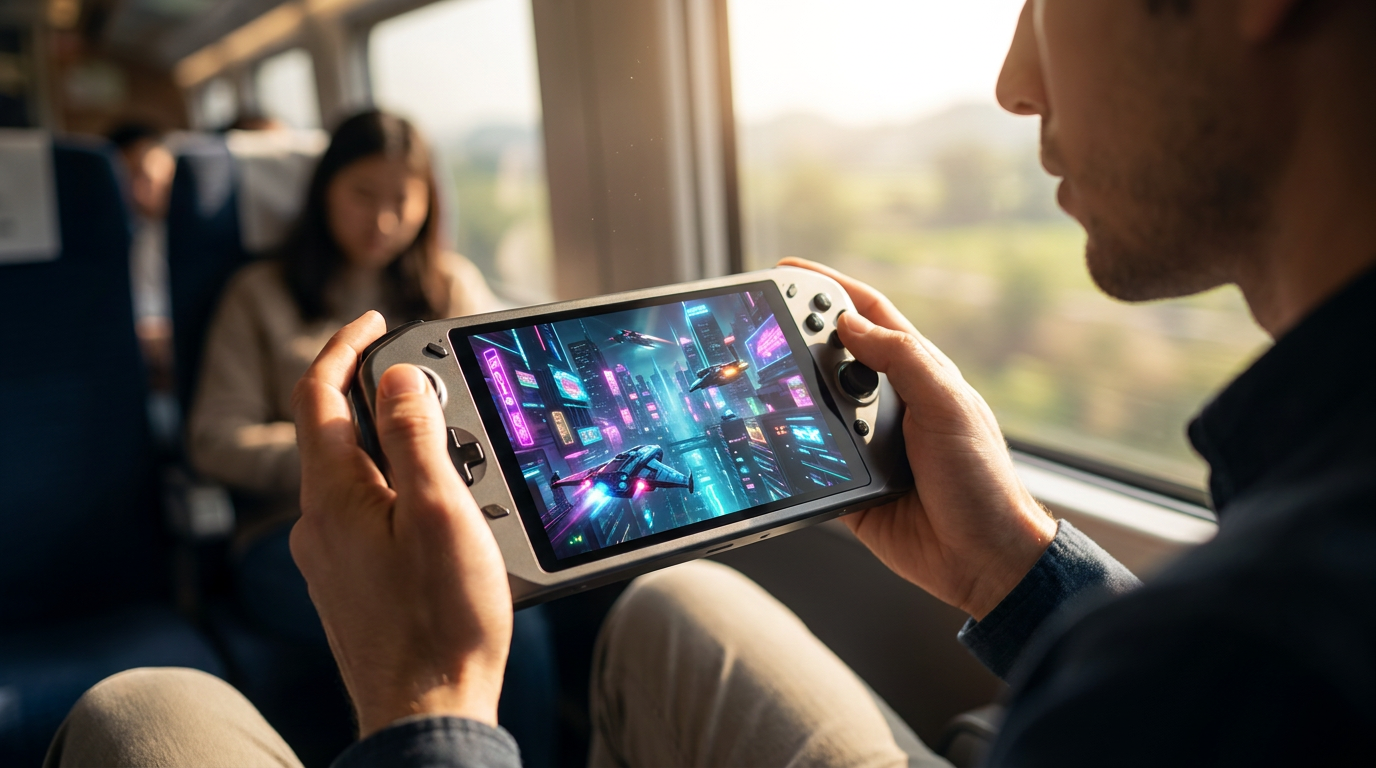
The era of being tethered to a desk for high-fidelity gaming is effectively over. In 2026, the handheld gaming PC has evolved from a niche enthusiast experiment into the dominant force in modern PC hardware. What was once considered a compromised way to play older titles on the go has transformed into a primary platform capable of running the industry's most demanding software in the palm of your hand.[5]
The shift has been staggering. Since the original Steam Deck disrupted the industry, the handheld sector has experienced hyper-growth, fundamentally changing how developers optimize games and how players consume them. Devices like the Asus ROG Ally X, Lenovo Legion Go S, and the Steam Deck OLED have proven that players are willing to trade the absolute graphical supremacy of a desktop tower for the freedom of portable power.[3][5]
How does a device the size of a paperback book run a sprawling, ray-traced world like Cyberpunk 2077? The secret lies in the architecture of the Accelerated Processing Unit, or APU. Unlike a traditional desktop computer that separates the central processor (CPU) and the graphics card (GPU) into two large, power-hungry components, an APU combines both onto a single piece of silicon.[6]
AMD has largely defined this segment with its custom silicon. Chips like the Ryzen Z1 Extreme and the newer Z2 series utilize the company's Zen 4 architecture for general computing and RDNA 3 for graphics. By placing these cores on the same die, data travels faster, latency drops, and power consumption is drastically reduced, allowing the chip to operate within the strict thermal limits of a plastic chassis.[6]

But the silicon landscape is rapidly diversifying. At Computex 2026, Intel launched a fierce counter-offensive with its Arc G3 Extreme processors, built specifically for handhelds rather than repurposed from laptops. Featured in upcoming devices like the MSI Claw 8 EX AI+, Intel claims a massive 44% performance jump at 1080p, turning the handheld market into a primary battleground for x86 platform design.[1][2]
The defining quirk of an APU is how it handles memory. Because the CPU and GPU share the same chip, they must also share the same system memory. In a traditional gaming PC, the graphics card has its own dedicated Video RAM (VRAM) to store high-resolution textures. In a handheld, the system RAM must do double duty, dynamically allocating space for both standard computing tasks and graphical rendering.[5]
This unified memory architecture is the root of the 2026 "RAM crisis" in the handheld market. Modern AAA games demand vast amounts of VRAM. If a user allocates 8GB of a 16GB system to the GPU, the remaining 8GB is often insufficient to run Windows 11 and the game's background logic. Consequently, 24GB to 32GB of RAM has become the new sweet spot for flagship handhelds.[5]
This unified memory architecture is the root of the 2026 "RAM crisis" in the handheld market.
Unfortunately, this necessary hardware bump has collided with global supply chain realities. Skyrocketing demand for AI servers has caused a global shortage of NAND and RAM, driving up component costs. Manufacturers are being forced to pass these costs onto consumers, pushing the price of premium handhelds like the Acer Predator Atlas 8 well above the $1,000 mark.[2][5]
Beyond memory, the central tension of any handheld is Thermal Design Power (TDP)—a measure of how much wattage the chip is allowed to draw. Most handheld APUs operate on a sliding scale between 9W and 30W. Pushing the TDP to 30W yields desktop-like frame rates, but it drains the battery in under an hour and generates significant heat that the internal fans must aggressively vent.[4][6]

To combat this power drain, 2026 has seen a revolution in battery physics. The industry standard has doubled from the 40Wh cells found in early models to massive 80Wh batteries in devices like the ROG Ally X. This leap allows for two to three hours of heavy AAA gaming, or practically all-day battery life for lighter indie titles and emulation.[4][5]
The screen is the primary interface, and the technological divide here is stark. Valve's Steam Deck OLED remains the gold standard for visual depth, offering unparalleled contrast, deep blacks, and a highly efficient panel that saves battery. Conversely, Windows-based competitors often prioritize speed, utilizing high-refresh-rate IPS panels that offer smoother motion but lack the vivid color reproduction of OLED.[3][4]
The secret weapon of modern handheld displays is Variable Refresh Rate (VRR). Because handhelds struggle to maintain a perfectly locked 60 frames per second in heavy games, VRR dynamically syncs the screen's refresh rate to the game's fluctuating frame rate. This hardware trick eliminates screen tearing and makes 45 FPS feel as smooth as a locked 60 FPS, a vital feature for portable play.[5]

Hardware, however, is only half the equation; the operating system dictates the actual user experience. Valve's SteamOS, built on a custom Linux distribution, offers a seamless, console-like interface. The operating system effectively disappears, allowing users to suspend and resume games instantly, though it sacrifices native compatibility with some anti-cheat software and rival storefronts.[3][5]
Windows 11 handhelds offer the exact opposite trade-off. Devices like the ROG Ally X provide total flexibility, allowing users to natively install Xbox Game Pass, run any anti-cheat software, and mod games just as they would on a desktop. The cost of this freedom is friction; users are forced to navigate a clunky desktop OS on a 7-inch touchscreen, dealing with background updates and driver quirks.[3][4][5]
Ultimately, raw hardware isn't enough to push modern pixels; handhelds rely heavily on software magic. AI-assisted upscaling technologies like AMD's FSR and Intel's XeSS 3 render the game at a lower internal resolution (such as 720p) and intelligently upscale it to 1080p, saving massive amounts of processing power.[2][6]

The newest frontier in this software arms race is frame generation. The APU uses algorithms to predict and insert artificial frames between real ones, artificially boosting the frame rate. It is this combination of hyper-efficient silicon, massive batteries, and AI software that has cemented the handheld gaming PC not as a novelty, but as the future of the medium.[1][2][5]
How we got here
Feb 2022
Valve releases the original Steam Deck, proving the viability of Linux-based handheld gaming PCs.
Jun 2023
Asus launches the ROG Ally, introducing the powerful AMD Ryzen Z1 Extreme and Windows 11 to the form factor.
Nov 2023
Valve counters with the Steam Deck OLED, drastically improving display quality and battery efficiency.
Jun 2026
Computex 2026 showcases the next generation of handhelds, featuring 80Wh batteries, 32GB of RAM, and Intel's Arc G3 Extreme chips.
Viewpoints in depth
The Seamless Experience Advocates
A camp that prioritizes console-like simplicity and battery efficiency over raw computing power.
This perspective, largely championed by Steam Deck loyalists, argues that a handheld should feel like a dedicated gaming console, not a shrunken laptop. They value the frictionless experience of SteamOS, where games can be suspended and resumed instantly without navigating desktop menus. For this group, the inclusion of an OLED screen and a highly optimized, low-wattage APU is far more important than achieving the highest possible frame rates in the latest AAA titles.
The Maximum Performance Seekers
Users who value the flexibility of Windows 11, high TDP limits, and compatibility with all software.
Power users argue that the true appeal of a handheld PC is its lack of restrictions. By running Windows 11, devices like the ROG Ally X can natively access Xbox Game Pass, Epic Games Store, and games with strict anti-cheat software that block Linux. This camp is willing to tolerate the clunkiness of a desktop OS on a small touchscreen in exchange for the ability to push the APU to 30W, install heavy mods, and achieve desktop-tier performance on the go.
The Silicon Engineers
Industry professionals focused on the architectural battle to maximize performance-per-watt.
For hardware manufacturers and silicon designers, the handheld market is the ultimate test of efficiency. The challenge is no longer just raw speed, but how much performance can be extracted from a chip drawing less than 20 watts before thermal throttling occurs. This camp views the competition between AMD's Zen 4/RDNA 3 architecture and Intel's new Arc G3 Extreme as the driving force that will eventually dictate the design of all future mobile computing.
What we don't know
- How the ongoing RAM shortage will ultimately affect the pricing floor for entry-level handhelds in late 2026.
- Whether Microsoft will release a dedicated, lightweight 'Windows Handheld Mode' to compete directly with the seamlessness of SteamOS.
- How long current APU architectures can keep up with the ballooning system requirements of next-generation Unreal Engine 5 titles.
Key terms
- APU (Accelerated Processing Unit)
- A single chip that combines both a central processor (CPU) and a graphics processor (GPU) to save space and power.
- TDP (Thermal Design Power)
- The maximum amount of heat a chip is allowed to generate, which dictates its power consumption in watts.
- VRR (Variable Refresh Rate)
- Display technology that dynamically syncs the screen's refresh rate to the game's frame rate to eliminate stuttering and screen tearing.
- Unified Memory
- A system architecture where the CPU and GPU share the same pool of RAM, rather than having separate, dedicated memory banks.
- Frame Generation
- AI software that predicts and inserts artificial frames between real ones to make gameplay look smoother without requiring extra raw rendering power.
Frequently asked
Can a handheld PC replace a traditional gaming laptop?
Yes, for many users. Modern handhelds can output to external monitors and run full desktop operating systems, making them viable for both 1080p gaming and daily productivity.
Why do newer handhelds need more than 16GB of RAM?
Because the CPU and GPU share the same memory pool, allocating enough RAM for high-resolution game textures (VRAM) leaves the system starved for general computing if the total is only 16GB.
Does Windows drain the battery faster than SteamOS?
Generally, yes. Windows 11 has more background processes and overhead than the gaming-optimized SteamOS, leading to slightly higher power consumption even when idle.
Sources
Source coverage
6 outlets
3 viewpoints surfaced






[1]TechPowerUpSilicon Engineers
Best of Computex 2026
Read on TechPowerUp →[2]TechRadarMaximum Performance Seekers
Handheld gaming in 2026 just got better, but at a big cost: here are the best handheld gaming PCs unveiled at Computex 2026
Read on TechRadar →[3]PC GamerSeamless Experience Advocates
Best handheld gaming PC in 2026: my recommendations for the best portable powerhouses
Read on PC Gamer →[4]Tom's HardwareSeamless Experience Advocates
Best Handheld Gaming PCs 2026
Read on Tom's Hardware →[5]Handheld Gaming HubMaximum Performance Seekers
The 2026 Landscape: A Market in Hyper-growth
Read on Handheld Gaming Hub →[6]AMDSilicon Engineers
AMD Ryzen™ Z1 Extreme
Read on AMD →
Every angle. Every day.
Get gaming esports stories with full source coverage and perspective breakdowns delivered to your inbox.