
US and Iran Open High-Stakes Peace Talks in Switzerland as Strait of Hormuz Remains Closed
Vice President JD Vance and Iranian leaders have arrived in Switzerland to negotiate a permanent end to the 2026 war, but the talks face immediate hurdles after Iran renewed its blockade of the world's most critical oil chokepoint.
By Factlen Editorial Team
- US & Allied Negotiators
- Focused on securing maritime trade routes and curbing Iran's nuclear program.
- Iranian Leadership
- Demanding comprehensive sanctions relief and an end to Israeli military operations in Lebanon.
- Energy & Economic Analysts
- Prioritizing the rapid reopening of the Strait of Hormuz to prevent a global recession.
What's not represented
- · European and Asian energy importers facing severe economic fallout
- · Lebanese civilians caught in the crossfire of the proxy conflict
- · Shipping and logistics companies navigating the maritime blockade
Why this matters
The Strait of Hormuz carries 20 percent of the world's traded oil. If these talks fail and the waterway remains closed, analysts warn that oil prices could more than double by the end of the year, triggering a severe global economic recession and widespread fuel shortages.
Key points
- US and Iranian delegations have arrived in Switzerland for high-stakes talks to finalize a permanent peace agreement.
- Iran's IRGC renewed its closure of the Strait of Hormuz just before the talks began, citing Israeli airstrikes in Lebanon.
- Vice President JD Vance is leading the US delegation, aiming to salvage the 60-day Memorandum of Understanding.
- The Strait of Hormuz closure has shut in over 11 million barrels per day of Gulf crude production.
- Analysts warn that a prolonged closure could push Brent crude prices toward $200 a barrel by the end of 2026.
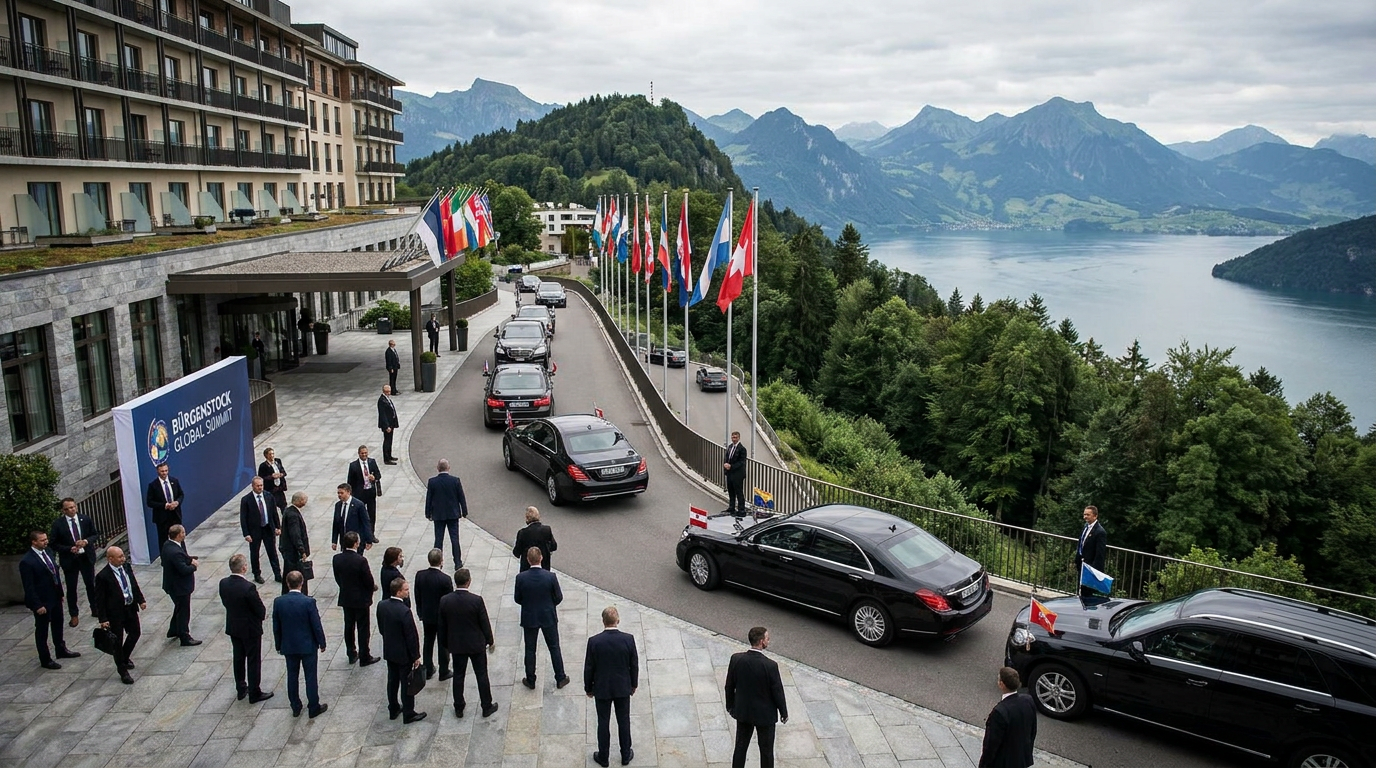
US Vice President JD Vance and Iranian leaders have arrived in Switzerland for high-stakes negotiations aimed at ending the 2026 US-Iran war. The talks, hosted at the Bürgenstock resort and mediated by Pakistan and Qatar, represent the most significant diplomatic effort since the conflict began in February. The delegations are tasked with finalizing the technical details of a fragile peace framework, with the stability of the global economy hanging in the balance.[1][3][8]
The summit begins under the shadow of an immediate crisis. Just hours before the delegations landed, Iran's Islamic Revolutionary Guard Corps (IRGC) announced the renewed closure of the Strait of Hormuz. This narrow waterway between Iran and Oman is the world's most critical energy chokepoint, historically carrying roughly 20 percent of global oil supplies and significant volumes of liquefied natural gas.[1][2][4]
Tehran claims the closure is a direct response to Israeli airstrikes against Hezbollah in Lebanon. Iranian officials argue that the continued fighting violates the first clause of a 14-point Memorandum of Understanding (MoU) signed earlier in June, which called for a comprehensive ceasefire across all fronts. Iran's Supreme National Security Council has maintained that the entire MoU will be jeopardized if all commitments are not fully implemented.[2][3][4]

Vice President Vance, accompanied by special envoys Steve Witkoff and Jared Kushner, is tasked with salvaging the 60-day MoU. Vance told reporters before departing Joint Base Andrews that he hopes to make progress on both the nuclear issue and the Lebanon ceasefire. By explicitly adding the Levant conflict to an agenda originally focused on maritime security and sanctions relief, the US acknowledges the interconnected nature of the regional crisis.[1][3][5]
The Iranian delegation, led by Parliament Speaker Mohammad Bagher Ghalibaf and Foreign Minister Abbas Araghchi, insists that the US must force Israel to halt its operations. For Tehran, leveraging its control over the vital waterway is viewed as the primary mechanism to ensure compliance from Washington and its regional allies, while simultaneously pressing for the unfreezing of assets.[4][5]
The preliminary MoU was designed to open a 60-day window for these exact technical negotiations. In exchange for Iran ending its blockade of the Strait of Hormuz and diluting its stockpile of highly enriched uranium, the United States agreed to lift its naval blockade of Iranian ports, unfreeze Iranian assets held overseas, and ease sanctions on oil exports.[1][3]

The economic stakes of the strait's closure are unprecedented. The disruption has already triggered what the International Energy Agency previously characterized as the greatest global energy security challenge in history. More than 11 million barrels per day of Gulf crude and condensate production remain shut in, effectively erasing a fifth of the market's supplies and threatening widespread fuel shortages.[7]
The economic stakes of the strait's closure are unprecedented.
Energy markets have swung wildly on the diplomatic developments. Brent crude, the international pricing benchmark, had tumbled to around $82 a barrel last week on optimism that the MoU would allow oil to flow freely again. However, the renewed closure threatens to reverse those gains, injecting massive volatility into global supply chains.[1][6]
Energy consultancy Wood Mackenzie outlines a stark divergence in potential outcomes. Under a "Quick Peace" scenario, where the talks succeed and the strait reopens by late summer, Brent crude could ease to $80 a barrel. This outcome would allow the global economy to avoid deep scarring and return to its pre-war trajectory by the fourth quarter of 2026.[7]
Conversely, the worst-case scenario paints a grim picture. If negotiations collapse and the strait remains closed through the end of 2026, Wood Mackenzie warns that Brent crude could approach $200 a barrel. This extended disruption would likely trigger a global recession, driving diesel and jet fuel prices to unprecedented highs in major refining centers.[7]

Financial analysts at Fitch Ratings offer a slightly more optimistic baseline, assuming the logistical supply shock remains temporary. Fitch projects that if the strait reopens by the end of July, a rapid recovery in Middle East production and strong non-OPEC supply growth will quickly return the market to an oversupply, pushing prices down sharply in the fourth quarter.[6]
Beyond the immediate maritime crisis, the technical teams in Switzerland must address the core of the US-Iran dispute: Tehran's nuclear program. The MoU requires Iran to address its highly enriched uranium—uranium processed to increase the concentration of the U-235 isotope—much of which is believed to be stored in underground facilities targeted by US strikes earlier in the war.[3][5]
The negotiations also carry significant domestic political weight in Washington. President Donald Trump has threatened to levy US tolls on the strait if a permanent deal is not reached within 60 days, framing the potential revenue as compensation for American military protection. Meanwhile, Vance's high-profile role in the talks is drawing intense scrutiny as he positions himself for a potential 2028 presidential campaign.[1][3]

Direct negotiations are being facilitated by Swiss hosts, alongside Pakistani Prime Minister Shehbaz Sharif and Qatari diplomats. These mediators face the daunting task of bridging the gap between Washington's demand for immediate maritime access and Tehran's insistence on a holistic regional ceasefire that includes Lebanon.[3][5]
The coming days in Bürgenstock will determine whether the 60-day MoU can survive its first major stress test. With the global economy hanging in the balance, the technical teams must find a way to decouple the volatile Israel-Hezbollah conflict from the broader US-Iran nuclear and maritime settlement, or risk plunging the world into a historic energy crisis.[1][2]
How we got here
Feb 2026
The US-Iran war begins following joint US-Israeli strikes on Iranian targets.
Mar 2026
Iran closes the Strait of Hormuz, triggering a massive global energy supply shock.
Early Jun 2026
The US and Iran sign a 14-point Memorandum of Understanding, opening a 60-day negotiation window.
Jun 20, 2026
Iran's IRGC announces the renewed closure of the Strait of Hormuz, citing Israeli strikes in Lebanon.
Jun 21, 2026
US and Iranian delegations arrive in Switzerland to begin high-stakes technical negotiations.
Viewpoints in depth
US Administration's view
The US prioritizes decoupling the Lebanon conflict from the nuclear and maritime agreements.
For the US delegation led by Vice President JD Vance, the primary objective is securing the uninterrupted flow of global energy and curbing Iran's nuclear enrichment. Washington views the Israel-Hezbollah conflict as a separate theater that should not derail the 60-day Memorandum of Understanding. The administration is pushing for immediate maritime access through the Strait of Hormuz, arguing that tying global economic stability to localized border skirmishes in the Levant is an unacceptable violation of the preliminary peace framework.
Iranian Leadership's view
Tehran views the regional conflicts as interconnected and demands full Israeli compliance.
Iran's negotiating team, guided by the Supreme National Security Council, insists that the 14-point MoU is a comprehensive package. They argue that Israeli airstrikes in Lebanon represent a direct violation of the ceasefire clause, justifying the renewed closure of the Strait of Hormuz. For Tehran, leveraging its control over the vital waterway is the only mechanism to ensure the US forces its regional allies to halt military operations, while simultaneously pressing for the unfreezing of assets and the lifting of the naval blockade.
Global Energy Markets' view
Analysts warn that prolonged geopolitical brinkmanship could trigger a historic economic recession.
Energy economists and market analysts are largely agnostic to the political grievances, focusing entirely on the logistical supply shock. Institutions like Wood Mackenzie and Fitch Ratings warn that while the market can absorb a short-term closure, an extended disruption through late 2026 would erase millions of barrels of daily supply. This camp emphasizes that if Brent crude approaches $200 a barrel, the resulting inflationary spike would force central banks to maintain high interest rates, almost certainly plunging the global economy into a severe recession.
What we don't know
- Whether the US can successfully pressure Israel to halt operations in Lebanon to satisfy Iranian demands.
- How long global energy markets can absorb the renewed closure of the Strait of Hormuz before prices spike uncontrollably.
- If the technical teams can reach a permanent agreement on Iran's highly enriched uranium stockpile within the 60-day window.
Key terms
- Strait of Hormuz
- A narrow waterway between Iran and Oman that serves as the only sea passage from the Persian Gulf to the open ocean, critical for global energy transport.
- Memorandum of Understanding (MoU)
- A preliminary diplomatic agreement outlining the framework and timeline for negotiating a permanent peace treaty.
- Brent Crude
- The primary pricing benchmark for Atlantic basin oil, used to price roughly two-thirds of the world's internationally traded crude oil.
- Highly Enriched Uranium
- Uranium that has been processed to increase the concentration of the U-235 isotope, a critical step in developing both civilian nuclear power and nuclear weapons.
- Shut-in Production
- Oil or gas production that has been deliberately halted or restricted due to geopolitical, economic, or logistical constraints.
Frequently asked
Why did Iran close the Strait of Hormuz again?
Iran's Islamic Revolutionary Guard Corps cited recent Israeli airstrikes against Hezbollah in Lebanon, claiming the continued fighting violates the comprehensive ceasefire outlined in the preliminary US-Iran Memorandum of Understanding.
What is the 60-day MoU?
It is a preliminary 14-point agreement signed in June 2026 that temporarily halted the US-Iran war. It provides a two-month window to negotiate permanent solutions regarding Iran's nuclear program, US sanctions, and maritime security.
How high could oil prices go if the talks fail?
Energy consultancy Wood Mackenzie warns that if the Strait of Hormuz remains closed through the end of 2026, Brent crude could approach $200 a barrel, likely triggering a global recession.
Who is mediating the negotiations?
The talks in Switzerland are being facilitated by Swiss hosts, alongside Pakistani Prime Minister Shehbaz Sharif and Qatari diplomats, who have served as primary intermediaries between Washington and Tehran.
Sources
Source coverage
8 outlets
3 viewpoints surfaced








[1]The GuardianUS & Allied Negotiators
US-Iran talks in Switzerland to get under way as strait of Hormuz remains closed
Read on The Guardian →[2]Al JazeeraIranian Leadership
US and Iran face make-or-break talks in Switzerland
Read on Al Jazeera →[3]CBS NewsUS & Allied Negotiators
Vance heads to Switzerland Saturday to begin negotiations with Iran
Read on CBS News →[4]Iran InternationalIranian Leadership
Negotiators in Switzerland for Iran-US talks amid Hormuz, Lebanon uncertainty
Read on Iran International →[5]Times of IsraelUS & Allied Negotiators
Vance heads to Switzerland, says hoping for progress on Lebanon truce and nuclear issue
Read on Times of Israel →[6]Fitch RatingsEnergy & Economic Analysts
Oil Market Will Return to Oversupply Once Hormuz Reopens
Read on Fitch Ratings →[7]Wood MackenzieEnergy & Economic Analysts
Strait Talking: Iran War Scenarios and the Future of Energy
Read on Wood Mackenzie →[8]AxiosUS & Allied Negotiators
Vance travels to Switzerland for nuclear talks with Iran
Read on Axios →
Every angle. Every day.
Get news politics stories with full source coverage and perspective breakdowns delivered to your inbox.