
OLED vs. Mini-LED: The 2026 TV Buyer's Trade-Off Guide
As Mini-LED technology closes the performance gap with OLED, choosing the right premium TV in 2026 comes down to room lighting, screen size, and viewing habits.
By Factlen Editorial Team
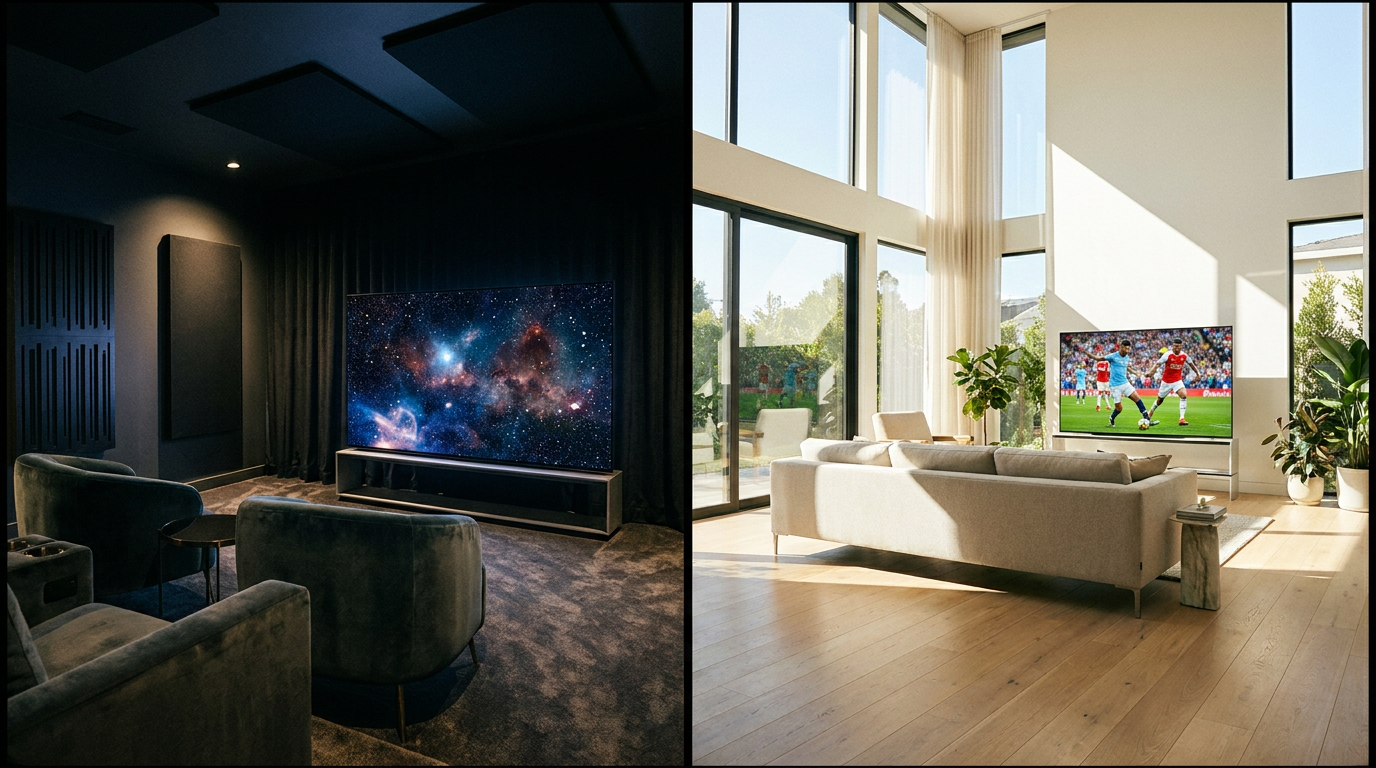
- Home Theater Purists
- Argues that perfect black levels and pixel-level contrast are the only way to watch cinematic content as the director intended.
- Bright-Room Viewers
- Values raw brightness and glare reduction for daytime viewing, sports, and open-plan living spaces.
- Heavy Gamers
- Weighs the need for OLED's instant response times against Mini-LED's immunity to static interface burn-in.
What's not represented
- · Budget-conscious buyers looking under $500
- · Commercial display installers
Why this matters
Premium televisions are expensive, multi-year investments. Understanding the specific trade-offs between organic pixels and advanced backlights ensures you buy the right panel for your living room's lighting and your daily viewing habits.
Key points
- OLED delivers perfect black levels and infinite contrast by turning off individual pixels.
- Mini-LED uses thousands of dimming zones to achieve massive, sustained brightness.
- OLED is the optimal choice for dark, cinematic home theater environments.
- Mini-LED easily cuts through glare in sun-drenched living rooms.
- Mini-LED offers significantly better value in screen sizes of 75 inches and above.
- OLED provides faster response times for gaming, while Mini-LED eliminates burn-in risks.
The 2026 television market has effectively narrowed to a two-horse race for premium buyers: OLED and Mini-LED. While older LED technologies still populate the budget aisles, anyone looking to invest in a high-performance display is faced with this specific fork in the road. The choice is no longer about which technology is objectively superior, but rather which architecture is engineered to survive and thrive in your specific living space.[2][4]
Understanding the trade-offs requires looking at the core architectural divide. OLED stands for Organic Light-Emitting Diode, meaning the television lacks a traditional backlight entirely; instead, each of its eight million pixels generates its own light and color. Mini-LED, conversely, is a highly evolved liquid crystal display (LCD) that utilizes thousands of microscopic, inorganic diodes clustered into tightly controlled dimming zones behind the screen.[1][7]
The case for OLED centers entirely on contrast and precision. Because an OLED panel can turn off individual pixels completely, it achieves absolute black levels that no backlit television can replicate. This pixel-level light control means that a bright white star in a sci-fi movie can sit directly next to the pitch-black vacuum of space without any light bleeding between the two.[1][2]
The evidence for OLED's dominance in dark rooms is unanimous across testing laboratories. Reviewers consistently note that cinematic shadows and letterbox bars show zero haloing, preserving the exact intent of the film's color grader. Furthermore, OLED pixels change state almost instantaneously, delivering a 0.03-millisecond response time that keeps fast-moving objects perfectly sharp.[1][5]

However, the case against OLED involves its organic limitations. To prevent the organic compounds from overheating and degrading, OLED televisions employ an Auto Brightness Limiter (ABL). When the screen displays a full-field bright image—such as a sunlit hockey rink or a snow-covered documentary landscape—the television's processor aggressively dims the entire panel to protect itself.[3][5]
Furthermore, while 2026 panels feature advanced heat sinks and pixel-shifting algorithms, the evidence shows that OLED still carries a non-zero risk of permanent image retention. For users who leave static news tickers on all day, or gamers who display the same heads-up interface for thousands of hours, organic degradation remains a lingering concern.[1][6]
The case for Mini-LED is built on raw, sustained power and inorganic durability. By utilizing up to 20,000 local dimming zones, these panels can push peak HDR highlights past 2,500 nits without breaking a sweat. Because the diodes are inorganic, the television does not need to aggressively dim full-screen bright images to protect itself.[3][5]
The case for Mini-LED is built on raw, sustained power and inorganic durability.
The evidence for Mini-LED shines brightest in sun-drenched living rooms. Testers confirm that modern Mini-LED displays can sustain full-screen brightness at levels nearly three times higher than competing OLEDs. This allows the picture to effortlessly cut through daytime glare, making it the undisputed champion for weekend sports viewing in open-plan houses with large windows.[3][6]

The case against Mini-LED focuses on the inherent limitations of any backlight system. Even with tens of thousands of zones, the backlight clusters are still larger than individual pixels. This architectural reality results in faint blooming or haloing—a subtle glow around bright text or objects when displayed against a dark background, which can briefly pull a viewer out of a cinematic experience.[1][2][5]
When evaluating the price-to-performance ratio, the 2026 market has shifted the calculus. While 55-inch and 65-inch models are now priced similarly across both technologies, Mini-LED offers a massive value advantage in the ultra-large categories. Buyers looking for 75-inch or 85-inch screens will find that Mini-LED delivers premium performance for thousands of dollars less than a comparably sized OLED.[3][4]

For gamers, the trade-off is stark and highly personal. OLED offers an instantaneous response time for perfect motion clarity in competitive shooters, while Mini-LED provides absolute peace of mind against HUD burn-in during marathon role-playing sessions. Both technologies now universally support 144Hz refresh rates and variable refresh rate (VRR) standards.[4][6]
Ultimately, OLED fits well when the television is placed in a light-controlled or dim room, the primary media diet consists of cinematic movies, and the viewer demands flawless shadow detail. It does not fit well in rooms with massive unshaded windows, or for households that use the television as a permanent background monitor for news networks.[2][6]
Conversely, Mini-LED fits well when the screen must compete with afternoon sunlight, for hosting daytime sports watch parties, and for buyers wanting an ultra-large display without an exorbitant premium markup. It does not fit well for dark-room home theater purists who are highly sensitive to backlight blooming around subtitles.[3][6]
Viewpoints in depth
The Cinematic Purist's View
Focuses on OLED's infinite contrast and lack of blooming as the ultimate standard.
For home theater enthusiasts, the conversation begins and ends with black levels. Because OLED can turn off individual pixels, it achieves a mathematically infinite contrast ratio. This camp argues that any form of backlight blooming—no matter how advanced the Mini-LED dimming algorithm—compromises the director's intent during dark, moody scenes. To them, the absolute precision of self-lit pixels outweighs any limitations in peak brightness.
The Daytime Viewer's View
Focuses on Mini-LED's ability to overpower sunlight and sustain full-screen brightness.
Viewers with open-plan, sunlit living rooms prioritize raw output over microscopic shadow detail. This perspective highlights that OLED's Auto Brightness Limiter (ABL) artificially dims bright scenes like hockey games or winter sports to protect the organic panel. Mini-LED advocates argue that a television is useless if you cannot see it through daytime glare, making inorganic, high-nit panels the only practical choice for everyday, mixed-use living spaces.
The Competitive Gamer's View
Weighs OLED's motion clarity against Mini-LED's durability for static UI elements.
The gaming community is split based on genre preferences. Competitive shooter fans lean heavily toward OLED for its near-instantaneous 0.03ms response time, which eliminates motion blur during rapid camera pans. However, players of MMOs, strategy games, or sports titles who leave static heads-up displays (HUDs) on screen for hours prefer Mini-LED, as it completely removes the anxiety of permanent image retention while still delivering vibrant HDR highlights.
What we don't know
- Whether future micro-LED technology will eventually combine the benefits of both panels at a consumer-friendly price.
- Exactly how long 2026-era OLED panels can last under heavy gaming use before showing signs of degradation.
Key terms
- OLED
- Organic Light-Emitting Diode; a display technology where each individual pixel generates its own light and can turn off completely.
- Mini-LED
- An advanced LCD backlight system using thousands of microscopic LEDs grouped into dimming zones for precise brightness control.
- Nits
- A measurement of screen brightness; one nit is roughly equivalent to the light of one candle per square meter.
- Blooming
- A visual artifact where light bleeds from a bright object into surrounding dark areas, common on backlit displays.
- ABL (Auto Brightness Limiter)
- A protective feature in OLED TVs that automatically dims the screen during sustained bright scenes to prevent overheating.
Frequently asked
Does OLED still suffer from burn-in in 2026?
While significantly reduced by better heat sinks and pixel-shifting algorithms, permanent image retention remains a slight risk if static elements are displayed for thousands of hours.
What is blooming on a Mini-LED TV?
Blooming, or haloing, is a faint glow around bright objects on dark backgrounds, caused by the backlight zones being larger than individual pixels.
Which technology is better for a bright living room?
Mini-LED is the superior choice for bright rooms, as it can sustain much higher full-screen brightness to cut through daytime glare without dimming.
Are Mini-LED TVs cheaper than OLEDs?
In 55-inch and 65-inch sizes, prices are nearly identical, but Mini-LED offers significantly better value in massive 75-inch and 85-inch sizes.
Sources
Source coverage
7 outlets
3 viewpoints surfaced







[1]RTINGSHome Theater Purists
OLED vs Mini LED: Which TV Technology is Better?
Read on RTINGS →[2]CNETHome Theater Purists
OLED vs. Mini-LED: Which TV Tech Is Best for You?
Read on CNET →[3]TechRadarBright-Room Viewers
Why I recommend mini-LED over OLED for big-screen sports
Read on TechRadar →[4]Data Wire SolutionsHeavy Gamers
Best TVs for 2026: 10 OLED and Mini-LED Picks by Room, Brightness, and Install Reality
Read on Data Wire Solutions →[5]EcoPicksGoHeavy Gamers
LG G5 OLED vs LG QNED9M Mini LED Comparison (2026 Buyer's Guide)
Read on EcoPicksGo →[6]Electric ShopBright-Room Viewers
Choosing between OLED and RGB Mini-LED in 2026
Read on Electric Shop →[7]LG UKHeavy Gamers
Mini LED TV vs. OLED TV – What's the difference?
Read on LG UK →

Every angle. Every day.
Get shopping stories with full source coverage and perspective breakdowns delivered to your inbox.