
The Evidence Is In: 'Missing Middle' Housing Reforms Actually Lower Rents
A wave of empirical data from cities like Auckland, Minneapolis, and Austin proves that upzoning and building more housing effectively stabilizes rent prices and expands affordability.
By Factlen Editorial Team
- Pro-Housing Advocates
- Argue that restrictive zoning is the root cause of the affordability crisis and that building more homes of all types is the only scalable solution.
- Urban Economists & Researchers
- Focus on empirical data to measure the exact causal impact of zoning reforms on rent prices and displacement.
- Neighborhood Preservationists
- Express concern that blanket upzoning can alter neighborhood character, strain local infrastructure, and fail to guarantee affordable units.
What's not represented
- · Renters currently facing eviction in transitioning neighborhoods
- · Small-scale developers navigating local permitting bottlenecks
Why this matters
For decades, the housing crisis has felt unsolvable, leaving millions priced out of homeownership and burdened by skyrocketing rents. This new wave of empirical data proves that changing local zoning laws to allow more housing actually works, offering a realistic blueprint to restore affordability.
Key points
- A 2025 Pew analysis of 1,654 ZIP codes found that a 10% increase in housing supply correlates with a 5% reduction in rent growth.
- Auckland's 2016 upzoning reform doubled new dwelling permits and kept rent growth to just 11-20%, compared to 41-59% in other New Zealand cities.
- The Minneapolis 2040 Plan lowered rent growth by up to 34% relative to a counterfactual scenario, largely by cooling speculative demand.
- Austin, Texas, added 120,000 new housing units over nine years, driving its median rent down by 4% overall.
The housing affordability crisis has long felt like an intractable mathematical trap. For decades, urban planners and economists have argued that re-legalizing "missing middle" housing—duplexes, triplexes, and townhomes—could break the deadlock and restore attainable living to major cities.[6][7]
Until recently, this premise was largely theoretical. But a wave of sweeping zoning reforms passed over the last decade has finally generated enough hard, empirical data to evaluate the claims. The emerging consensus from peer-reviewed studies and think-tank analyses is striking: upzoning works.[1][7]
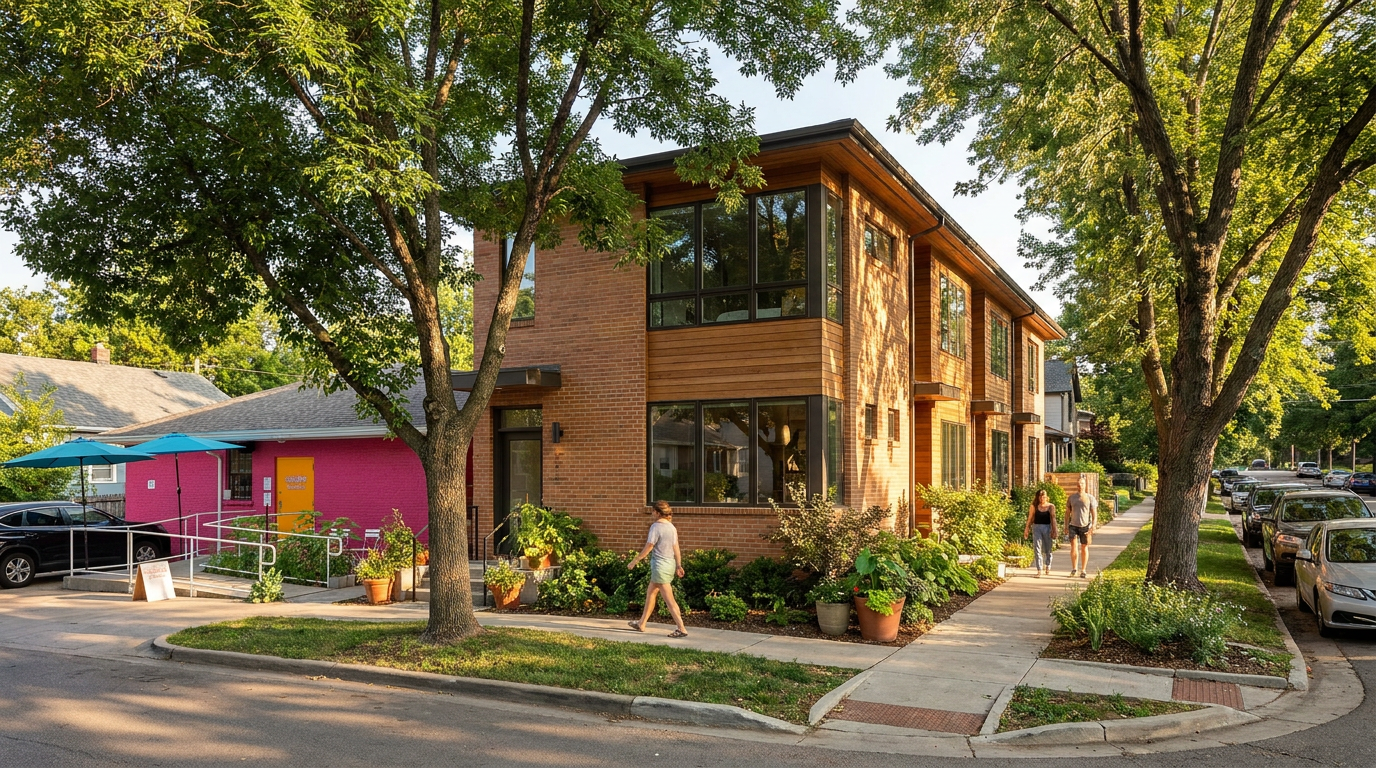
The "missing middle" refers to medium-density housing that bridges the structural gap between detached single-family homes and mid-rise apartment complexes. These structures, which include courtyard apartments and rowhouses, were largely outlawed in North America after World War II by restrictive zoning codes designed to enforce suburban sprawl.[6]
The most comprehensive evidence of the reform's efficacy comes from a 2025 analysis by The Pew Charitable Trusts, which examined rent data across 1,654 U.S. ZIP codes. The study sought to answer a critical, often-debated question: does building new, predominantly market-rate housing actually help lower-income renters?[1][5]
The data revealed a clear, inverse relationship between housing supply and rent growth. Researchers found that a 10% increase in a metropolitan area's housing stock between 2017 and 2023 correlated with a 5% reduction in rent growth over that same period.[1]

Crucially, this new supply relieved pressure on the lower end of the market. As higher-income earners moved into new construction, older, more affordable "Class C" apartments saw the steepest rent declines. This filtering effect directly benefits low-income tenants who are typically the most vulnerable to displacement.[1][5]
The most dramatic international case study validating this theory is unfolding in Auckland, New Zealand. In 2016, the city implemented a radical policy experiment, upzoning approximately 75% of its residential land to allow for medium- and high-density development.[2][8]
The results were unprecedented in modern urban planning. A study by the University of Auckland found that housing construction surged to a record high of 12 consented dwellings per thousand residents by 2022. A separate synthetic control analysis demonstrated that the reform effectively doubled the per-capita rate of new dwelling permits within five years.[2][8]
A study by the University of Auckland found that housing construction surged to a record high of 12 consented dwellings per thousand residents by 2022.
This sustained construction boom had a profound stabilizing effect on consumer prices. Between 2016 and 2023, rents in Auckland rose by just 11% to 20%, compared to massive 41% to 59% increases in other New Zealand cities that maintained their restrictive zoning laws.[2][4]

In the United States, Minneapolis served as the pioneer for this approach. In 2018, it became the first major U.S. city to abolish single-family zoning entirely through its landmark Minneapolis 2040 Plan.[3]
A 2025 study published on SSRN evaluated the plan's first five years using a sophisticated synthetic control model, comparing Minneapolis to 83 similar "donor" cities. The researchers found that the reform significantly suppressed housing costs, with rents sitting 17.5% to 34% lower than they would have been in a counterfactual scenario without the zoning changes.[3]
Interestingly, the mechanism in Minneapolis differed from the Auckland experience. The study found that the 2040 Plan did not trigger an immediate, massive construction boom. Instead, the mere policy shift altered market expectations, softening housing demand and cooling speculative price growth before the physical supply even materialized.[3]

Austin, Texas, provides another compelling data point, achieving absolute rent reductions through aggressive permitting reform rather than just zoning changes. By streamlining approvals and allowing larger apartment buildings near transit corridors, Austin expanded its housing stock by an astonishing 30%—adding 120,000 units between 2015 and 2024.[9]
The massive influx of supply pushed Austin's median rent down from $1,546 in late 2021 to $1,296 by early 2026. In large apartment buildings, rents fell by 7% in a single year, marking the steepest decline recorded in any major U.S. metropolitan area.[9]

Similar localized successes are visible in Portland and Houston. In Portland, middle housing reforms allowed developers to deliver new units for roughly $600,000—about $300,000 less than new single-family homes in the exact same neighborhoods. Houston's reduction of minimum lot sizes spurred a wave of affordable townhouse construction that transformed its urban core.[4]
Despite the overwhelming macro-level evidence, researchers emphasize a degree of transparent uncertainty regarding local implementation. Upzoning alone cannot force developers to build if macroeconomic conditions—such as high interest rates, labor shortages, or inflated material costs—make projects financially unviable.[6][7]
Furthermore, neighborhood preservationists and some local officials caution that upzoning without targeted tenant protections can occasionally incentivize the demolition of existing affordable structures. This can lead to short-term localized displacement, even if regional affordability improves in the aggregate.[6][7]
Ultimately, the accumulated evidence pack points to a clear, actionable conclusion: restrictive zoning is a primary driver of the housing affordability crisis. While it is not a magic wand, re-legalizing the missing middle and allowing cities to build is a proven, necessary mechanism for stabilizing rents and expanding access to housing for all income levels.[1][2][7]
How we got here
Mid-20th Century
North American cities adopt strict zoning codes, largely outlawing 'missing middle' housing in favor of single-family homes.
2016
Auckland, New Zealand, implements a sweeping reform, upzoning 75% of its residential land for medium- and high-density housing.
Dec 2018
Minneapolis passes the 2040 Plan, becoming the first major U.S. city to eliminate single-family zoning.
2021-2026
Austin's aggressive permitting reforms yield a 30% increase in housing stock, driving median rents down by 4% overall.
2025
Major empirical studies from Pew and SSRN confirm that upzoning and increased housing supply consistently slow rent growth.
Viewpoints in depth
Pro-Housing Advocates
Argue that restrictive zoning is the root cause of the affordability crisis and that building more homes of all types is the only scalable solution.
This camp points to the fundamental laws of supply and demand, arguing that when cities block new construction, wealthy newcomers simply outbid lower-income residents for the existing housing stock. They champion "missing middle" reforms as a way to gently increase density, create walkable neighborhoods, and restore attainable homeownership without requiring massive public subsidies.
Urban Economists & Researchers
Focus on empirical data to measure the exact causal impact of zoning reforms on rent prices and displacement.
Researchers emphasize that while the aggregate data strongly supports upzoning, the mechanisms can vary. In Auckland, the reform spurred a massive physical construction boom. In Minneapolis, the mere policy change altered market expectations and cooled speculative demand. They advocate for rigorous synthetic control studies to separate the effects of zoning from broader macroeconomic trends like interest rates.
Neighborhood Preservationists
Express concern that blanket upzoning can alter neighborhood character, strain local infrastructure, and fail to guarantee affordable units.
This perspective argues that developers often prioritize high-end, market-rate units over genuinely affordable housing, potentially leading to the demolition of older, cheaper structures. They advocate for coupling zoning reforms with strict tenant protections, inclusionary zoning mandates, and investments in public infrastructure to ensure that increased density does not lead to localized displacement.
What we don't know
- How high interest rates and elevated construction costs will impact the long-term pace of new 'missing middle' development.
- The exact threshold of new supply required to transition a specific neighborhood from slowing rent growth to absolute rent reduction.
- Whether the market expectation effects seen in Minneapolis can be replicated in cities with fundamentally different baseline demand.
Key terms
- Upzoning
- The process of changing local zoning codes to allow for higher-density development, such as permitting apartment buildings in areas previously restricted to single-family homes.
- Synthetic Control Method
- A statistical technique used by researchers to evaluate the effect of a policy by comparing the actual outcome to a mathematically constructed 'counterfactual' scenario.
- Class C Apartments
- Older, typically non-luxury apartment buildings that provide naturally occurring affordable housing for lower- and middle-income renters.
- Missing Middle
- A range of multi-family or clustered housing types compatible in scale with single-family neighborhoods, largely outlawed in the mid-20th century.
Frequently asked
What exactly is 'missing middle' housing?
It refers to medium-density housing types like duplexes, triplexes, townhomes, and courtyard apartments that sit between single-family homes and large apartment buildings.
Does building luxury apartments help lower-income renters?
Yes. Evidence shows that building market-rate housing relieves pressure on the entire market, preventing higher-income earners from bidding up the prices of older, more affordable apartments.
Did the Minneapolis zoning reform cause a construction boom?
Not immediately. Researchers found that the reform lowered housing costs primarily by softening demand and altering market expectations, rather than through an instant surge in physical supply.
How did Auckland's upzoning affect rent prices?
Following its 2016 upzoning, Auckland's rent growth slowed significantly, rising just 11% to 20% over seven years compared to 41% to 59% in other New Zealand cities.
Sources
Source coverage
9 outlets
3 viewpoints surfaced








[1]The Pew Charitable TrustsUrban Economists & Researchers
New Housing Slows Rent Growth Most for Older, More Affordable Units
Read on The Pew Charitable Trusts →[2]University of AucklandUrban Economists & Researchers
Will Upzoning Deliver Housing Affordability for Everyone? Evidence from Auckland
Read on University of Auckland →[3]SSRNUrban Economists & Researchers
Zoning Reforms and Housing Affordability: Evidence from the Minneapolis 2040 Plan
Read on SSRN →[4]California YIMBYPro-Housing Advocates
More Housing Options, Lower Prices: Evidence from Houston, Portland, and Auckland
Read on California YIMBY →[5]Davis VanguardPro-Housing Advocates
Pew Report: Increasing Housing Supply Could Reduce Rent Burden for Low-Income Renters
Read on Davis Vanguard →[6]WikipediaNeighborhood Preservationists
Missing middle housing
Read on Wikipedia →[7]Factlen Editorial TeamUrban Economists & Researchers
Synthesis by Factlen editorial team
Read on Factlen Editorial Team →[8]Cowles Foundation for Research in EconomicsUrban Economists & Researchers
The impact of upzoning on housing construction in Auckland
Read on Cowles Foundation for Research in Economics →Austin's Surge of New Housing Construction Drove Down Rents
Read on The Pew Charitable Trusts →

Every angle. Every day.
Get real estate stories with full source coverage and perspective breakdowns delivered to your inbox.