
The Pollen-Eating Butterfly That Defies the Laws of Aging
By evolving the unique ability to digest pollen, the Heliconius butterfly extended its lifespan from weeks to nearly a year, triggering a cascade of cognitive and physical upgrades.
By Factlen Editorial Team
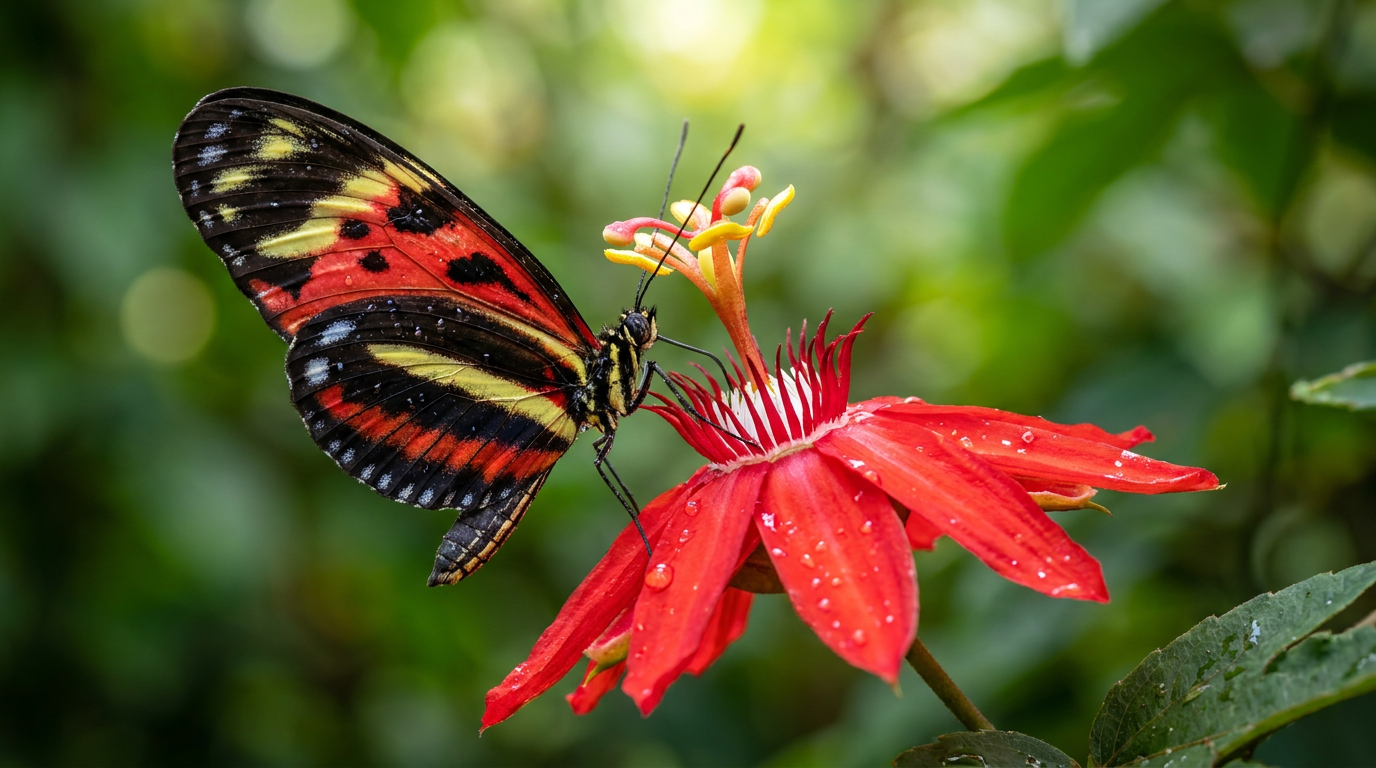
- Evolutionary Biologists
- Focuses on how a single behavioral innovation—eating pollen—triggered a cascade of morphological and ecological changes.
- Neurobiologists
- Examines the mosaic evolution of the butterfly's brain and how spatial memory demands physically expanded its neural architecture.
- Longevity Researchers
- Investigates the intrinsic, heritable anti-aging mechanisms that decouple the butterfly's chronological age from physiological decline.
What's not represented
- · Entomologists studying non-tropical species
- · Plant biologists studying the co-evolution of pollen sources
Why this matters
Understanding how this butterfly naturally delays both physical frailty and cognitive decline offers scientists a powerful new genetic model for studying the fundamental mechanisms of aging and neurobiology.
Key points
- Heliconius butterflies are the only lepidopterans known to actively consume pollen.
- They externally digest the pollen on their proboscis to extract essential amino acids.
- This diet allows them to live up to 348 days, compared to the 4-6 week lifespan of most butterflies.
- The need to remember pollen locations caused their brain's memory centers to physically expand.
- They maintain muscle mass and cognitive function long into old age, offering a new model for longevity research.
The lifespan of a typical butterfly is famously ephemeral. Most species flutter through their adult stage for mere weeks, their survival strictly constrained by the finite energy reserves they accumulated as caterpillars.[7]
But deep in the Neotropical rainforests of Central and South America, the Heliconius genus breaks the fundamental rules of lepidopteran aging. Some species within this group live for nearly a year, exhibiting a remarkable, sustained resistance to both physical frailty and cognitive decline.[1][4]
The secret to this extreme longevity begins with a unique dietary innovation: they are the only butterflies known to actively consume pollen. While the nectar that most butterflies drink provides short-term carbohydrate fuel, pollen is densely packed with essential amino acids, proteins, and lipids.[3][5]
Because butterflies lack the jaw structures necessary to chew solid food, Heliconius had to evolve a specialized physiological workaround to extract these nutrients.[3]
They gather pollen on their proboscis, mixing it with specialized saliva. For hours, the butterflies sit motionless, rapidly coiling and uncoiling their proboscis to gently masticate the pollen load, externally digesting it to release amino acids which are then drawn up as a nutrient-rich fluid.[3][7]

This protein-rich diet fundamentally alters their aging trajectory. A recent comprehensive study published in Nature Communications tracked the lifespans of dozens of species within the broader Heliconiini tribe to quantify this effect.[1]
The researchers found a staggering 25-fold variation in lifespan across the tribe. Non-pollen-feeding relatives lived an average of 58 days, while pollen-feeding Heliconius species averaged 177 days. One specific species, Heliconius hewitsoni, recorded a maximum lifespan of 348 days.[1][5][6]

Crucially, this extended lifespan is not merely a prolonged period of senescence. Heliconius butterflies maintain their muscle mass, flight capability, and even grip strength long after their closely related cousins have succumbed to old age.[4][6]
Crucially, this extended lifespan is not merely a prolonged period of senescence.
However, the longevity appears to be deeply genetic, not just a byproduct of good nutrition. When researchers deprived Heliconius of pollen in controlled insectary experiments, the butterflies still significantly outlived their non-pollen-feeding relatives.[1][4]
This indicates that while the pollen diet may have triggered the evolutionary shift millions of years ago, the butterflies have subsequently evolved heritable, intrinsic anti-aging mechanisms that delay cellular degradation independent of their immediate diet.[1][7]
This dietary shift also triggered a cascade of cognitive and neuroanatomical adaptations. A longer life and a reliance on pollen—a scarce and patchy resource in the dense rainforest—demanded entirely new behavioral strategies.[2]
Heliconius butterflies developed "traplining," a complex foraging strategy where individuals learn and remember specific spatial routes to pollen-bearing vines, returning to the exact same plants day after day.[2][3]
This intense demand for long-term spatial and visual memory drove a massive physical expansion of their brains. Recent neurobiological research reveals that Heliconius brains underwent "mosaic evolution," where specific integrative centers expanded dramatically while others remained unchanged.[2]
Specifically, the "mushroom bodies"—the brain structures responsible for learning and memory in insects—are vastly enlarged in Heliconius compared to their non-pollen-eating relatives.[2][7]

This expansion is driven by a massive increase in Kenyon cells and a higher density of synaptic connections, specifically in the neural areas dedicated to processing complex visual information.[2]
Furthermore, these butterflies exhibit delayed cognitive senescence. While most insects rapidly lose memory retention as they age, Heliconius retains the ability to recall learned color and spatial associations for weeks without any reinforcement.[2][7]
Evolutionary biologists view Heliconius as a textbook example of an "adaptive suite"—a scenario where a single behavioral innovation unlocks a new ecological niche, triggering a domino effect of physiological, morphological, and cognitive upgrades.[3][7]

How we got here
12–18 million years ago
The Heliconius genus emerges and develops the unique behavioral innovation of pollen feeding.
1970s
Field researchers first document Heliconius butterflies actively collecting and feeding on pollen.
August 2023
Research in Current Biology reveals the massive expansion of the mushroom bodies in Heliconius brains.
June 2026
A Nature Communications study confirms that Heliconius possess heritable anti-aging traits independent of their diet.
Viewpoints in depth
Evolutionary Biologists
Focuses on how a single behavioral innovation triggered a cascade of morphological changes.
For evolutionary biologists, the Heliconius butterfly is a premier example of an 'adaptive suite.' They argue that the simple behavioral shift to eating pollen unlocked a massive ecological advantage, which in turn exerted selective pressure on the rest of the butterfly's biology. Because pollen provided the protein necessary to live longer, natural selection could suddenly act on traits that favored extended survival, such as enhanced immune function and delayed reproductive senescence. This demonstrates how behavior can drive physical evolution, rather than the other way around.
Neurobiologists
Examines the physical expansion of the butterfly's brain to support spatial memory.
Neurobiologists are primarily interested in the 'mosaic evolution' of the Heliconius brain. Because pollen is a rare and patchy resource, the butterflies had to develop 'traplining'—the ability to remember complex routes to specific flowers. Neuroscientists have mapped how this specific ecological demand caused the mushroom bodies (the brain's learning centers) to physically expand, increasing the number of Kenyon cells and synapses. They view the butterfly as a perfect model for understanding how cognitive demands physically rewire neural architecture over evolutionary time.
Longevity Researchers
Investigates the intrinsic anti-aging mechanisms that decouple chronological age from physiological decline.
Researchers focused on aging are fascinated by the fact that Heliconius butterflies maintain their muscle mass, grip strength, and memory long after their relatives have died. Crucially, recent studies show that even when deprived of pollen, these butterflies still outlive their cousins. Longevity experts argue this proves the butterflies have evolved intrinsic, heritable genetic mechanisms that actively delay cellular senescence. By isolating these genetic pathways, researchers hope to uncover fundamental biological rules of aging that could eventually translate to human medicine.
What we don't know
- The exact genetic pathways that allow Heliconius to delay cellular senescence and maintain muscle mass.
- How the butterfly's brain manages to prune synapses without losing long-term spatial memories.
- Whether the specific enzymes in their saliva evolved from pre-existing grooming behaviors or entirely novel mutations.
Key terms
- Proboscis
- The elongated, tubular mouthpart of a butterfly, typically used for sucking nectar, but adapted in Heliconius for external digestion.
- Senescence
- The condition or process of deterioration with age, including loss of muscle function and cognitive ability.
- Mushroom Bodies
- A pair of structures in the brain of insects that are highly involved in learning, memory, and sensory integration.
- Adaptive Suite
- A collection of multiple, interrelated traits (behavioral, physical, and cognitive) that evolve together in response to a major ecological shift.
Frequently asked
Why don't other butterflies eat pollen?
Most butterflies lack the specialized saliva and the behavioral instinct to externally digest pollen on their proboscis, relying instead on the protein they stored as caterpillars.
Do they still live longer if they don't eat pollen?
Yes. Even when deprived of pollen in a lab, Heliconius butterflies still outlive their relatives, indicating they have evolved genetic anti-aging traits beyond just a healthy diet.
What is traplining?
Traplining is a foraging strategy where an animal learns and remembers a specific route between multiple food sources, returning to them in a regular sequence.
How does this help human aging research?
By studying how these butterflies naturally delay muscle loss and cognitive decline, scientists hope to identify genetic pathways that could inspire therapies for age-related diseases in humans.
Sources
Source coverage
7 outlets
3 viewpoints surfaced







[1]Nature CommunicationsLongevity Researchers
Pollen feeding and the evolution of extended lifespan in Heliconius butterflies
Read on Nature Communications →[2]Current BiologyNeurobiologists
Mosaic brain evolution and the expansion of the mushroom bodies in Heliconius butterflies
Read on Current Biology →[3]Philosophical Transactions of the Royal Society BEvolutionary Biologists
Behavioural innovation and the evolution of an adaptive suite in Heliconius butterflies
Read on Philosophical Transactions of the Royal Society B →[4]Discover MagazineLongevity Researchers
An Incredibly Long-Lived Butterfly May Hold The Secret To Slower Aging
Read on Discover Magazine →[5]ScienceAlertLongevity Researchers
An Incredibly Long-Lived Butterfly May Hold The Secret To Slower Aging
Read on ScienceAlert →[6]CNNLongevity Researchers
These long-lived tropical butterflies are shedding light on the secrets of longevity
Read on CNN →[7]Factlen Editorial TeamEvolutionary Biologists
Synthesis by Factlen editorial team
Read on Factlen Editorial Team →

More in science
See all 7 stories →Quantum Physics
The Physics of the Higgs Field: How the Universe Got Its Mass
6 sources

Urban Ecology
How 13-Centimeter Holes in London Fences Are Reversing Urban Biodiversity Loss
8 sources

Dark Oxygen
The Discovery of 'Dark Oxygen' is Rewriting the Rules of Life on Earth
6 sources

Superconductors
Nanoscale Substrate Sculpting Unlocks Higher Temperatures and Magnetic Tolerance in Superconductors
7 sources

Every angle. Every day.
Get science stories with full source coverage and perspective breakdowns delivered to your inbox.