
How the Cruise Industry is Engineering the Zero-Emission Ships of the Future
Faced with mounting environmental pressure and a 2050 net-zero mandate, cruise lines are overhauling how massive ships are powered. From retractable solar sails to liquefied natural gas and shore-power grids, here is how the next generation of vessels will operate.
By Factlen Editorial Team
- Cruise Industry Leaders
- Executives argue that billions in investments are yielding tangible results through transitional fuels and shore power.
- Environmental Watchdogs
- Climate advocates warn that transitional fossil fuels are a dangerous distraction from true zero-carbon solutions.
- Maritime Innovators
- Engineers and naval architects focus on the physical technologies required to drastically reduce a ship's energy demand.
What's not represented
- · Port City Residents
- · Alternative Fuel Producers
Why this matters
The cruise industry's massive energy demands have historically made it a significant source of global emissions. The successful deployment of zero-emission maritime technology will not only clean up port cities and fragile ecosystems, but also pioneer heavy-transport solutions that can be adapted by the global cargo shipping industry.
Key points
- The cruise industry has pledged to reach net-zero carbon emissions by 2050, driving massive investments in maritime technology.
- Liquefied natural gas (LNG) is currently being used as a bridge fuel to reduce CO2, though critics warn about methane slip.
- Over 85% of new cruise ships will be equipped to plug into onshore electrical grids, eliminating port emissions.
- Hurtigruten's Sea Zero project aims to launch a fully electric, emission-free cruise ship by 2030 using 60-megawatt batteries.
- Future vessels will rely on radical efficiency designs, including retractable solar sails and hull air lubrication, to make battery power viable.
The modern cruise ship is a marvel of engineering, a floating city that offers thousands of passengers everything from ice rinks to multi-story water parks. But powering these massive vessels requires an immense amount of energy, traditionally generated by burning heavy fuel oil. As global pressure mounts to address climate change, the cruise industry faces an existential engineering challenge: how to decarbonize a floating metropolis.
In late 2021, the Cruise Lines International Association (CLIA), which represents the vast majority of the global ocean-going fleet, made a landmark pledge to pursue net-zero carbon emissions by 2050. Achieving this goal requires a complete overhaul of maritime propulsion and onboard energy management, sparking a wave of multi-billion-dollar investments in green technology.[1][2]
The transition is happening in phases, with liquefied natural gas (LNG) currently serving as the industry's primary bridge fuel. Royal Caribbean’s massive new Icon of the Seas and its upcoming sister ships rely on dual-fuel engines capable of burning LNG. Compared to traditional marine diesel, LNG reduces carbon dioxide emissions by roughly 25 percent and virtually eliminates sulfur oxides and particulate matter.[3][4]
However, the reliance on LNG is heavily contested. Environmental watchdogs, including the International Council on Clean Transportation, argue that LNG is a false climate solution. Their primary concern is methane slip—the release of unburned methane gas from the engine exhaust. Because methane traps significantly more heat than carbon dioxide over a 20-year period, critics warn that the overall greenhouse gas footprint of an LNG-powered ship could actually be worse than one burning conventional fuel.[4]

Acknowledging these limitations, cruise lines are designing their newest vessels to be fuel flexible. Ships built with LNG infrastructure today are engineered to eventually run on bio-LNG or synthetic LNG once those fuels become available at scale, requiring no major engine modifications.[2]
Beyond the main engines, engineers are targeting the hotel load—the massive amount of electricity required to power lights, air conditioning, kitchens, and entertainment venues. This hotel load can account for up to 50 percent of a ship's total energy consumption. To address this, the industry is turning to advanced battery hybrids and hydrogen fuel cells.[6]
Fuel cells generate electricity through a chemical reaction rather than combustion, producing only water vapor and heat as byproducts. Recent ship designs are integrating fuel cell technology to power these massive hotel loads, treating the newest generation of mega-ships as large-scale testbeds for hybrid power systems that operate without producing harmful exhaust.[3]
Fuel cells generate electricity through a chemical reaction rather than combustion, producing only water vapor and heat as byproducts.
When ships dock, they historically kept their diesel engines running to maintain onboard services, blanketing port cities in noise and exhaust. The solution to this is shore power, also known in the maritime industry as cold ironing.[8]

Shore power allows a vessel to plug directly into the local electrical grid, completely shutting down its auxiliary engines. If the local grid is powered by renewable energy, the ship's port emissions drop to zero. According to industry data, 85 percent of new cruise ships coming online between now and 2028 will be equipped with shore power connectivity, and major ports across Europe and North America are rapidly installing the necessary high-voltage infrastructure.[2][8]
While LNG, fuel cells, and shore power represent the present, the ultimate goal is a ship that produces zero emissions from the moment it leaves the shipyard. Norwegian cruise operator Hurtigruten is leading this charge with its ambitious Sea Zero project, aiming to launch the world's first fully emission-free cruise ship by 2030.[6][7]
Developed in partnership with the research institute SINTEF and shipbuilder Vard, the Sea Zero concept represents a radical departure from traditional ship design. The 443-foot vessel will be entirely electric, powered by a massive 60-megawatt-hour battery bank that charges while connected to shore power in port.[6][7]
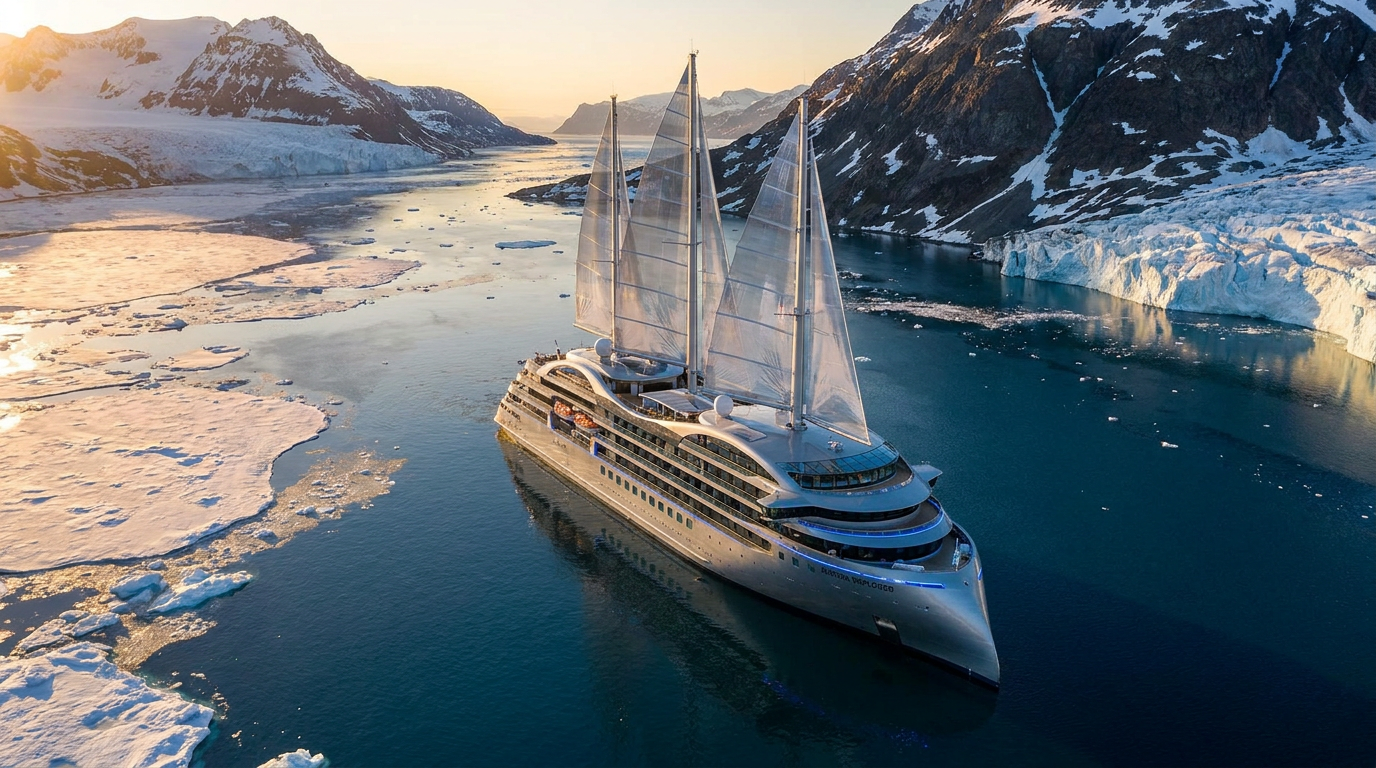
Because batteries alone cannot power a ship across open oceans for days at a time, the Sea Zero design incorporates cutting-edge wind and solar technology. The ship will feature two massive, retractable sails covered in 1,500 square meters of solar panels. When extended to their maximum height of 50 meters, these autonomous wing rigs will harness both wind and solar energy, reducing overall energy consumption by 10 to 15 percent.[6][7]

Efficiency is the cornerstone of the Sea Zero project. The hull is being optimized with air lubrication systems—which pump a carpet of micro-bubbles under the ship to reduce drag—and contra-rotating propellers. Artificial intelligence will manage the ship's maneuvering, learning the most efficient docking methods for specific ports and weather conditions.[6][7]
Combined, these innovations are expected to cut the ship's energy use by 40 to 50 percent compared to current vessels. With that drastic reduction in energy demand, engineers believe it is entirely realistic to fit a battery system with enough capacity to allow the ship to sail between charging ports under normal weather conditions.[7]
The expedition cruise sector is also pushing boundaries. The upcoming Captain Arctic, a 36-passenger polar expedition vessel, will utilize solar sail technology and run on HVO biofuel produced from waste oils. Its creators estimate the ship will emit 90 percent less carbon dioxide than conventional boats navigating the fragile Arctic environment.[5]

Despite these breakthroughs, the industry faces a daunting math problem. The technology for zero-carbon cruising exists today—engines can run on sustainable biofuels, e-methanol, or ammonia—but the global supply of these green fuels is minuscule. Without a massive, coordinated scale-up in global fuel production and port infrastructure, the 2050 net-zero target will remain an uphill battle.[5]
For now, the cruise industry is operating in a transitional era. By combining incremental efficiency gains, hybrid power systems, and bold conceptual redesigns, maritime engineers are proving that the floating cities of tomorrow can exist in harmony with the oceans they explore.
How we got here
2019
Hurtigruten introduces the MS Roald Amundsen, the world's first battery-hybrid powered cruise ship.
Nov 2021
The Cruise Lines International Association (CLIA) announces a collective pledge to pursue net-zero emissions by 2050.
Jan 2024
Royal Caribbean launches Icon of the Seas, utilizing LNG and preparing for fuel cell integration.
2030
Target launch year for Hurtigruten's Sea Zero, planned to be the world's first fully emission-free cruise ship.
Viewpoints in depth
Cruise Industry Leaders
Executives argue that billions in investments are yielding tangible results through transitional fuels and shore power.
Industry groups like CLIA and major operators like Royal Caribbean emphasize that decarbonizing a floating city cannot happen overnight. They view liquefied natural gas (LNG) and hybrid battery systems as necessary stepping stones that immediately reduce sulfur and particulate emissions. By building 'fuel flexible' ships today, they argue the fleet will be ready to seamlessly swap to synthetic or bio-fuels the moment global supply chains can produce them at scale.
Environmental Watchdogs
Climate advocates warn that transitional fossil fuels are a dangerous distraction from true zero-carbon solutions.
Organizations like the International Council on Clean Transportation point to the 'methane slip' associated with LNG engines, noting that unburned methane is a vastly more potent greenhouse gas than carbon dioxide. They argue that investing billions into LNG infrastructure locks the industry into decades of fossil fuel reliance, urging operators to skip the transitional phase and invest directly in green hydrogen, ammonia, and wind-assisted propulsion.
Maritime Innovators
Engineers and naval architects focus on the physical technologies required to drastically reduce a ship's energy demand.
For the engineering consortiums behind projects like Hurtigruten's Sea Zero, the focus is on radical efficiency. Because current battery technology is too heavy to power a massive ship across an ocean, innovators are looking at the hull and the sky. By combining air lubrication, contra-rotating propellers, and massive retractable solar sails, they believe they can cut a ship's energy requirement in half—making emission-free battery sailing mathematically possible between charging ports.
What we don't know
- Whether the global supply of true zero-carbon fuels, such as e-methanol and green ammonia, can scale up fast enough to meet the industry's 2050 deadline.
- How quickly developing nations and smaller ports can afford to install the expensive high-voltage infrastructure required for shore power.
- Whether the methane slip from LNG engines can be fully eliminated through future engine modifications.
Key terms
- Cold Ironing
- The maritime practice of shutting down a ship's engines while docked and connecting to an onshore electrical grid.
- Hotel Load
- The electrical power required to run a ship's non-propulsion systems, including lighting, climate control, kitchens, and passenger entertainment.
- Methane Slip
- The escape of unburned methane gas from an engine's exhaust, which contributes significantly to global warming.
- Air Lubrication
- A hull technology that pumps a layer of micro-bubbles under a ship to reduce friction with the water, improving fuel efficiency.
- Dual-Fuel Engine
- A marine engine designed to operate on two different types of fuel, typically traditional marine diesel and liquefied natural gas (LNG).
Frequently asked
What is shore power for cruise ships?
Shore power, also known as cold ironing, allows a ship to plug into a port's electrical grid. This lets the vessel shut down its diesel engines while docked, eliminating local air and noise pollution.
Why is LNG considered a controversial marine fuel?
While liquefied natural gas (LNG) reduces carbon dioxide emissions by about 25% compared to traditional marine diesel, engines can release unburned methane. Methane is a potent greenhouse gas, leading critics to argue LNG is a false climate solution.
Can a cruise ship run entirely on batteries?
Currently, batteries alone cannot power a large cruise ship across open oceans due to weight and capacity limits. However, future designs like Hurtigruten's Sea Zero plan to combine massive battery banks with wind and solar power for emission-free coastal sailing.
What are fuel cells on a ship?
Fuel cells generate electricity through a chemical reaction rather than combustion. They are being tested on newer ships to power 'hotel loads'—lights, air conditioning, and kitchens—without producing harmful exhaust.
Sources
Source coverage
8 outlets
3 viewpoints surfaced








[1]Leisure Group TravelCruise Industry Leaders
Cruise Industry Makes Sustainability Strides
Read on Leisure Group Travel →[2]Cruise Lines International AssociationCruise Industry Leaders
Environmental Sustainability
Read on Cruise Lines International Association →[3]Baird MaritimeCruise Industry Leaders
Royal Caribbean orders fourth Icon-class cruise ship
Read on Baird Maritime →[4]The GuardianEnvironmental Watchdogs
'Biggest, baddest' – but is it the cleanest? World's largest cruise ship sets sail
Read on The Guardian →[5]National GeographicMaritime Innovators
Can the cruise industry go carbon-neutral?
Read on National Geographic →[6]TravelAge WestMaritime Innovators
Can a Zero-Emission Cruise Ship Exist?
Read on TravelAge West →[7]The Maritime ExecutiveMaritime Innovators
Hurtigruten and Vard Reveal Updated Plans for Zero-Emission Cruise Ship
Read on The Maritime Executive →[8]Port Authority of NSWMaritime Innovators
What is Shore Power?
Read on Port Authority of NSW →

Every angle. Every day.
Get travel stories with full source coverage and perspective breakdowns delivered to your inbox.