
The Science of the Maillard Reaction: How Heat Transforms Flavor
The Maillard reaction is the chemical process responsible for the complex flavors and golden-brown colors of seared meats, baked bread, and roasted coffee. Understanding how amino acids and sugars react under heat allows home cooks to unlock restaurant-quality depth in their meals.
By Factlen Editorial Team
- Culinary Scientists
- Focus on the precise chemical mechanisms of flavor development.
- Home & Professional Chefs
- Focus on applying the science to improve daily kitchen techniques.
- Public Health Researchers
- Focus on the health implications and byproducts of high-heat cooking.
What's not represented
- · Industrial Food Manufacturers
Why this matters
Understanding the Maillard reaction is the single most effective way to elevate home cooking. By mastering the science of heat and moisture, home cooks can stop boiling their meats in crowded pans and start unlocking the rich, restaurant-quality flavors hidden inside everyday ingredients.
Key points
- The Maillard reaction is a chemical process between amino acids and reducing sugars that creates complex flavors and brown pigments.
- The reaction requires temperatures between 280°F and 330°F, meaning surface moisture must evaporate before browning can begin.
- Different combinations of proteins and sugars produce unique flavor profiles, explaining why roasted coffee and seared steak taste distinct.
- Alkaline environments, such as those created by baking soda or lye, significantly accelerate the browning process.
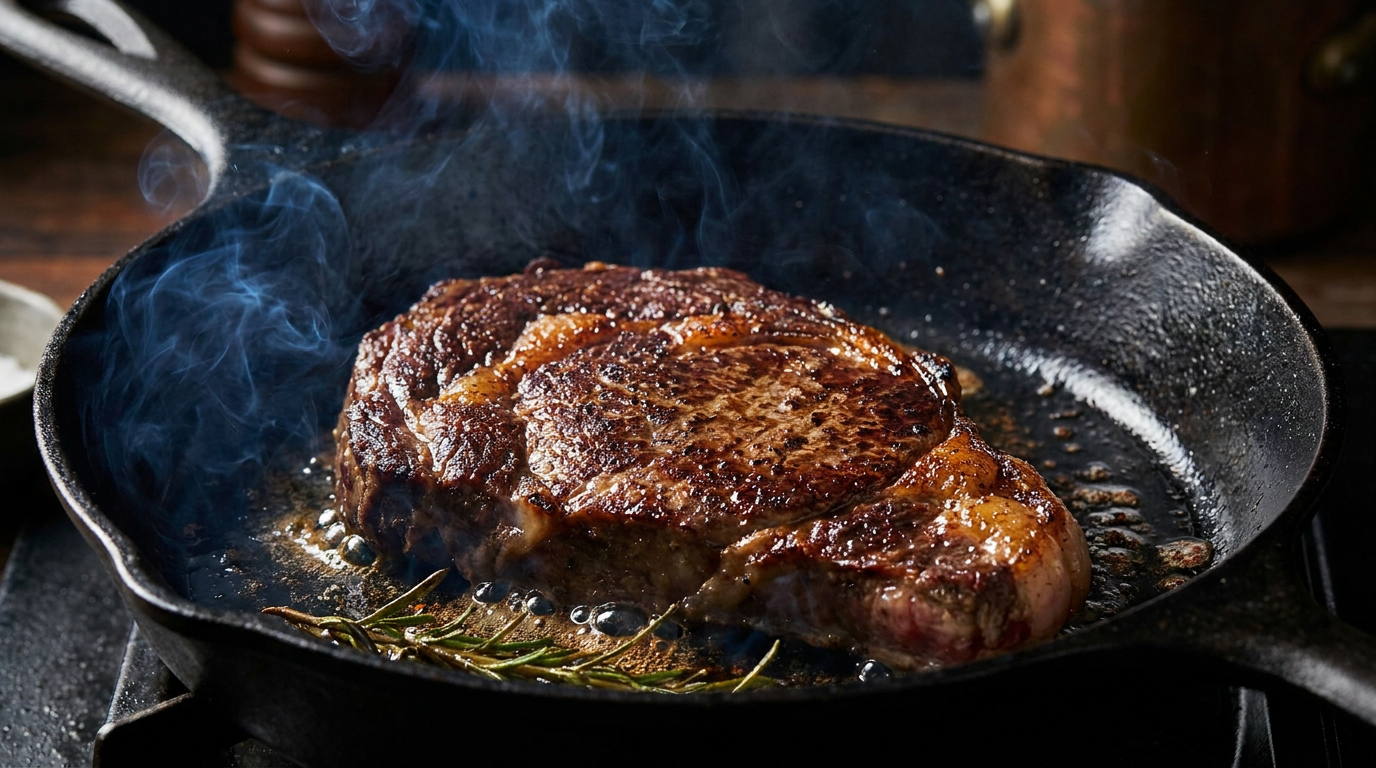
There is a defining moment in the cooking process when raw, pale ingredients transform into something entirely new and irresistible. It is the unmistakable smell of a thick steak hitting a smoking hot cast-iron skillet, the golden, crackling crust forming on a freshly baked loaf of sourdough bread, and the rich, intoxicating aroma of roasting coffee beans. While these culinary experiences might seem completely unrelated to the casual observer, the underlying magic driving them is identical. This transformation is driven by the Maillard reaction, a complex chemical process that is arguably the single most important flavor-producing mechanism in all of culinary science. Without it, our food would be bland, colorless, and entirely devoid of the savory depth we associate with a well-cooked meal.[5]
First described in 1912 by the French chemist and physician Louis-Camille Maillard, the process is frequently referred to in casual kitchen conversations as the "browning reaction." Maillard originally discovered the phenomenon while attempting to understand biological protein synthesis, but his observations quickly became foundational to food science. However, modern culinary experts and food scientists argue that labeling it merely a "browning reaction" is incomplete and somewhat misleading. The reaction's true value lies not in the visual color it produces on the surface of a pan, but in the hundreds of complex, volatile flavor and aroma molecules it generates. It is the engine of taste, turning simple raw materials into a symphony of savory, roasted, and toasted notes.[1][2][7]
At its core, the Maillard reaction is a sophisticated form of non-enzymatic browning, meaning it does not rely on enzymes to change the food's cellular structure. Instead, it requires two specific chemical components to initiate the process: amino acids, which serve as the fundamental building blocks of proteins, and reducing sugars, such as glucose, fructose, or lactose. When these two elements are present in an ingredient and exposed to sufficient heat, the reactive carbonyl group of the sugar interacts directly with the nucleophilic amino group of the amino acid. This initial interaction forms a highly unstable intermediate compound that rapidly breaks down, recombines, and triggers a cascading chain reaction of molecular transformations.[1][5][7]

The ultimate result of this rapid chemical cascade is the creation of melanoidins—the complex polymer compounds that are directly responsible for the rich brown pigment we see on seared foods—alongside a vast and unpredictable array of volatile flavor molecules. The sheer scale of this chemical generation is staggering. In a single piece of seared steak, this process can produce well over 600 distinct flavor compounds, each contributing a subtle note of earthiness, sweetness, or umami to the final dish. These new molecules continually react with one another, breaking down further to form even more complex layers of flavor, which is why a perfectly roasted piece of meat tastes so profoundly different from its raw counterpart.[4][7]
A common misconception among home cooks is that the Maillard reaction is identical to caramelization, as both processes require high heat and result in a deeply browned exterior. However, the two are chemically distinct. Caramelization is strictly the pyrolysis, or thermal breakdown, of sugars in the complete absence of amino acids. Because the Maillard reaction fundamentally relies on the specific amino acids present in the food, it produces wildly different results depending on the ingredient being cooked. This explains why roasting coffee beans smells entirely different from baking a brioche bun or searing a piece of fish, even though the underlying chemical mechanism driving the flavor development is exactly the same across all three scenarios.[2][5][7]
For this complex reaction to occur at a rapid, noticeable pace, the cooking environment must reach a specific temperature threshold. The Maillard reaction typically kicks into high gear between 280°F and 330°F (140°C to 165°C). This strict temperature requirement makes liquid moisture the primary enemy of the browning process. Because water evaporates at 212°F (100°C), any liquid present on the surface of the food will act as a thermal ceiling. As long as there is moisture actively evaporating, the surface temperature of the ingredient cannot rise above the boiling point, effectively halting the Maillard reaction before it even has a chance to begin.[1][2][5]

For this complex reaction to occur at a rapid, noticeable pace, the cooking environment must reach a specific temperature threshold.
This unforgiving scientific reality dictates some of the most fundamental techniques used in professional kitchens around the world. It is the exact reason why boiling, poaching, or steaming food never produces a brown crust or roasted flavor profile. It is also why chefs adamantly insist on thoroughly patting meat dry with paper towels—or leaving it uncovered in the refrigerator to air-dry—before it ever touches a hot pan. If a steak is placed into a skillet while wet, the initial heat energy is entirely wasted on boiling away the surface water, resulting in a grey, steamed exterior rather than a deeply flavorful, caramelized crust.[3][4][6]
The mechanics of heat transfer also explain why crowding a skillet consistently leads to disappointing culinary results. When too many cold, moisture-rich ingredients are added to a pan at once, the ambient temperature of the cooking surface plummets. Unable to maintain the high heat required to flash-evaporate moisture, the food begins to release its internal juices into the pan. The ingredients end up simmering in their own liquid, trapping the temperature at 212°F and entirely bypassing the Maillard zone. Cooking in smaller batches ensures the pan retains enough thermal mass to vaporize moisture instantly, allowing the surface temperature to climb back into the crucial 280°F to 330°F range.[4][6]

Beyond the careful management of heat and moisture, the Maillard reaction is also heavily influenced by the pH levels of the cooking environment. Food scientists have long known that the chemical process accelerates significantly in an alkaline setting, as the amino groups become deprotonated and exhibit increased nucleophilicity. Food producers and savvy chefs frequently exploit this quirk of chemistry to achieve dramatic results. Traditional pretzels, for example, are dipped in a highly alkaline lye bath before baking, which rapidly accelerates the Maillard reaction to create their signature dark, glossy, mahogany crust in a fraction of the normal baking time.[5][7]
Home cooks can easily harness this alkaline hack in their own kitchens without resorting to industrial lye. Adding a tiny pinch of baking soda—a common household alkali—to a pan of sliced onions will drastically speed up the browning process, reducing the time it takes to achieve deep, sweet caramelization. Similarly, marinades that incorporate slightly alkaline ingredients, or batters formulated with baking soda rather than baking powder, will brown much faster in the oven or fryer. This allows cooks to achieve a beautiful exterior crust without overcooking the delicate interior of the food, a technique frequently used in both professional baking and savory applications.[5][6]
While the culinary benefits of the Maillard reaction are universally celebrated, the process has also drawn intense scrutiny from public health researchers and nutrition scientists. The chemical cascade creates a variety of complexes that are thought to be highly beneficial to human health, including melanoidins that exhibit strong antioxidant properties. These antioxidants help protect the body's cells from oxidative stress and damage. However, the reaction is not entirely without risk. When starchy foods—particularly potatoes, wheat, and rye—are subjected to very high temperatures for extended periods, the Maillard reaction can produce a controversial byproduct known as acrylamide.[3][7]

The World Health Organization currently classifies acrylamide as a probable human carcinogen, a designation based primarily on studies demonstrating that the chemical causes cancer in laboratory animals when administered in very high doses. However, the scientific consensus regarding its danger to humans remains highly nuanced. To date, epidemiological evidence directly linking the levels of dietary acrylamide found in typical cooked foods to an increased risk of cancer in humans remains inconclusive. Despite the lack of definitive proof, health agencies generally advise the public to be mindful of their exposure to heavily browned or charred starchy foods.[3][6]
To manage this potential health risk without sacrificing the immense flavor benefits of the Maillard reaction, culinary experts and health professionals recommend a balanced approach to heat management. Cooking at the lower end of the Maillard temperature zone allows flavors to develop gently without pushing the food into the danger zone. Most importantly, cooks should actively avoid pyrolysis—the point where browning crosses over into burning, charring, and the development of acrid, bitter flavors. Ultimately, understanding the Maillard reaction shifts cooking from a series of blind instructions to an exercise in applied chemistry, empowering anyone to unlock the deep, complex flavors that elevate everyday meals.[1][4][7]
Viewpoints in depth
Culinary Scientists
Focusing on the precise chemical mechanisms of flavor development.
For food scientists, the Maillard reaction is a cascade of molecular transformations. They emphasize that it is not a single event, but a complex web of reactions where unstable intermediate compounds continually break down to form hundreds of volatile flavor molecules. Their focus is on mapping these pathways to understand exactly why different amino acid profiles yield different aromas, allowing the food industry to replicate specific savory notes.
Home & Professional Chefs
Applying the science to practical kitchen techniques.
Chefs view the Maillard reaction through the lens of technique and environmental control. Their primary concern is managing moisture and heat transfer. By understanding that water is the enemy of browning, they employ techniques like dry-brining, patting proteins dry, and avoiding pan-crowding. They also utilize alkaline ingredients, like baking soda, to manipulate the pH of marinades and batters, forcing the reaction to occur more rapidly without overcooking the interior of the food.
Public Health Researchers
Monitoring the health implications of high-heat cooking byproducts.
Health researchers approach the Maillard reaction with a focus on its byproducts, specifically acrylamide. While acknowledging the creation of beneficial antioxidants, they caution against excessive high-heat cooking of starchy foods like potatoes and grains. Their goal is to establish dietary guidelines that allow people to enjoy the flavor benefits of browning while minimizing exposure to compounds that are classified as probable carcinogens when consumed in high concentrations.
What we don't know
- While the World Health Organization classifies the byproduct acrylamide as a probable carcinogen, the exact risk level of consuming dietary acrylamide in humans remains inconclusive.
- Because the reaction produces hundreds of volatile compounds simultaneously, food scientists are still mapping the precise chemical pathways that generate specific artificial flavors.
Key terms
- Amino acids
- The organic molecules that serve as the building blocks of proteins, essential for triggering the Maillard reaction.
- Reducing sugars
- Simple carbohydrates, such as glucose and fructose, that react with amino acids under heat.
- Melanoidins
- The brown, complex polymer compounds created at the end of the Maillard reaction that give seared foods their color.
- Pyrolysis
- The chemical breakdown of organic materials at very high temperatures, commonly known as burning or charring.
- Acrylamide
- A chemical compound that can form in some starchy foods during high-temperature cooking, currently studied for potential health risks.
Frequently asked
Why doesn't boiled food turn brown?
Water boils at 212°F, which is too low to trigger the Maillard reaction. The food must exceed 280°F, which requires a dry cooking environment.
Is the Maillard reaction the same as caramelization?
No. Caramelization only involves the breakdown of sugars under high heat. The Maillard reaction requires both sugars and amino acids (proteins).
How can I make my food brown faster?
Ensure the surface is completely dry before cooking, use high heat, and optionally add a tiny pinch of baking soda to increase the alkalinity, which accelerates the reaction.
Does burnt food have more Maillard flavor?
No. Pushing the temperature too high leads to pyrolysis (burning), which destroys the complex flavor compounds and replaces them with bitter, acrid carbon.
Sources
Source coverage
7 outlets
3 viewpoints surfaced







[1]MasterClassCulinary Scientists
What Is the Maillard Reaction? 5 Phases of the Maillard Reaction
Read on MasterClass →[2]Modernist CuisineCulinary Scientists
The Maillard Reaction
Read on Modernist Cuisine →[3]University of Illinois ExtensionPublic Health Researchers
The Maillard Reaction
Read on University of Illinois Extension →[4]Club and Resort ChefHome & Professional Chefs
The Science of the Maillard Reaction
Read on Club and Resort Chef →[5]A Matter of NourishmentHome & Professional Chefs
The Maillard Reaction: What It Is and Why It Matters
Read on A Matter of Nourishment →[6]Factlen Editorial TeamHome & Professional Chefs
Synthesis by Factlen editorial team
Read on Factlen Editorial Team →[7]WikipediaCulinary Scientists
Maillard reaction
Read on Wikipedia →
Every angle. Every day.
Get food drink stories with full source coverage and perspective breakdowns delivered to your inbox.