
The End-to-End Era: How AI is Rewriting the Rules of Autonomous Driving
The autonomous vehicle industry is abandoning millions of lines of hand-coded rules in favor of "AV 2.0"—single neural networks that learn to drive by watching human behavior.
By Factlen Editorial Team
- End-to-End Pioneers
- Argue that single neural networks trained on massive data are the only scalable path to full autonomy.
- Hybrid Architecture Advocates
- Believe neural networks must be paired with hard-coded rules to ensure safety and reliability.
- Regulators & Safety Auditors
- Demand traceability and explainability for driving decisions, questioning the legality of black-box AI.
What's not represented
- · Pedestrian safety advocates
- · Traditional automotive software engineers
- · Urban planners
Why this matters
By abandoning brittle, hand-coded rules in favor of AI that learns like a human, the automotive industry is finally unlocking self-driving technology that can adapt to any city in the world—bringing mass-market autonomous vehicles years closer to reality.
Key points
- The autonomous vehicle industry is shifting from modular, hand-coded software to end-to-end neural networks.
- Known as AV 2.0, this approach allows cars to learn driving behavior directly from video data.
- End-to-end systems eliminate the need for expensive high-definition maps and can generalize to new cities instantly.
- The market for end-to-end autonomous systems is projected to reach $9.8 billion by 2033.
- Regulators remain concerned about the 'black box' nature of neural networks, demanding better explainability for driving decisions.
For the better part of a decade, the dream of the self-driving car was built on a foundation of rigid rules. Engineers wrote millions of lines of C++ code to tell vehicles exactly what to do: if the camera sees a red octagon, then apply the brakes. If a pedestrian steps into the crosswalk, then yield. This modular approach, often dubbed "AV 1.0," broke the monumental task of driving into discrete, hand-engineered software blocks for perception, mapping, planning, and control.[4][6]
It worked, but only up to a point. Traditional autonomous systems require highly detailed, centimeter-accurate 3D maps and struggle to adapt when they encounter a scenario not explicitly covered by their programming. Expanding an AV 1.0 fleet to a new city meant months of meticulous mapping and tweaking code to handle local driving quirks. The system was inherently brittle, and the industry's progress toward widespread autonomy stalled as edge cases multiplied.[1][4]
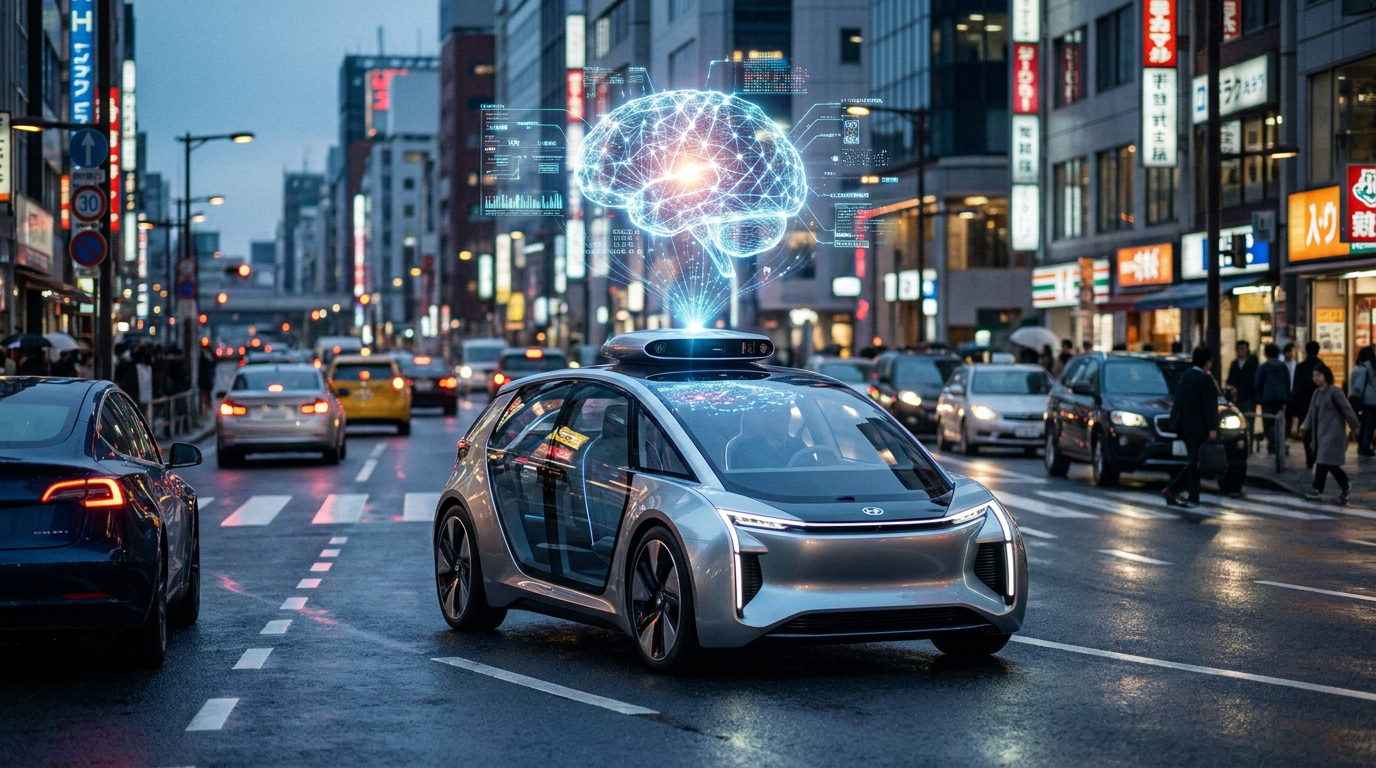
Now, a radical paradigm shift is sweeping the automotive world. Companies are throwing out the rulebooks and replacing them with "end-to-end" neural networks. In this new architecture, known as AV 2.0, raw sensor data flows directly into a massive artificial intelligence model, which instantly outputs steering, acceleration, and braking commands. There are no intermediate modules and no hard-coded "if-then" statements.[1][4]

"The result is an end-to-end solution that learns from experience to drive in any environment," explains Wayve, a London-based pioneer of the AV 2.0 approach. Instead of being programmed by engineers, these systems learn by ingesting millions of hours of human driving video, discovering the implicit rules of the road on their own.[1]
The shift mirrors the recent breakthroughs in generative AI. Just as large language models like ChatGPT learned to write by processing vast amounts of text, end-to-end driving models learn to navigate by processing vast amounts of video. They develop an intuitive, "embodied" intelligence that allows them to generalize their skills to entirely new cities and unfamiliar situations without needing a software update or a high-definition map.[1][6]
The financial momentum behind this shift is staggering. The global market for end-to-end neural network autonomous driving systems reached an estimated $1.5 billion in 2025 and is projected to surge to nearly $9.8 billion by 2033. Automakers and tech giants are racing to secure their position in this new ecosystem, recognizing that software intelligence is now the primary differentiator in the automotive space.[2]

Tesla has been a highly visible proponent of this approach, transitioning its Full Self-Driving (FSD) software to an end-to-end neural network starting with version 12. By mapping camera inputs directly to driving controls, Tesla dramatically reduced its reliance on traditional planning stacks, allowing the vehicle's behavior to become smoother and more human-like.[2][5]
Tesla has been a highly visible proponent of this approach, transitioning its Full Self-Driving (FSD) software to an end-to-end neural network starting with version 12.
But the AV 2.0 movement extends far beyond a single automaker. Wayve recently secured a massive $1.2 billion Series D investment backed by Nvidia, Microsoft, and Uber. The startup is partnering with traditional automakers like Nissan to integrate its AI driver into mass-market vehicles, and plans to launch fully autonomous robotaxi trials in London and Tokyo in late 2026.[3]
To train these massive neural networks, developers are relying heavily on "world models." These are sophisticated AI systems that simulate realistic driving environments and physics, allowing the driving AI to practice in a virtual world. Wayve's GAIA-3 model, for instance, can generate synthetic video of complex traffic scenarios based on text prompts.[3][5]

This synthetic training enables the AI to learn how to handle rare edge cases—like a cyclist swerving unexpectedly or a chaotic construction zone—without having to encounter them on real roads. Furthermore, researchers are utilizing reinforcement learning to fine-tune these models, rewarding the AI for safe, smooth driving in simulation so it continuously optimizes its behavior.[5]
Despite the rapid technical progress, the end-to-end approach faces a formidable hurdle: the "black box" problem. Because a single neural network handles everything from perception to action, it is incredibly difficult to pinpoint exactly why the AI made a specific decision. If an AV 1.0 car brakes unexpectedly, engineers can check the perception module to see if it hallucinated an obstacle. In an AV 2.0 car, the reasoning is buried within billions of mathematical weights.[4][5]
This lack of interpretability poses a major challenge for regulatory approval. "How can a company prove that its autonomous systems are safe and in line with regulations when it is an end-to-end network?" notes an analysis by the Edge AI and Vision Alliance. Legislation like the EU Artificial Intelligence Act demands traceability and explainability, requirements that pure neural networks currently struggle to meet.[4]

To bridge this gap, some researchers are developing hybrid systems. These architectures use end-to-end deep learning for the bulk of the driving tasks but retain deterministic, hard-coded algorithms for critical safety guardrails and route planning. Others are integrating language models that force the driving AI to narrate its decision-making process in real-time, providing a window into its "thought process."[4][5]
The transition to AV 2.0 represents the most significant leap in autonomous vehicle technology in a decade. By treating driving as a data-driven AI problem rather than a rigid software engineering problem, the industry has unlocked a path to scalable, adaptable autonomy that can finally handle the chaos of the real world.[6]
The next 24 months will be the ultimate proving ground. As end-to-end systems move from closed test tracks to public roads in major global cities, they will test not only the limits of artificial intelligence but also the readiness of society to hand the wheel over to a machine that learns exactly like a human.[3][6]
How we got here
2017
Wayve is founded with a contrarian vision to use end-to-end deep learning instead of modular robotics stacks.
2024
Tesla rolls out FSD v12, transitioning its driver-assistance system to an end-to-end neural network.
Early 2026
Wayve secures a $1.2 billion Series D investment to scale its AV 2.0 technology globally.
Late 2026
Scheduled launch of end-to-end robotaxi trials in London and Tokyo by Wayve, Uber, and Nissan.
Viewpoints in depth
End-to-End Pioneers
Argue that single neural networks trained on massive data are the only scalable path to full autonomy.
Proponents of AV 2.0, including Wayve and Tesla, argue that the real world is too complex to be captured by hand-coded rules. They believe that scaling laws—the principle that AI models get exponentially better as you feed them more data and compute power—apply just as much to driving as they do to language models. By relying on self-supervised learning and massive fleets collecting video data, they argue that end-to-end systems will soon surpass human driving capabilities in any environment, without the need for expensive high-definition mapping.
Hybrid Architecture Advocates
Believe neural networks must be paired with hard-coded rules to ensure safety and reliability.
Many traditional automotive engineers and safety researchers caution against handing complete control to a single neural network. They advocate for a hybrid approach where deep learning handles complex perception tasks, but deterministic, hard-coded algorithms remain in charge of route planning and emergency braking. This camp argues that while AI is excellent at pattern recognition, it lacks the logical reasoning required to guarantee safety in edge cases, making traditional software guardrails a permanent necessity.
Regulators & Safety Auditors
Demand traceability and explainability for driving decisions, questioning the legality of black-box AI.
As end-to-end systems move toward commercial deployment, regulatory bodies are raising red flags over the 'black box' nature of the technology. Under frameworks like the EU Artificial Intelligence Act, companies must be able to trace and explain the decisions made by their AI systems. Safety auditors argue that if an autonomous vehicle causes an accident, investigators must be able to determine exactly what went wrong—a standard that pure neural networks currently struggle to meet, potentially delaying their widespread legal approval.
What we don't know
- Whether pure end-to-end networks will ever be able to fully satisfy the explainability requirements of global regulators.
- How quickly traditional automakers can transition away from their legacy AV 1.0 investments to adopt the new architecture.
Key terms
- AV 1.0
- The traditional approach to autonomous driving using hand-coded, modular software stacks and high-definition maps.
- AV 2.0
- A next-generation approach that uses a single, end-to-end neural network to translate raw sensor data directly into driving actions.
- End-to-End Learning
- A machine learning process where a model learns to map inputs (like video) directly to outputs (like steering) without intermediate steps.
- World Model
- An AI system that simulates realistic environments and physics, allowing driving models to train safely in virtual scenarios.
- Embodied AI
- Artificial intelligence that interacts with and learns from the physical world, rather than just processing digital text or images.
Frequently asked
What is the difference between AV 1.0 and AV 2.0?
AV 1.0 relies on human-engineered rules and separate modules for tasks like perception and planning. AV 2.0 uses a single neural network that learns to drive entirely from data.
Do AV 2.0 vehicles need high-definition maps?
No. Because they learn to understand their environment dynamically, end-to-end systems can navigate unmapped roads and new cities without prior geographic data.
Why are regulators concerned about end-to-end AI?
End-to-end neural networks are often 'black boxes,' making it difficult for engineers to explain exactly why the AI made a specific driving decision in the event of a crash.
When will this technology be on the road?
Tesla's FSD v12 already utilizes end-to-end architecture, and companies like Wayve are launching fully autonomous robotaxi trials in major cities in late 2026.
Sources
Source coverage
6 outlets
3 viewpoints surfaced






[1]WayveEnd-to-End Pioneers
What is AV2.0?
Read on Wayve →[2]Global Market InsightsEnd-to-End Pioneers
End-to-End Neural Network Autonomous Driving System Market Size
Read on Global Market Insights →[3]Counterpoint ResearchRegulators & Safety Auditors
Wayve's AV2.0 and Robotaxi Rollout
Read on Counterpoint Research →[4]Edge AI and Vision AllianceHybrid Architecture Advocates
Is End-to-end the Endgame for Level 4 Autonomy?
Read on Edge AI and Vision Alliance →[5]arXivRegulators & Safety Auditors
Causality of End-to-End Autonomous Driving
Read on arXiv →[6]Factlen Editorial Team
Synthesis by Factlen editorial team
Read on Factlen Editorial Team →
Every angle. Every day.
Get automotive stories with full source coverage and perspective breakdowns delivered to your inbox.