
Psychobiotics: How Gut Bacteria Influence Mental Health Through Diet
Emerging research reveals that the trillions of microbes in the human digestive system act as a 'second brain,' producing neurotransmitters and regulating inflammation. By targeting the gut-brain axis with specific foods and 'psychobiotics,' scientists are developing new adjunctive treatments for depression and anxiety.
By Factlen Editorial Team
- Microbiome Researchers
- Focuses on the molecular mechanisms, clinical trials, and precision medicine applications of gut-brain science.
- Public Health Dietitians
- Emphasizes the role of whole-food dietary patterns and practical lifestyle interventions in supporting mental health.
- Integrative Health Analysts
- Synthesizes emerging therapies and evaluates psychobiotics as adjunctive treatments within broader care models.
What's not represented
- · Patients with severe treatment-resistant depression seeking alternative therapies
- · Gastroenterologists treating the physical symptoms of gut-brain dysregulation
Why this matters
Understanding the gut-brain connection empowers individuals to actively support their mental well-being through daily food choices. It also opens the door to personalized, non-pharmacological therapies for millions suffering from depression and anxiety.
Key points
- The gut microbiome contains trillions of bacteria that act as a 'second brain,' producing essential neurotransmitters like serotonin and GABA.
- Psychobiotics are specific strains of live bacteria and prebiotics that confer measurable mental health benefits.
- Gut bacteria communicate with the brain via the vagus nerve, short-chain fatty acids, and the regulation of stress hormones.
- Western diets high in ultra-processed foods reduce microbial diversity and increase inflammation, elevating depression risks.
- Clinical trials show psychobiotics offer moderate benefits for depression, primarily as an adjunctive therapy alongside traditional treatments.
- Future psychiatric care may use precision medicine to prescribe specific bacterial strains based on a patient's unique microbiome profile.
The human digestive tract is increasingly referred to by scientists as the "second brain," hosting a complex ecosystem of microorganisms that do far more than simply break down food. For decades, these bacteria were viewed strictly through the lens of digestion and physical health. Today, a rapidly expanding body of research demonstrates that they operate as a vast chemical factory, profoundly influencing mood, stress levels, and cognitive function.[5][6]
The scale of this internal ecosystem is staggering. The gut microbiome consists of an estimated 100 trillion microbes, outnumbering human cells and containing vastly more genetic material than the human genome itself. As researchers map this microscopic world, they are uncovering the precise biological mechanisms that link what we eat directly to how we feel.[5]
At the center of this scientific frontier is the concept of "psychobiotics." Broadly defined, psychobiotics are live microorganisms (probiotics) and the specific dietary fibers that feed them (prebiotics) which, when ingested in adequate amounts, confer measurable mental health benefits to the host.[2][3]
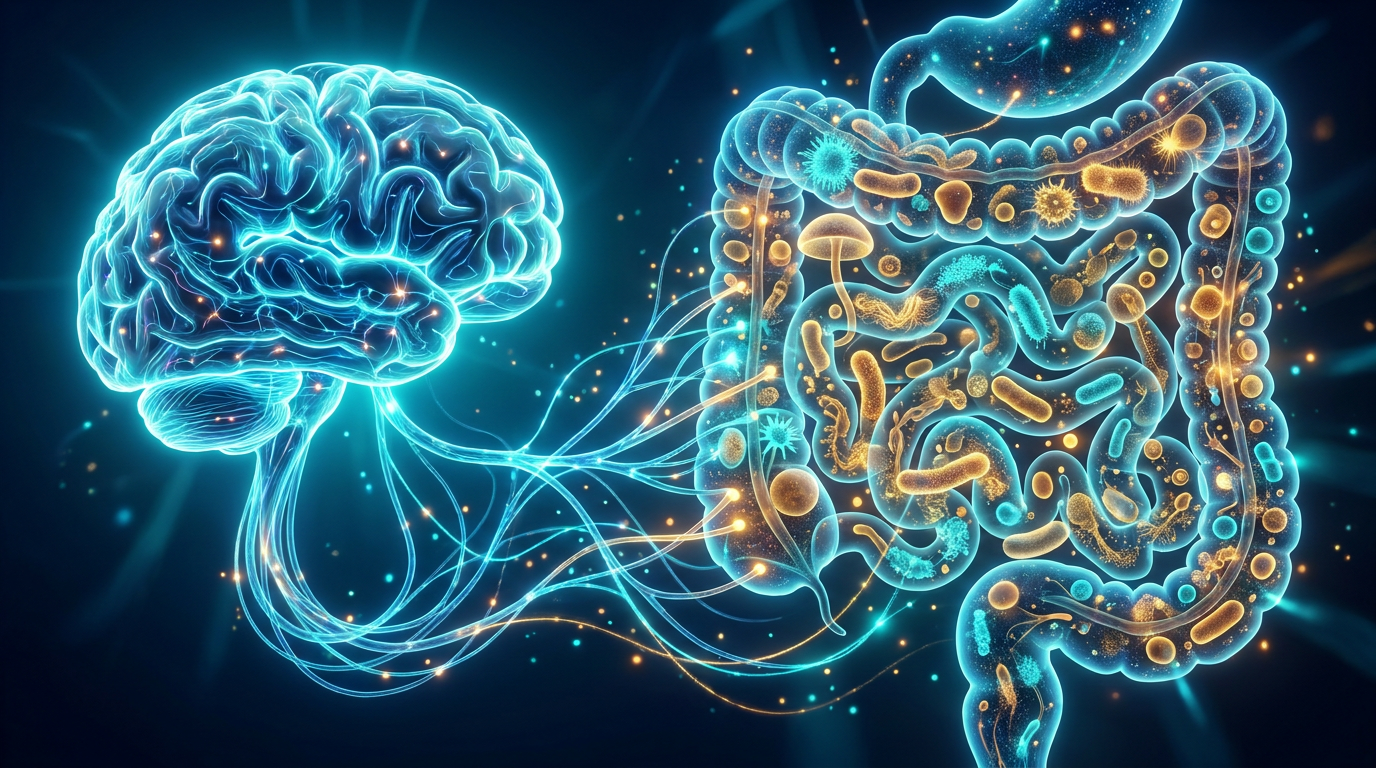
The communication highway enabling this relationship is known as the microbiota-gut-brain axis. This bidirectional network connects the enteric nervous system of the gut directly to the central nervous system of the brain, utilizing neural, immune, endocrine, and metabolic pathways to transmit signals back and forth constantly.[3]

One of the primary physical routes for this communication is the vagus nerve, a long cranial nerve that acts as a high-speed data cable between the abdomen and the brain. Gut-derived microbial signals travel up the vagus nerve to influence the amygdala—the brain's emotional processing center—modulating neuronal excitability and emotional reactivity to stress.[3]
Remarkably, gut bacteria are also capable of synthesizing major neurotransmitters. Certain strains of Lactobacillus and Bifidobacterium produce gamma-aminobutyric acid (GABA), dopamine, and precursors to serotonin. In fact, scientists estimate that the vast majority of the body's serotonin—a key hormone that stabilizes our mood, feelings of well-being, and happiness—is produced in the gastrointestinal tract, heavily influenced by microbial activity.[2][3][4]
Beyond neurotransmitters, the by-products of bacterial digestion play a crucial role in brain health. When gut bacteria ferment dietary fiber, they produce short-chain fatty acids (SCFAs). These SCFAs are essential for maintaining the integrity of the intestinal barrier, preventing "leaky gut," and reducing systemic inflammation across the body—a condition increasingly recognized as a core biological driver of clinical depression.[1][4]
Beyond neurotransmitters, the by-products of bacterial digestion play a crucial role in brain health.
Psychobiotics also regulate the hypothalamic-pituitary-adrenal (HPA) axis, the system governing the body's physiological response to stress. By lowering the secretion of cortisol and other stress hormones, a balanced and diverse microbiome can foster biological resilience against chronic occupational and psychological stress.[3]
Because the microbiome is highly responsive to what we consume, diet emerges as one of the most influential and readily modifiable determinants of mental health. The foods we eat dictate which bacterial populations thrive and which starve, directly altering the chemical signals sent to the brain.[1]
Western dietary patterns—characterized by high intakes of ultra-processed foods, saturated fats, and refined carbohydrates—are consistently associated with reduced microbial diversity. This dietary-induced dysbiosis depletes SCFA-producing bacteria, increases intestinal permeability, and triggers chronic low-grade inflammation, significantly elevating the risk for depression and anxiety disorders.[1][4]

Conversely, diets rich in fiber, colorful plant foods, and fermented products promote a robust and diverse microbiome. Foods rich in prebiotics, such as garlic, onions, asparagus, and bananas, provide the necessary fuel for beneficial bacteria. Meanwhile, probiotic foods like yogurt, kefir, and kimchi introduce live beneficial strains directly into the gut ecosystem.[4]
The clinical application of this science is showing tangible promise. Systematic reviews and meta-analyses of randomized controlled trials indicate that targeted probiotic interventions can yield consistent, moderate benefits for individuals diagnosed with major depressive disorder, often within a four to twelve-week timeframe.[2]
Rather than replacing traditional psychiatric medications, psychobiotics are currently viewed by the medical community as a powerful adjunctive treatment. They offer a highly favorable safety profile and may be particularly beneficial for patients with treatment-resistant depression or those who experience severe side effects from standard pharmacological agents.[2][6]
The evidence for anxiety and stress, however, remains more heterogeneous. While some human trials report significant improvements in panic, worry, and negative mood regulation, others show limited effects, particularly in healthy populations with low baseline stress levels. The complexity of anxiety disorders makes them harder to treat with broad-spectrum probiotics.[3]

Translating preclinical success in animal models to human populations remains a notoriously difficult challenge. The efficacy of a psychobiotic intervention depends heavily on the specific bacterial strain used, the dosage, the delivery method, and the individual's baseline microbiome composition.[2][3]
To overcome these hurdles, researchers are moving rapidly toward precision medicine. Future psychiatric care may involve analyzing a patient's stool or blood biomarkers to identify specific microbial deficits. This would allow clinicians to prescribe targeted psychobiotic strains tailored to the individual's unique biological profile, rather than relying on generic, over-the-counter supplements.[5][6]
While psychobiotics are not a standalone cure for severe psychiatric conditions, the science of the gut-brain axis represents a profound paradigm shift in mental health care. By recognizing the intimate partnership between what we eat and how we feel, individuals are empowered with a daily, accessible tool to actively support their psychological well-being.[4][6]
How we got here
Early 2000s
The concept of the microbiota-gut-brain axis begins to gain significant traction in neuroscience and gastroenterology.
2013
The term 'psychobiotics' is coined to describe live organisms that produce a health benefit in patients suffering from psychiatric illness.
2019
Large-scale population studies confirm strong links between specific gut bacteria depletion and the incidence of depression.
2024–2026
Clinical trials increasingly focus on precision medicine, attempting to match specific bacterial strains to individual patient biomarkers.
Viewpoints in depth
Microbiome & Neuroscience Researchers
Scientists focused on mapping the exact metabolic pathways between gut bacteria and the brain.
This camp argues that while the gut-brain connection is undeniable, the field must move beyond broad dietary advice and toward precision medicine. They emphasize the need to identify specific bacterial strains (like certain Lactobacillus species) and map exactly how they produce neuroactive metabolites. Their ultimate goal is to develop targeted psychobiotic therapies based on individual patient biomarkers, rather than relying on over-the-counter commercial probiotics which often lack clinical efficacy.
Public Health Dietitians
Nutrition professionals advocating for broad, accessible dietary shifts to improve population mental health.
Rather than waiting for precision psychobiotic pills, this perspective emphasizes that we already have the tools to modulate the gut microbiome: food. They argue that public health initiatives should focus on reducing the intake of ultra-processed foods and increasing dietary fiber. By promoting a Mediterranean-style diet rich in prebiotics and fermented foods, they believe we can achieve significant, population-wide reductions in systemic inflammation and associated depressive symptoms.
Clinical Psychiatrists
Medical professionals evaluating psychobiotics as part of a comprehensive psychiatric treatment plan.
Psychiatrists approach psychobiotics with cautious optimism. While they acknowledge the promising data showing moderate benefits for depression, they stress that psychobiotics are not a replacement for traditional antidepressants or cognitive behavioral therapy. Instead, they view gut-directed therapies as a valuable adjunctive treatment—particularly useful for patients with treatment-resistant depression or those highly sensitive to the side effects of standard psychiatric medications.
What we don't know
- Which specific combinations of bacterial strains are most effective for different subtypes of clinical depression.
- How long the mental health benefits of a psychobiotic intervention last after the supplementation or dietary change stops.
- Why psychobiotics show consistent benefits for depression but highly mixed and heterogeneous results for anxiety disorders.
Key terms
- Psychobiotics
- Live microorganisms (probiotics) or prebiotics that confer mental health benefits when consumed in adequate amounts.
- Microbiota-Gut-Brain Axis
- The bidirectional communication network linking the enteric nervous system of the gut with the central nervous system of the brain.
- Short-Chain Fatty Acids (SCFAs)
- Beneficial by-products created when gut bacteria ferment dietary fiber, known to reduce systemic inflammation.
- Dysbiosis
- An imbalance in the gut microbial community, often characterized by a loss of diversity and an increase in pro-inflammatory bacteria.
- Vagus Nerve
- A major cranial nerve that serves as a direct physical communication highway between the gut and the brain.
Frequently asked
Can eating yogurt cure depression?
No. While probiotic foods like yogurt support overall brain health and can be a helpful adjunctive therapy, they are not a standalone cure for clinical depression.
What is the difference between prebiotics and probiotics?
Prebiotics are dietary fibers that feed the beneficial bacteria already in your gut, while probiotics are the live beneficial bacteria themselves.
How quickly can diet change the gut microbiome?
Research shows that the gut microbiome can begin to alter its composition within just a few days of a major dietary shift, though lasting benefits require long-term habitual changes.
Are all probiotic supplements considered psychobiotics?
No. Only specific strains of bacteria, such as certain Lactobacillus and Bifidobacterium species, have been clinically shown to produce neuroactive compounds that affect the brain.
Sources
Source coverage
6 outlets
3 viewpoints surfaced






[1]MDPIMicrobiome Researchers
Dietary Modulation of the Gut Microbiome and its Implications for Mental Health
Read on MDPI →[2]National Institutes of HealthMicrobiome Researchers
Psychobiotics and the gut-brain axis: advances in metabolite quantification
Read on National Institutes of Health →[3]Frontiers in PsychiatryMicrobiome Researchers
Psychobiotics regulate the gut–brain axis through microbial metabolites
Read on Frontiers in Psychiatry →[4]Food & Mood CentrePublic Health Dietitians
Diet, the Gut Microbiome, and Mental Health
Read on Food & Mood Centre →[5]National Health and Medical Research CouncilMicrobiome Researchers
The Diet, Gut and Brain Group
Read on National Health and Medical Research Council →[6]Factlen Editorial TeamIntegrative Health Analysts
Synthesis by Factlen editorial team
Read on Factlen Editorial Team →


Every angle. Every day.
Get health stories with full source coverage and perspective breakdowns delivered to your inbox.