
How AI and Markerless Motion Capture Are Engineering Injuries Out of Sports
Advanced computer vision is moving biomechanics out of the lab and onto the field, allowing teams to track skeletal fatigue in real-time and predict non-contact injuries before they happen.

For decades, the gold standard of sports biomechanics looked more like a science fiction experiment than an athletic endeavor. To understand how a pitcher threw a baseball or how a sprinter exploded off the blocks, athletes had to visit specialized laboratories. There, technicians would glue dozens of reflective ping-pong-ball-sized markers to their joints, dress them in restrictive suits, and ask them to perform highly dynamic movements on a sterile treadmill.
While this passive marker-based motion capture provided highly accurate kinematic data, it suffered from a fatal flaw: it was fundamentally unnatural. Athletes rarely move in a laboratory exactly as they do in the chaotic, high-stakes environment of a live game. Furthermore, the sheer cost and time required to set up these assessments meant they were used sparingly, offering only a brief snapshot of an athlete's physical condition rather than a continuous monitor of their health.[2]
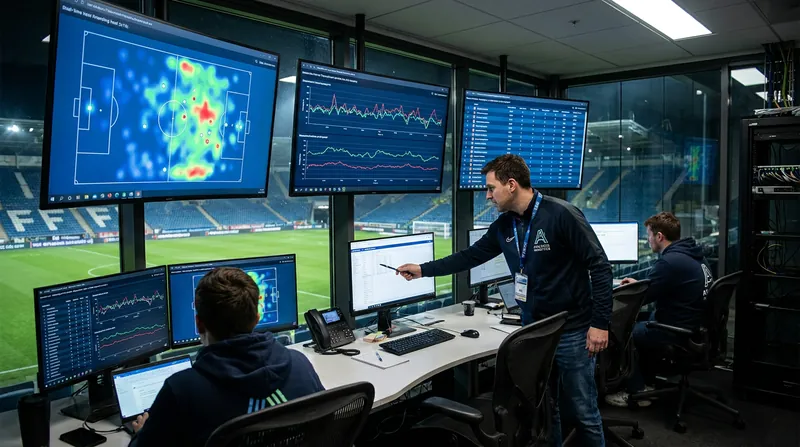
In 2026, the laboratory has officially moved to the field. A rapid convergence of artificial intelligence, advanced computer vision, and high-speed optical tracking has ushered in the era of "markerless" motion capture. This technology allows sports scientists to gather clinical-grade biomechanical data directly from live broadcasts and stadium cameras, entirely eliminating the need for wearable sensors or reflective markers.
Systems like Hawk-Eye's SkeleTRACK and Precision Sports Technology's KinetikIQ are now deployed across major professional leagues, silently mapping the skeletal movements of every player on the pitch, court, or diamond in real-time. By capturing human movement exactly where and when it happens, teams are unlocking an unprecedented understanding of athletic performance and, most importantly, pioneering a proactive approach to injury prevention that is extending careers and saving franchises millions.
The mechanism behind markerless motion capture relies on a sophisticated interplay between hardware and deep learning. In a typical professional setup, an array of high-resolution, high-frame-rate cameras is positioned around the stadium, capturing the action from multiple overlapping angles. Instead of looking for physical markers, the system feeds these raw video streams into artificial intelligence models trained on vast datasets of human anatomy.
These pose-estimation algorithms instantly identify and track dozens of key skeletal points on an athlete's body—mapping the exact position of the ankles, knees, hips, shoulders, and elbows up to hundreds of times per second. The AI can even track the center of mass and the orientation of the trunk, providing a complete three-dimensional recreation of the athlete's skeletal structure as they sprint, jump, or tackle.
What makes this technology truly revolutionary is the analytical layer applied on top of the raw skeletal data. Contemporary predictive models utilize advanced neural network architectures, such as CNN-xLSTM hybrids and attention-enhanced frameworks, to process the continuous stream of biomechanical information. These models do not just record movement; they understand it.
They can calculate joint flexion angles, measure hip-shoulder separation, and even estimate the invisible ground reaction forces an athlete absorbs when landing from a rebound. According to comprehensive research published in the International Journal of Artificial Intelligence, these multimodal AI systems can now classify athletic movements with over 93% accuracy and forecast potential injury risks with a staggering 95% accuracy under optimal conditions.[1]
The primary target for these predictive systems is the non-contact injury—the devastating ACL tears, Achilles ruptures, and hamstring strains that often occur without any collision. Sports medical professionals have long known that these injuries are rarely freak accidents; they are usually the final breaking point of a gradual, microscopic degradation in an athlete's biomechanics.
When a player becomes fatigued, their form subtly shifts. A basketball player might begin landing with slightly less knee flexion, transferring more shock to the ligaments. A soccer player might alter their stride length by a fraction of an inch to compensate for a tight hamstring. To the naked eye of a coach on the sideline, these microscopic compensations are entirely invisible.
To an AI processing skeletal data at 120 frames per second, however, these compensations are glaring red flags. By continuously monitoring an athlete throughout the season, the markerless motion capture system establishes a highly personalized biomechanical baseline for every individual on the roster.
The moment an athlete's movement patterns deviate from their established norm—perhaps their acceleration profile drops, or their joint load distribution becomes asymmetrical—the system alerts the team's medical staff. This transforms injury management from a reactive scramble into a proactive intervention. Coaches can adjust a player's minutes, mandate specific recovery protocols, or prescribe targeted strengthening exercises before the underlying fatigue manifests as a catastrophic tissue failure.
The real-world impact of this technology is already reshaping professional sports seasons. In one prominent case study, a leading NBA franchise implemented an AI-powered biomechanical analysis system to track player movements during both practices and live games. By identifying specific movement inefficiencies and addressing them through targeted load management and corrective training, the team reported a remarkable 37% reduction in non-contact lower-body injuries over a two-season span.
In Major League Baseball, where pitcher arm health is a multi-million dollar variable, teams utilize stadium-wide optical tracking to monitor elbow torque and shoulder fatigue pitch by pitch, pulling starters the moment their mechanics show dangerous signs of degradation.
Despite the rapid adoption and undeniable successes, the transition to markerless biomechanics is not without its scientific uncertainties. Clinical researchers note that while AI-driven optical tracking is exceptional for general kinematics and early warning systems, it still faces challenges in highly complex, obscured environments—such as a rugby scrum or a crowded penalty box—where cameras cannot maintain a clear line of sight on a player's limbs.
Furthermore, a 2026 study published in Frontiers in Physiology highlighted that for highly sensitive return-to-play assessments following a major surgery, traditional wearable sensors and force plates still hold a slight edge in predicting exact re-injury risks, as they measure direct physiological outputs rather than estimating them from video.
Beyond the technical hurdles, the explosion of markerless motion capture has ignited complex ethical and legal debates regarding data privacy and ownership. An AI system that tracks an athlete's skeletal degradation is essentially generating a highly predictive medical profile. Player unions and privacy advocates are increasingly raising concerns about who controls this data.
If a team's AI predicts that a star player has a 70% chance of a major knee injury within the next two years based on their biomechanical trends, could that data be weaponized during contract negotiations to lower their salary? Establishing clear regulatory frameworks for the ethical use, storage, and sharing of predictive biomechanical data remains one of the most pressing challenges for the sports technology industry.[1][3]
The utility of markerless AI extends far beyond the moment of injury prevention; it is also revolutionizing the grueling process of athletic rehabilitation. Historically, clearing an athlete to return to the field relied heavily on subjective physical therapy assessments and standardized strength tests. Today, rehabilitation protocols are increasingly guided by continuous biomechanical monitoring.
As an athlete recovers from an ACL reconstruction, AI systems track their gait symmetry, range of motion, and dynamic balance during functional exercises. This objective, quantitative feedback ensures that the athlete is not merely pain-free, but that they have genuinely restored their pre-injury movement mechanics, drastically reducing the notoriously high rates of secondary re-injuries.[1]
The next frontier for sports biomechanics lies in the concept of federated learning and massive cross-organizational datasets. Currently, most predictive models are siloed, trained only on the data generated by a single team or league. However, researchers are exploring privacy-preserving AI frameworks that would allow algorithms to learn from the biomechanical data of thousands of athletes globally without exposing any individual's private medical information. As these models ingest more diverse movement patterns across different sports, body types, and playing surfaces, their predictive accuracy will continue to climb.[1][3]
Looking ahead, the most profound impact of AI-driven motion capture may not be in the professional leagues, but in the democratization of sports science. While early iterations required hundreds of thousands of dollars in stadium infrastructure, the underlying computer vision models are becoming increasingly lightweight and accessible.
Startups are now deploying markerless motion analysis through standard smartphone cameras and portable LiDAR scanners, allowing high school coaches and amateur physical therapists to conduct clinical-grade biomechanical assessments on the sidelines of a public park. By bringing elite injury prevention tools to the grassroots level, this technology has the potential to safeguard millions of young athletes from preventable overuse injuries, fundamentally changing the landscape of youth sports health.[3]
The essentials
- Markerless motion capture uses AI and stadium cameras to track athlete biomechanics without wearable sensors.
- The technology detects microscopic form degradations caused by fatigue, which are invisible to the naked eye.
- By identifying these compensations early, medical staff can intervene before a catastrophic non-contact injury occurs.
- Advanced predictive models can now forecast potential injury risks with up to 95% accuracy.
- The technology is expanding from professional stadiums to smartphone apps, democratizing access for youth sports.
- Debates are emerging over who owns an athlete's highly predictive biomechanical data and how it can be used.
Timeline
Pre-2010s
Sports biomechanics relies heavily on sterile laboratory environments using restrictive, passive marker-based motion capture suits.
2019
Hawk-Eye releases early versions of SkeleTRACK, beginning the transition toward real-time skeletal tracking in live professional broadcasts.
2023
The NBA partners with optical tracking providers to supply real-time skeletal data for all 30 teams, accelerating load management analytics.
2025
Startups like Precision Sports Technology begin democratizing the technology, utilizing LiDAR and AI to offer markerless capture outside of professional stadiums.
2026
Multimodal AI architectures achieve up to 95% accuracy in forecasting injury risk, cementing markerless capture as the new standard in sports medicine.
- Team Medical Staff
- Focus on the practical application of load management and the ability to intervene before a catastrophic non-contact injury occurs.
- Sports Biomechanists
- Value the ability to capture natural, in-game movement data without altering athlete mechanics through restrictive lab equipment.
- AI Technology Developers
- Highlight the rapid advancements in computer vision and neural networks that make sub-second, multi-person tracking possible.
- Athlete Privacy Advocates
- Raise concerns about data ownership, consent, and how hyper-detailed predictive medical profiles might be used in contract negotiations.
Perspectives this story doesn't cover
- Youth sports coaches
- Sports insurance actuaries
Sources
Source coverage
3 outlets
4 viewpoints surfaced



- [1]International Journal of Artificial IntelligenceAI Technology Developers
AI Predictive Model Architectures in Sports Biomechanics
Read on International Journal of Artificial Intelligence → - [2]Journal of Sports SciencesSports Biomechanists
Examining the concurrent validity of markerless motion capture in team sports
Read on Journal of Sports Sciences → - [3]Factlen Editorial TeamAthlete Privacy Advocates
Synthesis by Factlen editorial team
Read on Factlen Editorial Team →
More in Sports
See all →Salary Cap
NBA Free Agency Spending Tiers Revealed as New CBA Rules Reshape Offseason Flexibility
4 sources

Sports Business
Leagues Abandon Traditional Media Rights Model for Equity Partnerships to Control Data and Distribution
4 sources

Soccer Analytics
Beyond Expected Goals: How 'Expected Threat' is Rewiring Soccer Analytics
3 sources

Baseball Biomechanics
How Invisible AI Cameras Are Solving Baseball's Pitching Injury Epidemic
4 sources

Comments
Every angle. Every day.
Get Sports stories with full source coverage and perspective breakdowns, free every day.