
The Evidence for Agrivoltaics: How Dual-Use Solar is Transforming Farmland
By co-locating solar panels and agriculture on the same land, agrivoltaic systems are proving they can boost crop yields, save massive amounts of water, and generate clean energy simultaneously.
By Factlen Editorial Team
- Agricultural Advocates
- Prioritize keeping prime farmland in active food production and protecting rural economies.
- Clean Energy Developers
- Prioritize rapid deployment of solar capacity and overcoming local zoning opposition.
- Resource Researchers
- Prioritize the ecological efficiency and water-saving benefits of the water-energy-food nexus.
What's not represented
- · Local Zoning Boards
- · Traditional Commodity Crop Farmers
Why this matters
The transition to renewable energy requires millions of acres of land, threatening to displace vital food production. Agrivoltaics solves this zero-sum conflict, offering a scalable way to protect rural economies, conserve water, and accelerate clean energy deployment all at once.
Key points
- Agrivoltaics allows farmers to generate solar energy and grow crops on the same land.
- The microclimate created by solar panels reduces water evaporation by 20% to 40%.
- Shade-tolerant crops like lettuce and tomatoes see yield increases of up to 18%.
- New state policies are allowing agrivoltaic farms to retain agricultural tax benefits.
- The global agrivoltaics market is projected to reach $182 billion by 2034.
The transition to renewable energy has a fundamental math problem: it requires vast amounts of physical space. The U.S. Department of Energy projects that achieving a 40% solar energy mix by 2035 will require approximately 5.7 million acres of land, much of which overlaps with prime agricultural real estate.[1]
For years, this land requirement created a zero-sum conflict between clean energy developers and rural farming communities, with local zoning boards frequently rejecting solar projects to protect local food supplies. But a rapidly maturing approach known as "agrivoltaics"—the co-location of solar panels and agriculture on the exact same plot of land—is transforming this dynamic from a competition into a symbiosis.[1][7]
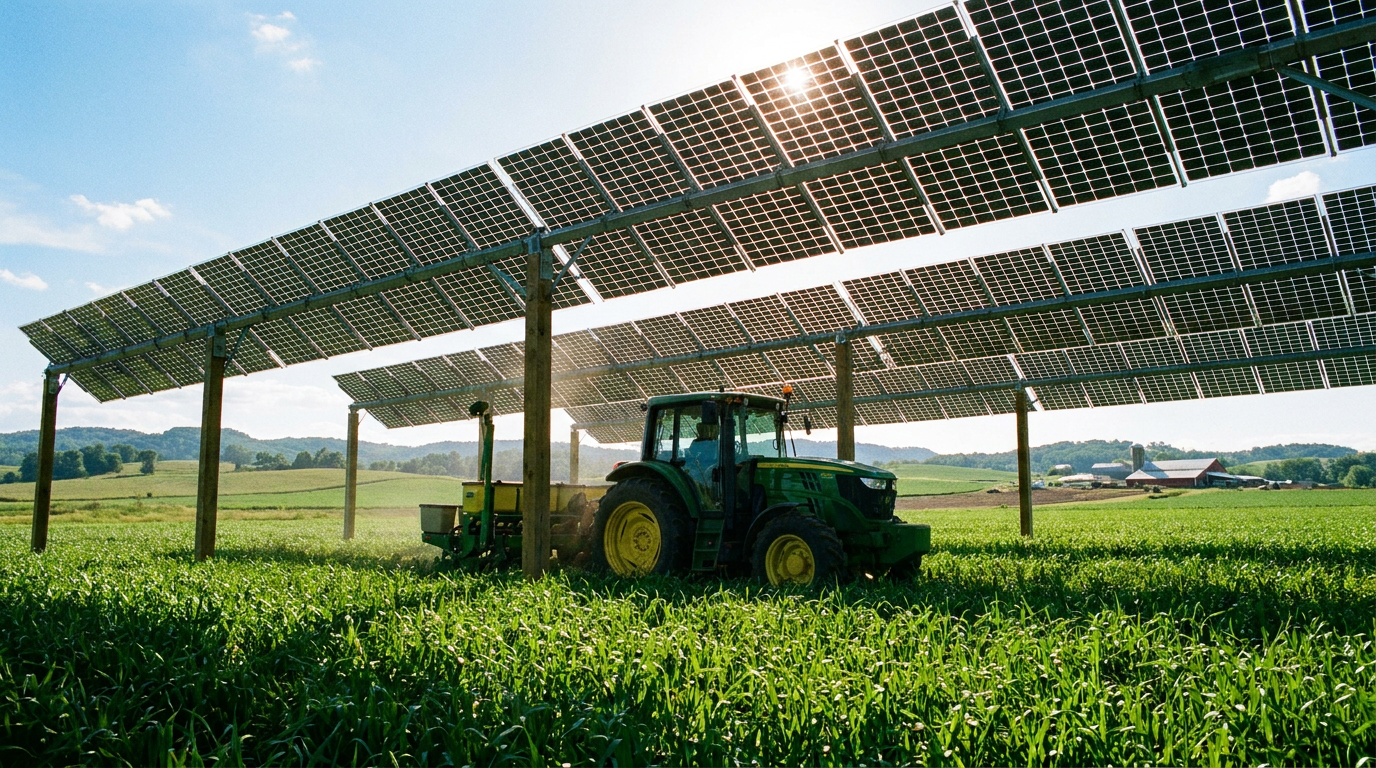
By elevating solar arrays and spacing them strategically, farmers can cultivate crops, maintain pollinator habitats, or graze livestock directly beneath the panels. The empirical evidence gathered over the last five years demonstrates that this dual-use model not only preserves agricultural output but, in many specific scenarios, actively enhances it.[3][4]
The most robust evidence for agrivoltaics centers on its impact on the water-energy-food nexus, particularly in arid and semi-arid regions. Solar panels create a distinct microclimate underneath them, shielding plants from the harshest midday sun and significantly lowering peak soil temperatures.[4]

Data from the Semi-arid Lab for Scaling Agrivoltaics (SALSAV) reveals that this shading reduces evapotranspiration—the process by which water is transferred from the land to the atmosphere—by 20% to 40%. In water-stressed agricultural basins facing historic droughts, this translates to massive irrigation savings and increased drought resilience.[4]
Furthermore, the relationship is mutually beneficial. The transpiration from the crops actually cools the underside of the solar panels. Because photovoltaic cells lose efficiency when they overheat, this localized cooling effect can boost electricity generation by 1% to 3% compared to panels installed over bare dirt or gravel.[1][4]
When it comes to crop yields, the evidence is highly crop-specific, requiring transparent agronomic planning. A 2026 comprehensive review published in Renewable and Sustainable Energy Reviews synthesized global pilot data, revealing a clear divide between shade-tolerant and sun-hungry plants.[3]
For C3 plants—such as lettuce, tomatoes, peppers, and berries, which evolved in forest understories—the partial shade provided by solar panels reduces heat stress and prevents sun-scald. Field trials consistently show yield increases of 8% to 18% for these crops when grown in agrivoltaic systems.[3][4]
Field trials consistently show yield increases of 8% to 18% for these crops when grown in agrivoltaic systems.
Conversely, C4 plants like corn, wheat, and soybeans, which require full, intense sunlight for efficient photosynthesis, typically see yield reductions of 25% to 40% under standard panel configurations. This means agrivoltaics is not a universal replacement for all traditional farming, but rather a specialized tool for specific agricultural profiles.[3][7]
When the right crops are paired with solar generation, the overall efficiency of the land skyrockets. Researchers measure this using the Land Equivalent Ratio (LER). Studies consistently show agrivoltaic LERs between 1.35 and 1.73, meaning a 100-acre agrivoltaic farm produces the same combined food and energy output as 135 to 173 acres of separated farmland and solar facilities.[1][3]
The economic implications of this efficiency are staggering. A 2026 market analysis by Fortune Business Insights projects the global agrivoltaics market will grow from $20.29 billion this year to over $182 billion by 2034, driven by technological maturity and shifting government subsidies.[6]

At the macro level, the Renewable and Sustainable Energy Reviews study estimates that maximizing agrivoltaic potential globally could add 1,800 million tonnes to global crop yields annually, generating over $1 trillion in added agricultural income while simultaneously decarbonizing the grid.[3]
However, scaling this technology requires overcoming significant financial and regulatory hurdles. Agrivoltaic systems require higher upfront capital expenditures—often 10% to 20% more than conventional solar—due to the need for elevated racking systems, specialized mounting, and reinforced steel to withstand wind loads at greater heights.[2][6]
To bridge this gap, policy frameworks are rapidly evolving in 2025 and 2026. Historically, zoning laws forced landowners to classify their property as either "agricultural" or "industrial," meaning farmers who installed solar panels risked losing crucial agricultural property tax exemptions.[2]

That is changing. In 2025, Nevada enacted A.B. 479, a landmark bipartisan bill that explicitly defines agrivoltaics and allows land hosting dual-use systems to retain its agricultural tax status. Other states, including New York and Massachusetts, have introduced production tax credits and incentive adders specifically for solar projects that keep land in active agricultural production.[1][5]
Organizations like the American Farmland Trust (AFT) are actively shaping these policies. The AFT recently released statutory guidelines to ensure the "agri" remains in agrivoltaics, stipulating that projects must produce marketable agricultural products throughout the 30-to-40-year lifespan of the solar array to qualify for state incentives.[2]
This regulatory clarity is crucial for protecting rural economies. Without policy intervention, the AFT projects that 83% of new solar capacity will be sited on farmland, threatening to permanently remove highly productive soil from the food supply. Agrivoltaics offers a viable off-ramp from that trajectory.[2][7]

While the evidence strongly supports the expansion of dual-use solar, uncertainties remain. Long-term studies on soil compaction from construction equipment, the impact of altered rain distribution off panel edges, and the economic viability of retrofitting existing farms are still ongoing.[1][7]
Despite these open questions, the consensus among agronomists and energy researchers is clear: agrivoltaics represents one of the most promising climate-adaptation strategies available today. By synchronizing the water, energy, and food systems, it offers a rare, scalable win-win for both the grid and the grower.[3][7]
How we got here
2011
The concept of 'agrivoltaics' gains scientific traction as early studies demonstrate the potential for increased Land Equivalent Ratios.
2021
The U.S. Department of Energy launches the FARMS program to fund foundational research into megawatt-scale agrivoltaic designs.
2022
The Inflation Reduction Act passes, providing significant federal funding that indirectly accelerates dual-use solar pilot programs.
2025
Nevada enacts A.B. 479, a landmark bill allowing land hosting agrivoltaic systems to retain its agricultural property tax benefits.
2026
Global agrivoltaics market valuation surpasses $20 billion, driven by state-level incentive adders and mature agronomic data.
Viewpoints in depth
Agricultural Advocates
Focused on preserving prime farmland and rural economies.
Organizations like the American Farmland Trust view agrivoltaics as a critical defense mechanism against the industrialization of rural land. They argue that without strict statutory definitions requiring continuous, marketable crop production under solar arrays, developers will simply build conventional solar farms and label them 'agrivoltaic' to secure tax breaks. Their priority is ensuring the 'agri' remains the primary focus, protecting the long-term viability of the nation's food supply.
Clean Energy Developers
Focused on accelerating renewable energy deployment and overcoming zoning hurdles.
For solar developers, agrivoltaics is a powerful tool to unlock land that would otherwise be blocked by local opposition. By partnering with farmers rather than displacing them, developers can bypass the 'Not In My Backyard' (NIMBY) resistance that frequently stalls utility-scale projects. While they acknowledge the 10% to 20% higher capital costs for elevated racking, they argue that faster permitting and state-level incentive adders make the dual-use model financially superior in the long run.
Resource Researchers
Focused on the ecological efficiency of the water-energy-food nexus.
Agronomists and hydrologists emphasize the systemic efficiencies of dual-use land. They point to data showing that the microclimate created by solar panels drastically reduces soil evaporation, making agrivoltaics an essential climate-adaptation strategy for water-stressed regions. Their primary concern is ensuring that crop selection is scientifically matched to the specific light environment of the array, warning that poor agronomic planning can lead to failed harvests and abandoned fields.
What we don't know
- The long-term impact of construction equipment and altered rain distribution on soil compaction and health.
- Whether federal tax incentives will be explicitly expanded to cover the higher capital costs of elevated racking systems.
- The economic viability of retrofitting existing conventional solar farms into functional agrivoltaic operations.
Key terms
- Agrivoltaics
- An integrated land-use approach that combines agricultural production and photovoltaic electricity generation on the same site.
- Land Equivalent Ratio (LER)
- A metric used to measure the productivity of dual-use land compared to growing crops and generating solar power on separate plots.
- Evapotranspiration
- The process by which water is transferred from the land to the atmosphere by evaporation from the soil and transpiration from plants.
- C3 Plants
- Plants that evolved in cooler, shadier environments (like lettuce and berries) and generally thrive under the partial shade of solar panels.
- C4 Plants
- Plants that evolved in hot, open environments (like corn and sugarcane) and require intense, full sunlight for optimal growth.
Frequently asked
What is agrivoltaics?
Agrivoltaics is the practice of co-locating solar panels and agriculture on the same plot of land, allowing for the simultaneous production of food and renewable energy.
Do solar panels reduce crop yields?
It depends on the crop. Shade-tolerant plants like lettuce and tomatoes can see yield increases of up to 18%, while sun-hungry crops like corn and wheat typically experience reduced yields.
How does agrivoltaics save water?
The solar panels create a cooler microclimate that shields the soil from direct midday sun, reducing water evaporation by 20% to 40%.
Is it more expensive to build?
Yes. Agrivoltaic systems generally require 10% to 20% more upfront capital than conventional solar farms due to the need for elevated racking and reinforced structures.
Sources
Source coverage
7 outlets
3 viewpoints surfaced




[1]U.S. Department of EnergyClean Energy Developers
SETO Research in Solar and Agriculture Co-Location
Read on U.S. Department of Energy →[2]American Farmland TrustAgricultural Advocates
Policy Recommendations to Increase Agrivoltaic Development
Read on American Farmland Trust →[3]Renewable and Sustainable Energy ReviewsResource Researchers
Agrivoltaics as a multidimensional solution with far-reaching global implications
Read on Renewable and Sustainable Energy Reviews →[4]Semi-arid Lab for Scaling AgrivoltaicsResource Researchers
Data-Driven Results: Yield & Water Efficiency in Agrivoltaics
Read on Semi-arid Lab for Scaling Agrivoltaics →[5]Nevada State Legislature
A.B. 479: Agrivoltaic Tax Benefits for Farmers
Read on Nevada State Legislature →[6]Fortune Business InsightsClean Energy Developers
Agrivoltaics Market Size & Future Outlook 2026-2034
Read on Fortune Business Insights →[7]Factlen Editorial Team
Synthesis by Factlen editorial team
Read on Factlen Editorial Team →
Every angle. Every day.
Get energy stories with full source coverage and perspective breakdowns delivered to your inbox.