
The Science of Ultra-Soft Bread: How Tangzhong and Yudane Defy Staling
Two traditional Asian water roux techniques are revolutionizing modern baking by using starch gelatinization to lock moisture into dough, creating bread that stays feathery soft for days.
By Factlen Editorial Team
- Home Baking Enthusiasts
- Focuses on the accessible techniques that allow home cooks to achieve bakery-level fluffiness and softness.
- Culinary Scientists
- Analyzes the molecular changes in wheat flour, specifically the glass transition and water absorption of starch granules.
- Commercial Bakers
- Values water roux methods for their ability to extend shelf life, reduce food waste, and lower ingredient costs by replacing fats.
- Factlen Synthesis
- Provides a comprehensive overview bridging the historical origins, scientific mechanisms, and practical applications of both methods.
What's not represented
- · Gluten-Free Bakers
- · Traditional European Artisans
Why this matters
Understanding water roux techniques allows home bakers to create bakery-quality, preservative-free bread that stays soft for days. For the commercial industry, it offers a natural way to extend shelf life and reduce reliance on expensive fats and artificial dough conditioners.
Key points
- Tangzhong and yudane are Asian water roux techniques that create ultra-soft, long-lasting bread.
- Both methods work by pre-gelatinizing the starches in a portion of the recipe's flour.
- Gelatinized starch traps water thermoirreversibly, allowing dough to hold higher hydration without becoming sticky.
- Tangzhong uses a 1:5 ratio cooked on a stove, yielding a delicate, feathery crumb.
- Yudane uses a 1:1 ratio of boiling water poured over flour, yielding a chewy, resilient crumb.
- Commercial bakeries use these methods to extend shelf life and reduce the need for expensive fats.
There is a universal disappointment in the lifecycle of homemade bread: the rapid transition from a warm, crusty triumph on day one to a dry, crumbly disappointment by day two. This process, known as staling or retrogradation, has plagued bakers for centuries.
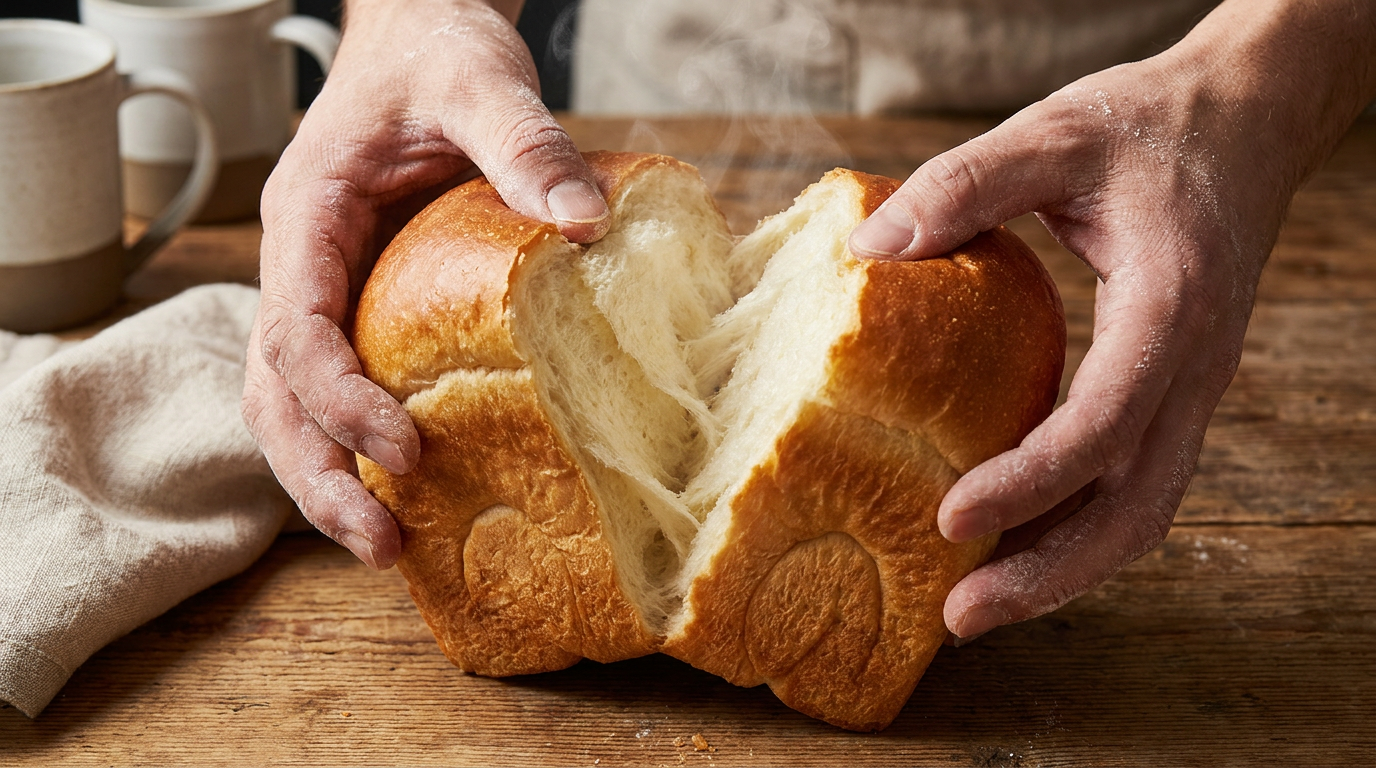
Yet, one specific style of loaf seems to defy the laws of culinary time. Japanese milk bread, or shokupan, is renowned for a feathery, pillowy crumb that remains exquisitely soft and moist for nearly a week on the kitchen counter.[3]
The secret behind this enduring softness is not a chemical preservative or an industrial dough conditioner. Instead, it relies on a pair of traditional Asian water roux techniques—tangzhong and yudane—that fundamentally alter the molecular structure of the flour before the dough is even mixed.[2]
To understand why these methods are so effective, it is necessary to look at the underlying chemistry of baking, specifically a process called starch gelatinization. Typical wheat flour is composed of approximately 70 percent starch.[6]
In their raw state, these starch granules are highly organized and crystalline. When mixed with cold or room-temperature water, they are relatively inactive, absorbing only about 30 to 40 percent of their own dry weight in moisture.[5]
However, when both heat and water are applied, the starch undergoes a dramatic glass transition. The granules swell rapidly, lose their crystalline structure, and eventually burst, spilling their contents to form a highly viscous gel.[5]

This gelatinization process traps water thermoirreversibly. Because the moisture is locked into the gel matrix, the resulting dough can handle a much higher overall hydration—sometimes up to 80 percent—without turning into an unworkable, sticky soup.[3][5]
The most globally recognized method for achieving this is tangzhong. While its exact historical origins are debated, the technique was widely popularized across Asia and the West by Taiwanese cookbook author Yvonne Chen in her seminal book, 65º C Bread Doctor.[1]
The most globally recognized method for achieving this is tangzhong.
The tangzhong method involves taking a small portion of the recipe's flour and whisking it with liquid at a ratio of one part flour to five parts liquid. This mixture is cooked on a stovetop until it reaches exactly 65 degrees Celsius (150 degrees Fahrenheit).[2]
At this precise temperature, the slurry thickens into a glossy, pudding-like paste. Once cooled, this pre-gelatinized roux is incorporated into the main dough, yielding a final bread with an incredibly delicate, feathery, and tender crumb.[1][2]
Yudane, the older Japanese counterpart to tangzhong, achieves a similar chemical result through a distinctly different physical process. Rather than cooking a slurry on the stove, the yudane method uses a one-to-one ratio of flour to boiling water.[2]

The boiling water is poured directly over the raw flour and stirred vigorously, scalding the starches into a stiff, dough-like paste. This mixture is typically covered and left to rest in the refrigerator overnight to allow the starches to fully hydrate and relax.[3]
Because of the lower hydration of the roux itself and the scalding technique, yudane produces a slightly different texture in the final bake. Breads made with yudane exhibit a chewy, resilient, almost mochi-like crumb that provides excellent structural integrity for tall, sliceable sandwich loaves.[3]
Beyond the home kitchen, these techniques have profound implications for commercial bakeries. The locked-in moisture provided by the pre-gelatinized starches naturally mimics the tenderizing effects of fat.[4]
As a result, commercial bakers can significantly reduce the amount of expensive ingredients like butter and oil in their enriched doughs without sacrificing the luxurious, soft mouthfeel that consumers expect.[4]

Furthermore, the yudane method is particularly attractive for mass production. Pouring boiling water from a commercial tank over a massive bin of flour is logistically simpler and less labor-intensive than carefully cooking a slurry on a stovetop.[4]
The most significant commercial benefit, however, is the natural extension of shelf life. By delaying the retrogradation of the starches, bakeries can keep their products on supermarket shelves longer, reducing food waste and improving profit margins.[4]
Ultimately, whether a baker chooses the delicate fluffiness of a tangzhong slurry or the chewy resilience of a yudane scald, the underlying science remains a testament to culinary ingenuity. By mastering the behavior of microscopic starch granules, bakers have unlocked the secret to the perfect, enduring loaf.[7]
How we got here
1862
British baker Robert Clarke opens Yokohama Bakery in Japan, introducing early Western-style breads that would evolve into Shokupan.
Late 20th Century
The Yudane method becomes a standard technique in Japanese commercial baking to produce soft, long-lasting milk bread.
2007
Taiwanese author Yvonne Chen publishes '65º C Bread Doctor', popularizing the Tangzhong method across Asia and eventually the West.
2020s
Water roux techniques become mainstream in Western home baking, widely used for cinnamon rolls, brioche, and sandwich loaves.
Viewpoints in depth
The Fluffiness Advocates
Bakers who prioritize the tangzhong method for its unparalleled delicate texture.
For bakers focused on sweet rolls, brioche, and ultra-soft buns, tangzhong is the undisputed champion. By cooking the flour and liquid into a smooth, pudding-like slurry, the resulting dough achieves a feathery, cloud-like crumb that melts in the mouth. Advocates of this method argue that the extra effort of stovetop cooking is a small price to pay for a texture that cannot be replicated by any other means.
The Structure Advocates
Bakers who prefer the yudane method for its chewy resilience and structural integrity.
Enthusiasts of traditional Japanese shokupan often lean toward the yudane method. Because the boiling water scalds the flour into a stiff paste that rests overnight, the final bread develops a slightly chewier, mochi-like bite. This resilience is crucial for tall sandwich loaves, as it provides enough structural integrity to slice cleanly and hold heavy fillings without collapsing, all while maintaining exceptional softness.
The Commercial Perspective
Industry professionals who value water roux techniques for their economic and logistical benefits.
From a manufacturing standpoint, water roux methods are a financial revelation. Because the locked-in moisture naturally tenderizes the crumb, commercial bakeries can significantly reduce the volume of expensive fats—like butter and oil—required in enriched doughs. Furthermore, the natural extension of shelf life reduces spoilage and food waste, allowing bakeries to deliver a superior, preservative-free product that stays fresh on supermarket shelves for days longer than standard loaves.
What we don't know
- The exact historical moment when the Chinese tangzhong diverged from the Japanese yudane remains debated among food historians.
- Whether the technique can be perfectly replicated using gluten-free flours, as their starch compositions differ significantly from wheat.
Key terms
- Starch Gelatinization
- The process where starch granules absorb water, swell, and burst when heated, forming a thick gel that traps moisture.
- Tangzhong
- A Chinese technique of cooking a portion of a bread recipe's flour and liquid into a pudding-like paste to pre-gelatinize the starches.
- Yudane
- A Japanese technique of pouring boiling water over a portion of flour to scald it into a stiff paste, achieving a similar gelatinizing effect.
- Shokupan
- A highly popular, ultra-soft Japanese milk bread known for its pillowy texture and long shelf life.
- Hydration
- The ratio of liquid to flour in a bread dough, expressed as a percentage.
Frequently asked
Can I use tangzhong in any bread recipe?
Yes, but you must adjust the recipe's overall liquid and flour to account for the amounts used in the roux to maintain the correct dough hydration.
Do I have to use milk for the roux?
No. Both tangzhong and yudane can be made with water, milk, or a combination of both, depending on the desired richness of the final bread.
How long does bread made with these methods stay fresh?
Breads made with a water roux can remain soft and fresh at room temperature for several days, significantly longer than standard homemade loaves.
Sources
Source coverage
7 outlets
4 viewpoints surfaced







[1]King Arthur BakingHome Baking Enthusiasts
Introduction to tangzhong
Read on King Arthur Baking →[2]The Perfect LoafHome Baking Enthusiasts
What is Tangzhong and Yudane?
Read on The Perfect Loaf →[3]The Daily MealCommercial Bakers
Tangzhong Vs Yudane: What's The Difference Between The Bread Baking Methods?
Read on The Daily Meal →[4]Institute of Culinary EducationCommercial Bakers
Tangzhong Method: A Revolutionary Baking Technique
Read on Institute of Culinary Education →[5]American Society of BakingCulinary Scientists
Starch Gelatinization | Baking Processes
Read on American Society of Baking →[6]KPM AnalyticsCulinary Scientists
Back to Flour: Understanding the Role of Starch Gelatinization in Baked Products
Read on KPM Analytics →[7]Factlen Editorial TeamFactlen Synthesis
Synthesis by Factlen editorial team
Read on Factlen Editorial Team →

Every angle. Every day.
Get food drink stories with full source coverage and perspective breakdowns delivered to your inbox.