
Deep-Ocean Sensors Confirm 15% Slowdown in Atlantic Overturning Circulation
New observational data from North Atlantic sensor arrays provides the first direct evidence that the AMOC ocean current has weakened significantly, shifting a major climate tipping point from theoretical modeling to measured reality.
By Factlen Editorial Team
- Physical Oceanographers
- Focuses on the empirical mooring data and the mechanics of thermohaline circulation, avoiding tipping-point alarmism while confirming the structural decline.
- Climate Risk Modelers
- Emphasizes the uncertainty intervals and the severe, irreversible consequences if the current crosses a bifurcation threshold.
- Socioeconomic Analysts
- Translates the oceanographic data into concrete impacts on European agriculture, US coastal real estate, and global food security.
What's not represented
- · Global South agricultural ministries
- · Coastal infrastructure planners
Why this matters
The AMOC regulates weather patterns, agricultural cycles, and sea levels across the Northern Hemisphere. Its confirmed slowdown accelerates localized sea-level rise on the US East Coast and threatens to disrupt the tropical rain belts that billions rely on for food production.
Key points
- Deep-ocean sensor arrays have provided the first direct observational evidence that the AMOC is slowing.
- The current has weakened by roughly 15% over the last two decades, dropping to an average transport of 12.5 Sverdrups.
- The slowdown is primarily driven by fresh meltwater from the Greenland Ice Sheet diluting the North Atlantic's salinity.
- A weakened AMOC accelerates sea-level rise on the US East Coast and threatens to disrupt tropical rain belts.
- While a full collapse is not expected imminently, the exact timing of an irreversible tipping point remains highly uncertain.
For decades, the weakening of the Atlantic Meridional Overturning Circulation (AMOC) has been a theoretical cornerstone of climate models—a looming threat projected for the late 21st century. Today, that narrative shifts from projection to direct observation. A landmark paper published in Nature confirms that the AMOC has slowed by approximately 15% over the past two decades, providing the most definitive evidence yet of structural changes in global ocean currents.[3]
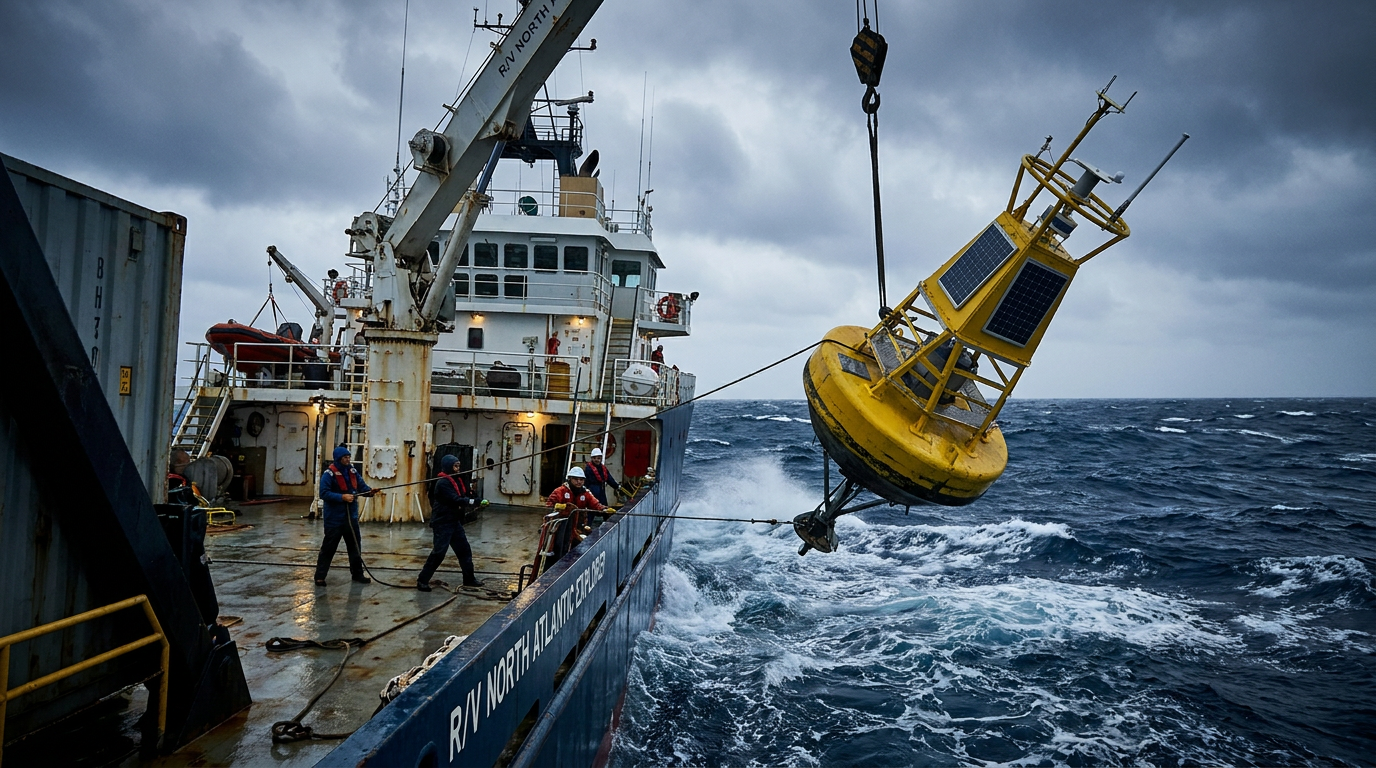
The findings, synthesized by an international team of physical oceanographers, rely on continuous deep-water measurements rather than proxy data like ice cores or tree rings. By analyzing data from the OSNAP (Overturning in the Subpolar North Atlantic Program) and RAPID sensor arrays, researchers measured a sustained drop in the volume of water transported northward.[3][4]
We are no longer waiting for the signal to emerge from the noise of natural ocean variability. The multi-decade sensor record now shows a clear, anthropogenic fingerprint on the Atlantic's primary heat conveyor, moving the scientific consensus from 'likely slowing' to 'measurably declining.'[6]
To understand the stakes, one must understand the mechanism. The AMOC is a massive system of ocean currents that acts as a conveyor belt, transporting warm, salty water from the tropics up toward the North Atlantic. As this water reaches the colder latitudes near Greenland, it cools, becomes denser, and sinks to the deep ocean, before flowing back southward.[5]

This thermohaline circulation—driven by differences in temperature and salinity—is responsible for keeping Northern Europe unusually mild for its latitude and regulating weather patterns across the Northern Hemisphere. It transports roughly 1.2 petawatts of heat continuously, equivalent to millions of power plants running simultaneously.[3]
The disruption of this cycle is primarily driven by the accelerated melting of the Greenland Ice Sheet. As billions of tons of fresh, cold meltwater pour into the North Atlantic, they dilute the surface salinity. This fresher water is less dense and struggles to sink, effectively creating a bottleneck that slows the entire global conveyor belt.[4][5]
The evidence pack presented in the Nature study centers on the metric of 'Sverdrups' (Sv), where one Sv equals one million cubic meters of water per second. Historical baselines estimated the AMOC's transport at roughly 15 to 16 Sv. The latest deep-mooring data indicates the current flow has dropped to an average of 12.5 Sv, with the steepest declines recorded since 2014.[3][4]

The evidence pack presented in the Nature study centers on the metric of 'Sverdrups' (Sv), where one Sv equals one million cubic meters of water per second.
Corroborating this deep-sea data is a surface phenomenon known as the 'Cold Blob.' While the rest of the globe has experienced record-breaking warming, a specific patch of the North Atlantic Ocean south of Greenland has persistently cooled. Climate risk analysts view this localized cooling as the direct thermal footprint of the AMOC slowdown, as less tropical heat reaches the subpolar region.[1]
The socioeconomic implications of a weakened AMOC are vast and unevenly distributed. A continued slowdown would drastically alter precipitation patterns, potentially shifting the tropical rain belt southward. This would severely disrupt agricultural cycles in West Africa, South America, and parts of Asia, threatening food security for hundreds of millions.[2]
In North America, the physical mechanics of the slowing current present a different threat: accelerated sea-level rise. The Coriolis effect and the sheer volume of the northward-flowing Gulf Stream currently pull water away from the US East Coast. As the current weakens, that water relaxes back toward the shoreline. Oceanographers project an additional 15 to 20 centimeters of localized sea-level rise along the Eastern Seaboard by 2050, independent of global ice melt.[4][5]
For Europe, the paradox of global warming could be regional cooling. While a full 'Day After Tomorrow' deep-freeze scenario is dismissed by scientists as Hollywood fiction, a significantly weakened AMOC would likely lead to harsher winters, increased winter storm intensity, and disrupted summer agricultural seasons across the UK and Scandinavia.[1][2]

Despite the robust observational data, significant uncertainties remain regarding the timeline of a potential 'tipping point'—a threshold beyond which the AMOC collapses entirely and irreversibly. The Intergovernmental Panel on Climate Change (IPCC) currently assesses a full collapse in the 21st century as 'unlikely,' though recent updates to their cryosphere reports acknowledge that the risk is higher than previously modeled.[5]
The debate among physical oceanographers now centers on whether the observed 15% decline represents a linear trend or the early stages of an exponential collapse. Some statistical models applied to the new OSNAP data suggest the system could reach a critical bifurcation point as early as the 2050s, though the confidence intervals remain wide.[3][6]
The uncertainty is not a reason for comfort; it is the core of the risk. Because the exact tipping point cannot be precisely mapped until the system is dangerously close to it, the margin for error in global emissions reductions is functionally zero.[6]
As policymakers digest the new evidence pack, the focus shifts to upcoming climate summits. With the AMOC's decline now a measured reality rather than a modeled projection, calls are intensifying for the integration of 'abrupt climate change' scenarios into national infrastructure planning and global agricultural risk assessments.[1][2]
How we got here
2004
The RAPID sensor array is deployed across the Atlantic at 26.5°N to begin continuously measuring the AMOC.
2014
The OSNAP array is installed further north in the subpolar Atlantic to capture data closer to where the deep-water sinking occurs.
2018
Studies analyzing sea-surface temperatures identify the 'Cold Blob' south of Greenland as a potential proxy signal of AMOC weakening.
2026
Combined data from the deep-water arrays confirms a structural 15% decline in volume transport, moving the slowdown from modeled theory to measured reality.
Viewpoints in depth
Physical Oceanographers
Focuses on the empirical mooring data and the mechanics of thermohaline circulation.
For physical oceanographers, the significance of the new data lies in its direct observational nature. For years, the discipline had to rely on proxy data—like sediment cores or surface temperature anomalies—to infer what was happening deep underwater. The OSNAP and RAPID arrays have provided a continuous, physical measurement of water volume moving across specific latitudes. This camp emphasizes that while a 15% reduction is highly significant and confirms anthropogenic forcing, it does not automatically mean a full collapse is imminent. They advocate for expanding the sensor networks to reduce the error bars in future projections.
Climate Risk Modelers
Emphasizes the uncertainty intervals and the severe consequences of crossing a bifurcation threshold.
Risk modelers view the 15% slowdown as a blaring warning siren. Their focus is on the non-linear nature of complex climate systems. In their view, the AMOC is not a dial that can be slowly turned down and then turned back up; it is a switch. Once the freshwater input from Greenland reaches a certain threshold, the sinking mechanism could shut off entirely, leading to an abrupt and irreversible collapse. Because the exact location of this 'bifurcation point' is unknown, modelers argue that any measured slowdown drastically increases the probability of a worst-case scenario occurring within this century.
Socioeconomic Analysts
Translates the oceanographic data into concrete impacts on infrastructure and food security.
This perspective shifts the focus from the North Atlantic to the populated continents. Socioeconomic analysts are primarily concerned with how a weakened AMOC alters global precipitation. If the tropical rain belt shifts southward as a result of the changing ocean temperatures, the agricultural foundations of West Africa, South America, and parts of Asia could be devastated. Furthermore, they highlight the immediate infrastructure costs for the US Eastern Seaboard, where the relaxing of the Gulf Stream will compound global sea-level rise, requiring billions in accelerated coastal defense spending.
What we don't know
- The exact threshold or 'tipping point' at which the AMOC would irreversibly collapse.
- How much of the observed 15% decline is driven by long-term anthropogenic climate change versus multi-decadal natural ocean cycles.
- Exactly how a severely weakened AMOC will interact with other climate tipping points, such as the Amazon rainforest dieback.
Key terms
- Sverdrup (Sv)
- A unit of measure for ocean currents, equal to one million cubic meters of water flowing per second.
- Thermohaline Circulation
- Deep-ocean currents driven by differences in the water's density, which is controlled by temperature (thermo) and salinity (haline).
- OSNAP Array
- A continuous line of scientific instruments moored to the ocean floor across the subpolar North Atlantic, designed to measure the volume of water moving through the AMOC.
- Bifurcation Point
- A critical threshold or 'tipping point' in a complex system where a small change pushes the system into a completely new, irreversible state.
Frequently asked
What is the AMOC?
The Atlantic Meridional Overturning Circulation is a system of ocean currents that carries warm water from the tropics into the North Atlantic, where it cools, sinks, and flows back south, regulating global climate.
Will a slowing AMOC cause an ice age?
No. While a collapse would cause significant regional cooling in Europe and disrupt global weather, scientists dismiss the sudden, extreme global freezing depicted in science fiction movies.
How does this affect sea levels?
The current's flow naturally pulls water away from the US East Coast. As the AMOC weakens, that water relaxes back toward the shore, accelerating localized sea-level rise.
Sources
Source coverage
6 outlets
3 viewpoints surfaced






[1]ReutersSocioeconomic Analysts
Ocean currents driving Atlantic weather show measured slowdown, study finds
Read on Reuters →[2]The GuardianSocioeconomic Analysts
Gulf Stream system at weakest in a millennium, new ocean sensor data confirms
Read on The Guardian →[3]NaturePhysical Oceanographers
Direct observation of Atlantic Meridional Overturning Circulation weakening via deep-water mooring arrays
Read on Nature →[4]NOAAPhysical Oceanographers
OSNAP Array Data Release: 2014-2026 Atlantic Transport Metrics
Read on NOAA →[5]IPCCClimate Risk Modelers
Special Report on the Ocean and Cryosphere in a Changing Climate (Updated 2026 Projections)
Read on IPCC →[6]Factlen Editorial TeamClimate Risk Modelers
Synthesis by Factlen editorial team
Read on Factlen Editorial Team →

Every angle. Every day.
Get science stories with full source coverage and perspective breakdowns delivered to your inbox.