
Evidence Pack: Fact-Checking the Biggest Claims About Ranked-Choice Voting
As ranked-choice voting expands to more municipalities and states in 2026, we examine the empirical data behind the most common claims regarding its impact on polarization, turnout, and voter comprehension.
By Factlen Editorial Team
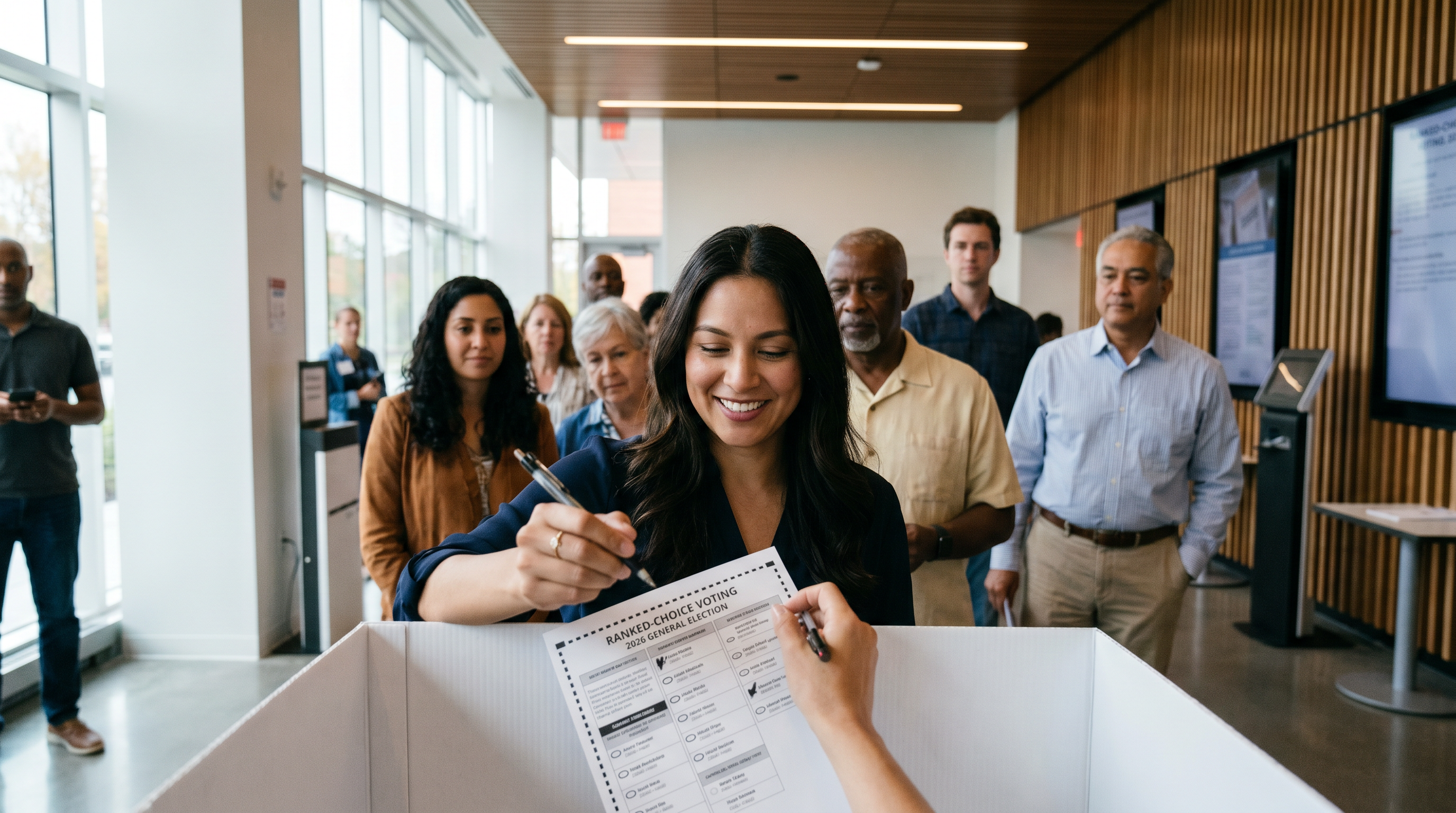
- Pro-RCV Reformers
- Argue that the system is essential for breaking partisan gridlock and ensuring elected officials have a true mandate.
- Election Scientists
- Focus on the empirical data, noting that while RCV improves campaign civility, it does not significantly alter baseline voter turnout.
- Traditional Party Strategists
- Express concern over the administrative complexity of the system and the potential for exhausted ballots in tight races.
What's not represented
- · Local election administrators managing the software transition
- · Third-party candidates running under the new system
Why this matters
With dozens of municipalities and several states voting on or implementing ranked-choice voting in 2026, understanding the actual data behind the reform helps voters separate political rhetoric from empirical reality.
Key points
- Ranked-choice voting is expanding rapidly across US municipalities and states in 2026.
- Strong evidence shows RCV reduces negative campaigning, as candidates need second-choice votes from rivals.
- Contrary to some claims, RCV does not significantly boost overall voter turnout.
- Data indicates the vast majority of voters find the ranked ballot simple to understand.
- RCV effectively eliminates the spoiler effect, allowing voters to support third-party candidates without wasting their vote.
The 2026 electoral landscape is defined by a quiet but profound structural shift: the rapid expansion of ranked-choice voting (RCV). From local mayoral races to statewide congressional elections, millions of Americans are encountering a ballot that asks them to rank candidates in order of preference rather than selecting just one. As the system spreads, it has become a lightning rod for both utopian promises and catastrophic warnings, leaving voters to navigate a maze of conflicting claims.[6][7]
Advocates frequently pitch RCV as a silver bullet for political polarization, arguing that it forces candidates to appeal to a broader swath of the electorate. Detractors, meanwhile, claim the system is overly complex, depresses turnout, and leads to discarded ballots. To separate the rhetoric from reality, election scientists and economists have spent the last several years analyzing the empirical data from jurisdictions that have already made the switch.[1][7]
This evidence pack evaluates the four most prominent claims about ranked-choice voting, grading the strength of the evidence behind each. By looking at peer-reviewed studies, municipal election data, and voter surveys, a clearer picture emerges of what RCV actually accomplishes—and what it does not.[7]

The first and most heavily debated claim is that ranked-choice voting reduces negative campaigning and political polarization. The theoretical mechanism is straightforward: in a traditional election, a candidate only needs to secure their base and suppress their opponent's turnout. In an RCV system, a candidate often needs to be the second choice of their opponent's supporters to cross the 50 percent threshold required to win.[2][5]
Empirical data strongly supports this claim. Studies tracking campaign communications in cities that adopted RCV found a measurable decrease in negative advertising. Candidates actively avoid alienating rival voter bases because they are competing for those crucial second- and third-place rankings. Polling from the Bipartisan Policy Center indicates that voters in RCV jurisdictions report experiencing significantly less vitriol during the campaign season compared to voters in plurality-rule cities.[2][4]
The verdict on campaign civility is that the evidence is strong. While RCV does not eliminate political disagreement, it fundamentally alters the incentive structure of campaigning. Candidates who rely entirely on base-mobilization and opponent-bashing historically underperform in RCV environments, as they fail to build the necessary consensus coalitions.[2][7]

The second major claim is that ranked-choice voting boosts overall voter turnout. Proponents argue that by eliminating the "lesser of two evils" dilemma and allowing voters to support their true favorite without fear of wasting their vote, more citizens will feel motivated to participate in the democratic process.[5]
The second major claim is that ranked-choice voting boosts overall voter turnout.
However, the data here is decidedly mixed. Research from the MIT Election Data and Science Lab shows that while RCV does not depress turnout, it does not reliably increase it either. Voter participation remains overwhelmingly driven by the competitiveness of the race, the resources spent on mobilization, and the presence of high-profile candidates at the top of the ticket.[1]
The verdict on turnout is that the evidence is weak. RCV is a ballot mechanism, not a mobilization tool. While it may make the act of voting feel more expressive and satisfying for those who already participate, it is not a magic wand for curing systemic voter apathy or structural barriers to the ballot box.[1][7]
The third claim, frequently leveled by traditional party strategists, is that the ranked ballot is too confusing for the average voter. Critics point to the phenomenon of the "exhausted ballot"—where a voter only ranks one or two candidates, and if those candidates are eliminated, their ballot no longer factors into the final rounds of tabulation.[3][6]
Extensive research into voter comprehension challenges this narrative. Data from the National Bureau of Economic Research indicates that the vast majority of voters understand how to rank candidates. In exit polls across multiple states, over 74 percent of voters consistently report that the RCV ballot was simple to use. Ballot exhaustion does occur, but it is most often a deliberate choice by voters who genuinely have no preference among the remaining candidates, rather than a result of confusion.[3][4]
The verdict on voter confusion is that the evidence is weak, provided the rollout is accompanied by adequate public education. Jurisdictions that invest in community outreach prior to their first RCV election see negligible increases in spoiled ballots. The learning curve exists, but it is remarkably short.[3][7]

The final claim is that ranked-choice voting eliminates the "spoiler effect," allowing third-party and independent candidates to compete fairly. In traditional elections, a popular independent can split the vote with a mainstream candidate of similar ideology, inadvertently handing the election to their ideological opposite.[1][5]
The evidence for this claim is exceptionally strong. In RCV systems, voters can rank a third-party candidate first and a mainstream candidate second. If the third-party candidate is eliminated, the vote seamlessly transfers. Real-world data from Alaska and Maine demonstrates that independent candidates receive a much higher share of first-place votes under RCV, as voters are freed from the strategic anxiety of wasting their ballot.[5][6]
While major-party candidates still win the vast majority of races due to structural advantages in funding and name recognition, RCV ensures that the final winner actually commands majority support. It accurately captures the electorate's true preferences without punishing ideological diversity.[1][7]

Ultimately, the empirical evidence paints a nuanced picture of ranked-choice voting. It is not a panacea for all democratic ailments, particularly regarding voter turnout. However, as a structural tool for reducing campaign vitriol, eliminating the spoiler effect, and ensuring majority consensus, the data confirms that RCV performs exactly as its architects designed.[7]
How we got here
2004
San Francisco becomes the first major modern US city to implement ranked-choice voting for local elections.
2018
Maine becomes the first state to use ranked-choice voting for federal elections.
2020
Alaska voters approve a ballot measure to implement open primaries and ranked-choice general elections.
2024–2026
A surge of ballot initiatives brings RCV to dozens of new municipalities and several additional states.
Viewpoints in depth
Pro-RCV Reformers
Advocates who view the system as a necessary evolution to save democratic norms.
Reform organizations argue that the traditional plurality system is fundamentally broken because it rewards extremism and punishes compromise. By requiring a candidate to secure 50 percent of the vote, reformers believe RCV ensures that elected officials actually represent the consensus of their constituents. They point to the reduction in negative campaigning as proof that the system forces politicians to build broader coalitions rather than simply inflaming their base.
Election Scientists
Researchers focused on the empirical outcomes of ballot mechanics.
Academic researchers take a more measured view, focusing strictly on what the data can prove. While they validate the claims regarding campaign civility and the elimination of the spoiler effect, they frequently push back against the more utopian claims made by advocates. Election scientists emphasize that RCV is a tabulation method, not a cure for systemic civic disengagement, noting that turnout remains stubbornly tied to the competitiveness of the race rather than the design of the ballot.
Traditional Party Strategists
Political operatives concerned about the unpredictability and administrative burden of the system.
Strategists from major political parties often express skepticism about RCV, arguing that it complicates the voting process and delays election results. They frequently cite the issue of ballot exhaustion, warning that voters who only rank one candidate may inadvertently disenfranchise themselves in later rounds of counting. Furthermore, they argue that the system makes polling and campaign resource allocation significantly more difficult, introducing unwanted volatility into the electoral process.
What we don't know
- Whether the reduction in negative campaigning seen in local RCV races will scale to highly polarized national elections.
- How the long-term presence of RCV might alter the types of candidates who choose to run for office in the first place.
- The exact threshold of public education funding required to completely eliminate ballot exhaustion in newly adopted jurisdictions.
Key terms
- Ranked-Choice Voting (RCV)
- An electoral system where voters rank candidates by preference on their ballots, rather than selecting just one.
- Instant Runoff
- The process used in RCV where the candidate with the fewest first-place votes is eliminated, and their votes are redistributed to those voters' next choices until a candidate surpasses 50 percent.
- Exhausted Ballot
- A ballot that can no longer be counted in the final rounds of an RCV election because all the candidates the voter chose to rank have been eliminated.
- Spoiler Effect
- A phenomenon in traditional elections where a third-party candidate draws votes away from a major candidate with similar views, causing a shared ideological opponent to win.
Frequently asked
Do I have to rank every candidate on the ballot?
No. You can rank as many or as few candidates as you like. If you only want to vote for one person, you can simply mark them as your first choice and leave the rest blank.
Does ranked-choice voting favor one political party over another?
Empirical data shows RCV does not inherently favor Democrats or Republicans. It tends to favor consensus candidates who can appeal to the center of their specific electorate, regardless of party affiliation.
What happens if my first choice is eliminated?
If your first choice finishes last in a round of counting, they are eliminated, and your vote is automatically transferred to the candidate you marked as your second choice.
Can ranking a second choice hurt my first choice?
No. Your second choice is only considered if your first choice has already been mathematically eliminated from the race.
Sources
Source coverage
7 outlets
3 viewpoints surfaced







[1]MIT Election Data and Science LabElection Scientists
Ranked-Choice Voting: Electoral Impacts and Voter Behavior
Read on MIT Election Data and Science Lab →[2]Bipartisan Policy CenterPro-RCV Reformers
Assessing the Impact of Ranked Choice Voting on Campaign Civility
Read on Bipartisan Policy Center →[3]National Bureau of Economic ResearchElection Scientists
Voter Comprehension and Ballot Exhaustion in Alternative Voting Systems
Read on National Bureau of Economic Research →[4]Pew Research CenterElection Scientists
Public Support for Electoral Reforms Ahead of the 2026 Midterms
Read on Pew Research Center →[5]FairVotePro-RCV Reformers
Data and Research on Ranked Choice Voting Outcomes
Read on FairVote →[6]AP NewsTraditional Party Strategists
Ranked-choice voting measures see a surge on 2026 state ballots
Read on AP News →[7]Factlen Editorial TeamElection Scientists
Synthesis by Factlen editorial team
Read on Factlen Editorial Team →

More in news politics
See all 72 stories →Death Penalty
Supreme Court Blocks Alabama From Executing Inmate Using Nitrogen Gas
8 sources
US-Iran Conflict
Trump Cancels Strikes on Iran, Claiming Imminent Peace Deal as Markets Surge
10 sources

Death Penalty
Supreme Court Blocks Alabama From Executing Inmate Using Nitrogen Gas
6 sources
Capital Punishment
Supreme Court Blocks Alabama From Executing Inmate Using Nitrogen Gas
6 sources
Every angle. Every day.
Get news politics stories with full source coverage and perspective breakdowns delivered to your inbox.