
Community-Owned Grocery Stores Are Successfully Eradicating Urban Food Deserts
Across the US, neighborhoods abandoned by corporate supermarket chains are successfully building and sustaining their own cooperative grocery stores. As flagship projects in Detroit and Dayton hit major milestones in 2026, the community-owned model is proving to be a viable, long-term solution to food apartheid.
By Factlen Editorial Team
- Cooperative Organizers
- Argue that community ownership is the only permanent solution to food apartheid, prioritizing local wealth retention and food sovereignty over corporate profit.
- Economic Analysts
- Highlight the razor-thin margins of the grocery industry and caution that co-ops require sustained, high-volume community shopping to survive inflation.
- Public Health & Policy Experts
- Focus on the public health benefits of eradicating food deserts and advocate for federal and private grants to bridge the massive capital gaps of opening supermarkets.
What's not represented
- · Corporate Grocery Executives
- · Wholesale Food Distributors
Why this matters
Access to fresh, affordable food dictates the health and economic stability of a neighborhood. By owning the grocery store, residents not only improve their physical health but keep capital circulating locally, creating jobs and preventing the wealth extraction typical of corporate chains.
Key points
- Community-owned grocery cooperatives are successfully replacing corporate supermarket chains in urban food deserts across the US.
- The Detroit People's Food Co-op celebrated its second anniversary in May 2026, anchoring a $22 million community food hub.
- Dayton's Gem City Market successfully rallied its 5,000 member-owners to boost weekly shopper counts and combat inflation.
- The cooperative model allows residents to purchase ownership shares, ensuring profits and jobs remain within the local economy.
- Federal programs and private grants are increasingly providing the millions in upfront capital required to build these facilities.
- Organizers emphasize 'food sovereignty,' prioritizing democratic community control over the food supply rather than relying on outside corporations.
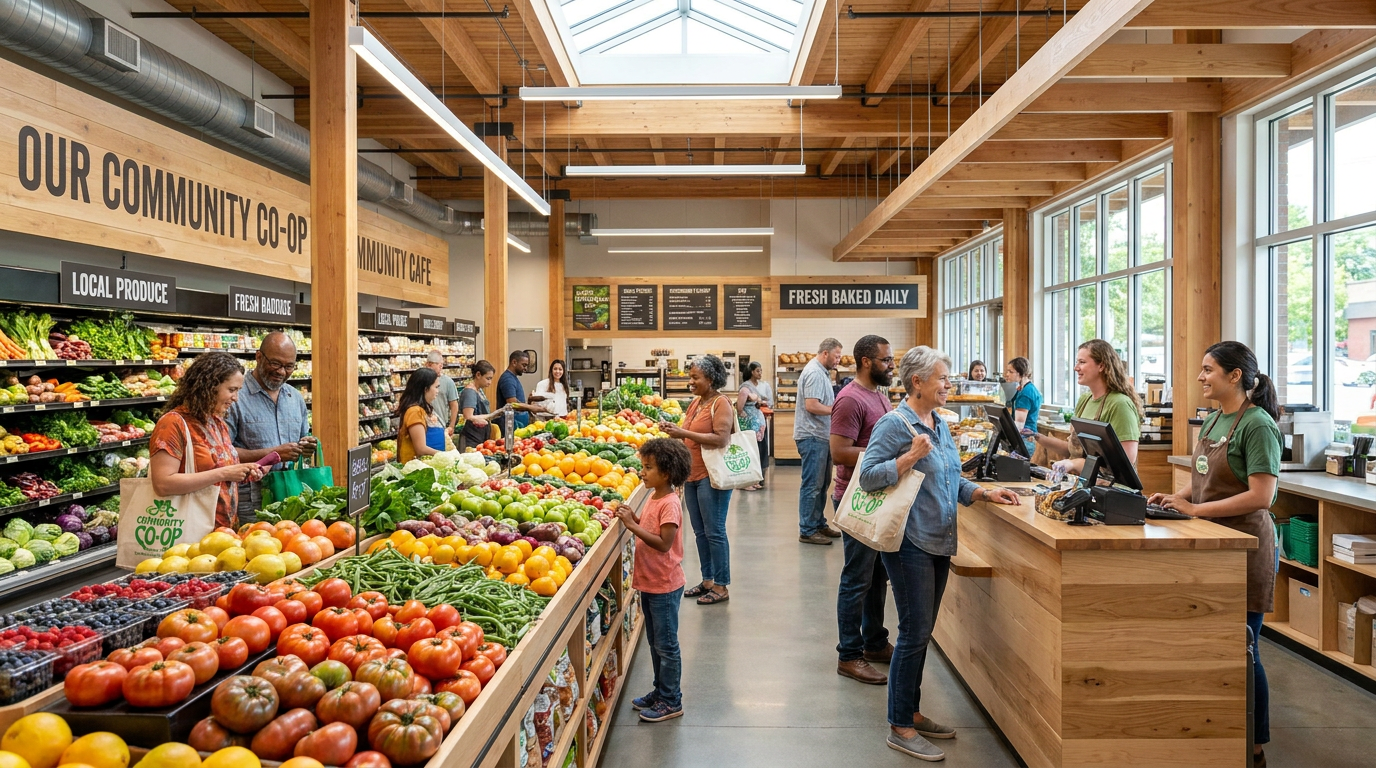
In May 2026, the Detroit People's Food Co-op celebrated its second anniversary, marking a major milestone for a neighborhood that had long been abandoned by corporate supermarket chains. Located in Detroit's historic North End, the bustling 30,000-square-foot facility is fully owned by its shoppers and workers. Its success is serving as a beacon for a growing national movement: community-owned grocery cooperatives designed to permanently eradicate urban food deserts.[1][3][5]
For decades, the standard response to food insecurity in low-income neighborhoods was to plead with corporate grocers to open new locations. However, traditional supermarkets operate on razor-thin profit margins—often between one and three percent—and frequently pull out of areas that do not meet strict demographic wealth targets. When these chains leave, residents are forced to rely on convenience stores, gas stations, or long commutes to access fresh produce.[4][7]
Rather than waiting for outside corporations to return, communities are increasingly pooling their own resources to build multi-stakeholder cooperatives. In this model, residents purchase lifetime ownership shares—often for around $100 to $200, payable in installments—which provides the seed capital to open the store. Because the cooperative is not beholden to distant shareholders demanding maximized quarterly profits, it can prioritize local job creation, living wages, and affordable healthy food.[1][7]

The Detroit People's Food Co-op is currently the movement's crown jewel. Spearheaded by the Detroit Black Community Food Sovereignty Network, the $22 million project took a decade of organizing to realize. Today, the building—known as the Detroit Food Commons—houses not only a full-service grocery store but also four commercial incubator kitchens for local food entrepreneurs and a banquet hall for community events.[1][5]
"Being able to control your food is one of the biggest freedoms you can have," noted Jason Ford, director of operations for the Detroit network. By sourcing heavily from local urban farms and Black-owned businesses, the cooperative ensures that grocery spending circulates within the local economy rather than being extracted by out-of-state corporate headquarters.[3]
"Being able to control your food is one of the biggest freedoms you can have," noted Jason Ford, director of operations for the Detroit network.
The path to sustainability, however, is notoriously difficult. Grocery retail is an unforgiving industry, and cooperatives must balance their social justice missions with harsh economic realities. In Dayton, Ohio, the Gem City Market opened in 2021 to serve a West Dayton community that had been without a full-service grocer for over a decade. While the market successfully amassed over 5,000 member-owners, it faced severe headwinds from post-pandemic inflation and supply chain disruptions.[2][4]
By late 2024, Gem City Market's leadership issued a transparent call for help, informing the community that current sales volumes were not sustainable. The response was immediate. Local organizations began purchasing gift cards in bulk to distribute as incentives, and weekly shopper counts surged from 2,150 to over 2,300. The market is now steadily approaching its break-even target of 2,500 weekly shoppers, proving that transparent, community-rooted businesses can weather economic storms that might cause a corporate chain to simply close its doors.[2]

The sheer difficulty of keeping an independent grocery store afloat is clear from past failures. In recent years, well-intentioned nonprofit markets in Oakland, California, and Chester, Pennsylvania, were forced to shut down after struggling to cover operating costs. Academic researchers note that successful co-ops are those that deeply consult their communities before opening, ensuring the product mix matches local cultural preferences and price sensitivities.[4][7]
To bridge the massive capital requirements of opening a modern supermarket, federal and private grants are increasingly stepping in. The USDA's Healthy Food Financing Initiative (HFFI) has distributed tens of millions of dollars to food retail projects in underserved areas, providing critical early-stage funding for cold storage, construction, and supply chain logistics.[6]
Private capital is also recognizing the viability of the model. In April 2026, Wells Fargo announced a $1.5 million donation to the West Boulevard Neighborhood Coalition in Charlotte, North Carolina. The funds are accelerating the development of the Three Sisters Market, an aspirational community-owned cooperative that will serve a corridor that has fought for a grocery store for decades. Organizers are breaking ground on outdoor planting beds this spring as they finalize the store's feasibility study.[8]

Similar efforts are advancing across the country. In Raleigh, North Carolina, the Fertile Ground Food Cooperative is currently navigating the city's rezoning process to open a multi-stakeholder grocery store and cultural center in Southeast Raleigh. By utilizing a "liberatory market study"—which actively challenges the historical redlining biases often baked into traditional real estate algorithms—the cooperative successfully proved the economic viability of their neighborhood to lenders.[1][9]
Ultimately, the cooperative grocery movement represents a profound shift in how neighborhoods view their own revitalization. The goal is no longer simply "food access"—a metric that can be satisfied by a corporate chain that extracts local wealth and can leave at any time. Instead, communities are fighting for "food sovereignty." By owning the physical infrastructure of their food supply, residents are building generational health, creating dignified jobs, and ensuring that their neighborhoods remain resilient for decades to come.[1][3]
How we got here
2013-2014
Corporate supermarket chains close multiple locations in cities like Detroit and Raleigh, prompting residents to begin organizing cooperative alternatives.
May 2021
The Gem City Market opens in West Dayton, Ohio, bringing a full-service grocery store to the area for the first time in over a decade.
May 2024
The Detroit People's Food Co-op opens its doors inside the newly constructed $22 million Detroit Food Commons.
Late 2024
Facing severe inflation, Gem City Market issues a call for community support, successfully boosting its weekly shopper count.
April 2026
Charlotte's proposed Three Sisters Market receives a $1.5 million grant to break ground, signaling growing institutional support for the cooperative model.
May 2026
The Detroit People's Food Co-op celebrates its second anniversary, proving the long-term viability of the community-owned model.
Viewpoints in depth
Cooperative Organizers
Advocates building local wealth and food sovereignty through community ownership.
For cooperative organizers, the mission extends far beyond simply selling fresh vegetables. They view the traditional corporate grocery model as inherently extractive, siphoning dollars out of low-income neighborhoods and funneling them to distant shareholders. By establishing multi-stakeholder cooperatives, these organizers aim to build 'food sovereignty'—giving residents democratic control over their food supply. They point to successes like the Detroit People's Food Co-op as proof that when a community owns its infrastructure, it can create local jobs, support regional farmers, and build generational wealth that corporate chains cannot take away.
Economic Analysts
Focuses on the harsh financial realities and thin margins of the grocery retail industry.
Industry analysts caution that while the cooperative model is socially inspiring, it is not immune to the brutal economics of the grocery business. Supermarkets operate on razor-thin margins of 1 to 3 percent, making them highly vulnerable to inflation, supply chain shocks, and shrinkage. Analysts point to past failures of nonprofit markets in Oakland and Pennsylvania as cautionary tales. They argue that for co-ops to survive long-term, initial enthusiasm must translate into sustained, high-volume weekly shopping by the community, as seen in Gem City Market's push to reach 2,500 regular shoppers.
Public Health & Policy Experts
Emphasizes the health outcomes of eradicating food deserts and the need for structural funding.
Public health professionals view community-owned grocery stores as critical interventions for reducing diet-related chronic illnesses, such as diabetes and heart disease, which disproportionately affect residents of food deserts. However, policy experts argue that marginalized communities should not have to bear the entire financial burden of solving systemic food apartheid. They advocate for robust public-private partnerships and expanded federal grants, such as the USDA's Healthy Food Financing Initiative, to provide the millions of dollars in upfront capital required to build modern, fully equipped supermarkets.
What we don't know
- Whether newly established cooperatives can maintain high weekly shopper volumes over the next decade as initial excitement fades.
- How effectively these independent stores can negotiate wholesale prices with suppliers compared to massive corporate grocery chains.
- If federal and private grant funding will scale up enough to meet the growing national demand for community-owned grocery projects.
Key terms
- Food Sovereignty
- The right of a community to control its own food systems, including how food is produced, distributed, and consumed, rather than relying on outside corporations.
- Multi-Stakeholder Cooperative
- A business model owned and governed by multiple groups of people—such as consumers, workers, and local producers—who all have a democratic say in its operations.
- Food Apartheid
- A term preferred by many organizers over 'food desert,' highlighting that the lack of fresh food in certain neighborhoods is the result of intentional human policies and systemic racism, rather than a natural phenomenon.
- Healthy Food Financing Initiative (HFFI)
- A federal program that provides grants and financial support to projects aiming to improve access to healthy food in underserved areas.
Frequently asked
What is a food desert?
A food desert, often referred to as food apartheid, is a geographic area where residents have severely limited access to affordable, fresh, and nutritious food, typically due to the absence of a full-service grocery store.
How does a community-owned grocery store work?
Residents purchase a lifetime ownership share (often around $100 to $200). This provides capital to open the store, and in return, members get a democratic vote in store operations and a share of future profits.
Are these stores only for members?
No. While members own the store and may receive special discounts or dividends, community-owned grocery cooperatives are open to the general public for everyday shopping.
Why do corporate grocery stores leave these neighborhoods?
Traditional supermarkets operate on extremely thin profit margins (1-3%). If a neighborhood does not meet their specific demographic or income targets, corporations often close the stores to protect their bottom line.
Sources
Source coverage
9 outlets
3 viewpoints surfaced









[1]Nonprofit QuarterlyCooperative Organizers
Food Is the Cover Story: The Real Story Is Black Self-Determination
Read on Nonprofit Quarterly →[2]WYSOEconomic Analysts
Gem City Market rallies community support as it approaches fourth anniversary
Read on WYSO →[3]Planet DetroitCooperative Organizers
Jason Ford's next chapter begins at Detroit People's Food Co-op: 'We gotta build the systems'
Read on Planet Detroit →[4]The GuardianEconomic Analysts
The sheer difficulty of keeping a community grocery store going
Read on The Guardian →[5]NCBA CLUSACooperative Organizers
Detroit People's Food Co-op opens its doors to Detroit's North End community
Read on NCBA CLUSA →[6]USDAPublic Health & Policy Experts
Healthy Food Financing Initiative Success Stories
Read on USDA →[7]Scholars Strategy NetworkPublic Health & Policy Experts
What to consider when you develop a new community-owned grocery store
Read on Scholars Strategy Network →[8]West Boulevard Neighborhood CoalitionCooperative Organizers
Three Sisters Market: A Community-Owned Food Cooperative
Read on West Boulevard Neighborhood Coalition →[9]Fertile Ground Food CooperativeCooperative Organizers
Fertile Ground Food Cooperative: Our Story
Read on Fertile Ground Food Cooperative →

Every angle. Every day.
Get community stories with full source coverage and perspective breakdowns delivered to your inbox.