
Choosing Between a Fully Electric Vehicle and a Plug-in Hybrid in 2026
As battery ranges expand and upfront costs shift, the decision between a pure electric vehicle and a plug-in hybrid comes down to daily charging access and long-distance driving habits.
By Factlen Editorial Team
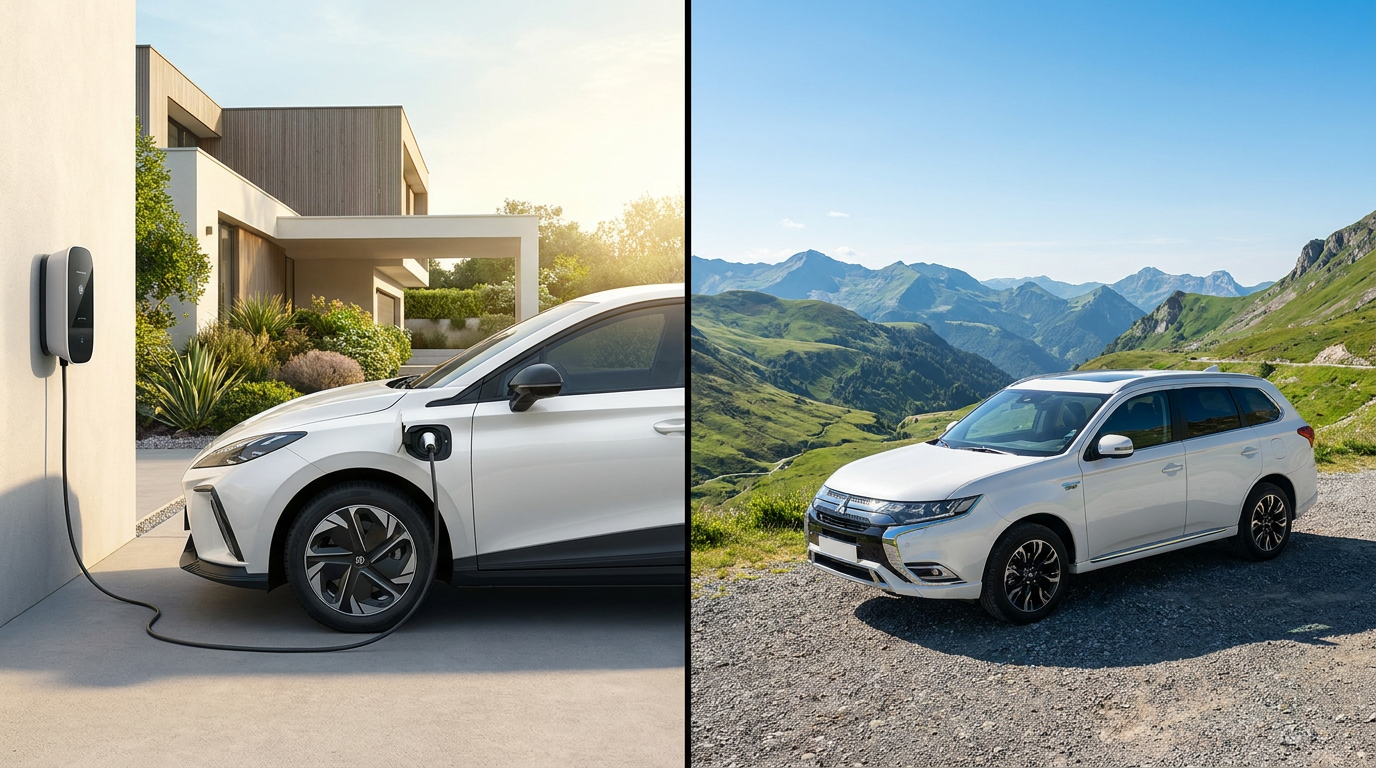
- Pure EV Advocates
- Argue that fully electric vehicles are the only true path to zero emissions and offer the lowest total cost of ownership.
- Pragmatic Commuters
- Value the plug-in hybrid as the ultimate transitional technology that eliminates range anxiety.
- Financial Analysts
- Focus strictly on the math of upfront premiums versus long-term operational savings.
What's not represented
- · Apartment Renters Without Charging Access
- · Rural Drivers in Extreme Cold Climates
Why this matters
Purchasing a new vehicle is one of the largest financial decisions a household makes. Choosing the right electrified powertrain can save thousands of dollars in fuel and maintenance over a five-year period, while picking the wrong one can lead to frustrating inefficiencies and higher insurance premiums.
Key points
- EVs offer the lowest total running costs, saving drivers an average of $330 annually on maintenance alone.
- PHEVs provide 40 to 80 kilometers of electric range for daily commutes while retaining a gas engine for road trips.
- Upfront purchase prices for fully electric vehicles remain higher than comparable hybrids, though the gap is narrowing.
- Insurance premiums for pure EVs typically run 10 to 15 percent higher due to specialized battery repair costs.
- A PHEV is only cost-effective if plugged in daily; otherwise, it operates as a heavy, less efficient gas vehicle.
- The optimal choice depends entirely on a driver's access to overnight home charging and annual mileage.
The transition to electrified transport is no longer a fringe movement, but the choice between a fully electric vehicle and a plug-in hybrid electric vehicle remains one of the most hotly debated topics in showrooms today. As battery technology matures and public charging infrastructure expands, the traditional calculus of car buying has fundamentally shifted. Drivers are no longer just comparing horsepower and trunk space; they are weighing daily charging habits against weekend road-trip aspirations.[1][2]
Understanding the core mechanical distinction is the first step in navigating this landscape. A fully electric vehicle, or EV, relies entirely on a large battery pack and electric motors, eliminating the internal combustion engine completely. A plug-in hybrid, conversely, houses both a smaller battery designed for short electric trips and a traditional gas engine that automatically takes over when the battery is depleted, offering a dual-powertrain approach.[4][7]
When weighing the arguments for a fully electric vehicle, the strongest evidence lies in mechanical simplicity and the absolute lowest operational cost per mile. Because an EV features only about twenty moving parts in its drivetrain, it completely eliminates the need for oil changes, spark plug replacements, and transmission servicing. This streamlined architecture translates directly into long-term reliability and fewer trips to the mechanic.[1][5]
The evidence supporting electric vehicle running costs is substantial and highly quantifiable. Charging an electric car at home overnight on off-peak utility tariffs costs the equivalent of roughly one dollar per gallon of gasoline. For high-mileage drivers, this efficiency allows them to save between $1,200 and $1,800 annually on fuel alone, representing a massive financial advantage over a standard combustion engine.[2][5]

Furthermore, maintenance data from 2026 reveals that electric vehicle owners save an average of $330 per year on routine servicing compared to their gas or hybrid counterparts. Over a five-year ownership period, these operational savings compound significantly. The regenerative braking systems in EVs also dramatically reduce wear on traditional brake pads, meaning many drivers exceed 100,000 miles before needing a brake replacement.[1][8]
However, the argument against the fully electric vehicle is firmly anchored in upfront pricing and insurance premiums. On average, battery electric vehicles still command a premium over comparable hybrids, with some market analyses showing a gap of up to $14,400 before tax incentives or rebates are applied. This higher initial barrier to entry means it can take several years of fuel savings just to break even on the purchase price.[2][6]
The evidence also points to higher insurance costs for pure electric models. Because their advanced battery packs and specialized components are more expensive to repair or replace after a collision, insurance premiums for electric vehicles typically run ten to fifteen percent higher than those for traditional or hybrid cars. This added monthly expense must be factored into the total cost of ownership.[1][6]
The evidence also points to higher insurance costs for pure electric models.
Conversely, the argument for the plug-in hybrid electric vehicle revolves around flexibility and the complete elimination of range anxiety. By offering 40 to 80 kilometers of pure electric driving, a modern plug-in hybrid can handle the average daily commute entirely on battery power. When the weekend arrives, the gas engine provides an unlimited safety net for long road trips, bypassing the need to plan routes around public fast-charging stations.[4][5]

The evidence supporting plug-in hybrids highlights their dual-nature efficiency when used correctly. Drivers who diligently plug in their vehicles every night report fuel consumption as low as 1.6 liters per 100 kilometers. This allows them to capture the vast majority of electric vehicle savings during the workweek without sacrificing the convenience of a five-minute fill-up at a traditional gas station during cross-country journeys.[3][4]
The primary argument against the plug-in hybrid focuses on its mechanical complexity and the behavioral discipline it requires from the owner. Housing two complete powertrains—an electric motor and a combustion engine—makes the vehicle heavier and technically more complicated. This dual system means owners are still liable for traditional engine maintenance while also managing a high-voltage battery system.[1][7]
The evidence regarding plug-in hybrid inefficiencies is stark for drivers who fail to charge them regularly. When the battery is depleted, the vehicle essentially becomes a heavy gas-powered car. Because it is hauling the dead weight of an electric motor and battery pack, a depleted plug-in hybrid often records worse fuel economy than a standard, non-plug-in hybrid model.[5][7]
Depreciation also factors heavily into the comparison between the two technologies. In the 2026 secondary market, fully electric vehicles from reputable brands are holding their value remarkably well as consumer confidence in battery longevity grows. Plug-in hybrids, while stable, face slightly steeper depreciation curves as battery technology rapidly advances and zero-emission zones become more common in major urban centers.[5][7]

Ultimately, the fully electric vehicle fits well when a driver has reliable access to overnight home charging, commutes regularly, and plans to keep the vehicle long enough for the fuel and maintenance savings to eclipse the higher initial purchase price. For this profile, the EV offers an unmatched, whisper-quiet driving experience and the lowest possible daily operating cost.[2][5]
Conversely, the fully electric vehicle does not fit well when a driver relies exclusively on street parking, frequently embarks on unpredictable long-distance road trips through rural areas with sparse charging infrastructure, or prioritizes the absolute lowest upfront purchase price. In these scenarios, the logistical hurdles of public charging can outweigh the financial benefits.[2][3]
The plug-in hybrid fits well when a household wants to transition to electric driving for daily errands but can only afford one vehicle that must also serve as the primary road-trip machine. It is the ideal stepping stone for drivers who want to reduce their carbon footprint but still require the absolute certainty of a combustion engine for remote travel.[3][4]
Finally, the plug-in hybrid does not fit well when a driver lacks a dedicated home charging outlet. Running a plug-in hybrid purely on gasoline negates its environmental and financial benefits entirely, leaving the owner with a heavier, more expensive car that offers no practical advantage over a standard, self-charging hybrid.[3][7]
How we got here
1997
Toyota introduces the Prius, popularizing the standard self-charging hybrid powertrain.
2010
The Chevrolet Volt and Nissan Leaf launch, introducing mass-market PHEVs and BEVs to consumers.
2020
Battery prices drop significantly, allowing EVs to reach mainstream price parity in premium vehicle segments.
2024
Several regions introduce Road User Charges for PHEVs and EVs to replace lost gas tax revenue.
2026
EV ranges routinely hit 600 kilometers, shifting the consumer debate from 'range anxiety' to total cost of ownership.
Viewpoints in depth
Pure EV Advocates
Focus on zero emissions, mechanical simplicity, and the lowest possible cost per mile.
This camp argues that plug-in hybrids are an unnecessary half-measure in 2026. With modern electric vehicles easily clearing 400 to 600 kilometers of range, they believe range anxiety is largely a myth for the vast majority of drivers. By eliminating the internal combustion engine entirely, EV advocates point out that owners escape the long-term maintenance liabilities of oil changes and transmission repairs, ultimately achieving the lowest total cost of ownership over the life of the vehicle.
Pragmatic Commuters
Value the plug-in hybrid as the ultimate transitional vehicle that eliminates range anxiety.
For this group, the plug-in hybrid represents the perfect compromise. They argue that hauling around a massive, heavy battery for 600 kilometers of range is inefficient when most daily commutes are under 50 kilometers. By using a smaller battery for daily electric driving and relying on a gas engine for occasional road trips, they believe PHEVs offer the best of both worlds without forcing drivers to rely on public fast-charging networks.
Financial Analysts
Focus strictly on the math of upfront premiums versus long-term operational savings.
Financial analysts take a dispassionate view of the transition, noting that while EVs save money on fuel and maintenance, they are hampered by higher upfront costs, steeper early depreciation, and insurance premiums that run 10 to 15 percent higher. They argue that the financially optimal choice depends entirely on a driver's annual mileage and access to cheap overnight home charging, making sweeping 'one-size-fits-all' recommendations impossible.
What we don't know
- How rapidly solid-state battery technology will depreciate the resale value of current lithium-ion EVs and PHEVs.
- Whether insurance companies will eventually lower EV premiums as repair networks and parts availability expand.
- How future changes to road user charges and registration fees will impact the long-term cost of ownership for both vehicle types.
Key terms
- BEV (Battery Electric Vehicle)
- A vehicle powered exclusively by electricity stored in a large battery pack, with no gas engine.
- PHEV (Plug-in Hybrid Electric Vehicle)
- A vehicle with both a gas engine and a battery large enough to drive short distances purely on electricity before the gas engine takes over.
- Regenerative Braking
- A system that captures the kinetic energy normally lost during braking and uses it to recharge the vehicle's battery.
- Total Cost of Ownership (TCO)
- The comprehensive financial cost of a vehicle over time, including purchase price, fuel, maintenance, insurance, and depreciation.
Frequently asked
Do plug-in hybrids charge themselves while driving?
While regenerative braking captures some energy, a plug-in hybrid must be physically plugged into an outlet to recharge its main battery for full electric driving.
Is an EV cheaper to maintain than a PHEV?
Yes. Because an EV lacks a gas engine, it requires no oil changes, spark plugs, or transmission fluid, saving drivers an average of $330 annually.
What happens if I never plug in my PHEV?
If you don't charge it, the PHEV operates entirely on gasoline. Because it carries the extra weight of a depleted battery, it will likely get worse gas mileage than a standard hybrid.
Do EVs cost more to insure?
Typically, yes. Insurance premiums for fully electric vehicles run 10 to 15 percent higher due to the specialized repair costs associated with their battery packs.
Sources
Source coverage
8 outlets
3 viewpoints surfaced








[1]Automotive MustFinancial Analysts
EV vs PHEV 2026 Landscape: What Changed
Read on Automotive Must →[2]CarzingFinancial Analysts
The honest case for an EV in 2026
Read on Carzing →[3]Cars.co.zaPragmatic Commuters
Maintenance costs: EV vs PHEV vs REEV
Read on Cars.co.za →[4]ZenithPragmatic Commuters
EV and PHEV comparison
Read on Zenith →[5]Go ElectraPure EV Advocates
Electric Car or Plug-in Hybrid: Which One Should You Choose?
Read on Go Electra →[6]FinanceBuzzFinancial Analysts
Electric vehicles may have higher car insurance rates
Read on FinanceBuzz →[7]Mobile Studio 24hPure EV Advocates
EV vs PHEV Which One Better
Read on Mobile Studio 24h →[8]Consumer Reports
Electric Vehicle Ownership Costs
Read on Consumer Reports →



Every angle. Every day.
Get shopping stories with full source coverage and perspective breakdowns delivered to your inbox.