
AI Acts as a Creative Collaborator Rather Than a Replacement, Major Study Finds
A study of over 800 participants by Swansea University reveals that AI-generated design suggestions, including intentionally flawed ones, significantly boost human creativity and engagement.
By Factlen Editorial Team
- Academic Researchers
- Argue that AI's impact on creativity should be measured by cognitive engagement rather than task efficiency.
- Creative Industry Professionals
- Value AI for its ability to rapidly generate diverse concepts that serve as a springboard for human vision.
- Technology Analysts
- Focus on the broader implications of human-AI collaboration across engineering, architecture, and software development.
What's not represented
- · Labor unions concerned about job displacement
- · Traditional artists who reject AI tools entirely
Why this matters
As artificial intelligence rapidly enters the workplace, anxiety over human obsolescence has dominated the conversation. This research provides concrete evidence that AI can actually enhance human ingenuity rather than replace it, offering a more optimistic blueprint for the future of creative work.
Key points
- A Swansea University study of over 800 participants found that AI acts as a creative collaborator rather than a replacement.
- The AI system generated diverse design galleries, including intentionally flawed concepts, to break users' early creative fixation.
- Participants using the diverse AI galleries spent more time on tasks and produced higher-quality final designs.
- Researchers argue that AI tools should be evaluated on how they influence cognitive engagement, not just task efficiency.
Artificial intelligence is frequently framed as an automation engine poised to replace human labor, but a major new study suggests a far more optimistic role: a creative collaborator. Researchers at Swansea University have published findings indicating that AI systems, when designed to offer diverse suggestions, actively deepen human engagement and creative thinking.[1][2]
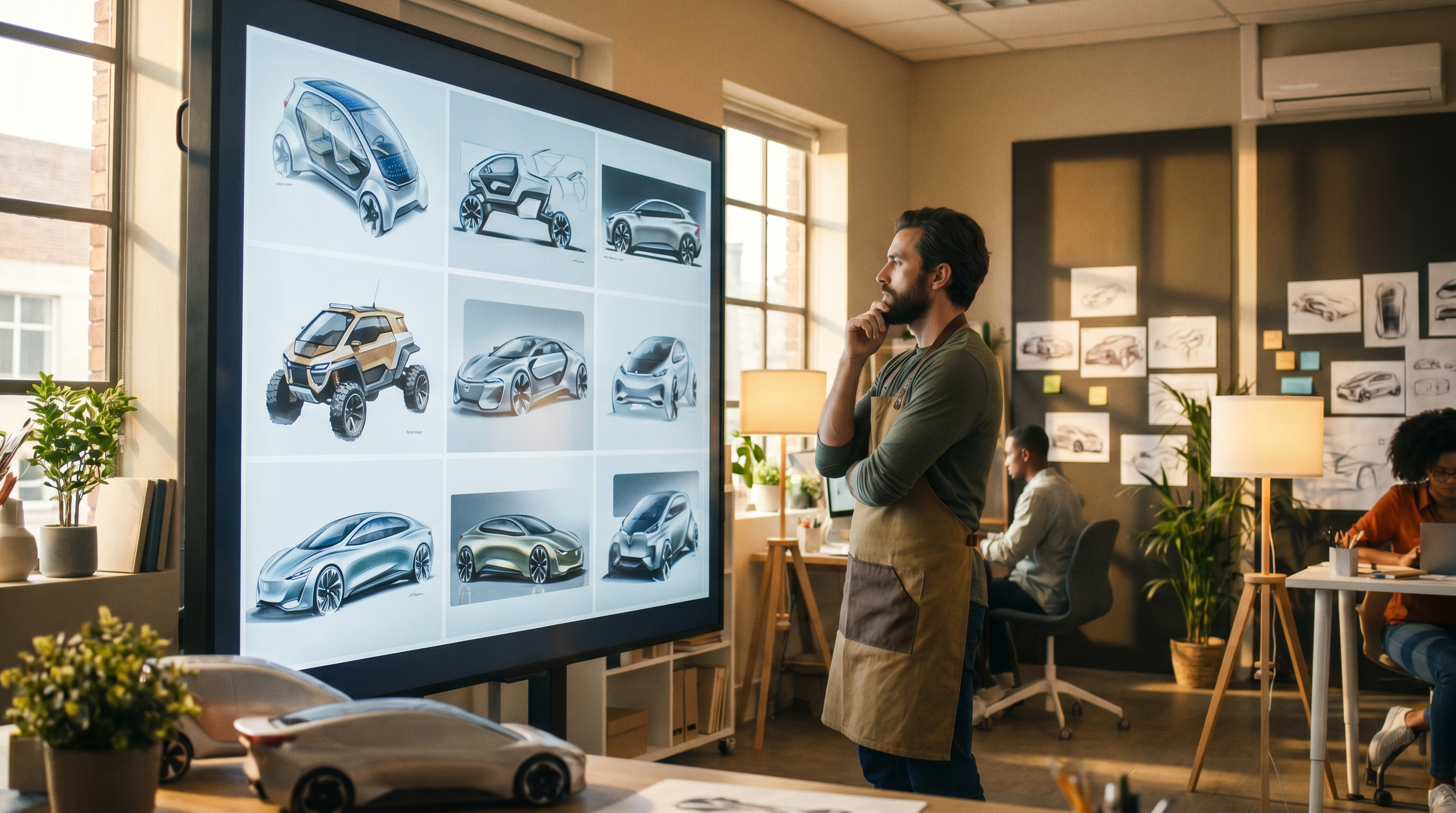
The research, conducted by the university's Computer Science Department, represents one of the largest studies to date examining human-AI collaboration in creative tasks. Over 800 participants took part in an online experiment where they were tasked with designing virtual cars using a platform called the Genetic Car Designer Game. The goal was not to test whether the AI could independently design a better vehicle, but rather to observe how human creativity shifted when AI was integrated into the workflow.[1][3][4][5]
Rather than operating behind the scenes to silently optimize a single "best" solution, the AI system utilized an algorithm known as MAP-Elites. Unlike standard generative models that attempt to guess exactly what the user wants, MAP-Elites is specifically engineered to map out a vast landscape of possibilities. This approach generated visual galleries filled with a wide spectrum of design variations that participants could browse at any time.[1][3][4][8]

Crucially, the system did not just present highly effective designs; it also offered unconventional concepts and intentionally flawed options. This structured variety proved to be the key to unlocking human ingenuity. Dr. Sean Walton, a Turing Fellow and the study's lead author, noted that participants responded most positively to galleries that included a wide array of ideas, including the "bad" ones.[1][2][3]
Seeing these imperfect or unusual suggestions helped users break out of their initial assumptions and explore a much broader design space. By presenting a diverse spread of options, the AI prevented "early fixation"—a common creative hurdle where designers cling to their first viable idea and refuse to iterate further.[1][2][5]
Seeing these imperfect or unusual suggestions helped users break out of their initial assumptions and explore a much broader design space.
"When people were shown AI-generated design suggestions, they spent more time on the task, produced better designs and felt more involved," Dr. Walton explained. The data showed that the interaction was not merely about speeding up the process, but about fostering genuine collaboration. Participants used the AI's output not as a final product, but as a raw material to be refined, combined, and elevated.[1][3][4][8]

These academic findings mirror a broader shift occurring within the creative industry. A 2026 report by Envato, which surveyed nearly 1,800 creative professionals, found that 45 percent of respondents already use AI to boost their speed and experimentation. The most effective workflows are emerging not from users who accept an AI's first output, but from those who use the technology's rapid generation capabilities as a springboard for their own vision.[4]
The Swansea study also challenges how the technology sector currently evaluates AI design tools. Standard industry metrics typically focus on surface-level behaviors, such as how quickly a user completes a task or how often they click on and copy an AI's direct suggestion. The researchers argue that these narrow measurements fail to capture the deeper cognitive and emotional dimensions of the user's experience.[1][3][4][5]
If an AI tool is judged solely on efficiency, developers may inadvertently build systems that stifle exploration. The research team advocates for more holistic evaluation methods that measure how a technology influences a user's willingness to take creative risks and think outside the box.[1][3][4][8]
As AI becomes increasingly embedded in fields ranging from architecture to game design, understanding this collaborative dynamic will be essential. The findings offer a blueprint for the next generation of software development: building tools that optimize for inspiration and diversity, ensuring that technology elevates human potential rather than sidelining it.[3][6][7]
How we got here
2022
The generative AI boom begins, sparking widespread anxiety about the automation of creative jobs.
2024
Major design software companies integrate AI generation directly into professional creative suites.
2025
Envato surveys 1,780 creative professionals, finding 45% use AI primarily for experimentation.
March 2026
Swansea University publishes its landmark study in the ACM journal, proving AI's value as a collaborative partner.
Viewpoints in depth
Academic Researchers
Focusing on cognitive engagement and the need for holistic evaluation metrics.
Researchers emphasize that the true value of AI in design cannot be captured by measuring how fast a task is completed or how often a user copies an AI's output. They argue that the industry must develop new evaluation frameworks that assess how technology influences a user's emotional involvement, willingness to take risks, and overall creative exploration.
Creative Industry Professionals
Viewing AI as a springboard for experimentation rather than a replacement for human vision.
For working creatives, the narrative of AI as a job-stealing automation engine is giving way to a more nuanced reality. Industry surveys indicate that professionals increasingly rely on AI to rapidly generate a wide variety of styles and compositions. This structured variety serves as a foundation for human designers to build upon, allowing them to see possibilities they might not have conceptualized on their own.
AI Developers
Shifting focus from single-answer accuracy to algorithmic diversity.
The findings present a new mandate for software engineers building creative tools. Instead of training models to converge on a single, highly optimized output, developers are being encouraged to utilize algorithms like MAP-Elites that prioritize a diverse spread of options. This approach ensures the AI acts as a brainstorming partner that expands the user's horizons rather than a machine that simply dictates the final product.
What we don't know
- Whether these findings hold true for highly complex, multi-disciplinary creative tasks like feature film production or urban planning.
- How long-term reliance on AI brainstorming partners might alter human cognitive processes over decades.
Key terms
- MAP-Elites
- An algorithm that generates a diverse set of high-performing solutions rather than converging on a single 'best' answer.
- Early Fixation
- A cognitive bias in creative work where a designer settles on their first viable idea instead of exploring alternative concepts.
- Generative AI
- Artificial intelligence systems capable of creating new text, images, or designs based on user prompts.
- Cognitive Engagement
- The level of mental effort, focus, and deep thinking a person applies to a specific task.
Frequently asked
Does AI make human designers lazy?
No. The Swansea University study found that when AI provides diverse suggestions, humans actually spend more time on the task and produce higher-quality work.
Why did the AI suggest 'bad' designs?
Intentionally flawed or unusual designs were included to break users' early fixation, encouraging them to take creative risks and explore broader concepts.
What algorithm was used in the study?
The researchers used an algorithm called MAP-Elites, which is designed to produce a wide spectrum of varied possibilities rather than a single optimized output.
How should AI tools be evaluated?
Researchers argue we should move beyond simple metrics like click-through rates and instead measure how AI influences a user's creative thinking and emotional engagement.
Sources
Source coverage
8 outlets
3 viewpoints surfaced








[1]Swansea UniversityAcademic Researchers
Can AI make us more creative? New study reveals surprising benefits of human-AI collaboration
Read on Swansea University →[2]ScienceDailyAcademic Researchers
Scientists discover AI can make humans more creative
Read on ScienceDaily →[3]Mirage NewsTechnology Analysts
AI Boosts Human Creativity, Scientists Reveal
Read on Mirage News →[4]EnvatoCreative Industry Professionals
AI and human creativity: study finds AI deepens creative thinking
Read on Envato →[5]Complete AI TrainingCreative Industry Professionals
Swansea University study finds AI design suggestions boost human creativity and engagement
Read on Complete AI Training →[6]Mimir's WellTechnology Analysts
The New News in AI: 3/20/26 Edition
Read on Mimir's Well →[7]IntegemTechnology Analysts
AI Creativity, Lunar Readiness, and the 24-Hour Robotic House
Read on Integem →[8]ACM Transactions on Interactive Intelligent SystemsAcademic Researchers
Evaluating Human-AI Collaboration in Design Tasks
Read on ACM Transactions on Interactive Intelligent Systems →
More in ai
See all 50 stories →EU AI Act
EU Reaches Agreement to Delay High-Risk AI Act Deadlines to 2027
8 sources
Accessibility Tech
Open-Source AI Breakthrough Brings Real-Time Sign Language Translation to Smartphones
7 sources

Local AI
How to Run AI Locally on Your Own Computer (and Why You Should)
8 sources
Agentic AI
Beyond Chatbots: How Agentic Workflows Give AI the Ability to Plan, Remember, and Act
7 sources

Every angle. Every day.
Get ai stories with full source coverage and perspective breakdowns delivered to your inbox.