
Open-Source AI Breakthrough Brings Real-Time Sign Language Translation to Smartphones
A global coalition of researchers has released an open-source AI model capable of real-time, two-way translation between multiple sign languages and spoken text, running entirely on consumer smartphones.
By Factlen Editorial Team
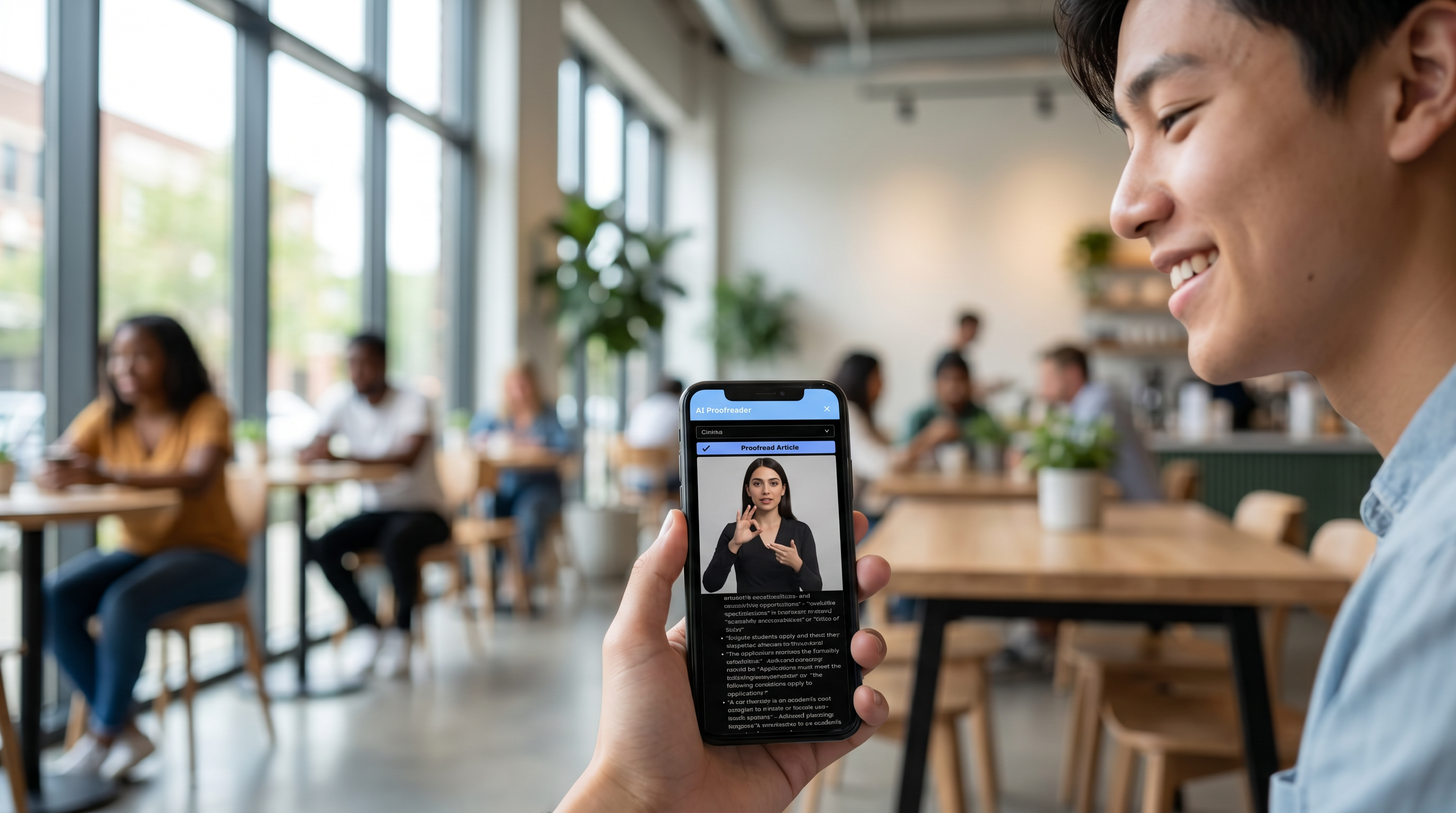
- Deaf Community Advocates
- Demand that AI tools be Deaf-led and respect the unique grammar of sign languages.
- Open-Source Developers
- Prioritize edge computing, privacy, and open datasets to scale the technology globally.
- Accessibility Policymakers
- Focus on deploying scalable AI solutions to mitigate the severe shortage of human interpreters.
What's not represented
- · Human Sign Language Interpreters
- · Deaf individuals in low-income regions without smartphone access
Why this matters
For decades, the digital divide has isolated the Deaf community from rapid advancements in voice-activated tech. By moving translation from expensive human interpreters and clunky cloud servers directly onto the smartphones in our pockets, this breakthrough fundamentally reshapes how millions of people will access healthcare, public services, and everyday conversation.
Key points
- New AI models can translate sign language to text and vice versa in real time.
- The technology runs locally on smartphones, ensuring privacy and eliminating cloud latency.
- Photorealistic avatars are used to generate natural, fluid sign language gestures.
- Development is increasingly Deaf-led to ensure accurate cultural and grammatical translation.
- The open-source approach allows regional teams to build tools for over 300 distinct sign languages.
For the world’s 430 million deaf and hard-of-hearing individuals, the generative AI boom has historically been a text-and-audio revolution that left visual languages behind. But in mid-2026, a convergence of open-source projects and academic coalitions has achieved a long-sought milestone: real-time, two-way sign language translation that runs locally on consumer smartphones.[7]
The breakthrough addresses a severe global bottleneck. Across the globe, there is a pronounced deficiency in certified sign language interpreters, leaving deaf individuals to navigate healthcare, legal systems, and daily commerce with inadequate support. Previous attempts to automate translation were clunky, relying on specialized gloves or massive cloud-computing resources that introduced conversational lag.[4]
Now, the paradigm has shifted toward native multimodality and edge computing. Modern AI models are increasingly capable of digesting complex video inputs and cross-referencing them with vast linguistic datasets in real time. By running these optimized models directly on mobile devices, developers have eliminated the latency and privacy concerns associated with cloud processing.[2][6]

The technical foundation of this leap relies on advanced spatial tracking. Researchers are utilizing open-source frameworks, such as Google's MediaPipe, to extract high-fidelity data points from a user's hands, facial expressions, and body posture. This is critical because sign language is not merely about hand shapes; a raised eyebrow or a shift in shoulder position can fundamentally alter the grammar and meaning of a sentence.[3]
Once the spatial data is captured, it is fed into specialized neural networks—often Long Short-Term Memory (LSTM) architectures or modern transformer models—that remember information over time. These networks decode the simultaneous, three-dimensional grammar of sign languages, translating the visual input into spoken or written text with unprecedented accuracy.[3]
The translation flows in both directions. When a hearing person speaks or types, the system translates the text back into sign language. Instead of relying on crude, robotic animations, the latest platforms utilize photorealistic AI-generated signers to deliver the message. These avatars are designed to capture the fluid, natural movements required for genuine comprehension.[1][5]
A driving force behind this progress is the UK’s SignGPT project, backed by £8.45 million in funding. A collaboration between the University of Surrey, University College London, and the University of Oxford, the initiative is building the world’s largest sign language dataset. Their goal is to provide the same level of foundational AI infrastructure for sign languages that currently exists for spoken languages like English or Mandarin.[1]

A driving force behind this progress is the UK’s SignGPT project, backed by £8.45 million in funding.
Crucially, these efforts are highly localized. Sign language is not universal; there are over 300 distinct sign languages globally. In Norway, researchers at SINTEF are training models specifically for Norwegian Sign Language (NTS). Meanwhile, the FastSign project at Hong Kong Baptist University is tackling the unique complexities of Hong Kong Sign Language (HKSL) and Cantonese.[3][4]
The open-source community has been instrumental in accelerating this localized development. Projects like sign.mt have built ambitious, open-source pipelines that allow developers to generate datasets and train models for sign-to-text translation across multiple languages. By making these tools freely available, they empower regional communities to build their own translation engines without waiting for commercial tech giants.[2]
However, developers emphasize that this is not merely a technical challenge; it is a human-centered one. Early attempts at sign language AI often failed because they were built by hearing engineers who fundamentally misunderstood how deaf people communicate, resulting in systems that produced literal, word-for-word glosses rather than true semantic translations.[2]
To solve this, the most successful platforms in 2026 are strictly Deaf-led. Companies like the US-based Sign-Speak and the UK-based Signapse ensure that Deaf staff hold leadership roles and guide the development process. This ensures the technology respects sign languages as rich, independent languages rather than broken versions of spoken tongues.[1]

The real-world applications are already transforming public life. AI translation services are being deployed in transport hubs and public service settings, allowing for automated interpreting where human interpreters are unavailable. In virtual meetings, automated systems can now interpret live conversations using generated avatars, seamlessly bridging the communication gap.[1][2]
In healthcare, the impact is particularly profound. Deaf patients can now communicate directly with doctors in real-time via tablet interfaces, ensuring that critical medical nuances are not lost in translation or delayed by the wait for an in-person interpreter.[7]
Despite the rapid progress, researchers acknowledge that AI will not replace human interpreters for high-stakes environments like courtrooms or complex medical diagnoses anytime soon. The technology serves as a vital augmentative tool—a digital front-line worker that removes friction from everyday interactions.[4][7]

As the technology matures, the focus is shifting toward expanding support for International Sign and integrating these translation layers natively into mobile operating systems. For the Deaf community, the promise of 2026 is not just better technology, but a more connected, inclusive, and accessible world.[1][2][4]
How we got here
2009
Norwegian Sign Language (NTS) is officially recognized as a full and independent language.
Feb 2024
The AI-Driven Norwegian Sign Language Translator project begins at SINTEF.
Jan 2025
The UK announces £8.45 million in funding for the SignGPT dataset project.
June 2026
Open-source coalitions successfully deploy real-time, two-way sign language translation models natively on smartphones.
Viewpoints in depth
Deaf Community & Advocates
Emphasizing that AI must be Deaf-led and respect the linguistic complexity of sign languages.
Advocates stress that sign languages are not merely visual codes for spoken languages, but rich, independent languages with their own grammar and syntax. They argue that historical AI attempts failed because they were built by hearing engineers without Deaf input. For this technology to succeed, it must be developed by and for the Deaf community, ensuring that cultural nuances, facial expressions, and spatial grammar are accurately captured rather than reduced to literal word-for-word translations.
Open-Source Developers
Focusing on edge computing and open datasets to democratize accessibility.
The developer community views this breakthrough as a triumph of decentralized, open-source engineering. By building lightweight models that run locally on smartphones, they bypass the latency and privacy issues of cloud-based processing. They argue that making datasets and tracking frameworks freely available allows regional teams to build tools for the 300+ distinct sign languages globally, rather than waiting for massive tech conglomerates to commercialize the space.
Accessibility Policymakers
Viewing AI translation as a scalable solution to the global interpreter shortage.
Public service administrators and policymakers highlight the severe, chronic shortage of certified human sign language interpreters. They view AI translation not as a replacement for human professionals in high-stakes legal or medical settings, but as a crucial bridge for everyday interactions—from transit announcements to retail banking. For policymakers, the goal is to deploy these systems in public infrastructure to meet legal accessibility mandates and foster a more inclusive society.
What we don't know
- How quickly these models can be scaled to cover the hundreds of less-documented regional sign languages.
- Whether public institutions will subsidize the cost of the high-end smartphones required to run these edge models.
Key terms
- Edge Computing
- Processing data locally on a device (like a smartphone) rather than relying on distant cloud servers, which improves speed and privacy.
- MediaPipe
- An open-source framework developed by Google that provides ready-made solutions for tracking hand movements, facial expressions, and body posture in real time.
- Native Multimodality
- An AI model's ability to seamlessly understand and process multiple types of data—such as video, text, and audio—simultaneously without needing separate bolt-on modules.
- Photorealistic Avatar
- An AI-generated digital character that looks and moves like a real human, used to produce natural and fluid sign language gestures.
Frequently asked
Does this AI replace human sign language interpreters?
No. While AI is highly effective for everyday interactions and public services, human interpreters remain essential for high-stakes environments like courtrooms and complex medical diagnoses.
Is sign language the same everywhere in the world?
No, there are over 300 distinct sign languages globally, such as American Sign Language (ASL) and British Sign Language (BSL), each with its own unique grammar and vocabulary.
Do these translation apps require an internet connection?
The latest breakthrough allows these optimized AI models to run locally on edge devices like smartphones, meaning they can function without a continuous cloud connection, ensuring privacy and zero latency.
Sources
Source coverage
7 outlets
3 viewpoints surfaced







[1]JiscDeaf Community Advocates
AI sign language translation is emerging as a fast-moving area
Read on Jisc →[2]Arm CommunityOpen-Source Developers
Sign language processing on mobile: A technical and human exploration
Read on Arm Community →[3]SINTEFOpen-Source Developers
Real Time Sign Language Translation Using AI
Read on SINTEF →[4]HKBUAccessibility Policymakers
FastSign: Fast AI Sign Language Translator
Read on HKBU →[5]WIREDDeaf Community Advocates
The Startups Using AI to Translate Sign Language
Read on WIRED →[6]Stanford HAIOpen-Source Developers
Artificial Intelligence Index Report 2026
Read on Stanford HAI →[7]Factlen Editorial TeamAccessibility Policymakers
Synthesis by Factlen editorial team
Read on Factlen Editorial Team →

More in ai
See all 54 stories →Prompt Engineering
How to Make AI Reason: The Science of Chain-of-Thought and ReAct Prompting
6 sources

Agentic AI
The Rise of Agentic Workflows: How Autonomous AI is Automating Everyday Knowledge Work
8 sources

Drug Discovery
New AI Model Accelerates Molecular Simulations 10,000 Times, Promising to Slash Drug Discovery Timelines
7 sources

Local AI
The Rise of Local AI: How Small Language Models Are Moving Offline
7 sources
Every angle. Every day.
Get ai stories with full source coverage and perspective breakdowns delivered to your inbox.