
The Resurgence of the 'Third Place' in the Fight Against Loneliness
As the loneliness epidemic deepens, communities are reviving "third places"—from run clubs to library parks—to rebuild social infrastructure outside of home and work.
By Factlen Editorial Team
- Public Health Advocates
- Viewing third places as essential medical infrastructure to combat the physiological effects of loneliness.
- Urban Designers
- Focusing on the built environment, zoning, and human-centric design to facilitate natural gathering.
- Grassroots Organizers
- Bypassing economic barriers by creating free, activity-based spaces like run clubs and DIY venues.
- Commercial Operators
- Balancing the desire to host community spaces with the financial realities of rising rents and inflation.
- Sociological Analysts
- Studying the structural decline of social cohesion and the historical context of community spaces.
What's not represented
- · Digital community managers
- · Commercial real estate developers
- · Rural residents lacking physical infrastructure
Why this matters
Social isolation is a measurable health crisis, carrying risks equivalent to smoking 15 cigarettes a day. Access to free, low-pressure gathering spaces is essential for building local support networks and improving mental health.
Key points
- Sociologists define 'third places' as neutral, accessible gathering spots outside of the home and workplace.
- The decline of these spaces due to suburban sprawl and commercialization has fueled a measurable loneliness epidemic.
- Younger generations are bypassing expensive commercial venues by forming free, activity-based groups like run clubs.
- Urban planners are redesigning public infrastructure, such as library parks, to encourage spontaneous community interaction.
In the wake of the 2020 global lockdowns, a quiet crisis that had been simmering for decades finally boiled over. Stripped of casual gathering spots, millions of people found themselves isolated, accelerating a loneliness epidemic that public health officials now view as a critical threat to societal well-being. As the immediate health crisis faded, the social hangover remained. People realized they were missing something fundamental—not just close friends or family, but the low-stakes, everyday connections that make a neighborhood feel like a community.[6]
The solution to this modern isolation is an idea first articulated nearly four decades ago. In his 1989 book The Great Good Place, urban sociologist Ray Oldenburg coined the term "third place" to describe the informal public gathering spaces that act as the social glue of a functioning society. Oldenburg argued that to live a balanced and healthy life, humans require engagement in three distinct realms, and the loss of the third is directly responsible for our current crisis of disconnection.[1][2]
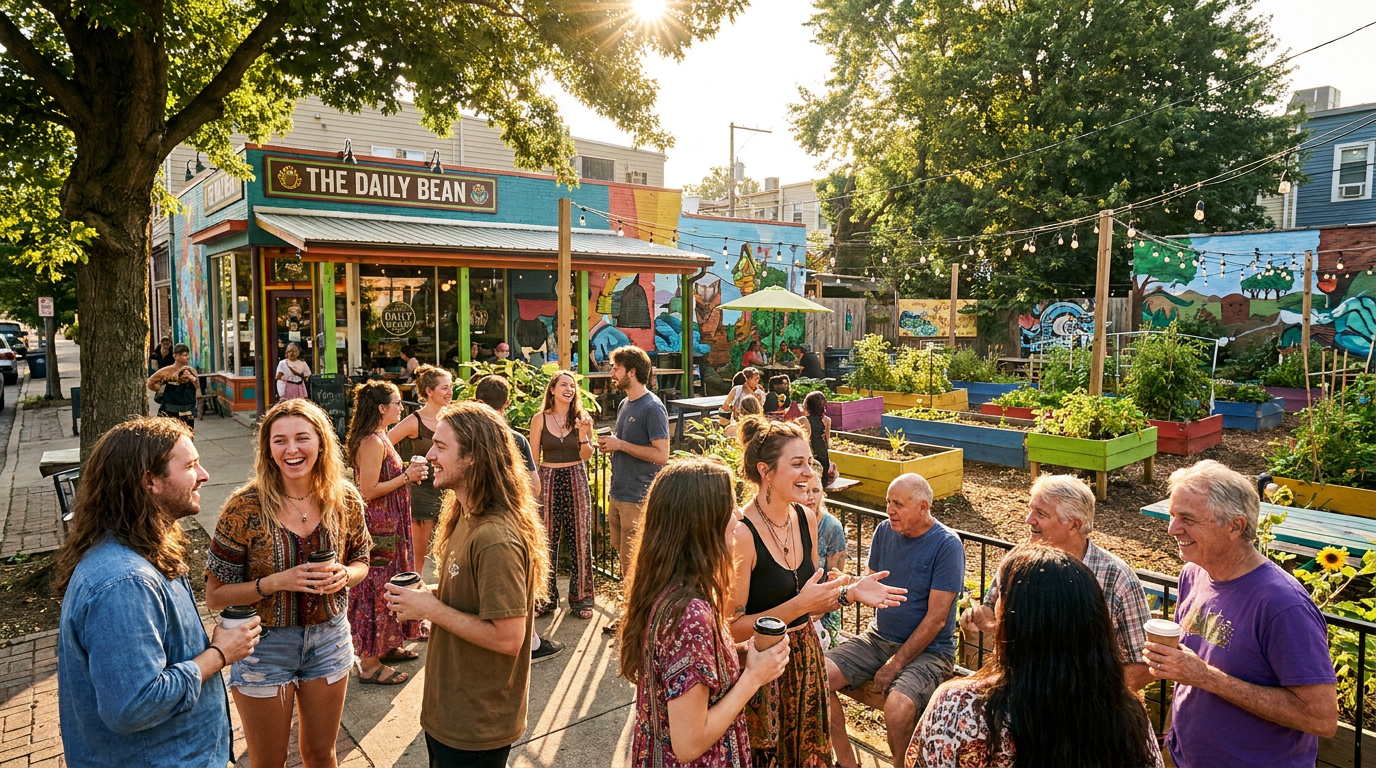
The framework is simple. The "first place" is the home—a private, domestic space where we retreat and rest. The "second place" is the workplace or school, characterized by structured social experiences, productivity, and hierarchy. The "third place," then, is the neutral ground. It is the neighborhood cafe, the public library, the local park, or the community center. These are environments where people gather informally, without an agenda or obligation, simply to enjoy the presence of others.[5]

For much of the 20th century, American life was rich with these spaces, from bowling alleys and diners to VFW halls and stoops. But a combination of suburban sprawl, car-centric urban planning, and the privatization of public land began to hollow out this social infrastructure. Neighborhoods were designed to maximize private property and personal space, often at the direct expense of communal gathering centers. Consequently, the time Americans spent socializing with friends plummeted, dropping by 37 percent between 2014 and 2019 alone.[4]
Compounding the architectural shift was a commercial one. Many spaces that traditionally served as third places, such as coffee shops and bookstores, became increasingly corporatized. While chains like Starbucks once prided themselves on offering a "living room" for the community, economic pressures and the rise of mobile ordering have shifted their models toward high turnover and rapid transactions. The pressure to buy something or leave has created an economic barrier, excluding those who cannot afford the rising cost of a daily latte.[3][4]
The disappearance of these spaces is not merely a nostalgic loss; it is a measurable public health crisis. Researchers have found that severe social isolation carries health risks equivalent to smoking 15 cigarettes a day, increasing the likelihood of premature mortality. Conversely, older adults and rural workers who live within easy reach of third places report higher levels of physical activity, stronger social networks, and significantly better overall mental health.[6]

The healing mechanism of a third place relies on a concept urban designers call "proximity without pressure." In a well-designed public park or community garden, individuals can share space and engage in micro-interactions—a nod, a shared complaint about the weather, a brief chat on a bench—without the obligation of a formal social plan. These passive encounters build a baseline of trust and belonging, creating an ecosystem where people naturally look out for one another.[7]
These passive encounters build a baseline of trust and belonging, creating an ecosystem where people naturally look out for one another.
Crucially, effective third places facilitate "social leveling." When you enter a true third place, your economic status, job title, and workplace hierarchy are left at the door. Everyone is on equal footing. This environment strips away the prerequisites for participation, allowing people from vastly different backgrounds, age groups, and industries to connect over a shared environment or activity.[8]
Faced with a landscape of expensive commercial venues and sterile suburbs, younger generations are actively rebuilding third places from the ground up. College students and young professionals are transforming apartments into DIY music venues, organizing neighborhood potlucks, and launching grassroots hobby groups that require no membership fees. They are rejecting the idea that socializing must be tied to consumption.[3]
Nowhere is this shift more visible than in the explosive rise of urban run clubs. Often free to join and requiring minimal equipment, run clubs have become the modern social hub for thousands of young adults. While some critics argue that the focus on exercise disqualifies them as traditional third places, sociologists note that the shared activity actually lowers the barrier to entry. The guise of productivity gives people a reason to show up, making it easier to strike up casual conversations while jogging or cooling down.[3][8]

For those seeking less strenuous connection, public libraries and municipal parks remain the ultimate democratic third places. Unlike commercial venues, libraries require no purchase and actively welcome lingering. They are evolving to meet modern needs, transforming from silent book repositories into vibrant community hubs that host language classes, maker spaces, and informal social hours.[5][7]
Urban planners are increasingly focused on creating "hybrid third places" to maximize this public infrastructure. Concepts like "library parks"—green spaces integrated directly with library facilities to offer outdoor reading areas and lending kiosks—are gaining traction. Similarly, neighborhood pocket parks are being redesigned with modular seating and water features to invite casual, unplanned interactions among residents.[7]
For individuals looking to integrate third places into their lives without breaking the bank, community organizers recommend the "two-hour rule": finding local spaces where you can comfortably spend two hours for free, such as free museum days or community choirs. When utilizing commercial spaces like independent cafes, the "anchor purchase" strategy—budgeting for one specific item and tipping well—allows patrons to support local businesses while maintaining a regular presence.[9]

Ultimately, the revival of the third place requires a shift in how cities are built. Urban design must prioritize people over cars and conversation over pure efficiency. Small-scale interventions, such as widening sidewalks to accommodate cafe seating or adding benches to a busy thoroughfare, can transform a transit corridor into a destination where people actually want to dwell.[2]
The greatest hurdle remains economic accessibility. As commercial rents rise, independent businesses that naturally serve as third places struggle to survive without pushing customers to spend more. Protecting these spaces will likely require civic investment, updated zoning laws, and public grants to ensure that community hubs can exist outside the relentless pressure of profit margins.[3]
There is also ongoing debate about the role of digital third places. While online communities, multiplayer games, and Discord servers offer vital connection for many, researchers question whether they can fully replicate the physiological benefits of face-to-face interaction and the serendipitous community-building of physical spaces.[9]

Community is not created by accident; it is built through shared space, intentional design, and regular rhythms. Whether it is a bustling run club, a quiet corner of a public library, or a neighborhood stoop, third places are the essential infrastructure of a healthy society. Reclaiming them is the first step toward curing the loneliness epidemic and rebuilding the social fabric of modern life.[5]
How we got here
1989
Sociologist Ray Oldenburg coins the term 'third place' in his book The Great Good Place.
2014–2019
The average time Americans spend socializing with friends drops by 37 percent.
2020
Global pandemic lockdowns sever access to physical community spaces, accelerating the loneliness epidemic.
2025–2026
A grassroots resurgence of alternative third places, such as run clubs and library parks, gains national momentum.
Viewpoints in depth
Public Health Officials
Viewing third places as essential medical infrastructure.
Public health experts argue that loneliness is no longer just a social issue, but a severe medical crisis. With isolation carrying health risks comparable to heavy smoking, officials advocate for treating parks, libraries, and community centers as preventative healthcare infrastructure. They emphasize that investing in these spaces reduces long-term medical costs by lowering rates of depression, anxiety, and cardiovascular disease associated with chronic loneliness.
Urban Planners
Focusing on the built environment and human-centric design.
For urban designers, the decline of the third place is a direct result of car-centric zoning and suburban sprawl. They argue that community cannot thrive in environments designed exclusively for private property and rapid transit. Their solution involves micro-interventions—such as widening sidewalks, building pocket parks, and integrating green spaces into existing municipal buildings—to create environments that naturally encourage residents to linger and interact.
Grassroots Organizers
Bypassing economic barriers through shared activities.
Community organizers and younger generations emphasize that third places do not need to be formal or expensive. By launching run clubs, DIY music venues, and neighborhood potlucks, they are proving that shared activities can foster deep connections without the pressure of consumption. They argue that the most resilient communities are built on mutual interests and low-stakes accessibility, rather than commercial transactions.
What we don't know
- Whether digital communities and multiplayer games can fully replicate the physiological health benefits of physical third places.
- How independent cafes and community spaces will remain financially viable in cities with rapidly rising commercial rents.
- If local governments will formally reallocate infrastructure budgets to support the maintenance of free public gathering spaces.
Key terms
- Third Place
- A neutral, accessible social environment distinct from the home and workplace where people gather informally.
- Social Leveling
- The phenomenon where a space strips away workplace hierarchy and socioeconomic status, putting everyone on equal footing.
- Proximity without Pressure
- A design principle allowing people to share space and interact casually without mandated participation.
- Anchor Purchase
- A budgeting strategy where a patron buys one item to justify lingering in a commercial third place while supporting the business.
Frequently asked
What makes a space a true third place?
A true third place is a neutral, accessible environment outside of home and work where people can gather informally. It should foster casual conversation without the pressure to spend large amounts of money.
Why are run clubs considered modern third places?
Run clubs offer a free, low-stakes environment where people from diverse backgrounds can meet. The shared activity lowers the barrier to conversation, making it easier to build community.
Are coffee shops still considered third places?
Yes, but many corporate chains have shifted toward high-turnover models that discourage lingering. Independent cafes remain strong third places, especially when patrons use strategies like the 'anchor purchase' to support the business.
Sources
Source coverage
9 outlets
5 viewpoints surfaced









[1]Albert Shanker InstituteSociological Analysts
What are Third Places and Why Do They Matter?
Read on Albert Shanker Institute →[2]Urban Design LabUrban Designers
Third Place Theory: Creating Community Spaces
Read on Urban Design Lab →[3]The DePauliaGrassroots Organizers
No Money and Nowhere to Go: The rebuilding of third places
Read on The DePaulia →[4]SUNN PostCommercial Operators
Op-Ed: Third Places Could Be the Solution to the Loneliness Epidemic
Read on SUNN Post →[5]MU ExtensionPublic Health Advocates
Creating Third Places for Connection and Belonging
Read on MU Extension →[6]Exploring HealthPublic Health Advocates
Sharing Public Space
Read on Exploring Health →[7]CNUUrban Designers
Fighting loneliness with parks and third places
Read on CNU →[8]OutsideGrassroots Organizers
Looking for a Third Place? Get Outside
Read on Outside →[9]Factlen Editorial TeamSociological Analysts
Synthesis by Factlen editorial team
Read on Factlen Editorial Team →
Every angle. Every day.
Get lifestyle stories with full source coverage and perspective breakdowns delivered to your inbox.