
The Evidence on Red Light Therapy: What Science Says About Masks, Panels, and Skin Health
At-home red light therapy devices promise to erase wrinkles, clear acne, and speed muscle recovery. A review of the clinical evidence reveals where the science supports the hype and where it falls short.
By Factlen Editorial Team
- Clinical Optimists
- Dermatologists and researchers who view RLT as a valid, evidence-backed tool for skin health.
- Medical Skeptics
- Doctors who warn that the effects are too modest to justify the cost and that industry bias taints the research.
- Sports Performance Analysts
- Researchers evaluating the mixed evidence on muscle recovery and athletic gains.
What's not represented
- · Device Manufacturers
- · Everyday Consumers
Why this matters
With at-home red light therapy devices costing anywhere from $100 to over $2,000, consumers are heavily targeted by marketing claims promising clinical-grade results. Understanding what the science actually supports—and what it doesn't—prevents wasted money and sets realistic expectations for skin health and physical recovery.
Key points
- Red light therapy uses specific wavelengths to stimulate cellular energy, a process known as photobiomodulation.
- Clinical evidence strongly supports its use for reducing inflammation, clearing acne, and gradually improving collagen density.
- Results are highly dependent on consistent use over several months; it is not a quick fix.
- Evidence for muscle recovery and athletic performance enhancement remains mixed and inconclusive.
- FDA clearance indicates a device is safe for consumer use, not necessarily that it is highly effective.
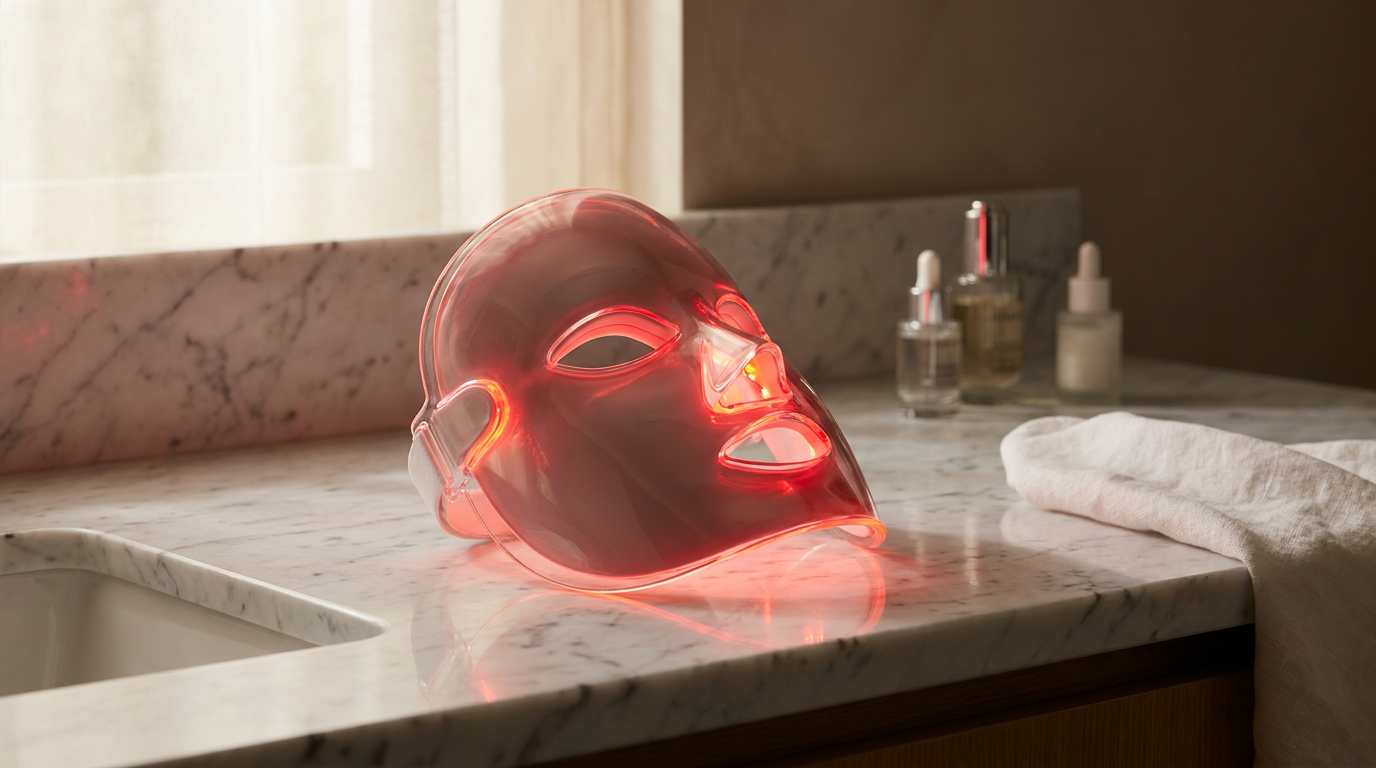
If you have scrolled through social media or walked into a high-end beauty retailer recently, you have likely seen them: glowing, futuristic masks that make the wearer look like a sci-fi extra. Red light therapy (RLT) has transitioned from dermatologist offices and physical therapy clinics into a booming at-home consumer market. Brands promise that spending a few hundred dollars on an LED mask or body panel can erase wrinkles, banish acne, and accelerate muscle recovery. But in an industry notorious for overpromising, consumers are left wondering what the clinical evidence actually supports.[1]
To separate the marketing hype from the science, it is necessary to understand the underlying mechanism, known clinically as photobiomodulation. Unlike ultraviolet light, which damages DNA and causes sunburns, red and near-infrared light penetrate the skin without causing thermal damage. The theory is that these specific wavelengths—typically between 630 and 850 nanometers—are absorbed by the mitochondria, the powerhouses of human cells. This absorption stimulates the production of adenosine triphosphate (ATP), essentially giving cells more energy to perform repair functions, such as synthesizing collagen and reducing inflammation.[2][3][8]
When it comes to anti-aging and wrinkle reduction, the evidence is surprisingly robust for an at-home treatment, though dermatologists caution about managing expectations. A 2023 systematic review documented measurable changes in skin elasticity and collagen density after consistent use. Clinical trials have shown that patients using LED masks for 10 to 20 minutes, several times a week, experienced improvements in skin roughness and firmness over a 12-week period. Researchers utilizing ultrasound imaging have even been able to physically measure the increased dermal thickness in patients who adhered strictly to the protocol, proving that the changes are structural rather than just superficial swelling or hydration.[4][8]

However, experts emphasize that the results are gradual and subtle, requiring a level of patience that many consumers lack. Dr. Heather Rogers, a board-certified dermatologist, notes that while red light therapy is one of the few at-home devices with meaningful clinical data, it will not replace in-office procedures like chemical peels, laser resurfacing, or Botox. Instead, it serves as a long-term maintenance tool that can improve overall skin quality and resilience over months of dedicated use. Furthermore, the results are not permanent; if a user stops the treatments, the cellular benefits typically fade within a few weeks, returning the skin to its baseline state.[4][7]
Some medical professionals are even more skeptical of the consumer craze. Dr. Raman Madan, a dermatologist with Northwell Health, warns that the visible benefits are "very, very modest" at best. He points out that many of the studies demonstrating dramatic improvements in skin texture are sponsored by the companies manufacturing the devices, which introduces a significant risk of bias. "At the end of the day, I don't think you'll have any miracles from it," Madan cautions, suggesting that patients might experience a placebo effect after spending hundreds of dollars on a premium mask.[5]
For acne treatment, the clinical consensus is slightly more definitive and often yields faster visible results than anti-aging protocols. A March 2025 meta-analysis published in JAMA Dermatology reviewed multiple trials and found that at-home LED devices reduced acne lesions by approximately 45% over four to eight weeks. The most effective treatments for breakouts combine red light, which calms the painful inflammation associated with cystic acne, with blue light (around 415 nanometers), which actively targets and kills the Cutibacterium acnes bacteria responsible for the infection. This dual-action approach offers a non-pharmacological alternative for patients who cannot tolerate harsh topical treatments or oral antibiotics.[1][8]

For acne treatment, the clinical consensus is slightly more definitive and often yields faster visible results than anti-aging protocols.
Beyond skincare, red light therapy is heavily marketed to athletes and fitness enthusiasts as a high-tech recovery hack. Companies sell large, expensive LED panels claiming to heal muscle tissue, reduce joint pain, and boost overall strength. Here, the scientific evidence is much murkier and heavily debated among physical therapists. Researchers at Stanford Medicine note that the data supporting red light for athletic performance, sleep improvement, or systemic inflammation reduction is currently lacking, despite the aggressive marketing claims made by wellness influencers.[3]
A comprehensive review of sports science literature reveals highly inconsistent findings. While some studies suggest that applying red light before a workout might slightly delay fatigue or reduce markers of muscle damage like creatine kinase, other trials show absolutely no benefit. Crucially, photobiomodulation does not increase raw muscle strength or hypertrophy. If there is a benefit, it is likely limited to a marginal reduction in delayed-onset muscle soreness (DOMS) for endurance athletes, but the overall certainty of this evidence remains low.[6]
One of the most misunderstood aspects of the red light therapy market is the regulatory labeling. Many brands prominently advertise their masks and panels as "FDA-Cleared," a phrase that consumers often interpret as a guarantee of effectiveness. The American Academy of Dermatology explicitly clarifies that FDA clearance only means the device is considered safe and poses a low risk to the public. It does not mean the FDA has verified the company's claims that the device will actually eliminate wrinkles or regrow hair.[2]

Safety, fortunately, is one area where medical experts largely agree, making the technology highly accessible for home use. Because LED devices do not emit ultraviolet rays, they do not increase the risk of skin cancer, cause sunburns, or damage cellular DNA when used as directed. The most common side effects reported in clinical trials are temporary mild redness or slight eye strain. Because of the intense brightness of the diodes, dermatologists strongly recommend using the built-in eye protection that comes with higher-end masks to prevent long-term retinal fatigue.[4][5]
For consumers deciding whether to invest in a device, the primary variables are wavelength accuracy, irradiance (power output), and lifestyle consistency. Effective devices must emit light at the correct therapeutic wavelengths—typically 630 to 660 nanometers for surface-level skin concerns, and 810 to 850 nanometers for deeper tissue penetration. Many cheap, generic masks sold online lack the precise calibration required to trigger a cellular response, essentially functioning as expensive flashlights. Furthermore, the LEDs must be powerful enough to deliver an adequate dose of energy (measured in joules) to the tissue within a reasonable timeframe.[7][8]

This power differential explains the gap between at-home masks and professional clinical treatments. Dermatologists and physical therapists use medical-grade panels that deliver a much higher concentration of light energy, allowing for shorter sessions and deeper penetration. While at-home devices are generally weaker to ensure consumer safety, they compensate through frequency of use. A daily 10-minute session with a high-quality consumer mask can theoretically accumulate a similar total energy dose over a week as a single professional treatment.[5][7]
Ultimately, the evidence suggests that red light therapy is not a scam, but it is also not a magic wand that will instantly transform your skin or physique. It is a scientifically grounded modality that requires a significant commitment of time—often 10 to 15 minutes a day, four days a week, for several months—to yield visible, lasting results. For those willing to put in the time and consistency, it offers a safe, non-invasive addition to a broader wellness routine, provided they understand the limitations of the technology and maintain realistic expectations about the final outcome.[1][4][7]
How we got here
1990s
NASA begins experimenting with red light therapy to promote plant growth in space and heal astronaut wounds.
2000s
Dermatologists begin using medical-grade LED panels in clinical settings for tissue repair and anti-aging.
2018
The FDA clears several at-home LED devices, sparking the initial wave of consumer red light masks.
2023
Major systematic reviews confirm measurable increases in collagen density from consistent at-home mask use.
2025
A JAMA Dermatology meta-analysis validates the efficacy of combining red and blue light for acne reduction.
Viewpoints in depth
Dermatological Consensus
Views it as a safe, modest adjunct to traditional skincare, emphasizing that it works but requires months of consistency.
Most board-certified dermatologists agree that photobiomodulation is grounded in real science, not pseudoscience. They point to decades of clinical data showing that specific wavelengths of light can stimulate ATP production and collagen synthesis. However, they uniformly stress that at-home devices are significantly weaker than in-office lasers. The consensus is that these masks are excellent for maintaining skin health and reducing inflammation, provided the user is willing to commit to a daily routine for at least three to four months.
Clinical Skeptics
Argues the benefits are overblown by social media and industry-sponsored studies, warning consumers about placebo effects.
A vocal minority of medical professionals warn that the consumer craze has outpaced the actual science. They highlight that many of the most promising studies on LED masks are funded by the device manufacturers themselves, introducing a high risk of bias. From this perspective, while the technology is safe, the visible results are often so subtle that they do not justify the hundreds of dollars spent. Skeptics argue that consumers might be experiencing a placebo effect, mistaking the glow of a dedicated skincare routine for the specific efficacy of the light.
Sports Science Researchers
Views the muscle recovery claims as premature, noting that while it may slightly reduce soreness, it does not build strength.
While the beauty industry has largely embraced red light therapy, the sports science community remains highly divided. Researchers evaluating full-body LED panels for athletic recovery note that the data is wildly inconsistent. Some trials show a slight reduction in delayed-onset muscle soreness (DOMS) and creatine kinase levels, but others show zero measurable benefit. This camp emphasizes that red light therapy does not induce muscle hypertrophy or increase raw power output, cautioning athletes against viewing it as a replacement for sleep, nutrition, and active recovery.
What we don't know
- The exact optimal 'dose' (duration and frequency) required for different specific skin conditions.
- Whether full-body LED panels provide any genuine athletic performance benefits beyond a placebo effect.
- How the long-term efficacy of at-home consumer devices compares directly to clinical-grade in-office treatments over multiple years.
Key terms
- Photobiomodulation
- The clinical term for using specific wavelengths of light to stimulate cellular function and healing.
- Mitochondria
- The energy-producing structures within cells that absorb red and near-infrared light.
- Adenosine Triphosphate (ATP)
- The primary energy carrier in cells, the production of which is boosted by red light therapy.
- Near-Infrared Light
- Light with wavelengths between 760 and 1200 nanometers that penetrates deeper into tissue than visible red light.
- Irradiance
- The power output of a light therapy device, determining how much energy is delivered to the skin over time.
Frequently asked
Does red light therapy cause skin cancer?
No. Unlike UV light, red and near-infrared light do not damage DNA or increase the risk of skin cancer.
How long does it take to see results from an LED mask?
Clinical studies suggest it takes 4 to 12 weeks of consistent use (3-5 times a week) to see measurable improvements in skin texture and wrinkles.
What does 'FDA-Cleared' mean for these devices?
FDA clearance indicates the device is safe for public use and poses a low risk of harm, but it does not guarantee that the device is effective.
Can red light therapy build muscle?
No. Current evidence shows that red light therapy does not increase raw muscle strength or hypertrophy, though it may slightly reduce post-workout soreness.
Sources
Source coverage
8 outlets
3 viewpoints surfaced








[1]Factlen Editorial TeamClinical Optimists
Synthesis by Factlen editorial team
Read on Factlen Editorial Team →[2]American Academy of DermatologyMedical Skeptics
Is red light therapy right for your skin?
Read on American Academy of Dermatology →[3]Stanford MedicineSports Performance Analysts
We turned to our Stanford Medicine experts for some red light answers
Read on Stanford Medicine →[4]Harvard HealthClinical Optimists
Is red light therapy all hype?
Read on Harvard Health →[5]MedPage TodayMedical Skeptics
The Truth About Red Light Therapy Masks, According to a Dermatologist
Read on MedPage Today →[6]ExamineSports Performance Analysts
Is red light therapy beneficial for exercise performance and recovery?
Read on Examine →[7]ForbesClinical Optimists
6 Best LED Face Masks in 2026, Tested by Dermatologists and Beauty Editors
Read on Forbes →[8]Scientific Research PublishingClinical Optimists
Efficacy of Low-Level Light Therapy for Skin Rejuvenation
Read on Scientific Research Publishing →

Every angle. Every day.
Get shopping stories with full source coverage and perspective breakdowns delivered to your inbox.