
Form Energy Launches Commercial Production of 100-Hour Iron-Air Batteries in Historic Steel Town
Climate tech startup Form Energy has opened its first high-volume manufacturing plant in West Virginia, producing revolutionary iron-air batteries that offer multi-day energy storage. The breakthrough technology is already slated for a record-breaking 30 GWh deployment to power a Google data center.
By Factlen Editorial Team
- Climate Tech Innovators
- Focus on solving the renewable intermittency problem through novel, low-cost chemistries.
- AI & Data Center Operators
- Prioritize securing massive, reliable 24/7 clean power to support explosive compute demands.
- Local Economic Development
- View advanced green manufacturing as a vital engine for revitalizing former industrial towns.
What's not represented
- · Lithium-Ion Manufacturers
- · Fossil Fuel Baseload Operators
Why this matters
The ability to store renewable energy for days at a time solves the biggest hurdle to a fully green electrical grid. By using cheap, abundant iron instead of expensive lithium, this technology enables 24/7 clean power for everything from residential grids to massive AI data centers, while reshoring manufacturing jobs to the U.S.
Key points
- Form Energy has launched commercial production of its 100-hour iron-air batteries at a former steel mill in Weirton, West Virginia.
- The startup will deploy a record-breaking 30 GWh battery system in Minnesota to power a new Google data center.
- Iron-air technology stores energy through reversible rusting, offering a vastly cheaper alternative to lithium-ion for multi-day storage.
- The technology provides a critical solution for AI data centers that require 24/7 clean power despite the intermittency of wind and solar.
- The $760 million Weirton factory is expected to employ over 750 workers by 2028, symbolizing a successful Rust Belt economic transition.
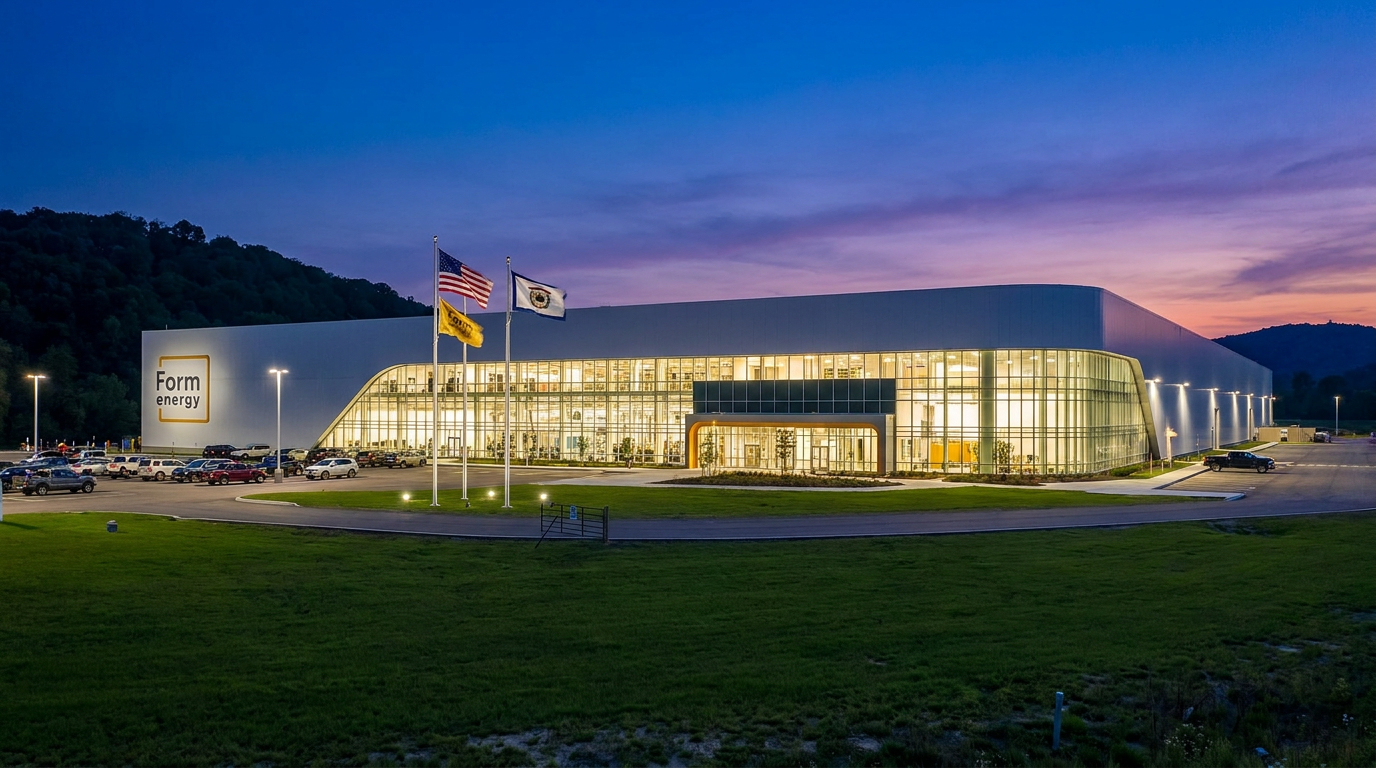
In a milestone for both climate technology and American manufacturing, Form Energy has officially launched high-volume commercial production of its revolutionary iron-air batteries. The startup's first major facility, Form Factory 1, is now operational in Weirton, West Virginia, transforming a 55-acre brownfield site into a hub for next-generation energy storage. The launch marks a critical transition from laboratory promise to commercial reality for a technology designed to solve one of the most stubborn challenges of the renewable energy transition: how to keep the lights on when the wind stops blowing and the sun goes down.[1][7]
The core innovation behind Form Energy's breakthrough is elegantly simple, relying on a process that engineers have traditionally tried to prevent: rusting. The company's iron-air batteries store and discharge electricity through a process of reversible oxidation. When discharging power, the battery takes in oxygen from the air and converts iron metal to rust, releasing electrons. To charge, the application of an electrical current reverses the process, turning the rust back into iron and releasing oxygen.[1][4]
This unique chemistry allows the batteries to deliver continuous electricity for up to 100 hours. By contrast, the lithium-ion batteries that currently dominate grid storage typically max out at around four hours of discharge time due to the high cost of their materials. While lithium-ion remains ideal for short-term daily energy shifting—like covering the evening peak when solar generation drops off—it is prohibitively expensive for bridging multi-day weather events, such as a week-long winter storm or a prolonged lull in wind generation.[3][6]

The commercial viability of this 100-hour storage was cemented in late May 2026, when Form Energy announced a landmark deployment with Xcel Energy. The project will see a 300-megawatt, 30-gigawatt-hour (GWh) iron-air battery system installed in Pine Island, Minnesota, to help power a new Google data center. At 30 GWh, it is the largest battery system by energy capacity ever announced globally, dwarfing previous grid-scale installations.[2][3]
The timing of this technological maturation aligns perfectly with a sudden, massive shift in global energy markets: the explosive growth of artificial intelligence. AI data centers require enormous amounts of continuous, 24/7 electricity to run complex compute workloads. Tech giants have made aggressive commitments to power these operations with carbon-free energy, but the intermittent nature of wind and solar power has made those pledges difficult to honor without relying on fossil-fuel baseload plants.[4][7]
The timing of this technological maturation aligns perfectly with a sudden, massive shift in global energy markets: the explosive growth of artificial intelligence.
Multi-day storage bridges that exact gap. Recognizing this, AI infrastructure developer Crusoe signed a strategic capacity agreement with Form Energy in March 2026 to secure 12 GWh of iron-air battery systems starting in 2027. The "Bring Your Own Capacity" model allows data center operators to pair renewable generation with massive storage, effectively creating their own always-on clean baseload power without destabilizing the local utility grid or driving up rates for residential consumers.[5]

Beyond the technological breakthrough, the materials used in iron-air batteries offer a profound geopolitical and economic advantage. The batteries are manufactured using iron, water, and air—some of the safest, most abundant, and cheapest materials on Earth. This dramatically reduces the supply-chain vulnerabilities associated with critical minerals like lithium, cobalt, and nickel, which are heavily concentrated in a few countries and subject to volatile price swings and intense global competition.[1][8]
The location of Form Factory 1 adds a layer of historic symmetry to the venture. Weirton, West Virginia, was once a booming steel town; the Ernest Weir mill, built in 1909, forged the steel that built mid-century America. But like many Rust Belt communities, Weirton suffered deeply when the steel industry contracted, culminating in the demolition of the old plant in 2019. Now, the town is reinventing itself by manufacturing batteries made of the very material it used to forge.[3][6]

The economic revitalization is already visible. The $760 million factory currently employs roughly 400 people, with plans to expand the facility to 850,000 square feet and grow the workforce to more than 750 employees by 2028. Local officials note that the brightly lit, modern manufacturing plant occupying the footprint of the old, dormant steel mill has become a powerful symbol of hope and economic transition for the community.[2][6]
Form Energy's success is indicative of a broader shift in the climate tech startup ecosystem in 2026. After a period of capital contraction, investment is flowing heavily into deep-tech hardware companies that can demonstrate credible manufacturing progress, secure massive offtake agreements, and solve hard infrastructure bottlenecks. Startups that can operate at the nexus of AI demand and grid reliability are seeing unprecedented commercial traction.[4][8]

As Form Factory 1 ramps up to its target capacity of 500 megawatts of batteries per year, the energy industry will be watching closely. If these multi-day storage systems perform as expected at the Google and Crusoe sites, they will provide the missing link required to fully decarbonize the electrical grid, proving that a reliable, modern economy can run entirely on the wind and the sun.[3][7]
How we got here
2017
Form Energy is founded to develop low-cost, multi-day energy storage systems.
2019
The historic Weirton Steel plant in West Virginia is demolished after years of industry decline.
2023
Form Energy selects the Weirton brownfield site for its first commercial manufacturing facility.
March 2026
AI infrastructure company Crusoe signs a 12 GWh capacity agreement with Form Energy.
May 2026
Form Energy and Xcel Energy announce a record-breaking 30 GWh battery system for a Google data center.
June 2026
Form Factory 1 officially launches high-volume commercial production.
Viewpoints in depth
Climate Tech Innovators
Focus on solving the renewable intermittency problem through novel, low-cost chemistries.
This camp argues that while lithium-ion batteries have successfully decarbonized transportation and short-term grid shifting, they are fundamentally the wrong chemistry for deep grid decarbonization. Because lithium is expensive and supply-constrained, scaling it for multi-day weather lulls is economically impossible. Innovators emphasize that unlocking cheap, abundant materials like iron is the only viable path to a 100% renewable grid that doesn't rely on fossil fuels for backup.
Rust Belt Communities
View advanced green manufacturing as a vital engine for revitalizing former industrial towns.
For decades, former steel and coal towns have borne the economic brunt of globalization and the energy transition. This perspective highlights the profound symbolism and economic relief of reshoring advanced manufacturing to these exact communities. Local leaders argue that the green transition must be paired with domestic industrial strategy, proving that climate tech can create high-quality, blue-collar jobs in the communities that need them most.
AI & Data Center Operators
Prioritize securing massive, reliable 24/7 clean power to support explosive compute demands.
Facing immense public and regulatory pressure to honor zero-carbon pledges, tech giants and AI infrastructure developers view long-duration storage as an operational necessity. They argue that the explosive energy demands of AI compute cannot be met by intermittent wind and solar alone. For this camp, investing in multi-day battery storage is a strategic imperative to ensure constant uptime without resorting to natural gas or coal baseload plants.
What we don't know
- While the 60% round-trip efficiency of iron-air batteries is lower than lithium-ion, it remains to be seen how this will impact overall project economics at scale.
- The exact timeline for when the 30 GWh Minnesota project will be fully operational and integrated into the Xcel Energy grid has not been finalized.
- It is unclear how quickly Form Energy can scale its supply chain to meet the sudden, massive demand from the AI data center sector.
Key terms
- Iron-Air Battery
- A type of energy storage that generates power by exposing iron to oxygen (rusting) and stores power by reversing the process.
- Multi-Day Storage
- Battery systems capable of discharging continuous electricity for 100 hours or more, bridging gaps when wind and solar are unavailable.
- Gigawatt-hour (GWh)
- A unit of energy representing one billion watt-hours, used to measure massive grid-scale battery capacity.
- Baseload Power
- The minimum, continuous amount of electric power needed to be supplied to the electrical grid at any given time.
Frequently asked
What is an iron-air battery?
An iron-air battery stores and releases electricity through a process of reversible rusting. It takes in oxygen to rust iron and release power, then uses electricity to turn the rust back into iron.
Why not just use lithium-ion batteries?
Lithium-ion batteries are excellent for short-term storage but become prohibitively expensive for durations longer than four hours. Iron-air batteries use cheap, abundant materials to provide up to 100 hours of continuous power.
Where are these batteries being manufactured?
Form Energy is manufacturing the batteries at Form Factory 1 in Weirton, West Virginia, located on the historic site of a former steel mill.
How does this technology help AI data centers?
AI data centers require massive, uninterrupted 24/7 power. Multi-day iron-air batteries can store enough wind and solar energy to keep data centers running cleanly even during prolonged weather lulls.
Sources
Source coverage
8 outlets
3 viewpoints surfaced








[1]Form EnergyClimate Tech Innovators
Manufacturing Iron-Air Batteries in the Heart of the Rust Belt
Read on Form Energy →[2]City of WeirtonLocal Economic Development
Form Energy Shares Exciting News for Weirton!
Read on City of Weirton →[3]AutonocionLocal Economic Development
A West Virginia steel town forged the iron that built mid-century America... now it's making batteries
Read on Autonocion →[4]TrellisClimate Tech Innovators
15 Climate Tech Startups to Watch in 2026
Read on Trellis →[5]CrusoeAI & Data Center Operators
Form Energy and Crusoe Announce Strategic Capacity Agreement
Read on Crusoe →[6]SEDCLocal Economic Development
Form Energy is transforming a former steel town into an advanced manufacturing hub
Read on SEDC →[7]Factlen Editorial TeamClimate Tech Innovators
Synthesis by Factlen editorial team
Read on Factlen Editorial Team →[8]Blazon AgencyClimate Tech Innovators
Top Climate Tech Startups to Watch in 2026
Read on Blazon Agency →
Every angle. Every day.
Get business stories with full source coverage and perspective breakdowns delivered to your inbox.