
The Evidence for Autonomous MedEvac: How Drones Are Reshaping Casualty Extraction
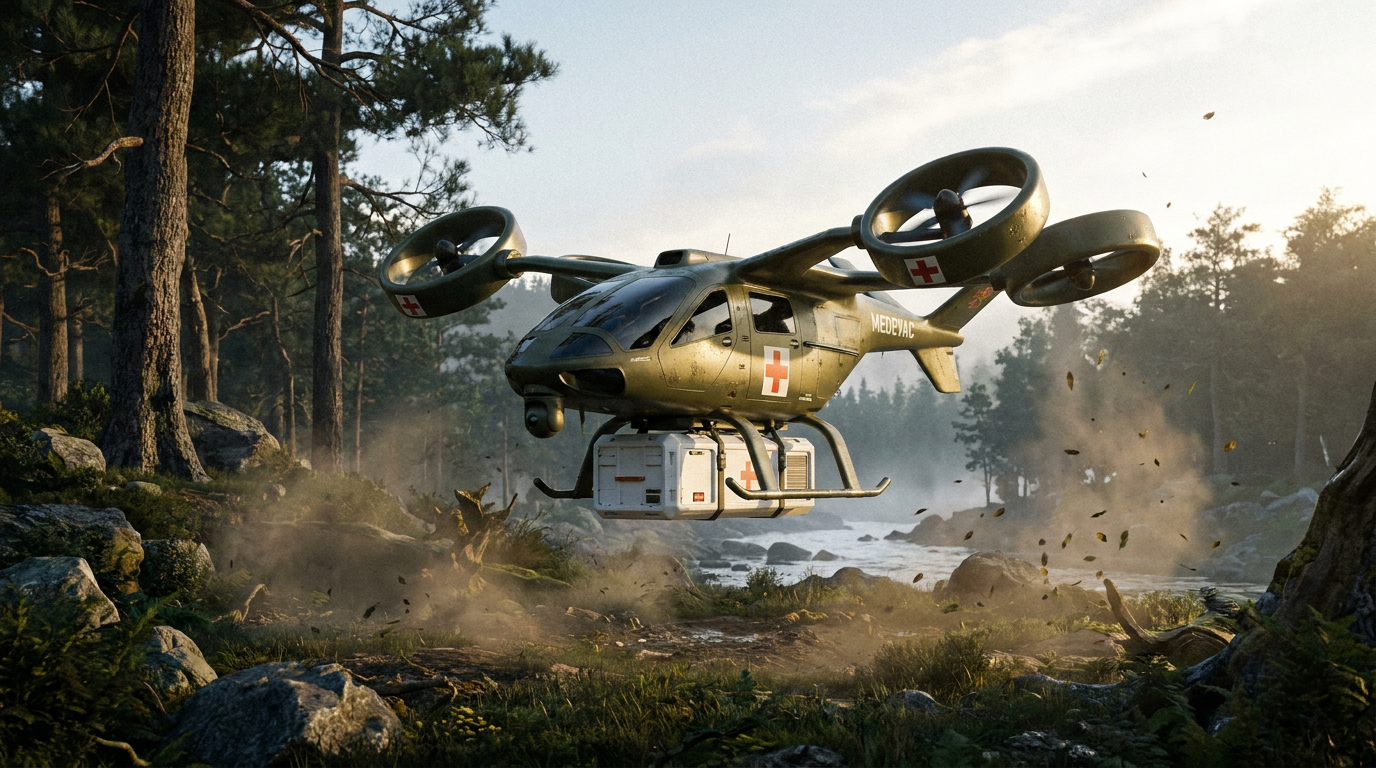
Heavy-lift drones and AI-driven navigation systems are moving from concept to field testing, promising to extract casualties from hazardous environments without risking human flight crews.
By Factlen Editorial Team
- Defense Technologists
- Prioritizes rapid prototyping, payload capacity, and the integration of AI-driven navigation systems.
- Military Commanders
- Focuses on operational reliability, rules of engagement, and the trust required to deploy autonomous systems.
- Medical Personnel
- Emphasizes the 'golden hour', triage accuracy, and maintaining continuous patient monitoring.
What's not represented
- · Civilian disaster relief organizations
- · Aviation regulatory bodies (e.g., FAA, EASA)
Why this matters
By removing human flight crews from the line of fire, autonomous MedEvac drones could drastically reduce casualties in combat and disaster zones. This technology ensures that life-saving extraction can occur in environments previously deemed too dangerous for traditional helicopters.
Key points
- NATO forces successfully tested the Flowcopter FC-100 heavy-lift drone for casualty evacuation during the Sabre Strike 2026 exercises.
- DARPA is fast-tracking flight tests for five advanced VTOL drone prototypes capable of carrying 60-pound payloads over 100 nautical miles.
- Sikorsky's MATRIX autonomy software allowed an untrained soldier to command an optionally piloted Black Hawk during a simulated MedEvac.
- The primary barrier to widespread adoption is shifting military doctrine to trust autonomous machines with human lives.
In modern conflict zones and disaster areas, the "golden hour"—the critical window for life-saving medical intervention—is increasingly compromised by contested airspace and hazardous terrain. Traditional medical evacuation relies on crewed helicopters, which require secure landing zones and expose flight crews to significant risk. When an environment is deemed too dangerous for a human crew, wounded personnel are often left waiting, drastically reducing their chances of survival.[6]
To solve this, defense agencies and aerospace contractors are rapidly advancing autonomous MedEvac drones and electric vertical takeoff and landing (eVTOL) aircraft. This evidence pack evaluates the core claims surrounding the deployment of these uncrewed systems, mapping the technological progress against the remaining operational uncertainties.
The first major claim is that heavy-lift autonomous platforms can now reliably transport human casualties over tactically significant distances. The evidence for this capability is strong and moving rapidly from simulation to field testing.
During the NATO Sabre Strike 2026 exercises in Poland, American and Polish forces successfully tested the Flowcopter FC-100, a gas-powered heavy-lift drone, for battlefield casualty evacuation. This exercise marked one of the most visible evaluations of autonomous unmanned systems in a medical role, demonstrating that the hardware can operate without the infrastructure required by traditional helicopters.[1]

Further supporting this claim, the German manufacturer Avilus recently completed the maiden flight of its Wespe tactical multi-role helicopter UAV. The platform, developed in partnership with South Korea's UI Helicopter, features a dedicated medical evacuation cabin and offers payload capacities of up to 350 kilograms in its turbine-powered variant.[2]
The U.S. Defense Advanced Research Projects Agency is also accelerating this hardware through its EVADE project. The agency is fast-tracking flight tests for five advanced Unmanned Aerial Systems prototypes, all required to maintain a minimum flight endurance of 12 hours and a range of 100 nautical miles.[5]
Addressing the uncertainty for this first claim, while payload and range metrics are increasingly validated, the evidence for autonomous takeoff and landing in severe weather or high sea states remains weak. DARPA has explicitly deferred specific requirements regarding high sea state operations to focus on rapid prototyping, indicating that environmental limitations are still a factor.[5]
The second major claim asserts that AI-driven navigation and triage systems can safely manage the entire evacuation chain without an onboard pilot. The evidence here is robust for navigation, but still developing for automated medical triage.
The second major claim asserts that AI-driven navigation and triage systems can safely manage the entire evacuation chain without an onboard pilot.
On the navigation front, Sikorsky's MATRIX flight autonomy software has demonstrated high reliability. In a recent milestone, an optionally piloted Black Hawk helicopter completed a simulated MedEvac recovery where an untrained soldier commanded the aircraft from within to execute a patient transfer at an unimproved landing zone.[4]

For medical triage, the European Union's SALUBRIS project—led by Maritime Robotics and Biodrone—is actively developing systems for the detection, classification, and transport of casualties. The goal is to enable unmanned systems to support battlefield triage and prioritize wounded personnel before extraction.[3]
The U.S. Military Health System's Autonomous Care and Evacuation portfolio is similarly funding the development of forward-deployed intelligent trauma systems. These systems aim to integrate wearable health monitoring sensors to provide a live feed of vital parameters to receiving medical facilities.[7]
A critical uncertainty for this second claim is highlighted by the Journal of Military and Veterans Health, which points to the vulnerability of bandwidth and connectivity denial. In highly contested environments, electronic warfare could sever the link between the drone and remote clinicians. The evidence suggests that until these systems can function entirely offline via local algorithmic decision-making, their reliability in peer-conflict scenarios remains uncertain.[6]
The third major claim is that the primary barrier to deployment is no longer engineering, but military doctrine and human trust. The evidence strongly supports this assertion.
Analysts observing the NATO Sabre Strike exercises noted that the limiting factor on autonomous MedEvac is the psychological threshold required before a commander sends a machine instead of a human crew to recover a wounded soldier. The hardware is capable, but the rules of engagement and operational doctrine have not yet caught up.[1]

To build this trust, military health strategies emphasize manned-unmanned teaming. By integrating autonomous systems gradually—first for medical resupply, then for casualty extraction under human supervision—commanders can build the operational record necessary to shift doctrine.[1][7]
Beyond the battlefield, the evidence points to a massive dual-use potential for these technologies. The NORDSEC cluster notes that autonomous MedEvac systems developed for defense can be seamlessly adapted for civilian disaster relief, search and rescue, and emergency response in remote or inaccessible areas.[3]
Ultimately, the data indicates that autonomous casualty extraction is transitioning from a theoretical concept to a standard capability. As the technology matures and doctrine adapts, these uncrewed systems stand to revolutionize trauma care, ensuring that life-saving interventions can reach those in need, regardless of the environment.[1][6]
How we got here
2018
The Australian Army publishes its Robotic and Autonomous Systems strategy, highlighting the need for AI in casualty extraction.
2020
The U.S. Army funds the Autonomous Casualty Extraction (ACE) program to develop mobile manipulation robots.
2025
DARPA fast-tracks the EVADE project, pushing five advanced VTOL drone prototypes into rapid flight testing.
May 2026
NATO forces successfully test the Flowcopter FC-100 heavy-lift drone for casualty evacuation during the Sabre Strike exercises in Poland.
Viewpoints in depth
Military Commanders' View
Focuses on operational reliability, rules of engagement, and the trust required to deploy autonomous systems.
For battlefield commanders, the primary concern is not just whether a drone can lift a casualty, but whether it can be trusted in the chaos of a contested environment. Doctrine currently dictates that human crews evaluate risk and make split-second decisions during a MedEvac. Transitioning to autonomous systems requires building an operational record that proves these machines can handle unpredictable variables without endangering the patient further.
Defense Technologists' View
Prioritizes rapid prototyping, payload capacity, and the integration of AI-driven navigation systems.
Aerospace engineers and defense contractors view the challenge as a solvable engineering problem. By leveraging existing autonomous flight software like Sikorsky's MATRIX and focusing on heavy-lift VTOL designs, they argue that the hardware is already capable of outperforming crewed helicopters in terms of endurance and risk reduction. Their focus is on pushing platforms through rapid testing phases to iron out edge cases.
Medical Personnel's View
Emphasizes the 'golden hour', triage accuracy, and maintaining continuous patient monitoring.
Combat medics and military health officials evaluate these systems based on patient outcomes. Their priority is ensuring that autonomous extraction does not mean a lapse in care. They advocate for the integration of AI-driven triage and wearable sensors that provide a continuous feed of vital signs to receiving hospitals, ensuring that the casualty is monitored and stabilized even when a human medic cannot be physically present during the flight.
What we don't know
- How well these autonomous systems will perform in severe weather or high sea states, which DARPA has temporarily deferred in testing.
- Whether the drones can maintain operational effectiveness if electronic warfare completely severs their communication links.
- How quickly civilian aviation authorities will certify these military-grade autonomous platforms for domestic disaster relief.
Key terms
- eVTOL
- Electric vertical takeoff and landing aircraft, which can hover like a helicopter but fly efficiently like an airplane.
- MUM-T
- Manned-Unmanned Teaming, a military concept where human operators work collaboratively with autonomous robotic systems.
- Group 3 UAS
- A military classification for unmanned aerial systems weighing between 56 and 1,320 pounds, typically operating below 18,000 feet.
- Golden Hour
- The critical 60-minute window following a traumatic injury where rapid medical intervention significantly increases the chances of survival.
Frequently asked
Can a drone actually carry a human?
Yes. Modern heavy-lift tactical drones, such as the Avilus Wespe and Flowcopter FC-100, are designed with payload capacities ranging from 200 to 350 kilograms, easily accommodating a human casualty and a medical cabin.
How does the drone know where to go?
These systems use advanced autonomous flight software, like Sikorsky's MATRIX, which handles navigation, obstacle avoidance, and landing without requiring a human pilot to manually steer the aircraft.
What happens if the drone loses connection?
This remains a key challenge. Developers are working to incorporate algorithmic decision support directly into the drone's hardware, allowing it to function offline and complete its mission even if electronic warfare severs its communication link.
Sources
Source coverage
7 outlets
3 viewpoints surfaced






[1]DroneXLMilitary Commanders
Nato Tests Flowcopter Medevac Drone In Poland Exercise
Read on DroneXL →[2]Unmanned Systems TechnologyDefense Technologists
AVILUS & UI Helicopter Partner to Develop Autonomous MEDEVAC Systems
Read on Unmanned Systems Technology →[3]NORDSEC ClusterDefense Technologists
Maritime Robotics and Biodrone central in new EU-funded autonomous battlefield medical project SALUBRIS
Read on NORDSEC Cluster →[4]Defence Industry EuropeDefense Technologists
Sikorsky demonstrates autonomous Black Hawk for MEDEVAC
Read on Defence Industry Europe →[5]DARPADefense Technologists
DARPA to test 5 light VTOL drones that can navigate autonomously
Read on DARPA →[6]Journal of Military and Veterans HealthMedical Personnel
Future battlefield medicine utilising robotic systems and crewless ground vehicles
Read on Journal of Military and Veterans Health →[7]U.S. Military Health SystemMedical Personnel
Medical Assist Support Technologies (MAST)/Autonomous Care and Evacuation (ACE)
Read on U.S. Military Health System →
Every angle. Every day.
Get defense security stories with full source coverage and perspective breakdowns delivered to your inbox.