
The End of the Quantum Physics Experiment: How Logical Qubits Ushered in the Engineering Era
A series of breakthroughs in quantum error correction has shifted the industry from noisy, fragile prototypes to stable, fault-tolerant architectures. By grouping physical qubits into reliable 'logical' qubits, researchers have dramatically accelerated the timeline for commercially useful quantum computers.
By Factlen Editorial Team
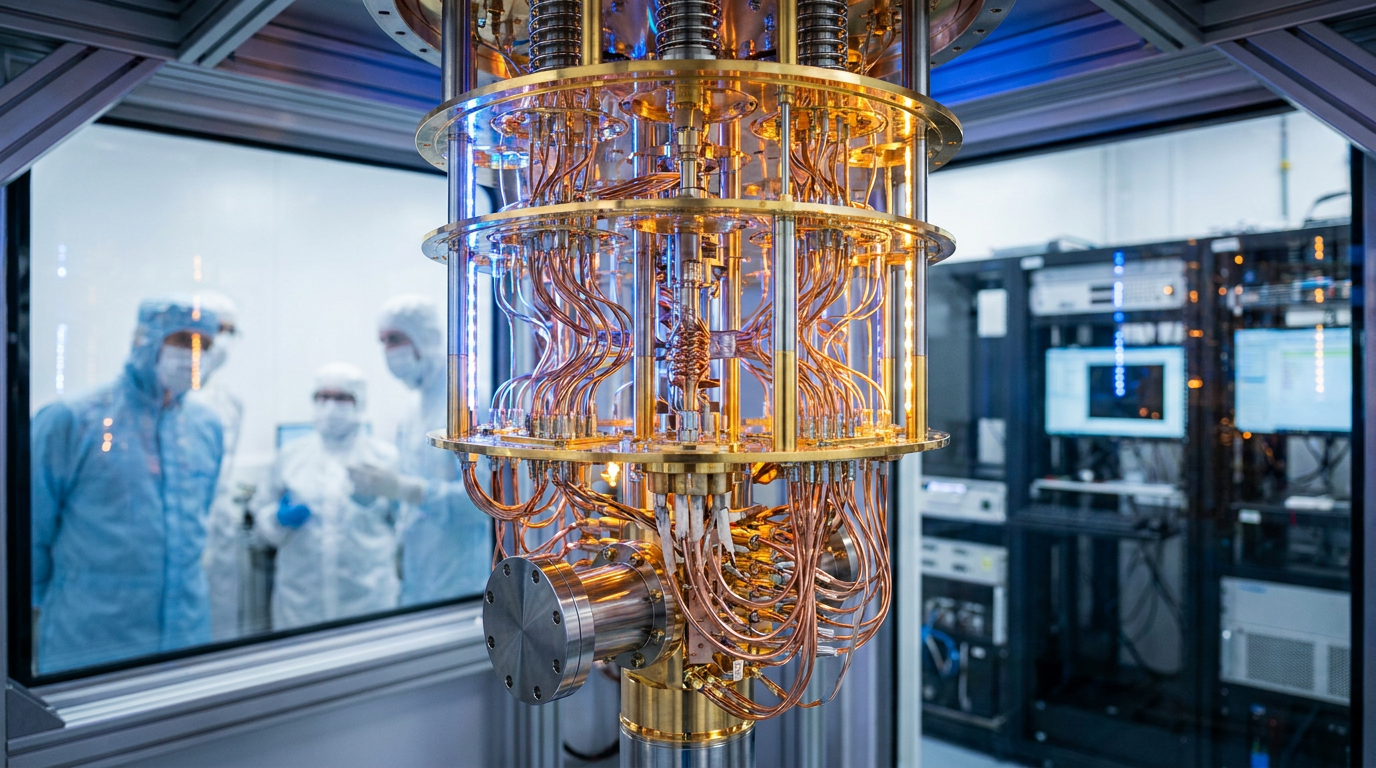
- Superconducting Circuit Developers
- Argue that solid-state chips offer the fastest gate speeds and best leverage existing semiconductor manufacturing.
- Neutral Atom & Ion Trap Innovators
- Argue that perfectly identical atoms and high connectivity offer the most efficient path to error correction.
- Quantum Theorists
- Focus on the mathematical proofs of error correction codes and below-threshold scaling.
- Commercial Adopters
- Focus on integrating quantum accelerators into existing classical high-performance computing workflows.
What's not represented
- · Cybersecurity experts concerned about encryption
- · Government regulators monitoring quantum export controls
Why this matters
For decades, quantum computing was trapped in a paradox: the systems were too fragile to run the complex calculations they were designed for. The successful demonstration of logical qubits means the hardware can now correct its own errors in real time, moving quantum computing from a theoretical physics problem to a scalable engineering discipline that will accelerate drug discovery, materials science, and cryptography.
Key points
- Quantum computers have historically been limited by the extreme fragility of physical qubits, which easily lose their state to environmental noise.
- Researchers have successfully created 'logical qubits' by grouping multiple physical qubits together to act as a single, error-corrected unit.
- Microsoft and Quantinuum demonstrated an 800-fold reduction in error rates using trapped-ion hardware.
- Harvard, MIT, and QuEra proved that logical error rates decrease exponentially as more neutral-atom qubits are added to the system.
- The breakthroughs shift quantum computing from a theoretical physics challenge to a scalable engineering discipline.
For decades, quantum computing has been the ultimate technology of "tomorrow"—a field defined by staggering theoretical promise and equally staggering physical fragility. The core unit of quantum information, the physical qubit, is notoriously unstable. Even the slightest environmental noise, a stray photon, or a microscopic temperature fluctuation can cause a qubit to lose its quantum state, a phenomenon known as decoherence.[6]
This fragility trapped the industry in what researchers call the Noisy Intermediate-Scale Quantum (NISQ) era. Engineers could build processors with dozens or even hundreds of physical qubits, but the error rates were too high to run deep, complex algorithms. The machines were brilliant, but fundamentally unreliable.[4][6]
Over the past 24 months, that paradigm has shattered. A cascade of breakthroughs across academia and industry has proven that quantum error correction—long a theoretical holy grail—actually works in practice. The field has officially crossed into the "fault-tolerant foundation era," where quantum computers can detect and fix their own errors in real time.[5][7]
The secret lies in a concept called the "logical qubit." Rather than relying on a single, fragile physical qubit to hold a piece of information, engineers group dozens or hundreds of physical qubits together to act as a single, highly stable virtual qubit. If one physical qubit in the cluster flips or decoheres, the others act as a redundant safety net, allowing the system to correct the error without interrupting the calculation.[2][6]

The turning point arrived when Microsoft and Quantinuum successfully applied a sophisticated qubit-virtualization system to ion-trap hardware. By grouping 30 physical qubits into four logical qubits, they achieved an astonishing 800-fold reduction in error rates. The team ran 14,000 independent instances of a quantum circuit without a single error, effectively proving that software-driven error correction could tame hardware noise.[2]
"An 800x improvement in error rate corresponds to a 29 dB improvement of signal, which is the same as that achieved with a high-quality noise-canceling headset," Microsoft researchers noted. Just as noise-canceling headphones use active sound waves to neutralize airplane engine roar, active syndrome extraction neutralizes the quantum noise that destroys calculations.[2]
While Microsoft and Quantinuum proved the concept on trapped ions, a collaboration between Harvard University, MIT, and QuEra Computing proved that logical qubits could scale massively using neutral atoms. In a landmark Nature paper, the team demonstrated an integrated architecture using 448 rubidium atoms suspended in optical tweezers.[4][5]
In a landmark Nature paper, the team demonstrated an integrated architecture using 448 rubidium atoms suspended in optical tweezers.
The Harvard-led team didn't just build logical qubits; they demonstrated the ability to execute hundreds of logical gate operations. More importantly, they crossed a critical mathematical threshold: they proved that as they added more physical qubits to the system, the logical error rate went down, not up. This "below-threshold" scaling is the definitive proof that fault-tolerant quantum computing is physically possible.[4][5]

But simply storing information isn't enough; a universal quantum computer must be able to perform complex, non-standard operations. This requires "magic states"—special high-quality quantum states that are incredibly resource-intensive to generate. In mid-2025, the QuEra and Harvard team successfully demonstrated "magic state distillation" entirely on logical qubits, completing the toolkit required for universal computation.[1][8]
The hardware race is now fracturing into distinct architectural philosophies. Tech giants like IBM and Google are betting heavily on superconducting circuits. IBM's updated roadmap targets the "Starling" system by 2029, which aims to run 100 million gates across 200 logical qubits using a highly efficient error-correcting code known as bivariate bicycle codes.[3][7]
Conversely, startups like QuEra and Atom Computing are championing neutral atoms, which offer identical qubits and the ability to dynamically move atoms around during a computation. This high connectivity allows for highly efficient error correction, leading some researchers to estimate that a commercially useful quantum computer might only require 10,000 to 20,000 physical qubits—a massive reduction from previous estimates of millions.[5][8]

Despite the rapid progress, quantum computers are not poised to replace classical laptops or smartphones. Classical bits remain perfectly suited for general-purpose computing, web browsing, and standard software. Instead, the future is hybrid.[6]
In this hybrid model, classical supercomputers will handle the bulk of a workflow, calling on a quantum co-processor specifically to solve intractable bottlenecks—like simulating the exact molecular binding of a new pharmaceutical drug, or optimizing a global logistics network.[3][6]
The era of quantum computing as a pure physics experiment is drawing to a close. By proving that logical qubits can suppress errors exponentially, the industry has transformed quantum computing into a scalable engineering discipline. The remaining challenges are immense—wiring, cooling, and laser control at scale—but the fundamental physics no longer stand in the way.[6][7]
How we got here
Dec 2023
Harvard researchers demonstrate the first programmable logical quantum processor with 48 logical qubits.
April 2024
Microsoft and Quantinuum achieve an 800-fold reduction in error rates by creating four highly reliable logical qubits from 30 physical trapped-ion qubits.
June 2025
IBM updates its roadmap, targeting the delivery of the 'Starling' system with 200 logical qubits by 2029.
July 2025
QuEra, Harvard, and MIT successfully demonstrate magic state distillation entirely on logical qubits, unlocking universal computation.
Nov 2025
Harvard and collaborators publish a Nature paper demonstrating a scalable fault-tolerant architecture using 448 neutral atom qubits.
Viewpoints in depth
Superconducting Circuit Developers
Advocates for building qubits using established semiconductor fabrication techniques.
Companies like IBM and Google argue that superconducting qubits offer the fastest gate speeds and the clearest path to commercial scaling, because they leverage the same lithography and fabrication infrastructure that built the modern silicon industry. While they require extreme cryogenic cooling, their solid-state nature makes them highly reliable for rapid, sequential gate operations.
Neutral Atom & Ion Trap Innovators
Advocates for using individual atoms or ions suspended by lasers as qubits.
Firms like QuEra, Atom Computing, and Quantinuum point out that every atom of a specific isotope is perfectly identical, eliminating the manufacturing defects that plague solid-state qubits. Furthermore, because these atoms are suspended in a vacuum by optical tweezers, they can be physically moved around during a computation, allowing for 'all-to-all connectivity' that makes error correction significantly more efficient.
Enterprise Adopters
Organizations looking to integrate quantum capabilities into existing classical workflows.
For industries like pharmaceuticals, finance, and logistics, the underlying hardware architecture matters less than the software integration. These adopters are focused on hybrid quantum-classical cloud environments, where a classical supercomputer orchestrates a workflow and only offloads specific, highly complex mathematical bottlenecks to the quantum processor.
What we don't know
- Which hardware architecture (superconducting, neutral atom, or trapped ion) will ultimately dominate the commercial market.
- Exactly when the first fully fault-tolerant quantum computer will achieve 'quantum advantage' over classical supercomputers in a commercial setting.
- How quickly the supply chain for specialized quantum components (like cryogenic cooling and precision lasers) can scale to meet industrial demand.
Key terms
- Qubit
- The basic unit of quantum information, capable of existing in multiple states simultaneously, unlike a classical bit which is strictly a 0 or a 1.
- Decoherence
- The process by which a qubit loses its fragile quantum state due to interference from the outside environment, such as heat or electromagnetic noise.
- Fault Tolerance
- The ability of a computing system to continue operating reliably even when individual components fail or produce errors.
- Magic State Distillation
- A complex error-correction protocol used to generate highly pure quantum states, which are required to perform the advanced logic gates necessary for universal quantum computing.
- Syndrome Extraction
- The process of measuring a quantum system to detect where an error has occurred without actually measuring (and thereby destroying) the quantum information itself.
Frequently asked
What is the difference between a physical and logical qubit?
A physical qubit is the actual hardware component (like an atom or a superconducting circuit) that holds quantum information, but it is highly prone to errors. A logical qubit is a 'virtual' qubit created by grouping many physical qubits together using software, allowing the system to detect and correct errors in real time.
Will quantum computers replace classical computers?
No. Classical computers are perfectly suited for general-purpose tasks like web browsing and word processing. Quantum computers will act as specialized co-processors, used specifically to solve complex problems in chemistry, materials science, and optimization that classical machines cannot handle.
What is quantum error correction?
It is a set of algorithms and hardware designs that allow a quantum computer to monitor its qubits for errors caused by environmental noise (decoherence) and fix them without destroying the underlying quantum calculation.
Why are neutral atoms gaining traction?
Neutral atoms are perfectly identical to one another, which reduces manufacturing defects. They can also be moved around dynamically using lasers, which makes it easier to connect different qubits together for efficient error correction.
Sources
Source coverage
8 outlets
4 viewpoints surfaced








[1]NatureQuantum Theorists
Experimental Demonstration of Logical Magic State Distillation
Read on Nature →[2]MicrosoftNeutral Atom & Ion Trap Innovators
Microsoft and Quantinuum demonstrate the most reliable logical qubits on record
Read on Microsoft →[3]IBM ResearchSuperconducting Circuit Developers
Building a fault-tolerant quantum computer
Read on IBM Research →[4]Harvard UniversityNeutral Atom & Ion Trap Innovators
Harvard researchers realize key milestone in quest for stable, scalable quantum computing
Read on Harvard University →[5]Quantum Computing ReportCommercial Adopters
Harvard and Collaborators Demonstrate Scalable Fault-Tolerant Architecture with 448 Neutral Atom Qubits
Read on Quantum Computing Report →[6]Factlen Editorial TeamCommercial Adopters
Synthesis by Factlen editorial team
Read on Factlen Editorial Team →[7]RiverlaneQuantum Theorists
12 significant announcements from the world of quantum error correction
Read on Riverlane →[8]QuEra ComputingNeutral Atom & Ion Trap Innovators
Landmark experiment delivers a key building block for universal, fault-tolerant quantum computing
Read on QuEra Computing →
More in technology
See all 76 stories →AI Security
Evidence Pack: How Defensive AI is Outpacing the Automation of Cybercrime
8 sources

Web Trust
How Portable Social Graphs Are Finally Letting Users Own Their Online Networks
6 sources

Green Cloud
The Zero-Carbon Cloud: How Geothermal Energy and AI Are Decarbonizing Data Centers
9 sources
AI Architecture
Why Enterprises Are Abandoning Massive AI for Small Language Models
9 sources
Every angle. Every day.
Get technology stories with full source coverage and perspective breakdowns delivered to your inbox.