
The Alpha Wolf Myth: How a Scientific Error Changed Our View of Nature
For decades, the concept of the 'alpha wolf' fighting for dominance has shaped how we view animal and human behavior. But the scientist who popularized the idea has spent the last 25 years trying to correct the record: wild wolf packs are actually just cooperative families.
By Factlen Editorial Team
- Wildlife Biologists
- Focus on accurate field observations and the nuclear family structure of wild packs.
- Conservation Organizations
- Highlight the cooperative, empathetic nature of wolves to promote ecological protection.
- Public Science Communicators
- Focus on debunking the cultural myth and correcting its impact on psychology and dog training.
What's not represented
- · Authors of werewolf and fantasy fiction
- · Dominance-based dog trainers
Why this matters
The 'alpha' myth has deeply influenced how humans approach leadership, social dynamics, and even dog training, often promoting unnecessary aggression. Understanding the true, cooperative nature of wolf families offers a healthier, science-backed model for leadership and animal welfare.
Key points
- The 'alpha wolf' concept originated from a flawed 1947 study of captive, unrelated wolves forced into a small enclosure.
- Wild wolf packs are actually nuclear families consisting of a breeding pair and their offspring.
- Young wolves do not fight their parents for dominance; they naturally disperse to start their own families.
- The scientist who popularized the alpha myth in 1970 has spent the last 25 years trying to correct the record.
If you ask the average person to describe a wolf pack, they will likely sketch a ruthless hierarchy. At the top sits the "alpha male," a dominant dictator who fought his way to power through tooth, claw, and sheer aggression. Below him are the betas, and at the bottom, the submissive omegas. This concept of the alpha wolf has deeply infiltrated human culture, serving as a metaphor for aggressive business tactics, "alpha male" dating strategies, and dominance-based dog training.[5][8]
There is only one problem with the alpha wolf: in the wild, it does not exist. For the past twenty-five years, wildlife biologists have been trying to correct a scientific error that accidentally reshaped our understanding of animal and human behavior.[1][7]
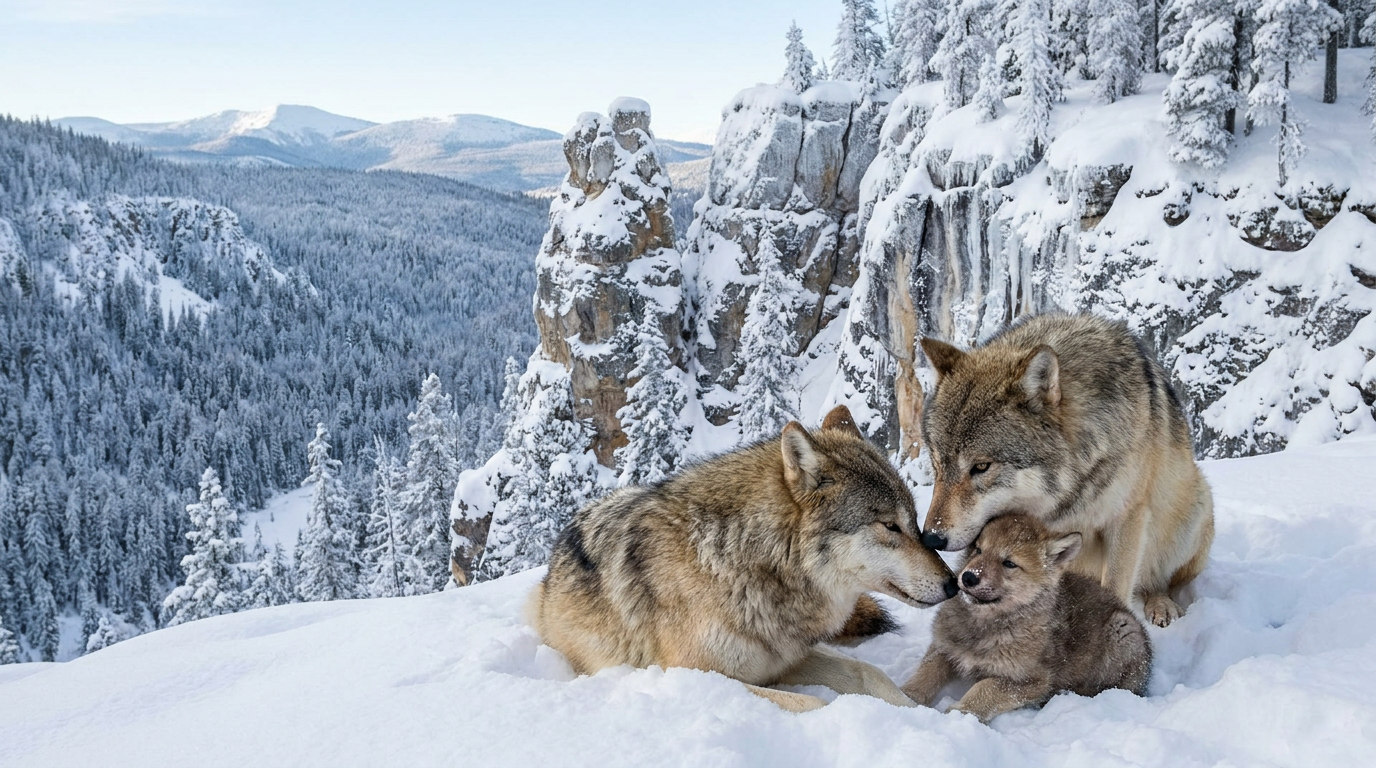
The true story of the wolf pack is not one of brutal competition, but of cooperation, alloparenting, and deep familial bonds. In their natural habitats, wolves do not fight for the right to lead. They simply grow up, find a mate, and become parents.[2][4]
To understand how the world got wolf behavior so wrong, we have to look back to 1947. Swiss animal behaviorist Rudolph Schenkel published a groundbreaking paper based on his observations of wolves at Zoo Basel. Schenkel noted violent rivalries and a strict rank order, coining the terms "alpha" and "beta" to describe the victors and the vanquished.[5][8]

However, Schenkel's study had a fatal design flaw. He was observing captive wolves that had been gathered from different locations and forced to live together in a confined enclosure. They were unrelated adults, stripped of their natural social structures and unable to leave.[1][5]
Biologists today compare this captive environment to a human prison. If you place a group of unrelated, stressed human strangers into a small cell, violent hierarchies and dominance struggles will inevitably emerge. But it would be scientifically inaccurate to observe that prison yard and conclude that this is how the human family naturally operates.[7][8]
Despite this flaw, the captive model became the scientific consensus. In 1970, a young wildlife biologist named L. David Mech published 'The Wolf: Ecology and Behavior of an Endangered Species'. Relying on the best available data at the time, Mech's book heavily featured the alpha concept. It became a massive bestseller, cementing the alpha wolf in the public imagination.[5][8]
Despite this flaw, the captive model became the scientific consensus.
But science is a process of continuous correction. As tracking technology improved and wolves were reintroduced to places like Yellowstone National Park, researchers were finally able to observe wild wolves in their natural habitats for extended periods. Mech himself spent decades studying wild packs on Ellesmere Island in Canada.[1][7]

What Mech and other biologists witnessed in the wild contradicted everything in the textbooks. They did not see fierce battles for dominance. They did not see betas overthrowing alphas. Instead, they saw nuclear families.[1][4]
A typical wild wolf pack consists of a breeding pair—the mother and father—and their offspring from the past one to three years. The parents lead the pack not through aggression, but through the natural authority of being parents. They guide the daily activities, decide when to hunt, and protect the group.[4][7]
When the pups reach maturity, usually between one and three years of age, they do not challenge their parents for control of the pack. Instead, their natural instinct is to disperse. They leave their family territory, search for a mate, and start a new family of their own.[4][5]
Within the family unit, the dynamics are remarkably cooperative. Wolves practice "alloparenting," meaning older siblings help raise and feed the new litters of pups. Pack members care for sick or injured individuals, and older wolves pass down hunting strategies and territorial knowledge to the younger generation.[2][4]

In 1999, Mech published a paper in the Canadian Journal of Zoology formally renouncing the alpha concept, stating that the term should be abandoned for wild populations. He spent the subsequent years pleading with his publisher to stop printing his 1970 bestseller, arguing that the information was outdated and misleading.[5][6]
Despite the scientific community moving on, the cultural myth proved impossible to kill. The alpha concept had already spawned a massive industry of dominance-based dog training, popularized by television personalities who advised owners to physically assert dominance over their pets. Veterinary associations have since condemned these methods, noting that they increase fear and aggression in dogs.[8]
The myth also seeped into human leadership models, promoting the false notion that successful leadership requires coercion and the suppression of rivals. In reality, the most successful apex predators in North America thrive under a completely different model: supportive, experienced leadership focused on the survival of the group.[2][8]
How we got here
1947
Rudolph Schenkel publishes a study on captive wolves, coining the terms 'alpha' and 'beta' to describe dominance fights.
1970
Biologist L. David Mech publishes a bestselling book that popularizes the alpha wolf concept globally.
1999
After decades of observing wild wolves, Mech publishes a paper formally retracting the alpha concept, explaining that packs are simply families.
Present
Despite scientific consensus, the myth continues to influence popular culture, human leadership models, and dog training.
Viewpoints in depth
Wildlife Biologists
Emphasize that wild wolf packs are nuclear families led by parents, not aggressive dictators.
Modern field biologists stress that the captive wolf studies of the 1940s created an artificial environment that distorted natural behavior. By observing wolves in places like Yellowstone and the high Arctic, researchers confirmed that leadership in a pack is not won through combat. Instead, it is a natural division of labor where parents guide, protect, and provide for their offspring until the young are old enough to disperse.
Conservation Organizations
Focus on the cooperative and highly social nature of wolves to promote coexistence.
Conservation groups work to dismantle the 'bloodthirsty alpha' stereotype because it fuels anti-wolf sentiment and policies. They highlight behaviors like alloparenting, where older siblings help raise pups, and the pack's tendency to care for sick or injured members. By framing wolves as devoted family units, these organizations hope to foster greater public empathy and support for habitat protection.
Animal Behaviorists
Advocate for abandoning dominance-based dog training in favor of positive reinforcement.
Veterinary behaviorists point out that the alpha myth has caused immense harm to domestic dogs. The belief that an owner must physically dominate a dog to establish 'pack leadership' often leads to fear, anxiety, and defensive aggression. Modern behaviorists rely on the updated scientific consensus, teaching that dogs, like wild wolves, respond best to clear guidance, cooperation, and positive reinforcement rather than intimidation.
What we don't know
- How long it will take for the cultural metaphor of the 'alpha male' to fade from human psychology and business literature.
- Exactly how wolves navigate the rare instances when two unrelated packs meet in the wild and must resolve territorial disputes.
Key terms
- Alpha wolf
- An outdated scientific concept describing a wolf that fights its way to the top of a pack hierarchy; now known to be inaccurate for wild wolves.
- Alloparenting
- A cooperative system where individuals other than the parents, such as older siblings, help care for and raise the young.
- Dispersal
- The natural process where young adult wolves leave their birth pack to find a mate and establish their own territory.
- Dominance theory
- A controversial and largely debunked dog-training philosophy based on the idea that humans must physically assert themselves as the 'alpha' over their pets.
Frequently asked
Do wolves fight to become the leader of the pack?
No. In the wild, wolves become leaders simply by finding a mate and having pups. The pack is a family, and the parents naturally lead their offspring.
Where did the 'alpha wolf' myth come from?
It originated from a 1947 study of captive wolves forced to live together in a small enclosure. Because they were unrelated strangers, they fought for dominance, much like humans might in a prison environment.
Why do some dog trainers still use 'alpha' methods?
The myth became deeply ingrained in popular culture before scientists could correct the record. Major veterinary associations now advise against dominance-based training, as it can increase fear and aggression in dogs.
Sources
Source coverage
8 outlets
3 viewpoints surfaced






[1]International Wolf CenterWildlife Biologists
Is the alpha wolf idea a myth?
Read on International Wolf Center →[2]Living With WolvesConservation Organizations
The Social Wolf and Pack Dynamics
Read on Living With Wolves →[3]Defenders of WildlifeConservation Organizations
Wolf pack hierarchy and conflict resolution
Read on Defenders of Wildlife →[4]Wolf Haven InternationalConservation Organizations
Social Dynamics and Pack Formation
Read on Wolf Haven International →[5]HowStuffWorksPublic Science Communicators
The wolf pack mentality — one for all and all for one?
Read on HowStuffWorks →[6]Canadian Journal of ZoologyWildlife Biologists
Alpha status, dominance, and division of labor in wolf packs
Read on Canadian Journal of Zoology →[7]Factlen Editorial TeamPublic Science Communicators
Synthesis by Factlen editorial team
Read on Factlen Editorial Team →[8]Scientific AmericanWildlife Biologists
Is the Alpha Wolf Idea a Myth?
Read on Scientific American →

More in meta
See all 35 stories →Longevity Science
The Science of Zone 2 Cardio: Why Low-Intensity Training is Longevity's Magic Bullet
11 sources

Media Trust
Beyond the Bleed: How Solutions Journalism is Rewiring the News Ecosystem
7 sources

Neuroplasticity
The Science of Neuroplasticity: How to Rewire Your Brain for Better Focus and Learning
7 sources

Enterprise AI
Ranking the Top AI Models for Enterprise: Open-Source vs. Proprietary
7 sources

Every angle. Every day.
Get meta stories with full source coverage and perspective breakdowns delivered to your inbox.