
The Accessibility Revolution: How Hardware and Software Innovations Are Opening Gaming to Everyone
Driven by modular controllers and comprehensive software features, the video game industry is setting new standards for accessibility. These innovations are dismantling historical barriers, allowing millions of disabled players to reclaim their favorite hobby.
By Factlen Editorial Team
- Hardware & Platform Creators
- Focus on building scalable, modular ecosystems that allow players to customize their physical inputs out-of-the-box.
- Accessibility Advocates
- Emphasize the real-world impact of these tools on disabled individuals' quality of life and the ongoing need for affordable solutions.
- Software Developers & QA
- Focus on integrating inclusive design early in the development pipeline, ensuring games are playable regardless of sensory or motor limitations.
What's not represented
- · Independent game developers with limited budgets for accessibility features
- · Gamers in developing nations with limited access to specialized hardware
Why this matters
For decades, millions of people with disabilities were locked out of the world's most popular entertainment medium due to rigid hardware and software design. The rapid standardization of adaptive controllers and inclusive game mechanics is not just a technological triumph—it is restoring independence, community connection, and the simple joy of play to a massive global audience.
Key points
- Major platform holders like Sony and Microsoft have released highly customizable, first-party adaptive controllers.
- Microsoft offers free 3D-printable files so players can manufacture custom thumbstick toppers at home.
- Software features like Navigational Assist and comprehensive audio cues allow completely blind gamers to play complex 3D titles.
- Accessibility is shifting from a post-launch afterthought to a core pillar of early game development and QA testing.
The era of "one size fits all" gaming is officially over. With an estimated 450 million gamers worldwide navigating some form of disability, the industry is undergoing a profound and necessary transformation.[1][7]
For decades, the primary barrier to entry was the standard video game controller. These ubiquitous devices demand fine motor control, sustained grip strength, and the ability to execute simultaneous, rapid-fire button presses. Players with physical disabilities often had to rely on expensive, bespoke workarounds or abandon the hobby entirely.[2][5]
That paradigm is actively being dismantled. Major platform holders and software developers have recognized that accessibility is not a niche feature to be patched in later, but a fundamental pillar of modern game design that benefits everyone.[4][7]
On the hardware front, industry giants have fundamentally changed the landscape by releasing highly modular, first-party adaptive controllers designed to meet players exactly where they are.[2][5]

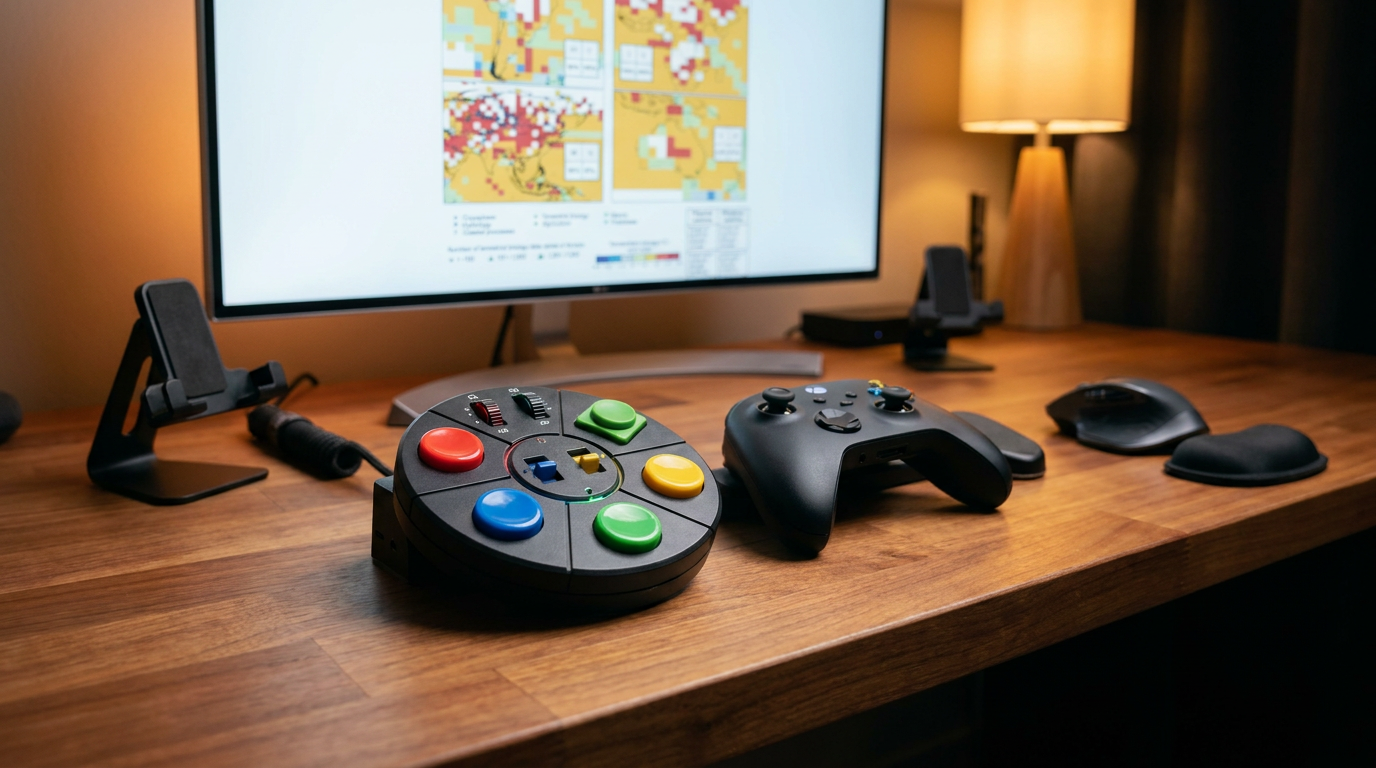
Sony’s PlayStation Access controller, which recently celebrated its first anniversary, was developed in close collaboration with accessibility charities like AbleGamers and SpecialEffect. It features a unique circular, lay-flat design equipped with 19 interchangeable button caps and an industry-standard AMPS mount for securing it to wheelchairs or trays.[2]
This deep modularity allows players to create a setup tailored to their specific range of motion. For example, a player with limited hand contraction can map the trigger functions to large, flat buttons that require minimal force, allowing them to comfortably play fast-paced shooters that were previously inaccessible.[2][5]
Microsoft, a pioneer in this space with its original Adaptive Controller, has continued to iterate rapidly. In early 2025, the company launched the Xbox Adaptive Joystick, a $29.99 companion device designed specifically for one-handed use or for mounting in unconventional positions, such as near the chin.[1][5]
Further democratizing access, Microsoft expanded its 3D-printable thumbstick topper program in May 2026. Players can download free digital files for custom shapes—like the newly introduced "Goal Post" design—and print them at home or via a local service, ensuring that hardware modifications remain affordable and easily replaceable.[1]

Further democratizing access, Microsoft expanded its 3D-printable thumbstick topper program in May 2026.
But hardware is only half the equation. If a game's software demands rapid-fire button mashing, relies entirely on visual cues, or features unreadable text, a custom controller cannot bridge the gap alone.[4][6]
Software accessibility has seen a parallel revolution, heavily influenced by Naughty Dog's landmark title The Last of Us Part II, which remains a gold standard for inclusive software design.[3][7]
For blind and low-vision players, the game introduced a comprehensive suite of audio cues. Every single action—from picking up a health kit to dodging an incoming attack—is telegraphed with a distinct, spatial sound effect.[3]
Combined with a "Navigational Assist" feature that automatically points the in-game camera toward the next story objective, a completely blind player can navigate complex 3D environments and complete the game without any sighted assistance.[3]
High contrast modes also strip away complex environmental textures, rendering allies in one bright color and enemies in another. This drastically reduces visual clutter, allowing players with partial vision to easily parse the on-screen action.[3][6]

Today, these pioneering features are rapidly becoming industry standards. Quality assurance teams now routinely test for cognitive load, ensuring that UI fonts are readable, subtitles are highly customizable, and color-blind filters are baked into the game engine from day one.[4][6]
Developers are also implementing flexible difficulty systems that allow players to adjust specific mechanics. Rather than simply lowering enemy health, players can extend the time limit on a complex puzzle, disable the need to hold down a button, or turn off screen shake to prevent motion sickness.[3][4]
The impact of these innovations extends far beyond mere convenience. For individuals recovering from catastrophic injuries or managing degenerative conditions, the ability to reclaim a beloved hobby offers profound psychological benefits.[2][7]
Looking ahead, the industry is exploring assistive AI and advanced eye-tracking technologies to further reduce physical barriers, translating subtle eye movements into complex in-game actions.[6]
How we got here
2018
Microsoft launches the original Xbox Adaptive Controller, pioneering first-party accessible hardware.
June 2020
The Last of Us Part II releases, setting a new industry benchmark for software accessibility with over 60 customizable features.
December 2023
Sony launches the PlayStation Access controller, a highly customizable circular kit for the PS5.
Early 2025
Microsoft releases the Xbox Adaptive Joystick, expanding its accessible hardware ecosystem.
May 2026
Microsoft updates its 3D-printable thumbstick topper program with new, community-requested shapes like the Goal Post.
Viewpoints in depth
Hardware Innovators
Focuses on the physical interface and modularity of gaming.
Platform creators like Microsoft and Sony view accessibility through the lens of physical modularity. By creating devices with industry-standard mounting points (like the AMPS pattern) and 3.5mm expansion jacks, they allow players to plug in third-party switches, pedals, and custom 3D-printed parts. The goal is to provide a standardized "hub" that can be infinitely customized to match any individual's unique physical mobility, rather than trying to build a single controller that works for everyone.
Software & Engine Developers
Focuses on in-game mechanics, UI, and engine-level inclusive design.
For software developers, accessibility is about "shifting left"—integrating inclusive design at the very beginning of the development cycle rather than patching it in later. This involves building game engines that natively support text-to-speech, high-contrast rendering, and remappable inputs. Developers argue that features initially designed for accessibility, such as customizable subtitles or the ability to toggle a button hold, ultimately improve the user experience for the entire player base.
Accessibility Advocates
Focuses on the human impact and the push for affordability and awareness.
Charities and advocates emphasize that gaming is a vital social lifeline, particularly for individuals recovering from catastrophic injuries or dealing with isolation. While they celebrate the recent hardware and software milestones, advocates continue to push for greater affordability. Specialized adaptive equipment has historically been prohibitively expensive, making initiatives like Microsoft's $30 Adaptive Joystick and free 3D-printable files crucial steps toward true democratization of the medium.
What we don't know
- How quickly independent studios with smaller budgets will be able to adopt these comprehensive software accessibility standards.
- The extent to which emerging technologies, like consumer-grade eye-tracking and neural interfaces, will replace traditional physical controllers in the next decade.
Key terms
- AMPS mount
- An industry-standard screw pattern used to securely attach devices, such as adaptive controllers, to wheelchairs or specialized mounts.
- Navigational Assist
- A software feature that automatically turns the player's in-game camera toward their next objective, aiding those with visual or cognitive impairments.
- High Contrast Mode
- A visual setting that mutes environmental colors and highlights allies, enemies, and items in bright, distinct colors to help low-vision players.
- Text-to-Speech (TTS)
- A system that reads on-screen text, menus, and UI elements aloud, essential for blind and low-vision gamers.
Frequently asked
What is the Xbox Adaptive Joystick?
It is a $29.99 modular controller released in early 2025 that can be used one-handed or mounted to a wheelchair, designed to work alongside other Xbox controllers.
How do blind gamers play modern video games?
Games like The Last of Us Part II use comprehensive audio cues, text-to-speech, and navigational assist features that allow blind players to traverse environments and engage in combat without visual input.
Can players 3D print their own controller parts?
Yes, Microsoft offers free 3D-printable files for custom thumbstick toppers, allowing players to print ergonomic shapes tailored to their specific mobility needs at home.
Sources
Source coverage
7 outlets
3 viewpoints surfaced







[1]MicrosoftHardware & Platform Creators
Improved Xbox Adaptive Thumbstick Toppers and Accessible Gaming Updates
Read on Microsoft →[2]Sony Interactive EntertainmentHardware & Platform Creators
From Vision to Reality: The Access Controller's Impact on Gamers One Year Later
Read on Sony Interactive Entertainment →[3]Game Accessibility NexusSoftware Developers & QA
The Last of Us Part II Blind / Low Vision Accessibility Review
Read on Game Accessibility Nexus →[4]TestDevLabSoftware Developers & QA
Gaming Accessibility: 4 Ways to Make Your Games More Accessible
Read on TestDevLab →[5]New MobilityAccessibility Advocates
Adaptive Products Roundup: Xbox Adaptive Joystick and Modular Controllers
Read on New Mobility →[6]RMCADSoftware Developers & QA
Understanding Accessibility in Game Art and Inclusive Design
Read on RMCAD →[7]Factlen Editorial TeamSoftware Developers & QA
Synthesis by Factlen editorial team
Read on Factlen Editorial Team →
More in gaming esports
See all 7 stories →AI NPCs
The End of the Dialogue Tree: How Generative AI is Rewiring Video Game NPCs
9 sources
Handheld PCs
Handheld PC Gaming in 2026: Steam Deck OLED vs. ASUS ROG Ally X
6 sources
Hardware Tech
How Magnetic Sensors Are Finally Killing Controller Stick Drift
8 sources
Nation-Based Esports
The Rise of Nation-Based Esports: How the 2026 Nations Cup and Mobile Gaming Are Reshaping the Industry
8 sources
Every angle. Every day.
Get gaming esports stories with full source coverage and perspective breakdowns delivered to your inbox.