
The Accessibility Revolution: How Hardware and Software are Erasing Barriers in Gaming
Driven by innovative modular controllers and deep software integration, the video game industry is undergoing a paradigm shift to ensure millions of disabled players can fully participate in digital worlds.
By Factlen Editorial Team
- Accessibility Advocates & Disabled Gamers
- Focuses on player independence, hardware customization, and the removal of barriers that cause social isolation.
- Hardware & Software Developers
- Focuses on universal design principles, creating industry standards, and the technical implementation of inclusive features.
- Academic & Clinical Researchers
- Focuses on the cognitive and mental health benefits of gaming, social inclusion, and gathering empirical data on accessibility.
What's not represented
- · Indie developers struggling with the budget required to implement 60+ accessibility presets.
- · VR hardware manufacturers facing unique spatial accessibility challenges.
Why this matters
Video games are a primary engine for modern social connection and stress relief. By dismantling physical and sensory barriers, the industry is ending the digital isolation of millions of disabled individuals and proving that complex technology can be universally designed.
Key points
- Hardware like the Xbox Adaptive Controller and PlayStation Access Controller allow players to bypass standard controller limitations.
- Software features like Blind Drive Assist and high-contrast modes are making 3D environments navigable for visually impaired players.
- Cognitive accessibility, which reduces sensory overload and time pressure, is the next major frontier for inclusive game design.
- Accessible gaming provides significant mental health benefits by combating social isolation and lowering stress.
Video games are the most profitable entertainment industry in the world, offering unparalleled avenues for social connection, interactive storytelling, and stress relief. Yet, for decades, the medium inadvertently excluded millions of potential players. A standard controller requires complex bimanual dexterity, and virtual worlds demand rapid visual and auditory processing, creating an environment where physical or sensory impairments act as a hard lock on participation.[4][7]
The scale of this exclusion has historically been massive. The nonprofit AbleGamers estimates that approximately 46 million gamers in the United States alone have some form of disability. According to industry surveys, a staggering 66% of disabled gamers report facing significant barriers while trying to play, and half say that a lack of information regarding inclusive features directly impacts their purchasing decisions.[6][7]
However, the industry is currently undergoing a sweeping accessibility revolution. Driven by relentless advocacy from disabled gamers, academic research, and a new wave of inclusive design philosophies, hardware manufacturers and software developers are systematically dismantling these barriers. Accessibility is no longer viewed as a niche afterthought; it is becoming a fundamental pillar of AAA game development.[4][6]

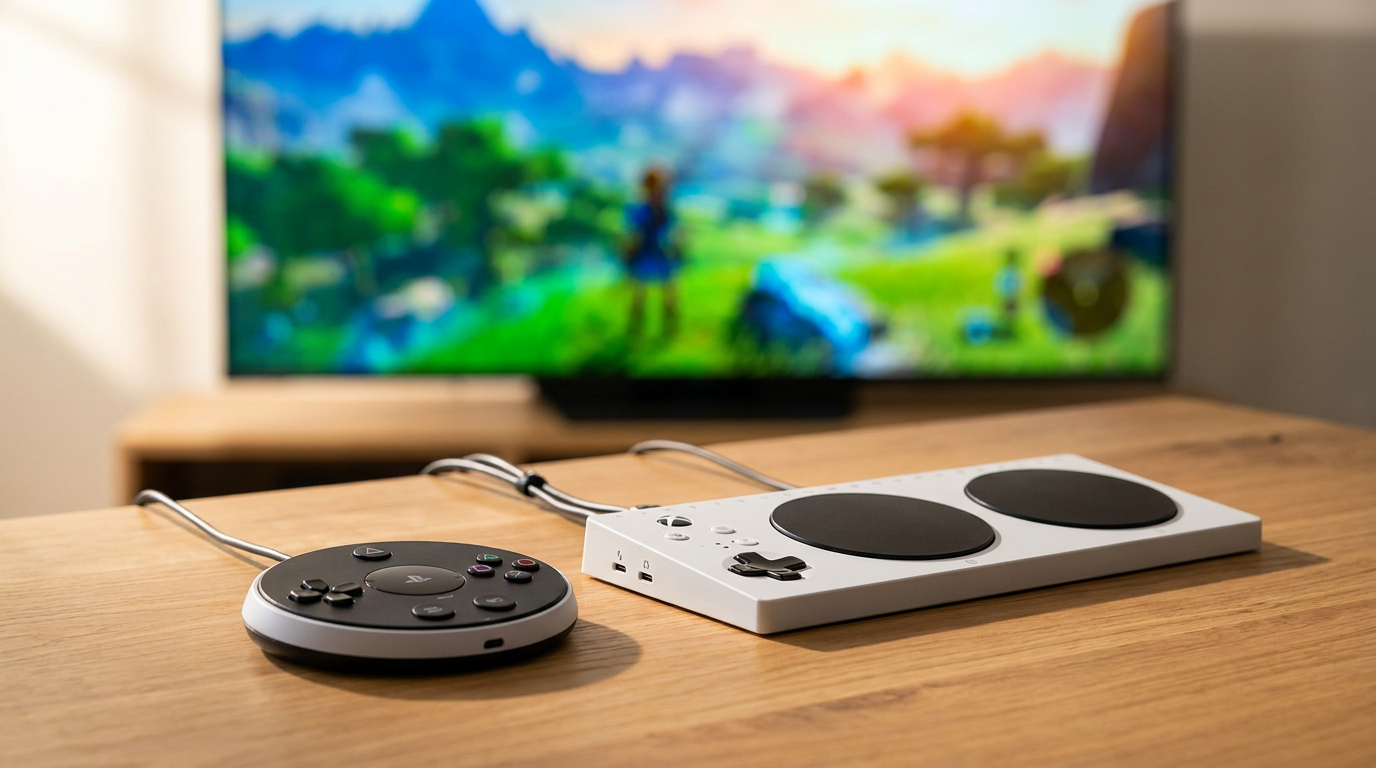
The hardware landscape experienced its first major paradigm shift in 2018 with the release of the Xbox Adaptive Controller. Rather than attempting to build a single controller that works for everyone—an impossible task given the vast spectrum of physical disabilities—Microsoft designed a rectangular hub that acts as a blank canvas for custom setups.[1][2]
The Xbox Adaptive Controller features 19 standard 3.5mm ports and USB connections, allowing players to plug in specialized switches, foot pedals, and sip-and-puff devices. This modularity enables users to build a bespoke control scheme tailored entirely to their specific motor capabilities, mapping every standard button press to an external input they can comfortably trigger.[1][2]
In late 2023, Sony introduced its own solution: the PlayStation Access Controller. While sharing the overarching goal of inclusivity, it takes a fundamentally different approach. The Access Controller is a circular, highly modular device that functions as a complete controller straight out of the box, rather than primarily serving as a hub.[1][2]
Players can swap out joystick caps and button shapes, adjusting the physical layout to accommodate limited reach, atrophied hands, or specific strength requirements. It also includes four 3.5mm expansion ports for external switches. Reviewers note that while the Xbox device excels as a limitless hub for complex setups, the PlayStation offering provides a lower setup cost and less hassle for players who need an immediate, all-in-one solution.[1][2]

Players can swap out joystick caps and button shapes, adjusting the physical layout to accommodate limited reach, atrophied hands, or specific strength requirements.
But hardware is only half the equation. Software accessibility has seen an equally dramatic evolution, transforming how games convey information. The term "video game accessibility" now encompasses a vast spectrum of design elements, from subtitle font size sliders and colorblind modes to AI-assisted aim correction and global game-speed toggles.[6][7]
For visually impaired and blind players, advanced audio cues have become a profound game-changer. Historically, a blind player could not navigate a complex 3D environment. Today, developers utilize spatial audio, text-to-speech menu narration, and specific sound effects to indicate enemy positions, interactable objects, or the boundaries of a level.[3][6]
Titles in the racing genre have introduced dynamic steering assistance and "Blind Drive Assist," using a complex system of audio indicators to help players understand their car's speed and track position. When implemented correctly, these auditory displays allow blind subjects to navigate tracks and perform as well as sighted players, retaining the thrill and complexity of the game without diluting the experience.[3]

In the action-adventure space, titles like The Last of Us Part II set a new high watermark by launching with over 60 distinct accessibility presets. The game featured high-contrast visual modes that stripped away environmental textures to highlight enemies and items in bright, solid colors, alongside robust motor and auditory assists that allowed players to bypass inaccessible mechanics entirely.[6]
The next frontier in inclusive design is cognitive accessibility. While visual, auditory, and motor barriers are increasingly addressed by standardized menus, cognitive features—designed for players with learning difficulties, ADHD, or traumatic brain injuries—are still nascent and require careful integration into the core game loop.[4][5]
Cognitive accessibility involves reducing visual clutter, allowing players to progress through text prompts at their own pace, disabling time-pressure mechanics, and offering narrative recaps. Researchers emphasize that these features are crucial for ensuring neurodivergent players can enjoy games without becoming overwhelmed by sensory overload or complex puzzle logic.[4][5]

The push for accessibility is not just about entertainment; it is deeply tied to mental health and social inclusion. Academic studies demonstrate that playing video games can lower stress, elevate mood, and combat social isolation. For individuals with disabilities, accessible games provide a vital space to unwind, build relationships, and participate in a global cultural conversation on equal terms.[4][7]
Industry standards are being codified by resources like the Game Accessibility Guidelines, a comprehensive framework created by studios and academics. Furthermore, legislation like the 21st Century Communications and Video Accessibility Act (CVAA) in the United States mandates that in-game communication features, such as text and voice chat, must be accessible to players with sensory disabilities.[5][6]
While challenges remain—such as the high cost of specialized adaptive equipment and the lack of standardized UI narration across all game engines—the trajectory is clear. Accessibility is no longer viewed as a charitable addition. It is a fundamental pillar of modern game design, ensuring that the magic circle of digital play is open to everyone.[7]
How we got here
2010
The CVAA is passed in the US, laying the groundwork for accessible digital communications.
2012
A coalition of studios and specialists publish the Game Accessibility Guidelines.
2018
Microsoft releases the Xbox Adaptive Controller, standardizing hardware accessibility.
2020
The Last of Us Part II launches with over 60 accessibility presets, setting a new software benchmark.
2023
Sony releases the PlayStation Access Controller, providing a highly modular out-of-the-box solution.
Viewpoints in depth
Accessibility Advocates
Focuses on the necessity of independence and the removal of barriers that cause social isolation.
For disabled gamers and advocacy groups, accessibility is fundamentally about independence. The ability to navigate a menu, remap a button, or understand an audio cue without asking a sighted or able-bodied person for help transforms gaming from a frustrating hurdle into a liberating experience. Advocates stress that when games are inaccessible, they don't just block entertainment—they actively exclude disabled individuals from the cultural zeitgeist and social communities that form around popular titles.
Hardware & Software Developers
Focuses on the technical challenges and universal design principles required to build inclusive systems.
From the developer's perspective, implementing accessibility requires a ground-up rethinking of game architecture. Audio engineers must design spatial soundscapes that convey precise telemetry data, while UI designers must build menus that interface seamlessly with text-to-speech software. Developers argue that these features ultimately benefit the entire player base—often citing how subtitles, originally designed for the deaf and hard-of-hearing, are now used by the vast majority of all players.
Clinical Researchers
Focuses on the empirical mental health benefits and cognitive impacts of accessible play.
Researchers view video games as powerful tools for cognitive engagement and psychological well-being. Clinical studies highlight that accessible gaming can significantly reduce anxiety, improve spatial awareness, and foster a sense of agency that might be lacking in a disabled person's physical life. Academics are currently pushing the industry to expand its focus beyond physical and sensory impairments, urging developers to create robust cognitive accessibility features that accommodate neurodivergent players.
What we don't know
- Whether cognitive accessibility features can be standardized across genres as easily as visual and motor assists.
- How quickly the high cost of specialized adaptive hardware will decrease to make setups universally affordable.
- If future legislation will mandate broader gameplay accessibility beyond basic communication features.
Key terms
- Cognitive Accessibility
- Design features that assist players with learning difficulties or neurodivergence, such as reducing visual clutter or slowing game speed.
- Audio Cues
- Specific sound effects used to convey visual information, such as the location of an enemy or an upcoming turn in a racing game.
- High Contrast Mode
- A visual setting that alters the game's color palette to make characters, items, and environments easily distinguishable for visually impaired players.
- CVAA
- The 21st Century Communications and Video Accessibility Act, a US law requiring accessible communication options in digital services, including video games.
- Haptic Feedback
- The use of advanced vibrations in a controller to convey crucial in-game information to players who cannot rely on visual or audio cues.
Frequently asked
What is the difference between the Xbox and PlayStation adaptive controllers?
The Xbox Adaptive Controller functions primarily as a customizable hub with 19 ports for external switches. The PlayStation Access Controller is a circular, modular device designed to be a complete, playable controller straight out of the box.
How do blind players navigate complex video games?
Blind players rely on advanced software features like text-to-speech menu narration, spatial audio cues, and dynamic navigational assistance to understand their environment and interact with the game.
Can accessibility features benefit players without disabilities?
Yes. Features like subtitles, fully remappable controls, and auto-pickup are widely used by the general gaming population for convenience, comfort, and playing in noisy environments.
Are game developers legally required to include accessibility features?
In the US, the CVAA requires games with communication elements (like text or voice chat) to be accessible. However, broader gameplay accessibility is largely driven by industry guidelines and consumer demand rather than strict legal mandates.
Sources
Source coverage
7 outlets
3 viewpoints surfaced







[1]IGNAccessibility Advocates & Disabled Gamers
PlayStation Access Controller Review
Read on IGN →[2]ReviewedAccessibility Advocates & Disabled Gamers
PlayStation Access Controller Review
Read on Reviewed →[3]QuartzHardware & Software Developers
How audio cues are making racing games accessible to blind players
Read on Quartz →[4]ResearchGateAcademic & Clinical Researchers
From Global Play to Inclusive Play: A Scoping Review of Video Game Accessibility Research
Read on ResearchGate →[5]Game Accessibility GuidelinesHardware & Software Developers
Game Accessibility Guidelines
Read on Game Accessibility Guidelines →[6]WikipediaAcademic & Clinical Researchers
Video game accessibility
Read on Wikipedia →[7]Factlen Editorial TeamAcademic & Clinical Researchers
Synthesis by Factlen editorial team
Read on Factlen Editorial Team →
Every angle. Every day.
Get gaming esports stories with full source coverage and perspective breakdowns delivered to your inbox.