
How Enhanced Geothermal Systems Are Unlocking 24/7 Clean Energy Anywhere
By borrowing horizontal drilling techniques from the oil and gas industry, next-generation geothermal technology is creating man-made underground reservoirs to harvest the Earth's heat. The breakthrough could provide a massive source of reliable, around-the-clock clean electricity.
By Factlen Editorial Team
- Clean Energy Advocates
- View EGS as the missing puzzle piece for a fully decarbonized grid, providing the 24/7 reliability that wind and solar lack.
- Geothermal Developers
- Focus on rapid cost reductions, drilling efficiency, and scaling pilot projects into massive commercial power stations.
- Government Researchers
- Prioritize de-risking the technology through open-source field laboratories to catalyze private sector investment.
What's not represented
- · Local communities near drilling sites
- · Fossil fuel workers transitioning to green energy
- · Environmental groups monitoring water usage
Why this matters
The global transition to clean energy requires power sources that run 24/7 to back up intermittent wind and solar. If enhanced geothermal systems can scale globally, they offer a practically limitless, carbon-free baseload power supply that can be built almost anywhere on the planet.
Key points
- Enhanced Geothermal Systems (EGS) create man-made underground reservoirs to harvest the Earth's heat.
- The technology borrows horizontal drilling and fracturing techniques from the oil and gas industry.
- Unlike wind and solar, EGS provides 24/7, carbon-free baseload power.
- Startups like Fervo Energy are rapidly reducing drilling costs and building utility-scale EGS plants.
- Princeton researchers estimate EGS could supply 20% of U.S. electricity by 2050.
The clean energy transition has a "firm power" problem. While wind and solar power have become remarkably cheap and abundant, they are inherently intermittent—they only generate electricity when the wind blows or the sun shines. Grid-scale batteries are excellent for bridging gaps of a few hours, but they cannot economically sustain a grid through weeks of stagnant, cloudy weather. To fully decarbonize, the world needs a clean baseload: power that runs 24 hours a day, seven days a week, regardless of the weather.[5][6]
Traditional geothermal energy has always offered this exact promise. By tapping into the immense thermal energy radiating from the Earth's core, geothermal plants provide continuous, carbon-free electricity. However, conventional geothermal plants require a rare geologic trifecta: extreme underground heat, naturally occurring subterranean water, and highly permeable rock so the water can flow. Because of these strict requirements, traditional geothermal has historically been limited to volcanic hotspots like Iceland, New Zealand, or California's Geysers.[1][5]
That geographic limitation is now being shattered by a breakthrough known as Enhanced Geothermal Systems (EGS). The premise of EGS is simple but revolutionary: if the Earth provides the heat, but lacks the water and the permeability, engineers can artificially provide the rest. By engineering man-made reservoirs deep underground, EGS technology theoretically allows geothermal power plants to be built anywhere with hot rock beneath the surface.[1][6]
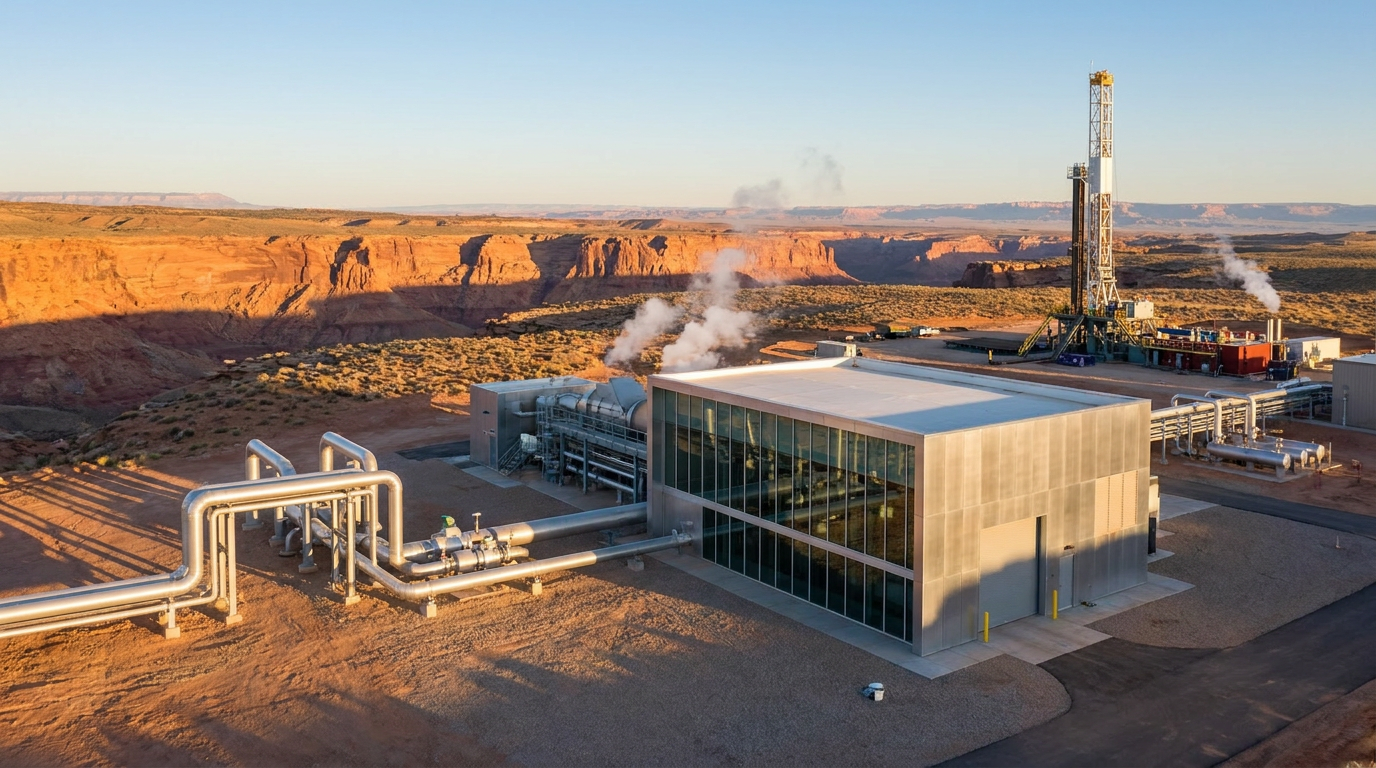
The process begins by drilling deep into hot, dry, solid rock—often up to two miles below the Earth's surface. Once the drill reaches the target depth and temperature, engineers utilize directional drilling techniques to turn the drill bit horizontally, extending the wellbore thousands of feet through the hot rock layer. This horizontal reach maximizes the well's exposure to the subterranean heat.[1][4]

Next comes the crucial step of creating permeability. High-pressure water is injected into the horizontal wellbore to create a network of tiny, millimeter-wide fractures in the solid rock. This process, known as hydraulic stimulation, creates a massive, man-made subterranean radiator. Unlike the natural, unpredictable aquifers of traditional geothermal, this engineered fracture network is highly controlled and mapped using advanced fiber-optic sensors.[1][5]
Once the reservoir is prepared, the system operates as a continuous loop. Cold water is pumped down an "injection well" and forced through the newly fractured hot rock. As the water seeps through the artificial fissures, it absorbs massive amounts of thermal energy from the surrounding stone. The superheated fluid is then pushed up a second, parallel "production well" back to the surface.[1][5]
At the surface, the superheated fluid is kept under pressure so it doesn't boil. It is passed through a heat exchanger, where it transfers its thermal energy to a secondary fluid with a much lower boiling point. This secondary fluid flashes into vapor, spinning a turbine to generate electricity. The original geothermal water, now cooled, is pumped right back down the injection well to be reheated, creating a closed, zero-emission cycle.[5][6]
At the surface, the superheated fluid is kept under pressure so it doesn't boil.
This is no longer just theoretical physics. The U.S. Department of Energy has spent years proving the viability of EGS at the Utah FORGE project, a massive field laboratory in Beaver County, Utah. By testing cutting-edge drilling and stimulation techniques in a controlled environment, FORGE has demonstrated that these artificial fracture networks can be created efficiently and sustained safely, effectively de-risking the technology for the private sector.[1][3]
Commercial startups are now translating this research into grid-scale power. Fervo Energy, a leading next-generation geothermal developer, recently achieved breakthrough results by applying modern oil and gas techniques to geothermal rock. The company reported a 300% increase in drilling speeds, which slashed the cost of drilling by nearly $5 million per well across a six-month period. In the energy sector, faster drilling directly translates to cheaper electricity.[3][4]

Fervo is currently constructing "Cape Station," a massive commercial EGS facility located near the FORGE site in Utah. When it reaches full-scale production in 2028, Cape Station is expected to deliver 400 megawatts of continuous, carbon-free electricity to the grid—enough to power hundreds of thousands of homes. It marks a historic transition from pilot projects to utility-scale infrastructure.[4]
There is a profound irony—and a massive economic opportunity—in how EGS is being developed. The very technologies that fueled the fossil fuel boom over the last two decades, namely horizontal drilling and hydraulic fracturing, are the exact tools required to scale this clean energy solution. This creates a direct transition path for the existing oil and gas workforce, allowing roughnecks, petroleum engineers, and drilling rig operators to seamlessly pivot to the green economy.[4][6]

The potential scale of this deployment is staggering. A recent analysis by Princeton University modeled the impact of these falling drilling costs on the broader energy market. The researchers found that if EGS follows a standard technology learning curve—where costs drop as the industry gains experience—enhanced geothermal could plausibly supply up to 20% of all U.S. electricity by 2050, emerging as the third largest clean energy source behind wind and solar.[2]
Looking even further ahead, researchers and policy groups like the Clean Air Task Force are exploring "Superhot Rock" geothermal. This involves drilling even deeper to reach rock temperatures exceeding 400 degrees Celsius. At these extreme temperatures, water reaches a "supercritical" state where it behaves as both a liquid and a gas, capable of carrying exponentially more thermal energy to the surface and dramatically increasing the power output of a single well.[3]
Challenges certainly remain. The upfront capital costs of drilling deep wells are immense, and like all new energy projects, geothermal plants face sluggish grid interconnection queues and complex permitting processes. Furthermore, while the hydraulic stimulation used in EGS is tightly monitored to prevent induced seismicity, public education is required to differentiate it from the more disruptive forms of fossil-fuel fracking.[2][6]
Despite these hurdles, the fundamental engineering of Enhanced Geothermal Systems has been proven. By unlocking the heat trapped in dry rock, humanity is gaining access to a boundless, ubiquitous battery right beneath our feet. As drilling costs continue to plummet, the Earth itself may provide the ultimate solution to the clean energy baseload puzzle.[2][6]
How we got here
2018
The U.S. Department of Energy establishes the Utah FORGE project to research and test EGS technologies.
2023
Fervo Energy successfully completes a 30-day well test at Project Red, proving the commercial viability of EGS.
September 2023
Fervo breaks ground on Cape Station in Utah, a massive 400 MW commercial EGS facility.
June 2024
Princeton University publishes a study projecting EGS could supply 20% of U.S. electricity by 2050.
Early 2025
Fervo reports a 300% increase in drilling speeds, drastically reducing the cost of EGS deployment.
Viewpoints in depth
Grid Planners' View
Grid operators see EGS as the ultimate solution to the intermittency of renewable energy.
For grid operators, the transition to clean energy has been a balancing act of managing intermittent wind and solar with massive battery installations. EGS offers a "holy grail" alternative: clean, firm baseload power that can be dispatched exactly when needed. Because EGS plants can theoretically be built anywhere there is hot rock, grid planners view the technology as a way to replace retiring coal and natural gas plants locally, utilizing existing transmission infrastructure rather than building thousands of miles of new high-voltage lines.
Oil & Gas Industry's View
Fossil fuel veterans view EGS as a natural pivot that utilizes their existing expertise and equipment.
The oil and gas sector recognizes that EGS relies on the exact same core competencies that drove the shale revolution: deep directional drilling, hydraulic fracturing, and subsurface reservoir modeling. For drilling contractors and petroleum engineers, geothermal represents a massive new market that doesn't require retraining. It offers a rare, seamless transition path for the fossil fuel workforce to participate directly in the green energy economy without abandoning their specialized skills.
What we don't know
- How quickly grid interconnection queues will allow these massive new power plants to come online.
- Whether the extreme depths required for 'Superhot Rock' geothermal can be drilled economically at commercial scale.
- How local communities will respond to the use of hydraulic fracturing techniques, even for clean energy purposes.
Key terms
- Enhanced Geothermal Systems (EGS)
- A technology that generates geothermal electricity by injecting water into artificially fractured hot, dry rock, creating a man-made subterranean reservoir.
- Firm Power
- Electricity generation that can be relied upon to produce power continuously, 24/7, regardless of weather conditions.
- Hydraulic Stimulation
- The process of injecting high-pressure fluid into underground rock to create or widen fractures, increasing permeability.
- Superhot Rock Geothermal
- An advanced, experimental form of EGS that drills deep enough to reach temperatures over 400°C, where water becomes supercritical and yields exponentially more energy.
- Binary Cycle Power Plant
- A geothermal plant where the hot underground water heats a secondary fluid with a lower boiling point, which then flashes to vapor to spin the turbine.
Frequently asked
What is the difference between traditional geothermal and EGS?
Traditional geothermal requires naturally occurring underground water and permeable rock, limiting it to volcanic regions. EGS artificially creates permeability by fracturing hot, dry rock and injecting water, allowing plants to be built almost anywhere.
Does EGS use fracking?
Yes, EGS uses hydraulic stimulation (fracking) to create tiny fissures in the rock. However, it uses clean water rather than chemical slurries, and the process is highly monitored to prevent significant induced seismicity.
How much power can EGS provide?
Recent modeling from Princeton University suggests that if costs continue to fall, EGS could supply up to 20% of all electricity in the United States by 2050.
Is the water used in EGS wasted?
No. EGS operates as a closed-loop system. The water pumped underground is brought to the surface to generate power, cooled, and then continuously reinjected back into the reservoir.
Sources
Source coverage
6 outlets
3 viewpoints surfaced






[1]U.S. Department of EnergyGovernment Researchers
Enhanced Geothermal Systems (EGS)
Read on U.S. Department of Energy →[2]Princeton UniversityClean Energy Advocates
Geothermal energy could supply 20% of US electricity by 2050
Read on Princeton University →[3]Clean Air Task ForceClean Energy Advocates
An introduction to the next clean energy frontier: Superhot rock geothermal and pathways to commercial liftoff
Read on Clean Air Task Force →[4]Fervo EnergyGeothermal Developers
Fervo Energy Breaks Ground on 400 MW Cape Station
Read on Fervo Energy →[5]MITGovernment Researchers
Explainer: Geothermal Energy
Read on MIT →[6]Factlen Editorial Team
Synthesis by Factlen editorial team
Read on Factlen Editorial Team →


Every angle. Every day.
Get guides stories with full source coverage and perspective breakdowns delivered to your inbox.