
Steam Deck OLED vs. ROG Ally X: The 2026 Handheld Gaming PC Trade-Off
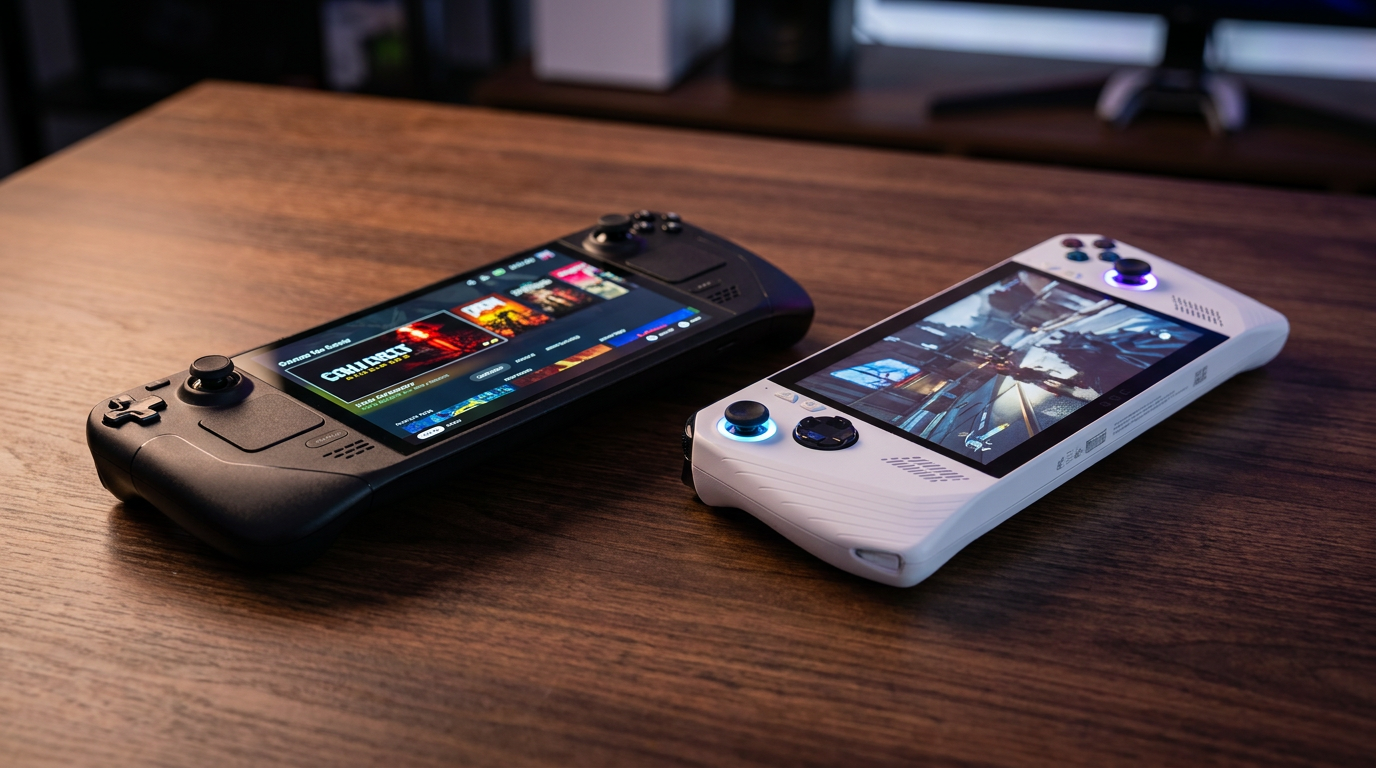
As the portable PC market matures in 2026, choosing between Valve's Steam Deck OLED and ASUS's ROG Ally X comes down to a strict trade-off between console-like efficiency and raw Windows performance.
By Factlen Editorial Team
- Console Purists
- Advocates for seamless software and battery efficiency over raw power.
- Performance Enthusiasts
- Prioritizes raw framerates, visual fidelity, and ecosystem freedom.
- Hardware Analysts
- Evaluates devices strictly on silicon efficiency and market economics.
What's not represented
- · Budget Gamers priced out by 2026 hardware inflation
- · Game Developers optimizing for fixed handheld hardware
Why this matters
Choosing the right handheld gaming PC in 2026 means navigating a $700+ investment that dictates which game libraries you can access and how much troubleshooting you will endure. Understanding the strict trade-offs between battery efficiency and raw processing power ensures you buy the device that actually fits your daily routine.
Key points
- The 2026 handheld PC market is dominated by the Steam Deck OLED and the ASUS ROG Ally X.
- Valve's Steam Deck OLED prioritizes a seamless, console-like experience and superior battery efficiency.
- The ASUS ROG Ally X offers raw Windows 11 performance, 120Hz refresh rates, and native Game Pass support.
- The Steam Deck OLED's 15W power cap allows its 50Wh battery to outlast the Ally X in many scenarios.
- Global RAM shortages in 2026 have pushed premium handheld prices to nearly $1,000, altering the value proposition.
The 2026 handheld PC market has exploded, moving past early growing pains into a mature duopoly of design philosophies. At the top of the premium tier sit two distinct heavyweights: Valve’s Steam Deck OLED and the ASUS ROG Ally X.[1][3]
Rather than a simple race for the highest frame rates, the decision between these two devices represents a fundamental split in how players want to interact with their games on the go. One prioritizes a curated, console-like ecosystem, while the other brute-forces a full Windows 11 desktop into a seven-inch form factor.[5][6]
In the case for the Steam Deck OLED, the primary advantage centers entirely on friction—or rather, the lack of it. Valve’s custom SteamOS provides a highly polished, suspend-and-resume experience that mirrors traditional consoles, allowing players to jump in and out of games instantly without navigating desktop menus.[1][7]
Furthermore, the argument for the Steam Deck OLED is anchored by its display and efficiency. The 7.4-inch HDR OLED panel delivers absolute blacks and vibrant contrast that traditional IPS screens cannot match, making it ideal for atmospheric single-player titles and cinematic experiences.[1][5]

Against the Steam Deck OLED, the main drawback focuses on its performance ceiling and software limitations. Because it runs a Linux-based operating system, games utilizing certain anti-cheat software—such as major competitive shooters—simply will not run without extensive, unsupported workarounds.[6][7]
The evidence for the Steam Deck's trade-offs is found in its power draw. The device utilizes a 50-watt-hour battery but strictly caps its processor at a 15-watt thermal design power. This limitation means it cannot push the highest frame rates in demanding 2026 releases, but it consistently delivers three to six hours of battery life.[3][5]
In the case for the ASUS ROG Ally X, the argument is built on raw, uncompromised power and total library compatibility. Equipped with AMD's Extreme APU architecture and a massive 24 gigabytes of RAM, it is designed to handle heavy workloads that would stutter on lesser hardware.[2][4]
In the case for the ASUS ROG Ally X, the argument is built on raw, uncompromised power and total library compatibility.
Additionally, the argument for the ROG Ally X highlights its display speed and ecosystem freedom. Running native Windows 11 means players have frictionless access to PC Game Pass, the Epic Games Store, and third-party launchers. The 7-inch, 120Hz variable refresh rate display ensures that fast-paced games feel incredibly responsive.[4][5]
Against the ROG Ally X, the primary complaint revolves around the inherent clunkiness of Windows on a small touchscreen and the device's premium price tag. Navigating desktop menus with a joystick remains cumbersome, even with ASUS's custom software overlays attempting to mask the operating system.[6][7]
The evidence against the Ally X's portability lies in its thermal and power demands. Despite housing a massive 80-watt-hour battery—the largest in its class—the device's ability to draw up to 30 watts of power means that running AAA games at maximum settings will drain the battery just as fast, if not faster, than highly optimized, less powerful handhelds.[2][5]

Looking at the evidence comparing their raw performance, benchmark testing consistently places the ROG Ally X 20 to 40 percent ahead of the Steam Deck OLED in demanding titles when both are running at their higher power profiles, validating its higher cost for framerate enthusiasts.[4][5]
Pricing dynamics in 2026 have also complicated the comparison. A global component shortage, dubbed the RAM crisis by hardware analysts, has driven up manufacturing costs. The Steam Deck OLED now sits around $789, while the premium ROG Ally X commands $999, forcing buyers to weigh whether a 20 percent performance bump is worth a $200 premium.[2][5]
Ultimately, the Steam Deck OLED fits well when a player primarily relies on an existing Steam library, values OLED image quality, and wants a device that simply works out of the box. It is the definitive choice for indie games, older AAA titles, and emulation.[1][3]
Conversely, the Steam Deck OLED does not fit when a user needs to play competitive multiplayer shooters with kernel-level anti-cheat, or when they demand 60 frames per second in the most graphically intense releases of the year.[6][7]

How we got here
Feb 2022
Valve releases the original Steam Deck, proving the viability of the modern handheld PC market.
Jun 2023
ASUS launches the first ROG Ally, introducing a high-performance Windows alternative to Valve's ecosystem.
Nov 2023
Valve introduces the Steam Deck OLED, featuring a vastly improved screen and better battery efficiency.
Jul 2024
ASUS releases the ROG Ally X, doubling the battery capacity and increasing RAM to address the original model's shortcomings.
May 2026
Global RAM shortages force price hikes across the handheld market, altering the value proposition of flagship devices.
Viewpoints in depth
Console Purists
Advocates for seamless software and battery efficiency over raw power.
This camp argues that a handheld device should fundamentally act like a portable console, not a miniaturized desktop. They point to the Steam Deck's suspend-and-resume feature, its unified interface, and its highly efficient 15W power cap as the gold standard. For these users, the deep contrast of an OLED screen and the ability to play for four hours without hunting for an outlet vastly outweigh the ability to push 60 frames per second in the latest demanding releases.
Performance Enthusiasts
Prioritizes raw framerates, visual fidelity, and ecosystem freedom.
Enthusiasts in this camp view handhelds as true PC replacements. They argue that being locked out of major multiplayer titles due to Linux anti-cheat issues is a dealbreaker. By championing devices like the ROG Ally X, they prioritize the Z2 Extreme's ability to brute-force modern AAA games at 1080p. They are willing to accept the clunkiness of Windows 11 and shorter battery lifespans in exchange for 120Hz refresh rates and native access to Xbox Game Pass and the Epic Games Store.
Hardware Analysts
Evaluates devices strictly on silicon efficiency and market economics.
Analysts focus on the underlying architecture and the economic realities of the 2026 market. They note that while the ROG Ally X boasts an 80Wh battery, its 30W power draw negates much of that capacity advantage under heavy load. Furthermore, they highlight how the 2026 RAM shortage has shifted the market; with the Ally X pushing $999 and the Deck OLED rising to $789, analysts argue the base models of older handhelds are quietly becoming the most logical purchases for budget-conscious consumers.
What we don't know
- Whether Microsoft will release a truly optimized 'Handheld Mode' for Windows 11 to fix UI clunkiness.
- How long the 2026 RAM shortage will keep handheld PC prices artificially inflated.
- When Valve will officially announce the true next-generation Steam Deck 2.
Key terms
- APU
- Accelerated Processing Unit, a single chip that combines both the central processor (CPU) and graphics processor (GPU), commonly used in handhelds.
- TDP
- Thermal Design Power, a measurement in watts that indicates how much power a chip is allowed to draw, directly impacting both performance and battery life.
- SteamOS
- A Linux-based operating system developed by Valve, designed specifically to provide a console-like interface for PC games.
- VRR
- Variable Refresh Rate, a display technology that syncs the screen's update rate with the game's frame rate to eliminate visual tearing and stuttering.
Frequently asked
Can I play Xbox Game Pass on the Steam Deck?
Not natively. Because the Steam Deck runs a Linux-based OS, you must either stream Game Pass titles via the cloud or go through a complex process to install Windows.
Does the ROG Ally X have an OLED screen?
No, the ROG Ally X uses a 7-inch IPS LCD panel. While it lacks the deep blacks of OLED, it offers a higher 1080p resolution and a faster 120Hz refresh rate.
Why did handheld PC prices increase in 2026?
A global component shortage, driven by high demand for AI servers, significantly increased the manufacturing costs of RAM and storage, forcing companies to raise retail prices.
Which device is better for playing offline on an airplane?
The Steam Deck OLED is generally better for travel due to its highly efficient 15W power cap, which stretches its 50Wh battery further in offline indie and older AAA games.
Sources
Source coverage
7 outlets
3 viewpoints surfaced







[1]Gadget ScoutConsole Purists
Best handheld gaming PCs
Read on Gadget Scout →[2]DROIX BlogsPerformance Enthusiasts
The Best Handheld Gaming PCs: Your Ultimate 2026 Buying Guide
Read on DROIX Blogs →[3]Rock Paper ShotgunConsole Purists
The best handheld PCs
Read on Rock Paper Shotgun →[4]Tom's HardwarePerformance Enthusiasts
Best Handheld Gaming PCs 2026: Windows and Steam Decks tested
Read on Tom's Hardware →[5]Windows ForumHardware Analysts
Steam Deck OLED vs ROG Ally X: Handheld PC Showdown 2026
Read on Windows Forum →[6]EnebaHardware Analysts
ROG Ally vs Steam Deck: A Complete Breakdown Before You Buy
Read on Eneba →[7]PCMagHardware Analysts
Steam Deck and Beyond: The Best Handheld Gaming PCs We've Tested for 2026
Read on PCMag →

More in shopping
See all 84 stories →Retail Strategy
Amazon, Walmart, and Target Announce Competing Summer Deal Events for Late June
8 sources

Sustainable Fabrics
Decoding Sustainable Fabrics: The Real Trade-Offs Behind Tencel, Recycled Polyester, and Organic Cotton
7 sources

Display Tech
The 2026 Guide to Premium Television Displays: OLED and Mini-LED Trade-Offs
8 sources

Premium TVs
OLED vs. Mini-LED in 2026: Which Premium TV Technology Wins?
7 sources

Every angle. Every day.
Get shopping stories with full source coverage and perspective breakdowns delivered to your inbox.