
SpaceX Shatters Market Records with $85 Billion IPO and Immediate $60 Billion AI Acquisition
Following the largest initial public offering in U.S. history, SpaceX has driven unprecedented options trading volume and moved swiftly to acquire AI coding startup Cursor.
By Factlen Editorial Team
- Bullish Tech Investors
- View the IPO and subsequent acquisition as a generational wealth-creation event that redefines the tech sector.
- Aerospace Analysts
- Focus on how the influx of public capital and AI integration will accelerate timelines for Mars missions and satellite deployment.
- Market Strategists
- Analyze the structural market impact, noting the massive liquidity flows and the shift in index weightings.
What's not represented
- · Legacy Aerospace Competitors
- · Open-Source AI Advocates
Why this matters
SpaceX's public debut has instantly injected massive liquidity and enthusiasm into the stock market, offering retail and institutional investors direct access to the commercial space economy while signaling a major convergence between aerospace engineering and artificial intelligence.
Key points
- SpaceX completed the largest IPO in U.S. history, raising over $85 billion.
- First-day options trading for the stock shattered all previous records for a tech debut.
- The company immediately used its public currency to acquire AI coding startup Cursor for $60 billion.
- The acquisition aims to merge generative AI with complex aerospace engineering.
- Wall Street is adopting the new acronym 'MANGOS' to include SpaceX among top tech stocks.
- The massive liquidity event is boosting confidence across the broader technology sector.
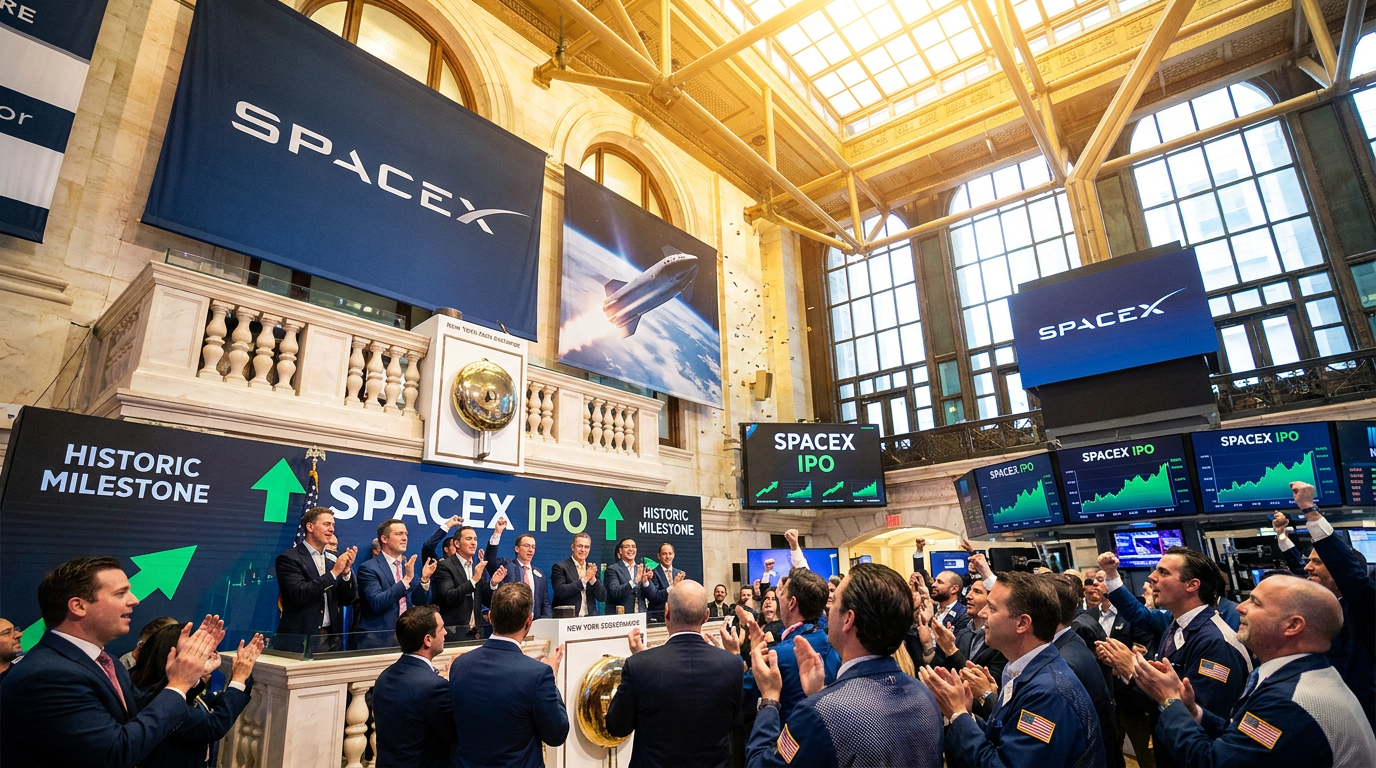
The landscape of the U.S. stock market fundamentally shifted this week as SpaceX executed the largest Initial Public Offering in history, raising a staggering $85 billion. The long-awaited public debut of the aerospace giant not only shattered previous capital-raising records but instantly injected a massive wave of enthusiasm into global equities, proving that investor appetite for generational technology companies remains insatiable.[3]
The momentum from Friday's historic equity debut spilled directly into the derivatives market by Tuesday. First-day options trading for the newly listed stock shattered all existing records, dwarfing the historical debuts of previous tech behemoths. Investors, ranging from retail traders to massive institutional funds, piled into moonshot bets, eager to capture the volatility and upside of the commercial space sector's new bellwether.[1][7]

But the capital raise was merely the opening act. Wasting no time in deploying its newly minted public currency, SpaceX immediately exercised a previous agreement to acquire the artificial intelligence coding startup Cursor for $60 billion. The blockbuster deal merges the world's premier private space enterprise with one of the most highly valued AI development platforms in the software ecosystem.[2][5]
The acquisition of Cursor highlights a critical convergence between aerospace engineering and generative artificial intelligence. Cursor's engineers had already been working closely with SpaceX prior to the IPO, developing specialized AI models capable of writing, debugging, and optimizing the complex codebases required for orbital mechanics and spacecraft telemetry.[2][8]
Industry analysts note that modern rocketry is as much a software challenge as a hardware one. By bringing Cursor's advanced AI capabilities in-house, SpaceX aims to radically accelerate the development cycles for its Starship program and Starlink satellite network. The integration promises to automate thousands of hours of routine programming, allowing human engineers to focus on high-level systems design and mission-critical safety architecture.[8]

Industry analysts note that modern rocketry is as much a software challenge as a hardware one.
Wall Street has rapidly adjusted its vocabulary to accommodate the new titan. Financial advisors and portfolio managers are increasingly discarding the "Magnificent Seven" moniker in favor of "MANGOS"—a new acronym designed to encapsulate the market's most coveted tech and AI-driven equities, now prominently featuring SpaceX alongside traditional software and hardware giants.[6]
This rebranding reflects a broader shift in investor appetite. The market is actively seeking companies that offer tangible, physical infrastructure combined with cutting-edge artificial intelligence. SpaceX's dual dominance in low-Earth orbit logistics and its new $60 billion AI software arm perfectly threads this needle, making it an anchor asset for growth-focused portfolios.[6]
The enthusiasm has triggered a massive influx of capital into adjacent financial products. Newly launched leveraged Exchange-Traded Funds (ETFs) designed to track SpaceX and the broader space economy are seeing "bonkers" levels of inflows. Retail investors, in particular, are utilizing these vehicles to gain amplified exposure to the company's post-IPO price action without having to navigate the complexities of the options market directly.[1][4]
This flood of liquidity is providing a rising tide for the broader technology sector. The successful absorption of an $85 billion IPO demonstrates immense underlying strength and available capital in the U.S. equity markets, alleviating previous concerns about market fatigue or liquidity crunches that had occasionally surfaced earlier in the year.[3][4]
Furthermore, the Cursor acquisition is sending positive shockwaves through the venture capital and startup ecosystems. The $60 billion exit provides a massive liquidity event for early AI investors and validates the immense premium public markets are willing to pay for functional, revenue-generating artificial intelligence tools that integrate seamlessly with hard-tech industries.[5]

Looking ahead, the integration of Cursor's workforce into SpaceX's engineering hubs in Texas and California will be closely watched. The cultural and operational merger of a nimble AI software startup with a heavy-manufacturing aerospace company presents unique management challenges, though the pre-existing working relationship between the two entities provides a strong foundation for success.[2][8]
Ultimately, SpaceX's historic week marks a new chapter in public market history. By successfully transitioning to a public entity, securing unprecedented capital, and aggressively expanding its AI capabilities, the company has cemented its position at the absolute center of the modern innovation economy, offering investors a direct stake in the future of human spaceflight and artificial intelligence.[3][7]
How we got here
Friday
SpaceX clinches the biggest IPO in U.S. equity market history, raising $85 billion.
Tuesday Morning
SpaceX options trading officially opens, immediately shattering historical volume records.
Tuesday Afternoon
SpaceX announces the $60 billion acquisition of AI coding startup Cursor.
Viewpoints in depth
Bullish Tech Investors
View the IPO and subsequent acquisition as a generational wealth-creation event that redefines the tech sector.
For growth-focused investors and tech portfolio managers, SpaceX's public debut is the most significant market event of the decade. They argue that the company's dominance in launch logistics and satellite internet already justified a massive valuation, but the immediate $60 billion acquisition of Cursor transforms the thesis. By bringing top-tier generative AI capabilities in-house, investors believe SpaceX is positioning itself not just as an aerospace company, but as the ultimate hard-tech AI platform, capable of capturing unprecedented margins and market share.
Aerospace Analysts
Focus on how the influx of public capital and AI integration will accelerate timelines for Mars missions and satellite deployment.
Industry experts within the aerospace sector are primarily focused on the operational implications of the capital raise and the Cursor deal. They note that the Starship program requires immense, sustained capital expenditure. The $85 billion raised provides a virtually bottomless war chest to fund deep-space exploration and lunar base construction. Furthermore, analysts argue that integrating Cursor's AI will solve one of the industry's biggest bottlenecks: the thousands of hours required to write and debug the flawless code necessary for autonomous orbital docking and interplanetary telemetry.
Market Strategists
Analyze the structural market impact, noting the massive liquidity flows and the shift in index weightings.
Macro strategists and index managers are closely watching the plumbing of the financial system in the wake of the debut. The sheer size of SpaceX means it will rapidly be included in major indices like the S&P 500 and Nasdaq 100, forcing passive funds to buy billions of dollars of the stock regardless of price. Strategists point out that the record-breaking options volume and the flood of cash into leveraged ETFs demonstrate a market that is flush with liquidity, suggesting that the broader economy can easily absorb mega-cap public offerings without starving other sectors of capital.
What we don't know
- How quickly SpaceX will be integrated into major passive indices like the S&P 500.
- The exact regulatory hurdles the $60 billion Cursor acquisition might face from antitrust watchdogs.
- How the cultural integration between a nimble AI software startup and a heavy-manufacturing aerospace firm will unfold.
Key terms
- Initial Public Offering (IPO)
- The process by which a private company offers shares of its stock to the public for the first time, raising capital from public market investors.
- Options Trading
- Financial contracts that give investors the right, but not the obligation, to buy or sell a stock at an agreed-upon price and date, often used to leverage bets on a stock's direction.
- Leveraged ETF
- An exchange-traded fund that uses financial derivatives and debt to amplify the returns of an underlying index or specific asset.
- Public Currency
- A publicly traded company's stock, which can be used instead of cash to acquire other companies or compensate employees.
Frequently asked
How much did SpaceX raise in its IPO?
SpaceX raised more than $85 billion, making it the largest initial public offering in the history of the U.S. equity market.
Why did SpaceX buy an AI company?
SpaceX acquired Cursor to integrate advanced AI coding capabilities into its engineering processes, aiming to automate complex programming for its rockets and satellite networks.
What does the acronym MANGOS mean?
MANGOS is a new Wall Street acronym replacing the 'Magnificent Seven,' created to group the most highly valued and sought-after tech and AI stocks, now including SpaceX.
Can retail investors trade SpaceX options?
Yes, the options market for SpaceX opened immediately after the IPO, and retail investors have heavily participated, driving record-breaking first-day trading volumes.
Sources
Source coverage
8 outlets
3 viewpoints surfaced







[1]MarketWatchBullish Tech Investors
Investors pile into moonshot SpaceX bets as first-day options trading shatters records
Read on MarketWatch →What to know about Cursor, the AI coding startup SpaceX is buying for $60 billion
Read on MarketWatch →[3]BloombergAerospace Analysts
SpaceX's $85 Billion IPO Rewrites Wall Street Record Books
Read on Bloomberg →[4]CNBCBullish Tech Investors
Retail Investors Flood SpaceX Options Market, Sparking ETF Inflows
Read on CNBC →[5]Financial TimesMarket Strategists
Musk's SpaceX Leverages Public Currency for $60bn Cursor AI Takeover
Read on Financial Times →[6]The Wall Street JournalBullish Tech Investors
The 'MANGOS' Era: How SpaceX's Debut is Reshaping Big Tech Portfolios
Read on The Wall Street Journal →[7]ReutersMarket Strategists
SpaceX Options Volume Eclipses Previous Tech Debuts on Day One
Read on Reuters →[8]TechCrunchAerospace Analysts
Why SpaceX Needs Cursor: The Convergence of Aerospace and AI
Read on TechCrunch →

More in finance
See all 6 stories →Life Insurance
Why Indexed Universal Life Insurance Is Booming — And How It Actually Works
8 sources

SpaceX IPO
SpaceX Shatters Market Records Following Historic $85 Billion IPO and Cursor Acquisition
8 sources
Fiduciary Duty
The One-Page Pledge That Forces Your Financial Adviser to Put You First
7 sources

Fiduciary Duty
How a One-Page Pledge Forces Financial Advisors to Put Your Interests First
6 sources

Every angle. Every day.
Get finance stories with full source coverage and perspective breakdowns delivered to your inbox.