
The Science of Enzymatic Cleaners: How Biological Agents Break Down Stains
Unlike traditional chemicals that mask odors or lift surface dirt, enzymatic cleaners use biological catalysts to permanently dismantle organic waste at the molecular level.
By Factlen Editorial Team
- Biological Cleaning Proponents
- Advocates for the superiority of molecular breakdown over traditional chemical masking.
- Environmental Sustainability Advocates
- Focuses on the ecological benefits of replacing harsh chemicals with biodegradable proteins.
- Professional Restoration Cleaners
- Highlights the practical limitations of surface enzymes on deep-set saturation.
Why this matters
Understanding how biological cleaners function allows households to permanently eliminate stubborn odors and stains without relying on harsh, environmentally damaging chemicals.
Anyone who has tried to clean a persistent pet stain or a greasy kitchen spill knows the frustration of the phantom odor. You scrub the area with soap, the surface looks clean, and the smell disappears—only to return with a vengeance a few days later. This cycle occurs because traditional cleaning products often fail to address the microscopic root of the problem, leaving behind organic residues that continue to emit odors.[7][8]
To solve this, households, healthcare facilities, and industrial cleaners are increasingly turning to a biological solution: enzymatic cleaners. Rather than relying on harsh chemical reactions to bleach or mask a stain, these formulas use the same biological mechanisms that nature uses to decompose organic matter. The result is a paradigm shift in how we approach household hygiene.[4][8]
At the core of this technology are enzymes—specialized proteins that act as biological catalysts. In nature, enzymes are responsible for speeding up chemical reactions, breaking down complex molecules into simpler, smaller fragments. They perform this function without being consumed or altered by the reaction itself, meaning a single enzyme can dismantle thousands of molecules in rapid succession.[2][4]
What makes enzymes particularly effective for cleaning is their specificity. They operate on a "lock-and-key" model. Unlike bleach, which indiscriminately oxidizes and burns through any material it touches, an enzyme is perfectly shaped to attach to one specific type of organic molecule. This precision allows enzymatic cleaners to target the exact source of a stain without damaging the surrounding fabric, carpet fibers, or hard surfaces.[4]

Because organic messes vary, manufacturers blend different types of enzymes to tackle specific soils. Proteases are designed to break down protein-based stains like blood, sweat, vomit, and food spills. Lipases target fats and oils, making them essential for kitchen degreasing. Amylases dismantle starches found in carbohydrates, while ureases are specifically formulated to break down urea, a primary component of urine.[2][7]
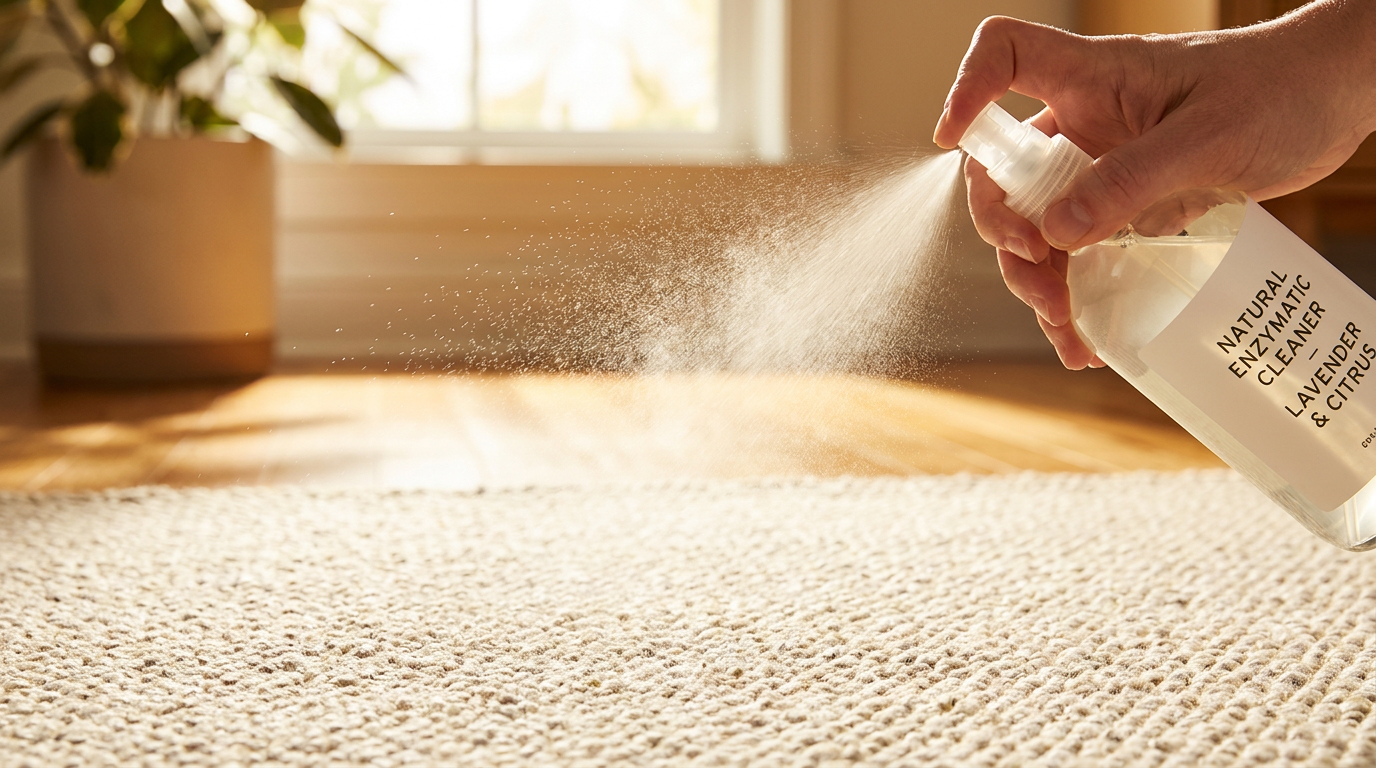
However, enzymes are only half of the equation. The most effective enzymatic cleaners actually contain live, non-pathogenic bacteria. When the cleaner is sprayed onto a stain, these beneficial microbes "wake up" and begin producing enzymes on demand. The enzymes act like a chemical knife, chopping the complex organic waste into tiny, bite-sized pieces.[3][5]
Once the enzymes have dismantled the stain, the bacteria enter the consumption phase. They ingest the smaller molecular fragments, using them as a food source. Through natural digestion, the bacteria convert the organic waste into two completely harmless and odorless byproducts: carbon dioxide and water. The stain is not just lifted; it is biologically erased.[4][5]

Once the enzymes have dismantled the stain, the bacteria enter the consumption phase.
This biological partnership provides a unique advantage known as "continuous action." Traditional chemical cleaners stop working the moment they evaporate or are wiped away. In contrast, the bacteria in an enzymatic cleaner will continue to multiply, produce enzymes, and digest waste for hours or even days. As long as the area remains slightly moist and there is organic "food" left to consume, the microscopic cleaning crew keeps working.[3]
This mechanism explains why traditional cleaners fail so spectacularly on biological messes. Detergents use surfactants to lift dirt, while disinfectants like ammonia or bleach kill surface bacteria. But neither approach can dismantle complex organic structures. They might sanitize the top layer of a spill, but they leave the microscopic organic residue intact, providing a food source for new, odor-causing bacteria to colonize.[7][8]
Pet urine is the classic example of this failure. Urine contains uric acid crystals, which are insoluble in water and highly resistant to standard detergents. When you clean a pet accident with soap, the water evaporates, but the uric acid crystals remain embedded in the carpet fibers. Whenever the ambient humidity rises, those crystals absorb moisture and off-gas, bringing the smell back. Enzymatic cleaners specifically target and destroy these crystals, permanently eliminating the source of the odor.[6][7]

Beyond their efficacy, enzymatic cleaners offer a vastly superior environmental profile. Because the active ingredients are naturally occurring proteins and bacteria, the formulas are 100% biodegradable. They break down safely in the environment without leaving toxic residues in the soil or contributing to the chemical pollution of municipal waterways.[1][2]
They are also significantly safer for indoor use. Traditional cleaners often rely on volatile organic compounds (VOCs) and harsh solvents that can trigger respiratory issues, irritate the skin, and degrade indoor air quality. Enzymatic cleaners are typically pH-neutral and free from toxic fumes, making them a safer choice for households with children, pets, or individuals with chemical sensitivities.[1][3]

Despite their power, biological cleaners have distinct limitations that require a change in cleaning habits. They are not instant. Because they rely on a biological digestion process, enzymes require "dwell time" to work. Users must spray the area thoroughly and let the solution sit for 10 to 30 minutes—or sometimes cover it with a damp towel overnight—to give the bacteria time to consume the waste.[6][8]
Furthermore, professional restoration experts warn that surface sprays cannot perform miracles on deep-set saturation. If a pet has repeatedly soiled a carpet and the urine has soaked through the padding and into the wooden subfloor, an enzymatic spray applied to the top fibers will never reach the deepest crystals. In these severe cases, professional mechanical extraction or subfloor replacement is still required.[6]
Finally, enzymatic cleaners are highly sensitive to their chemical environment. They cannot be mixed with traditional cleaning agents. Applying bleach, antibacterial soap, or high-heat steam to an area treated with enzymes will instantly kill the beneficial bacteria and denature the proteins, rendering the biological cleaner completely useless.[9]
When used correctly, however, enzymatic cleaners represent a fundamental shift in household maintenance. By trading harsh chemical warfare for targeted biological remediation, consumers can achieve deeper, longer-lasting cleanliness while working in harmony with natural processes.[9]
Viewpoints in depth
Biological Cleaning Proponents
Advocates for the superiority of molecular breakdown over traditional chemical masking.
Manufacturers of enzymatic products argue that traditional cleaning is fundamentally flawed when dealing with organic waste. They point out that disinfectants and detergents only address the surface layer, leaving microscopic residues that allow odors to return. By utilizing a biological lock-and-key mechanism, they argue that enzymes provide the only true permanent solution by converting the actual source of the stain into harmless carbon dioxide and water.
Environmental Sustainability Advocates
Focuses on the ecological benefits of replacing harsh chemicals with biodegradable proteins.
Environmental organizations and green-cleaning advocates champion enzymatic cleaners for their minimal ecological footprint. Because the active ingredients are naturally occurring proteins and non-pathogenic bacteria, they break down safely in the environment. This camp emphasizes that widespread adoption of biological cleaners significantly reduces the volume of toxic solvents, phosphates, and volatile organic compounds (VOCs) that pollute municipal water systems and degrade indoor air quality.
Professional Restoration Cleaners
Highlights the practical limitations of surface enzymes on deep-set saturation.
While acknowledging the chemical superiority of enzymes, professional carpet cleaners and restoration experts caution against viewing them as a magic bullet. They emphasize that enzymes require physical contact with the organic waste to work. If a liquid like pet urine has soaked through the carpet, into the padding, and down to the wooden subfloor, a surface spray will never reach the deepest uric acid crystals. In these cases, they argue that DIY enzymatic treatments must be paired with professional mechanical extraction.
What we don't know
- How quickly the commercial cleaning industry will fully transition away from traditional disinfectants in favor of biological alternatives.
- Whether future bio-engineering can significantly reduce the required 'dwell time' for enzymatic cleaners to work instantly.
Sources
Source coverage
9 outlets
3 viewpoints surfaced








[1]Oxa BiotechEnvironmental Sustainability Advocates
Advantages of enzymatic cleaning compared to traditional chemicals
Read on Oxa Biotech →[2]Creative EnzymesEnvironmental Sustainability Advocates
Understanding Enzyme-Based Cleaning Products
Read on Creative Enzymes →[3]HillyardBiological Cleaning Proponents
The Power of Enzymatic Cleaning Solutions
Read on Hillyard →[4]Clean ChapsBiological Cleaning Proponents
The Science Behind Enzymatic Cleaners
Read on Clean Chaps →[5]PupfordBiological Cleaning Proponents
How Do Enzyme Cleaners Work?
Read on Pupford →[6]Vital CleanProfessional Restoration Cleaners
Understanding the Science: How Enzymatic Cleaners Work
Read on Vital Clean →[7]UseOnaBiological Cleaning Proponents
Enzymatic vs Chemical Pet Cleaners: Which Actually Works?
Read on UseOna →[8]Platinum Health SupplyBiological Cleaning Proponents
Breaking Down Enzymatic Cleaners: How Do They Work?
Read on Platinum Health Supply →[9]Factlen Editorial TeamBiological Cleaning Proponents
Synthesis by Factlen editorial team
Read on Factlen Editorial Team →
Every angle. Every day.
Get home stories with full source coverage and perspective breakdowns delivered to your inbox.