
SpaceX's Historic IPO Triggers Retail Frenzy, Forcing Wall Street to Rethink the 'Magnificent Seven'
Retail investors poured nearly $370 million into SpaceX during its first three days of trading, capturing an unprecedented share of the largest IPO in history and prompting analysts to declare a new era of tech leadership.
By Factlen Editorial Team
- Retail & Access Advocates
- View the SpaceX IPO as a triumph for everyday investors who are usually locked out of generational wealth creation.
- Market Strategists
- Focus on the structural impact of SpaceX's entry into major indices and the shift from the Magnificent Seven to the FAB 10.
- Valuation Skeptics
- Warn that the $1.77 trillion valuation is detached from current fundamentals and engineered by artificial scarcity.
What's not represented
- · Early private investors facing lock-ups
- · Competitors in the aerospace sector
Why this matters
The SpaceX IPO proves that everyday investors can gain meaningful access to generational tech debuts when structural barriers are lowered. It also signals a massive capital rotation that will reshape the index funds sitting in millions of retirement accounts.
Key points
- SpaceX executed the largest IPO in history, raising $75 billion at a $1.77 trillion valuation.
- Retail investors net-bought nearly $370 million in SpaceX stock during its first three days of trading.
- Analysts are proposing the 'FAB 10' to replace the 'Magnificent Seven' as the new benchmark for tech leadership.
- SpaceX's valuation is heavily tied to its Starlink network and plans for orbital AI data centers.
- Skeptics warn that the stock's 55% surge is driven by artificial scarcity, as only 5% of shares were floated.
For years, the stock market's narrative has been dominated by a single, unshakeable monolith: the "Magnificent Seven." This elite club of tech giants dictated index movements, absorbed the lion's share of retail capital, and defined the artificial intelligence boom. But on June 12, 2026, the gravitational pull of the market fundamentally shifted. Space Exploration Technologies Corp., better known as SpaceX, executed the largest initial public offering in history, raising $75 billion and debuting with a staggering $1.77 trillion valuation.[2][4]
The sheer scale of the debut shattered Wall Street records, instantly minting CEO Elon Musk as the world's first trillionaire and propelling the aerospace company to a market capitalization north of $2 trillion by the end of its first trading day. Yet, the most remarkable aspect of the SpaceX IPO was not just its size, but who was doing the buying. In a stark departure from traditional Wall Street mechanics, retail investors were handed the keys to the rocket.[4][5]
Typically, retail investors are locked out of the lucrative early stages of a mega-IPO, forced to wait until institutional players have already secured their allocations and driven up the price. Historically, retail clients are offered a mere 5% to 10% of total shares in a public offering. SpaceX, however, engineered a radically different structure, reserving up to 30% of its offering for everyday investors. Brokerages like Fidelity lowered their eligibility requirements to just $2,000 in a retail account, democratizing access to a generational tech debut.[3][5]

The response was a tidal wave of capital. In its first three days of trading, retail investors net-bought nearly $370 million worth of SpaceX stock. On the first day alone, SpaceX attracted $117 million in net retail purchases—accounting for an astonishing 56% of all retail stock buying across the entire U.S. market. To put that into perspective, retail investors bought more SpaceX shares during that window than all of the "Magnificent Seven" stocks combined.[1][6]
This unprecedented retail migration is forcing market strategists to rewrite their playbooks. The "Magnificent Seven" moniker, coined in 2023 to describe Apple, Microsoft, Alphabet, Amazon, Nvidia, Meta, and Tesla, suddenly feels inadequate. With SpaceX vaulting over the market caps of both Meta and Tesla in its opening week, financial analysts are scrambling for a new framework. Research firm Vanda has proposed replacing the old guard with the "FAB 10"—the Frontier AI & Big Tech 10.[6][8]

This new classification expands the traditional tech leadership to include SpaceX, alongside highly anticipated upcoming IPOs from AI heavyweights OpenAI and Anthropic. The shift reflects a broader market realization: the next decade of growth is no longer just about mature software cash flows, but about the convergence of physical infrastructure, space exploration, and frontier artificial intelligence.[6][8]
This new classification expands the traditional tech leadership to include SpaceX, alongside highly anticipated upcoming IPOs from AI heavyweights OpenAI and Anthropic.
SpaceX's valuation is anchored precisely in this convergence. While the company is famous for its reusable Falcon 9 rockets and the Starship program, its financial engine is increasingly driven by its Starlink satellite internet constellation and its aggressive expansion into AI computing. In early 2026, SpaceX acquired Musk's artificial intelligence startup xAI, effectively merging the world's premier launch provider with a top-tier AI lab.[2][4]
The company's prospectus revealed ambitious plans to build orbital data centers, leveraging the cold vacuum of space to cool massive server farms dedicated to AI processing. By combining xAI's computing needs with Starlink's global data transmission capabilities, SpaceX is positioning itself not just as a transport company, but as the ultimate off-planet infrastructure provider for the AI economy.[2][7]

However, the stock's meteoric rise—jumping 19% on its first day to close at $161, and rallying roughly 55% over its first three days—has sparked intense debate about its fundamental valuation. The company offered an unusually small public float, selling only about 5% of its outstanding shares. This engineered scarcity, combined with overwhelming retail demand, created a pressure cooker for the stock price.[2][4]
Financial commentators and institutional skeptics warn that this limited supply is distorting the market. Prominent investors have pointed out that despite its multi-trillion-dollar valuation, SpaceX currently operates at a loss and generates under $20 billion in annual revenue. While Musk has publicly projected that the firm could reach $1 trillion in annual revenue by 2030, critics argue that the current premium pricing leaves little room for execution errors.[7][8]
Adding fuel to the fire is the impending wave of forced institutional buying. SpaceX secured a rule change allowing for accelerated inclusion into major market indices, including the Nasdaq-100 and the CRSP U.S. Total Market Index. This means that passive index funds and retirement accounts will be mandated to automatically purchase SpaceX shares, regardless of the price, further intensifying the buying pressure on the limited float.[2][7]
The true test of SpaceX's valuation will likely come when the initial euphoria fades and insider lock-up periods expire. Musk and other company insiders are bound by a 366-day lock-up, while other pre-IPO investors face a staggered 180-day restriction. When these shares eventually flood the market, true price discovery will begin, and the newly minted options market—which is already seeing trading volumes rivaling Nvidia—will face its first real stress test.[2][7]

Despite the risks, the SpaceX IPO represents a watershed moment for public markets. It proves that there is a massive, untapped appetite among everyday investors for frontier technology, provided they are given a seat at the table. The decision to allocate a record portion of the float to retail accounts challenges the traditional Wall Street gatekeeping model, where the most lucrative gains are often captured in private markets before the public ever gets a chance to invest.[3][5]
As the dust settles on the largest capital raise in history, the implications ripple far beyond the aerospace sector. The success of the SpaceX debut has laid the groundwork for a banner year of mega-IPOs, setting a high bar for the anticipated public offerings of OpenAI and Anthropic. For now, the market has a new center of gravity, and retail investors are firmly strapped in for the ride.[4][6]
How we got here
April 2026
SpaceX confidentially submits a draft registration statement to the SEC, marking the formal beginning of the IPO process.
May 2026
SpaceX files its S-1 offering statement, revealing plans to build data centers in space and its acquisition of xAI.
June 11, 2026
The final IPO price is set at $135 per share in a take-it-or-leave-it pricing model.
June 12, 2026
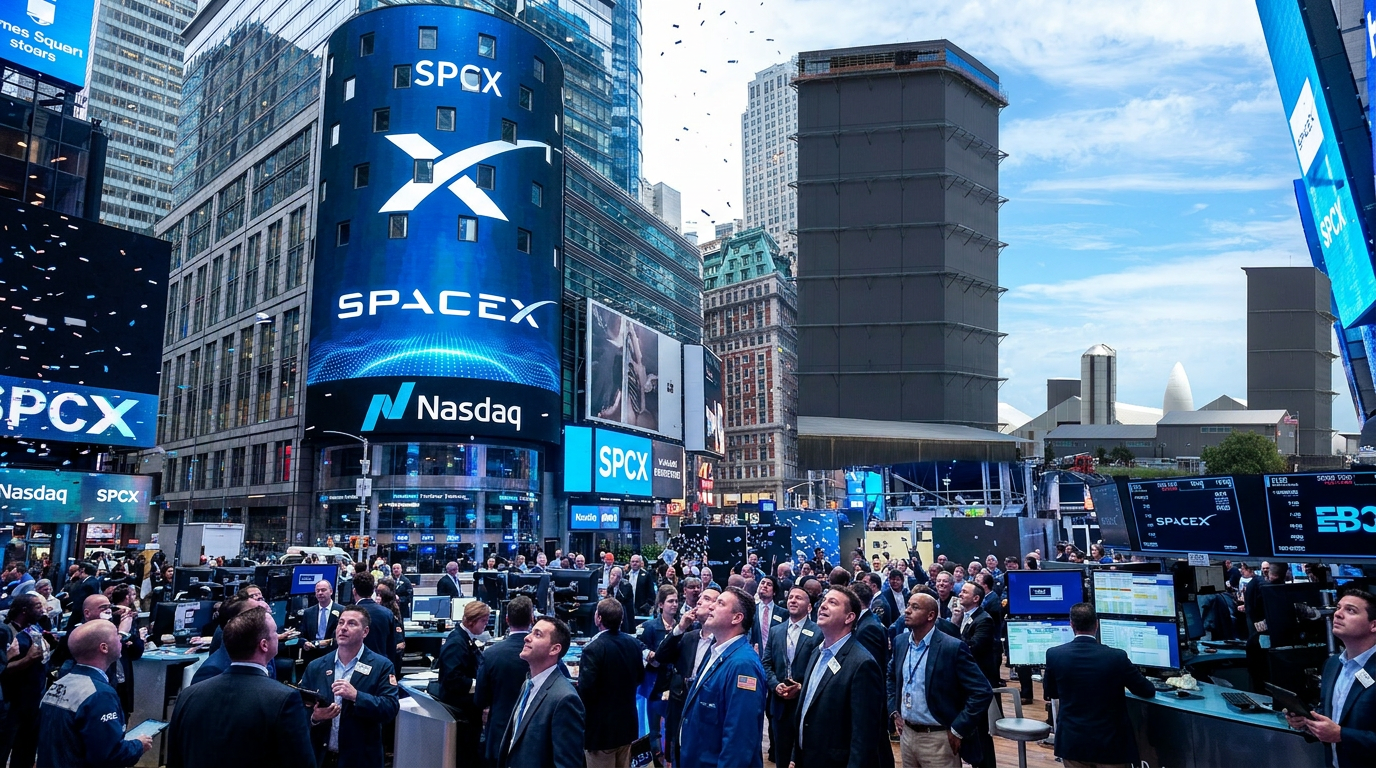
SpaceX begins trading on the Nasdaq under the ticker SPCX, closing its first day up 19% at $161.
June 16, 2026
Data reveals retail investors net-bought nearly $370 million worth of SpaceX stock in its first three days, prompting analysts to propose the FAB 10 index.
Viewpoints in depth
Retail Investors & Democratization Advocates
View the SpaceX IPO as a triumph for everyday investors who are usually locked out of generational wealth creation.
This camp argues that traditional Wall Street mechanics unfairly favor institutional gatekeepers, allowing hedge funds to capture the steepest growth curves while retail investors are left buying at a premium. By allocating up to 30% of the float to retail accounts and lowering the barrier to entry to just $2,000, they see the SpaceX offering as a blueprint for democratizing access to frontier technology. For these advocates, the massive retail buying volume is not irrational exuberance, but a rational response to finally being invited to the table.
Institutional Skeptics & Valuation Analysts
Warn that the $1.77 trillion valuation is detached from current fundamentals and engineered by artificial scarcity.
Skeptics point out that SpaceX is currently operating at a loss with under $20 billion in annual revenue, making its multi-trillion-dollar market cap highly speculative. They argue that offering only a 5% public float created an artificial supply squeeze, driving the price up 55% in three days. This camp cautions that true price discovery won't happen until insider lock-up periods expire and the market is flooded with new shares, leaving retail investors vulnerable to a sudden correction.
Market Strategists & Index Managers
Focused on the structural impact of SpaceX's entry into major indices and the shift from the 'Magnificent Seven' to the 'FAB 10.'
For this group, the story is about market mechanics and capital rotation. They note that SpaceX's accelerated inclusion into the Nasdaq-100 forces passive index funds to buy the stock regardless of its premium price. Furthermore, they argue that the sheer gravitational pull of SpaceX, along with upcoming IPOs from OpenAI and Anthropic, requires a new framework—the 'FAB 10'—as capital drains from mature semiconductor stocks into next-generation space and AI infrastructure.
What we don't know
- How the stock price will react when insider lock-up periods expire and millions of new shares flood the market.
- Whether SpaceX can successfully execute its plans for orbital AI data centers to justify its premium valuation.
- If the 'FAB 10' moniker will permanently replace the 'Magnificent Seven' in mainstream financial reporting.
Key terms
- Initial Public Offering (IPO)
- The process by which a private company offers its shares to the public for the first time, transitioning into a publicly traded entity.
- Public Float
- The portion of a company's shares that are available for trading by the general public, excluding closely held shares by insiders.
- Lock-up Period
- A predetermined window of time after an IPO during which company insiders and early investors are legally restricted from selling their shares.
- Passive Index Fund
- A mutual fund or ETF designed to automatically track the performance of a specific market index, such as the Nasdaq-100, by holding all the stocks in that index.
- Magnificent Seven
- A term coined in 2023 to describe the seven dominant U.S. technology stocks: Apple, Microsoft, Alphabet, Amazon, Nvidia, Meta, and Tesla.
Frequently asked
How much of SpaceX is publicly traded?
SpaceX offered a relatively small public float during its IPO, selling only about 5% of its outstanding shares to the public. The vast majority of shares remain held by Elon Musk and early private investors.
What is the 'FAB 10'?
The 'FAB 10' (Frontier AI & Big Tech 10) is a new market classification proposed by analysts to replace the 'Magnificent Seven.' It includes the original seven tech giants plus SpaceX, OpenAI, and Anthropic.
Why did retail investors buy so much SpaceX stock?
Unlike typical IPOs that reserve only 5-10% for the public, SpaceX allocated up to 30% of its offering to retail investors. Brokerages also lowered minimum investment requirements, making it highly accessible.
Is SpaceX profitable?
While specific divisions like Starlink generate significant revenue, analysts note that the company as a whole currently operates at a loss as it invests heavily in its Starship program and orbital AI infrastructure.
Sources
Source coverage
8 outlets
3 viewpoints surfaced








[1]MarketWatchRetail & Access Advocates
Retail investors have been buying more SpaceX shares than all of the ‘Magnificent Seven’ combined
Read on MarketWatch →[2]WikipediaMarket Strategists
Initial public offering of SpaceX
Read on Wikipedia →[3]Fidelity InvestmentsRetail & Access Advocates
SpaceX IPO explained
Read on Fidelity Investments →[4]The GuardianValuation Skeptics
SpaceX makes largest ever stock market debut, making Elon Musk world's first trillionaire
Read on The Guardian →[5]Financial TimesRetail & Access Advocates
Elon Musk's SpaceX lines up retail investors for record IPO allocation
Read on Financial Times →[6]Vanda ResearchMarket Strategists
Are the “Magnificent Seven” no longer enough? Retail investors rush to buy SpaceX shares ahead of its IPO
Read on Vanda Research →[7]Factlen Editorial TeamMarket Strategists
Synthesis by Factlen editorial team
Read on Factlen Editorial Team →[8]HTXValuation Skeptics
Are the "Magnificent Seven" No Longer Enough? SpaceX IPO Attracts Retail Frenzy, Wall Street Serves Up the "AI Tech Ten"
Read on HTX →

Every angle. Every day.
Get finance stories with full source coverage and perspective breakdowns delivered to your inbox.