
SpaceX Prices Historic $75 Billion IPO, Launching Elon Musk to Trillionaire Status
SpaceX has officially priced its initial public offering at $135 per share, securing a record $1.75 trillion valuation and generating unprecedented investor demand. The landmark Nasdaq debut marks the largest public offering in history and fundamentally alters the landscape of major stock indexes.
By Factlen Editorial Team
- Growth Investors & Bulls
- Investors focused on SpaceX's dominant market position and long-term potential.
- Fundamental Skeptics
- Analysts warning that the IPO price is disconnected from the company's actual financial performance.
- Index & ETF Strategists
- Market professionals focused on the mechanical impacts of the mega-cap listing on passive funds.
What's not represented
- · Traditional Aerospace Competitors
- · Retail Investors Priced Out of the IPO
Why this matters
SpaceX's record-breaking $75 billion IPO fundamentally reshapes the global stock market, instantly creating one of the world's most valuable public companies. For everyday investors, its entry into major indexes means millions of retirement accounts and passive funds will automatically gain exposure to the commercial space economy, regardless of whether they actively buy the stock.
Key points
- SpaceX priced its IPO at $135 per share, raising a record $75 billion.
- The offering values the aerospace and AI company at approximately $1.75 trillion.
- Investor demand exceeded $250 billion, oversubscribing the offering by nearly four times.
- The valuation pushes CEO Elon Musk's combined net worth past $1.1 trillion.
- Skeptics warn the stock is overvalued, citing the company's $4.9 billion net loss in 2025.
- Nasdaq rules will force passive index funds to buy the stock within 15 days of its debut.
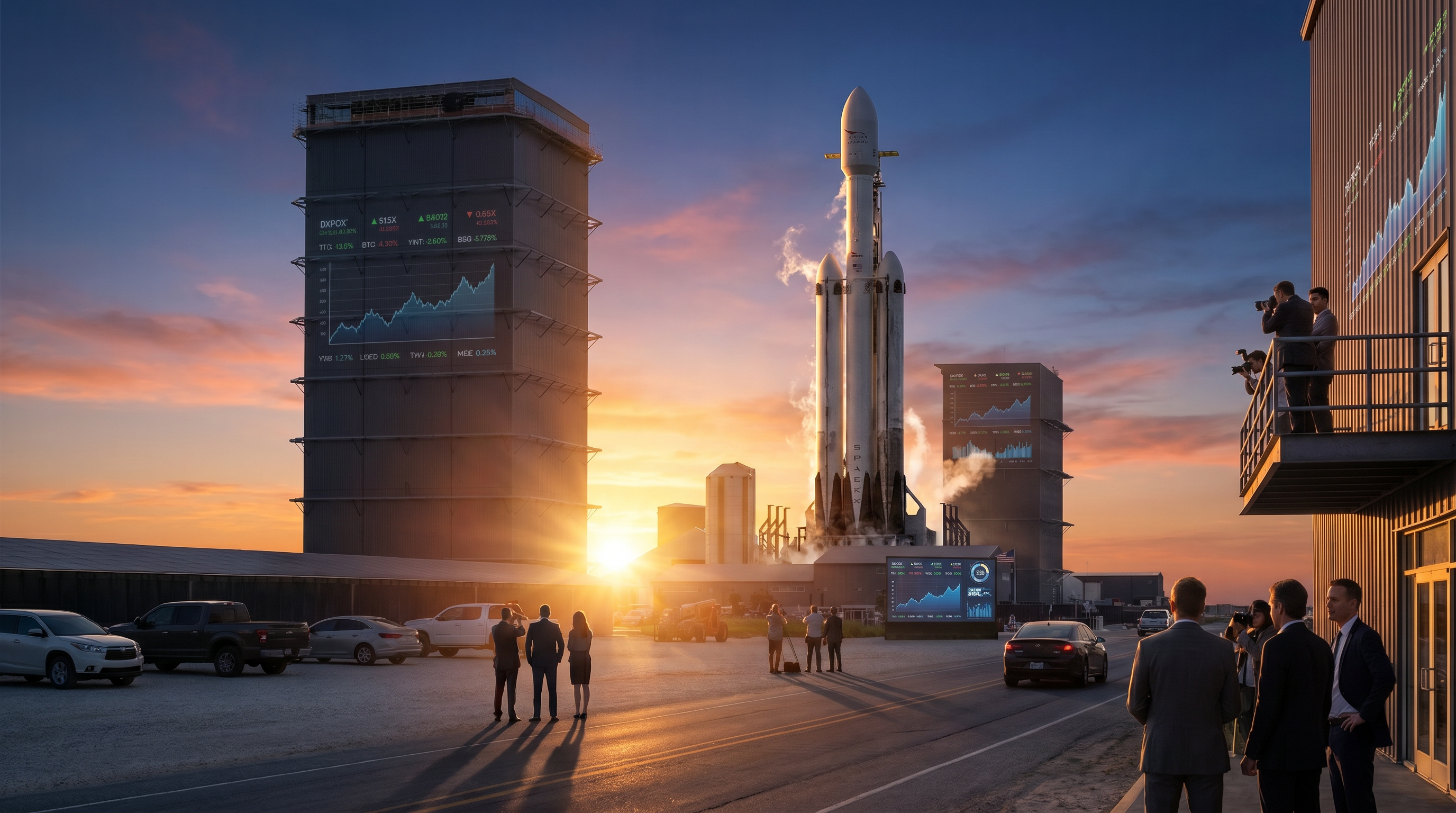
SpaceX has officially priced its highly anticipated initial public offering at $135 per share, successfully raising $75 billion in the largest public market debut in financial history. The Thursday evening pricing awards Elon Musk's aerospace, satellite communications, and artificial intelligence giant a staggering valuation of approximately $1.75 trillion. When shares begin trading on the Nasdaq exchange under the ticker symbol SPCX on Friday morning, the company will immediately join the exclusive ranks of the most valuable corporations on Earth, trailing only established tech behemoths like Apple, Microsoft, and Nvidia in total market capitalization.[1][2]
The sheer scale of the offering completely dwarfs all previous records set in global equity markets. The $75 billion capital raise is nearly three times the size of the previous high-water mark, which was established by Saudi Aramco's $29.4 billion float in 2019. Investor appetite for the space venture has been voracious across the board, with total demand for the shares exceeding $250 billion. This massive influx of capital means the offering was oversubscribed by roughly three and a half to four times the available supply, underscoring the intense market enthusiasm.[1][2][4]
Retail investors have played an unusually outsized role in fueling this unprecedented frenzy. Individual traders placed advance orders for more than $100 billion in shares ahead of the debut, representing a historic level of retail participation for a mega-cap listing. Institutional giants were equally aggressive in their pursuit of allocations, with massive asset managers like BlackRock reportedly placing single orders of $5 billion or more to ensure they secured a meaningful piece of the commercial space economy before the stock hits the open market.[4]

The historic valuation also triggers a monumental personal milestone for the company's founder and chief executive. Based on Thursday's final pricing, Elon Musk's roughly 50 percent stake in SpaceX is now worth approximately $867 billion on paper. When combined with his existing holdings and performance packages in the automaker Tesla, Musk's total estimated net worth eclipses the $1.1 trillion mark. This unprecedented accumulation of wealth makes him the world's first paper trillionaire, though much of that fortune remains tied to audacious, long-term performance milestones, including the eventual establishment of a permanent human settlement on Mars.[3]
Despite the overwhelming demand and record-breaking numbers, some financial analysts are sounding the alarm over what they see as a severe disconnect between the company's $1.75 trillion price tag and its underlying financial fundamentals. While revenue is growing rapidly, SpaceX remains deeply unprofitable on a GAAP basis. The company posted a staggering net loss of $4.9 billion for the full year of 2025, and followed that up by shedding another $4.3 billion in just the first quarter of 2026, driven largely by heavy capital expenditures in rocketry and artificial intelligence.[2][8]
Investment research firm Morningstar has been particularly vocal in its skepticism, estimating the company's actual fair value at just $63 per share—less than half of the $135 IPO price that investors eagerly paid. Skeptics argue that while the Starlink satellite broadband business is a legitimate, cash-generating revenue engine, the broader trillion-dollar valuation relies heavily on untested technologies and highly speculative artificial intelligence ventures that were absorbed following SpaceX's recent merger with xAI. They caution that pricing the company for perfection leaves little room for the inevitable delays and setbacks inherent in deep-space exploration and bleeding-edge AI development.[2][8]

Michael Field, the chief equity strategist at Morningstar, explicitly advised caution for everyday investors caught up in the hype. 'We believe the business has real strengths, particularly in Starlink, but with so many unknown and untested technologies underpinning much of the valuation price, particularly within the AI business, we think the valuation is extremely speculative,' Field noted. He suggested that prudent investors should sit out the initial public offering frenzy and wait for a more attractive entry point down the line once the post-IPO volatility subsides.[2]
Michael Field, the chief equity strategist at Morningstar, explicitly advised caution for everyday investors caught up in the hype.
Beyond the fierce debate over intrinsic value and profitability, the sheer size of the SPCX listing is forcing a structural reckoning across global equity markets. The mechanics of passive index tracking are being severely tested by a debut of this magnitude, with major index providers taking sharply divergent approaches to absorbing the new heavyweight into their benchmarks. Because trillions of dollars are tied to these indexes, the decisions made by these providers will dictate massive flows of capital in the coming weeks.[5]
The Nasdaq exchange has proactively altered its inclusion rules specifically to accommodate mega-cap entrants like SpaceX. Under a newly implemented 'Fast Entry' standard, SpaceX is eligible to join the prestigious Nasdaq-100 index within just 15 trading days of its debut, entirely bypassing the traditional three-month seasoning period. This accelerated timeline will force passive mutual funds and ETFs tracking the Nasdaq-100 to execute tens of billions of dollars in automatic, price-agnostic buying to replicate the index's new weightings, potentially driving the stock price even higher regardless of fundamental news.[5]
Conversely, S&P Global has opted to maintain its strict, traditional eligibility criteria for the benchmark S&P 500 index, which requires a company to demonstrate four consecutive quarters of positive GAAP earnings before it can be considered for inclusion. Because SpaceX is currently operating at a significant loss, it will be excluded from the S&P 500 for the foreseeable future. This strict adherence to profitability rules spares the massive universe of funds benchmarked to the S&P 500 from the immediate liquidity scramble, creating a stark divide in how passive capital will interact with the stock.[5]

For retail investors who missed out on the initial allocation or prefer a diversified approach, the exchange-traded fund ecosystem has rapidly evolved to offer alternative exposure. Space-themed funds like the Tema Space Innovators ETF (NASA) and the VanEck Space Innovators ETF have seen massive capital inflows in the weeks leading up to the IPO. The NASA fund alone crossed $2.5 billion in assets shortly after launching, driven almost entirely by anticipation of the SpaceX float and the broader halo effect it is expected to cast over the entire commercial space sector.[6]
The international financial community is also watching the listing closely, with foreign investors showing historic demand for the IPO as they seek exposure to the undisputed leader of the U.S. commercial space sector. However, foreign exchange analysts at MarketWatch note that this targeted equity buying is unlikely to trigger a broader macroeconomic frenzy for the U.S. dollar. The massive capital inflows are highly specific to Musk's enterprise and the unique opportunity it presents, rather than a structural bet on the strength of the American economy or its currency.[7]
Ultimately, the Friday trading session will serve as a real-time, high-stakes referendum on whether the broader public market is willing to underwrite Musk's expansive vision of orbital data centers, global broadband dominance, and interplanetary colonization at a premium valuation. While the financial fundamentals may be tough to justify by traditional value-investing metrics, the $250 billion wall of institutional and retail demand suggests that, for now, investors are far more afraid of missing the launch than they are of the astronomical price tag.[1][2][8]
How we got here
Dec 2025
A private tender offer prices SpaceX shares at $421, implying an $800 billion valuation.
Feb 2026
SpaceX merges with artificial intelligence startup xAI, boosting the combined entity's valuation to $1.25 trillion.
May 2026
SpaceX publicly files its S-1 prospectus, revealing massive revenue growth alongside multi-billion-dollar net losses.
Jun 11, 2026
SpaceX officially prices its IPO at $135 per share, cementing a $1.75 trillion valuation.
Jun 12, 2026
Shares begin trading on the Nasdaq exchange under the ticker symbol SPCX.
Viewpoints in depth
Growth Investors & Bulls
Investors focused on SpaceX's dominant market position and long-term potential.
Proponents of the $1.75 trillion valuation argue that traditional financial metrics fail to capture SpaceX's true potential. They view the company not just as a rocket manufacturer, but as a monopolistic utility for the space economy. Bulls point to Starlink's rapidly expanding high-speed internet monopoly and the recent integration of xAI as transformative growth engines. For these investors, the $250 billion in IPO demand reflects a belief that Elon Musk is building the foundational infrastructure for the next century of human technological advancement, making near-term profitability irrelevant.
Fundamental Skeptics
Analysts warning that the IPO price is disconnected from the company's actual financial performance.
Skeptics, led by research firms like Morningstar, argue that the IPO is priced for absolute perfection and ignores glaring financial realities. They point to the company's $4.9 billion net loss in 2025 and an additional $4.3 billion loss in the first quarter of 2026 as evidence that the core business model is still burning unsustainable amounts of cash. These analysts warn that the $1.75 trillion valuation relies too heavily on speculative, unproven technologies—such as orbital data centers and Mars colonization—rather than cash-generating operations, leaving retail investors highly vulnerable to a post-IPO correction.
Index & ETF Strategists
Market professionals focused on the mechanical impacts of the mega-cap listing on passive funds.
For index strategists, the SpaceX IPO is less about the company's fundamentals and more about market mechanics. Because Nasdaq altered its rules to allow 'Fast Entry' for mega-cap companies, passive funds tracking the Nasdaq-100 will be forced to buy tens of billions of dollars of SPCX stock within 15 days of its debut, regardless of the price. Conversely, because the S&P 500 requires four quarters of profitability, funds tracking that index will be entirely excluded from the action. Strategists warn this divergence could create unprecedented volatility and supply-demand imbalances in the stock's early trading days.
What we don't know
- How the stock will perform in its first week of trading given the massive retail demand.
- Whether SpaceX can achieve profitability in the near term to qualify for S&P 500 inclusion.
- How much of the $1.75 trillion valuation relies on the unproven xAI merger versus the established Starlink business.
Key terms
- Initial Public Offering (IPO)
- The process by which a private company offers shares to the public for the first time, allowing it to raise capital from public market investors.
- Public Float
- The portion of a company's shares that are in the hands of public investors and available for trading on the open market.
- Passive Index Fund
- An investment fund designed to automatically track the performance of a specific market benchmark, like the Nasdaq-100, rather than relying on a manager to pick stocks.
- Oversubscribed
- A situation in an IPO where the number of shares investors want to buy exceeds the number of shares the company is actually selling.
- GAAP Earnings
- A company's profit or loss calculated according to Generally Accepted Accounting Principles, the standard framework of guidelines for financial accounting.
Frequently asked
What is the SpaceX IPO price?
SpaceX priced its initial public offering at $135 per share, successfully raising $75 billion.
When does SpaceX start trading?
Shares will begin trading on the Nasdaq exchange on Friday, June 12, 2026, under the ticker symbol SPCX.
Will SpaceX be included in the S&P 500?
Not immediately. The S&P 500 requires companies to demonstrate four consecutive quarters of positive earnings, and SpaceX is currently operating at a loss.
How can retail investors buy in if they missed the IPO?
Investors can purchase SPCX shares on the open market once trading begins, or gain indirect exposure through space-themed ETFs like the Tema Space Innovators ETF.
Sources
Source coverage
8 outlets
3 viewpoints surfaced








[1]Business InsiderGrowth Investors & Bulls
SpaceX IPO live updates: Record-setting IPO prices at $135 a share
Read on Business Insider →[2]The GuardianFundamental Skeptics
SpaceX heads for record $1.78tn float amid fears it is overvalued
Read on The Guardian →[3]The Washington PostGrowth Investors & Bulls
Elon Musk is the world's first trillionaire (on paper) thanks to the SpaceX IPO
Read on The Washington Post →[4]ForbesGrowth Investors & Bulls
SpaceX Cements Final IPO Price At $135 As Retail Investor Orders Top $100 Billion
Read on Forbes →[5]CME GroupIndex & ETF Strategists
The SpaceX Mega-IPO: Why Index Choice Matters
Read on CME Group →[6]etf.comIndex & ETF Strategists
SpaceX IPO: Every ETF That Will Hold SPCX — and When
Read on etf.com →[7]MarketWatchGrowth Investors & Bulls
The SpaceX IPO is drawing historic demand from foreign investors. But don't expect a dollar-buying frenzy.
Read on MarketWatch →[8]CNAFundamental Skeptics
Elon Musk's SpaceX IPO: Is it worth the hype?
Read on CNA →
More in finance
See all 49 stories →Space Economy
How the SpaceX IPO Works: Market Mechanics, Valuation, and Navigating the Hype
6 sources
Soft Landing
The Mechanics of the Soft Landing: How Real Wages Finally Outpaced Inflation
7 sources

Parametric Models
How Parametric Insurance Uses Data to Pay Disaster Claims Instantly
8 sources

Space Economy
Inside the SpaceX IPO: How the $1.75 Trillion Listing Reshapes the Space Economy
7 sources
Every angle. Every day.
Get finance stories with full source coverage and perspective breakdowns delivered to your inbox.