
Solid-State Batteries Move From Lab to Production Line in 2026
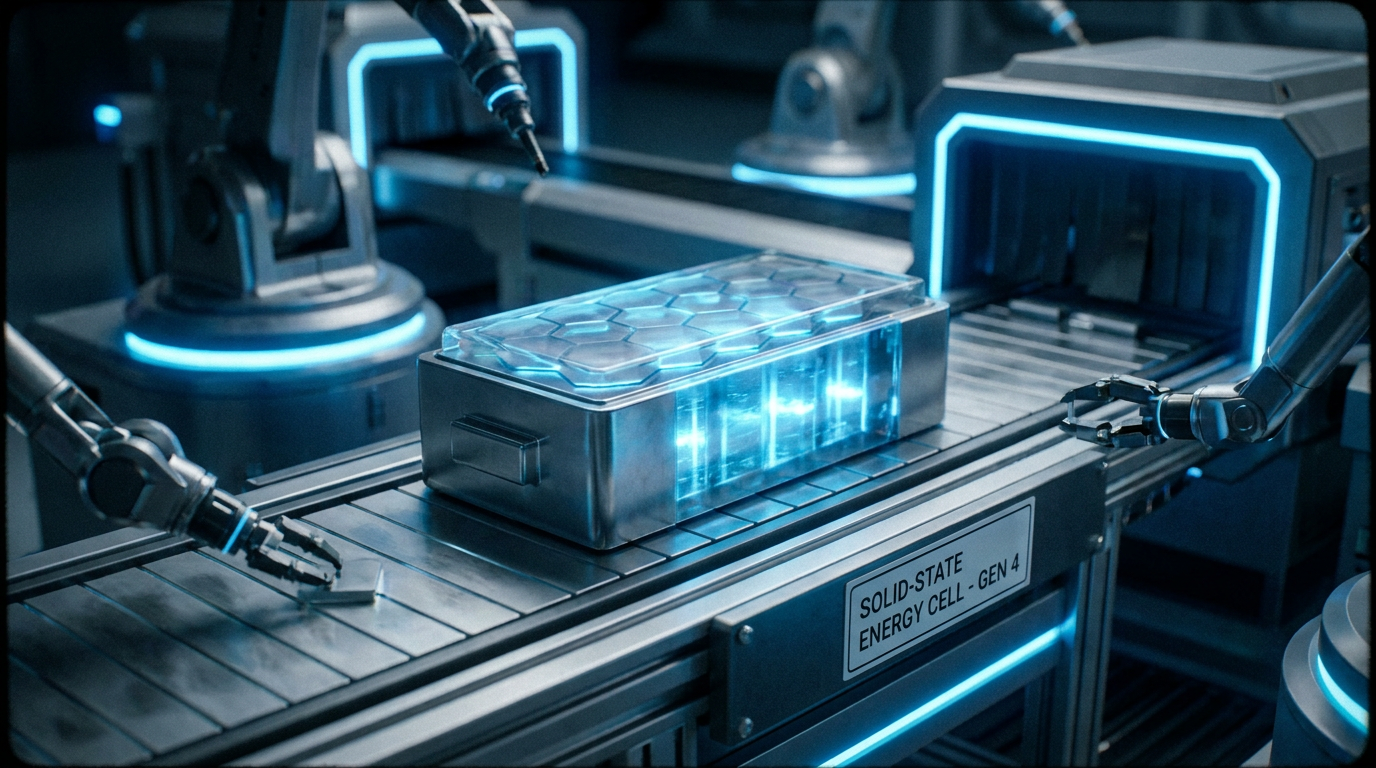
After decades of research, next-generation solid-state batteries have officially entered pilot production. The breakthrough technology promises to double electric vehicle range, cut charging times to ten minutes, and virtually eliminate battery fire risks.
By Factlen Editorial Team
- Solid-State Pioneers
- Startups and aggressive automakers pushing to commercialize the technology rapidly to capture early market dominance.
- Legacy Automakers
- Established giants prioritizing methodical scaling, supply chain security, and absolute safety over being first to market.
- Industry Analysts
- Observers highlighting the immense difficulty and cost of scaling from pilot lines to gigawatt-hour mega-factories.
What's not represented
- · Raw Material Suppliers
- · Grid Infrastructure Operators
Why this matters
Solid-state batteries represent the biggest leap in energy storage since the invention of lithium-ion. By solving the core issues of range anxiety, slow charging, and fire hazards, this technology removes the final barriers to mass electric vehicle adoption and opens the door for electric aviation.
Key points
- Multiple companies, including QuantumScape and GBT, have launched pilot production lines for solid-state batteries in 2026.
- The new cells replace flammable liquid electrolytes with solid materials, drastically improving safety and thermal stability.
- Energy density is expected to double, potentially allowing electric vehicles to travel over 600 miles on a single charge.
- While pilot production is underway, widespread integration into mass-market consumer vehicles is targeted for 2028 to 2030.
The electric vehicle industry has been chasing a singular holy grail for over a decade, and in 2026, it finally crossed the threshold from laboratory theory to factory reality. Solid-state batteries, long heralded as the technology that will render internal combustion engines obsolete, have officially entered pilot production. This milestone marks the beginning of a profound shift in how the world stores and deploys energy.[1][3]
To understand the magnitude of this breakthrough, one must look at the limitations of the technology it replaces. Traditional lithium-ion batteries have powered everything from smartphones to the current generation of electric vehicles, but they are fundamentally constrained by their chemistry. They suffer from range ceilings, prolonged charging times, and, under extreme stress, a vulnerability to thermal runaway and fire.[7]
The solid-state battery solves these inherent flaws through a seemingly simple architectural swap. In a conventional battery, lithium ions travel between the cathode and anode through a liquid electrolyte—a flammable solution of lithium salts dissolved in organic solvents. Solid-state technology replaces this volatile liquid with a stable, non-flammable solid material, typically composed of advanced ceramics, polymers, or sulfides.[7]

This substitution is not merely a safety upgrade; it is the key that unlocks an entirely new tier of chemical performance. By utilizing a solid electrolyte, engineers can safely replace the bulky graphite anode used in traditional cells with a pure lithium-metal anode. In liquid batteries, lithium metal tends to form dendrites—microscopic, needle-like structures that pierce the separator and cause short circuits—but a robust solid electrolyte physically suppresses this destructive growth.[7]
The immediate result of this architectural leap is a staggering increase in energy density. While the very best lithium-ion cells on the market today max out between 250 and 300 watt-hours per kilogram (Wh/kg), the solid-state cells rolling off 2026 pilot lines are targeting between 400 and 600 Wh/kg. This metric dictates exactly how much energy a vehicle can carry without adding prohibitive weight.[3][4][7]
For the consumer, this translates to electric vehicles capable of traveling 600 to 750 miles—roughly 1,000 to 1,200 kilometers—on a single charge. This effectively eliminates range anxiety, allowing drivers to complete interstate road trips without the constant calculus of mapping out charging stations.[4][5]

Charging speed is the second major breakthrough. Because solid electrolytes are vastly more efficient at shuttling ions back and forth without degrading, these next-generation batteries can handle immense influxes of power. Both Chinese manufacturers and Japanese automotive giants are projecting charge times of roughly ten minutes to reach an 80 percent capacity.[3][5]
Crucially, this rapid charging does not come at the expense of safety. The elimination of the liquid solvent fundamentally alters the battery's thermal profile. Comparative testing has demonstrated that while traditional lithium-ion cells can enter a dangerous thermal runaway state at temperatures as low as 90 degrees Celsius, solid-state systems remain stable well past 240 degrees Celsius. Even when punctured or crushed, they do not explode.[3][7]
Crucially, this rapid charging does not come at the expense of safety.
The race to commercialize this technology hit a fever pitch in early 2026. In February, California-based QuantumScape inaugurated its "Eagle Line" in San Jose, a highly automated pilot facility designed to prove that solid-state cells can be manufactured at scale. The facility represents the culmination of fifteen years of research and billions of dollars in investment.[1][2]
QuantumScape's proprietary "Cobra process" allows for the rapid, scalable production of its unique ceramic separator. To prove the technology's viability outside the lab, the company partnered with Volkswagen's battery subsidiary, PowerCo, to successfully power a Ducati motorcycle in a live demonstration. The Eagle Line is now producing cells for automotive partners to begin rigorous real-world testing.[2][6]

Meanwhile, the Chinese battery sector is moving with aggressive speed. In April 2026, Greater Bay Technology (GBT), a startup backed by the GAC Group, announced that its first "A-sample" all-solid-state battery cells had successfully rolled off the production line. These cells passed stringent needle penetration and thermal shock tests without incident, clearing the path for industrialization.[3]
The integration of these batteries into consumer vehicles is happening faster than many analysts predicted. Chinese automaker Chery recently announced plans to deploy solid-state technology in its Exeed Liefeng model before the end of the year, boasting a cell energy density of 600 Wh/kg. If successful, it would mark one of the first commercial deployments of the technology in a passenger car.[4]
Legacy automakers are taking a more methodical, scale-focused approach. Toyota, which holds more solid-state battery patents than any other company, broke ground on a large-scale solid electrolyte pilot plant in collaboration with petroleum giant Idemitsu in early 2026. Rather than rushing a low-volume prototype to market, Toyota is targeting 2027 and 2028 for its first solid-state vehicles, ensuring the supply chain can support global demand.[5]
Despite the palpable momentum, the transition from pilot lines to gigawatt-hour mega-factories remains fraught with challenges. Producing a few thousand flawless A-samples in a controlled environment is a monumental achievement, but manufacturing millions of cells annually requires unprecedented precision.[6]

The manufacturing tolerances for solid-state batteries are unforgiving. The solid layers must be pressed together with exact, uniform pressure to ensure perfect contact; even microscopic air gaps or impurities can severely degrade the battery's performance. Developing the automated machinery to achieve this at high speeds is the industry's current bottleneck.[1][6]
Cost will also dictate the pace of adoption. The advanced materials required for solid electrolytes, combined with the massive capital expenditure needed to build entirely new production lines, mean that early solid-state batteries will carry a premium price tag. For the first few years, they will likely be reserved for luxury sedans and high-performance sports cars.[5]
However, the implications of this technology extend far beyond the automotive sector. The drastic reduction in weight and elimination of fire risks make solid-state batteries the missing link for low-altitude aviation. Companies are already testing these high-density cells in electric vertical takeoff and landing (eVTOL) aircraft, drones, and advanced robotics.[3][6]
The developments of 2026 have definitively answered the question of whether solid-state batteries are viable. The industry has moved past theoretical chemistry and into the grueling but inevitable phase of industrial scaling. As production lines refine their processes and costs begin to fall, the electric vehicle market is poised for a generational leap that will permanently alter the landscape of global transportation.[1][5]
How we got here
2012–2020
Early laboratory breakthroughs and initial automotive investments in solid-state startups.
June 2023
Toyota announces a technological breakthrough in solid electrolyte durability.
February 2026
QuantumScape inaugurates its 'Eagle Line' for pilot manufacturing in California.
April 2026
China's GBT rolls its first A-sample solid-state cells off the production line.
2027–2028
Target window for the first premium passenger EVs equipped with solid-state batteries.
Viewpoints in depth
Solid-State Pioneers
Startups and aggressive automakers pushing to commercialize the technology rapidly to capture early market dominance.
Companies like QuantumScape and GBT argue that the fundamental chemistry problems of solid-state batteries have been solved. By successfully launching pilot production lines and delivering A-samples to automotive partners, these pioneers believe the industry is ready for rapid commercialization. They point to successful live demonstrations, such as powering motorcycles and eVTOL aircraft, as evidence that the technology is robust enough for immediate integration into high-performance applications.
Legacy Automakers
Established giants prioritizing methodical scaling, supply chain security, and absolute safety over being first to market.
Automakers like Toyota view solid-state batteries as a generational shift that requires a completely rebuilt supply chain. Rather than rushing low-volume prototypes to consumers, they are investing heavily in massive solid-electrolyte manufacturing plants with partners like Idemitsu. Their argument is that the true value of solid-state technology will only be realized when it can be produced at gigawatt-hour scale with zero defects, a milestone they project for 2027 to 2028.
Manufacturing Skeptics
Observers highlighting the immense difficulty and cost of scaling from pilot lines to gigawatt-hour mega-factories.
Industry analysts and manufacturing experts caution against the hype surrounding pilot lines. They note that producing a few thousand flawless cells in a controlled environment is vastly different from manufacturing millions of cells annually. The precision required to press solid layers together without microscopic air gaps is unprecedented in battery manufacturing. Skeptics argue that high capital expenditures and low initial yields will keep solid-state batteries prohibitively expensive for mass-market vehicles until well into the 2030s.
What we don't know
- Exactly how quickly the cost of solid-state cells will reach parity with traditional lithium-ion batteries.
- Which specific solid electrolyte chemistry (polymers, sulfides, or oxides) will ultimately dominate the mass market.
- Whether the global supply chain for raw lithium can scale fast enough to meet the increased demand generated by lithium-metal anodes.
Key terms
- Solid Electrolyte
- A non-flammable solid material, such as ceramics or polymers, that conducts ions between the battery's anode and cathode.
- Lithium-Metal Anode
- An advanced battery component that replaces traditional graphite, drastically increasing the amount of energy the cell can store.
- Energy Density
- The amount of energy a battery can hold relative to its weight, typically measured in watt-hours per kilogram (Wh/kg).
- Thermal Runaway
- A dangerous chain reaction where a battery cell overheats and catches fire, a risk significantly reduced in solid-state designs.
- A-Sample
- An early-stage prototype battery cell produced on a pilot line to prove the manufacturing concept to automotive partners.
Frequently asked
What makes a solid-state battery different from lithium-ion?
It replaces the flammable liquid electrolyte with a solid material, allowing for a lithium-metal anode that stores significantly more energy safely.
When will I be able to buy a car with a solid-state battery?
While pilot production began in 2026, widespread consumer availability in mass-market vehicles is expected between 2028 and 2030.
Are solid-state batteries safer?
Yes. Because they lack flammable liquid solvents, they are highly resistant to thermal runaway and battery fires, even when punctured or crushed.
Sources
Source coverage
7 outlets
3 viewpoints surfaced







[1]InsideEVsSolid-State Pioneers
QuantumScape Inaugurates Eagle Line For Solid-State Batteries
Read on InsideEVs →[2]QuantumScapeSolid-State Pioneers
QuantumScape Celebrates Inauguration of Eagle Line
Read on QuantumScape →[3]ElectrekSolid-State Pioneers
China ramps up solid-state EV battery production
Read on Electrek →[4]ElectriveSolid-State Pioneers
Chery to debut solid-state battery in Exeed Liefeng this year
Read on Electrive →[5]Vision TimesLegacy Automakers
Toyota Bets on Solid-State Batteries to Redefine EV Industry
Read on Vision Times →[6]Battery Tech OnlineIndustry Analysts
QuantumScape CEO details commercialization blueprint
Read on Battery Tech Online →[7]To7MotorIndustry Analysts
Solid-State Batteries 2026: The EV Breakthrough Explained
Read on To7Motor →
Every angle. Every day.
Get automotive stories with full source coverage and perspective breakdowns delivered to your inbox.