
Sanju Samson's Redemption Arc Anchors India's Historic T20 World Cup Title Defense
After being benched in 2024 and nearly broken by poor form, Sanju Samson delivered three consecutive knockout masterclasses to secure India's unprecedented title defense.
By Factlen Editorial Team
- Indian Supporters & Analysts
- Celebrating the historic three-peat and Samson's mental fortitude.
- Neutral Cricket Observers
- Focusing on the statistical anomalies and aggressive evolution of the format.
- New Zealand Camp
- Acknowledging the insurmountable challenge posed by India's peak form.
What's not represented
- · Domestic coaches who worked with Samson during his slump
- · Bowlers' perspectives on the increasingly batsman-friendly T20 format
Why this matters
Samson's journey from a benched squad player to the undisputed Player of the Tournament highlights the psychological resilience required in elite sports. For cricket fans, India's unprecedented title defense sets a new historical benchmark for dominance in the T20 format.
Key points
- India defeated New Zealand by 96 runs to win the 2026 T20 World Cup.
- The victory marks India's third title and the first successful defense in tournament history.
- India posted a record-breaking 255/5 in the final at Ahmedabad.
- Sanju Samson was named Player of the Tournament with 321 runs in five innings.
- Jasprit Bumrah took 4/15 in the final, finishing as joint-highest wicket-taker.
- Pakistan's Sahibzada Farhan led all scorers with 383 runs and two centuries.
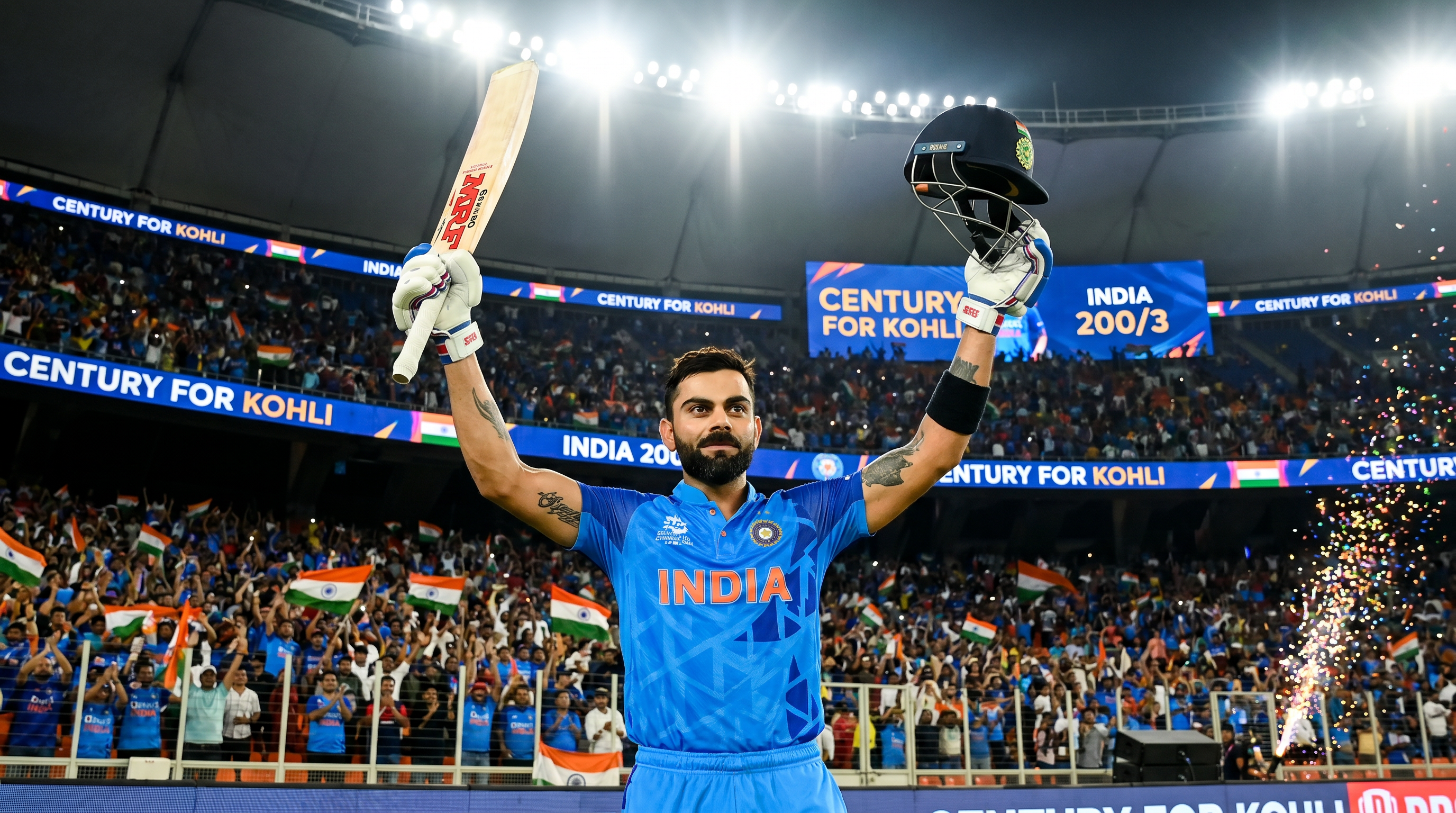
The roar of 86,000 fans at the Narendra Modi Stadium in Ahmedabad on March 8, 2026, signaled more than just a tournament victory; it marked the coronation of a cricketing dynasty. When India defeated New Zealand by a staggering 96 runs to clinch the 2026 ICC Men's T20 World Cup, they shattered a ceiling that had stood for nearly two decades. They became the first nation to win three T20 World Cup titles, the first to successfully defend the crown, and the first to win the tournament on home soil. Yet, beneath the confetti and the historic team accolades, the defining narrative of the month-long tournament belonged to one man: Sanju Samson.[5][6]
Samson's journey to becoming the undisputed Player of the Tournament is a quintessential sports redemption arc. Just two years prior, during India's victorious 2024 campaign, the Kerala-born wicketkeeper-batter was a peripheral figure, unable to break into the starting XI. His fortunes seemed to worsen in January 2026 during a bilateral series against New Zealand, where he managed a meager 46 runs across five matches. Samson later admitted that the slump left him feeling "broken" with his dreams "completely shattered."[1]
Rather than succumbing to the pressure, the 31-year-old sought out the counsel of Indian cricket legend Sachin Tendulkar. Months of constant communication and mental recalibration followed. When the World Cup commenced in February, co-hosted by India and Sri Lanka, Samson arrived with a clarified mindset and an aggressive mandate. What followed was one of the most destructive individual campaigns in the history of the shortest format.[1]
Samson's tournament was defined by his ability to deliver when the stakes were highest. While he only batted in five innings throughout the competition, his impact was seismic. The turning point arrived in the Super 8 stage during a virtual quarter-final against the West Indies. Samson unleashed an unbeaten 97 off just 50 deliveries, single-handedly guiding India to a commanding total and securing his place at the top of the order.[1][4]

He proved the innings was no fluke in the semi-final against England. Facing a formidable bowling attack, Samson bludgeoned a rapid 89 off 42 balls, propelling India to a massive 253 and earning his second consecutive Player of the Match award. His ability to effortlessly clear the boundary ropes—dominating both express pace and mystery spin—made him the most feared batter in the tournament.[2][6]
He proved the innings was no fluke in the semi-final against England.
The grand finale in Ahmedabad provided the ultimate stage for Samson's masterclass. After New Zealand won the toss and elected to field, hoping to exploit early nerves, Samson and opening partner Abhishek Sharma launched a relentless counter-attack. Samson top-scored once again, hammering 89 off 46 balls. His innings anchored a historic batting display, as India posted 255 for 5—the highest total ever recorded in a T20 World Cup final, eclipsing their own record from 2024.[3][5]

Facing a monumental target of 256, New Zealand's chase was suffocated before it could truly begin. While opener Tim Seifert offered brief resistance with a spirited 52 off 26 balls, the sheer weight of the required run rate proved insurmountable. The Indian bowling attack, spearheaded by the surgical precision of Jasprit Bumrah, systematically dismantled the Kiwi lineup.[3]
Bumrah delivered a masterclass in defensive bowling, returning astonishing figures of 4 for 15 in his four overs. Utilizing his trademark slower balls and pinpoint yorkers, he removed key threats including New Zealand captain Mitchell Santner and James Neesham. Supported by Axar Patel's three wickets, India bowled New Zealand out for 159 in the 19th over, sealing the 96-run victory—the largest margin in a men's T20 World Cup final.[3][5]

Bumrah's performance in the final cemented his status as the premier fast bowler of his generation, finishing the tournament as the joint-highest wicket-taker alongside spinner Varun Chakravarthy, with 14 scalps each. Yet, when the post-match awards were distributed, it was Samson who was universally recognized as the tournament's most valuable asset. He finished with 321 runs at an astonishing strike rate hovering near 200, alongside a tournament-leading 24 sixes.[1][4]
Beyond the Indian camp, the 2026 World Cup showcased a wealth of global talent. Pakistan's Sahibzada Farhan delivered a historic individual campaign, finishing as the tournament's leading run-scorer with 383 runs. Farhan became the first player to score two centuries in a single edition of the Men's T20 World Cup, punishing attacks from the United States, Namibia, and Sri Lanka.[4]
The tournament also featured breakout performances from emerging nations. Zimbabwe's Brian Bennett captured the imagination of neutral fans, powering his team to the Super 8 stage with upset victories over Australia and Sri Lanka, highlighted by an unbeaten 97 against India. Meanwhile, the United States' Shadley van Schalkwyk made waves by taking 13 wickets in just four group-stage matches.[6]
Ultimately, the 2026 T20 World Cup will be remembered as the pinnacle of India's white-ball dominance under captain Suryakumar Yadav. Having not lost a single bilateral series or tournament since August 2023, the team has redefined the parameters of aggressive T20 cricket. For Sanju Samson, the victory represents the ultimate vindication—a testament to the power of resilience, mentorship, and the courage to dream on cricket's biggest stage.[3][5]

How we got here
2024
India wins the T20 World Cup, but Sanju Samson remains benched for the entirety of the tournament.
January 2026
Samson struggles in a bilateral series against New Zealand, scoring only 46 runs in five matches, leaving him 'broken'.
February 2026
Samson seeks guidance from Sachin Tendulkar to rebuild his mental approach ahead of the World Cup.
Late February 2026
Samson scores an unbeaten 97 against the West Indies in the Super 8s, cementing his form.
March 5, 2026
Samson blasts 89 off 42 balls in the semi-final against England, earning Player of the Match.
March 8, 2026
India defeats New Zealand by 96 runs in the final; Samson scores 89 and is named Player of the Tournament.
Viewpoints in depth
Indian Supporters & Analysts
Celebrating the historic three-peat and Samson's mental fortitude.
For the Indian cricket fraternity, this victory is the culmination of years of structural dominance. Analysts point to the sheer depth of India's talent pool, noting that a player of Samson's caliber couldn't even make the starting XI in 2024. His turnaround, aided by mentorship from legends like Sachin Tendulkar, is viewed as a triumph of the domestic system's mental conditioning as much as its technical coaching.
Neutral Cricket Observers
Focusing on the statistical anomalies and aggressive evolution of the format.
Neutral observers and statisticians have focused on the sheer absurdity of India's numbers. Posting 255 in a high-pressure World Cup final represents a paradigm shift in how the shortest format is played. Pundits argue that Samson's strike rate of nearly 200, combined with Sahibzada Farhan's record-breaking run tally for Pakistan, proves that the anchor role in T20 cricket is rapidly becoming obsolete.
New Zealand Camp
Acknowledging the insurmountable challenge posed by India's peak form.
From the New Zealand perspective, the final was less a failure of their own execution and more a collision with an unstoppable force. Kiwi analysts noted that once Samson and Abhishek Sharma survived the initial powerplay, the sheer momentum of the Indian innings took the game away. Facing a target of 256, combined with Jasprit Bumrah's surgical 4/15, left the Black Caps with virtually no mathematical path to victory.
What we don't know
- Whether Sanju Samson will permanently retain his spot at the top of the order across all formats.
- How New Zealand will rebuild their bowling attack after conceding record totals in the knockouts.
- If the ICC will adjust pitch preparations to balance the increasingly batter-dominated T20 format.
Key terms
- T20 International (T20I)
- A form of cricket where each team plays a single innings restricted to a maximum of 20 overs (120 legal deliveries).
- Strike Rate
- A metric measuring a batter's scoring speed, calculated as the average number of runs scored per 100 balls faced.
- Super 8s
- The second group stage of the T20 World Cup, where the top eight teams from the initial groups compete for a spot in the semi-finals.
- Powerplay
- The first six overs of a T20 innings, during which fielding restrictions are enforced to encourage aggressive batting.
- Yorker
- A delivery bowled by a fast bowler that pitches directly at the batter's feet, making it exceptionally difficult to hit.
Frequently asked
Who won the 2026 T20 World Cup?
India won the tournament, defeating New Zealand by 96 runs in the final at Ahmedabad.
Who was named Player of the Tournament?
India's Sanju Samson won the award after scoring 321 runs in five innings, including three massive scores in the knockouts.
What records did India break in the final?
India became the first team to win three T20 World Cup titles, the first to successfully defend the trophy, and posted the highest-ever final score with 255/5.
Who was the leading run-scorer overall?
Pakistan's Sahibzada Farhan was the leading run-scorer with 383 runs, becoming the first player to hit two centuries in a single tournament.
Sources
Source coverage
6 outlets
3 viewpoints surfaced






[1]Olympics.comIndian Supporters & Analysts
T20 World Cup 2026: Sanju Samson named Player of the Tournament
Read on Olympics.com →[2]ICCNeutral Cricket Observers
Sanju Samson adjudged T20 World Cup Player of the Tournament
Read on ICC →[3]Heavy SportsIndian Supporters & Analysts
India Win 2026 T20 World Cup With Biggest Victory Ever
Read on Heavy Sports →[4]Playo Sports BlogIndian Supporters & Analysts
Star Players of ICC T20 World Cup 2026 | Sanju Samson Leads India
Read on Playo Sports Blog →[5]WikipediaNeutral Cricket Observers
2026 Men's T20 World Cup
Read on Wikipedia →[6]BritannicaNeutral Cricket Observers
2026 T20 World Cup Highlights
Read on Britannica →

More in sports
See all 6 stories →Women's Soccer
Women's Football Hits $3 Billion Revenue Milestone as Global Fanbase Surges
0 sources

Tactics
Tiki-Taka 2.0: Inside Spain's Tactical Evolution for the 2026 World Cup
0 sources
Preview
England's 2026 World Cup Outlook: Inside Thomas Tuchel's High-Stakes Group L Campaign
0 sources
College Baseball
Troy Trojans Complete Historic Cinderella Run to Reach First Men's College World Series
0 sources

Every angle. Every day.
Get sports stories with full source coverage and perspective breakdowns delivered to your inbox.