
OLED vs. Mini-LED: The 2026 TV Buyer's Guide
As television sizes grow and prices shift, the choice between OLED's perfect blacks and Mini-LED's blinding brightness remains the most critical decision for buyers in 2026.
By Factlen Editorial Team
- Everyday Bright-Room Viewers
- Values high peak brightness and durability for casual, daytime viewing.
- Home Theater Enthusiasts
- Prioritizes absolute black levels and infinite contrast for cinematic viewing.
- Creative Professionals & Gamers
- Weighs motion clarity against the risks of static interface burn-in.
What's not represented
- · Commercial Digital Signage Operators
- · Budget TV Buyers
Why this matters
Choosing the wrong television technology can lead to frustrating glare in a sunlit room or distracting visual artifacts during movie night. Understanding the specific trade-offs between OLED and Mini-LED ensures buyers invest in a screen that actually matches their living space and viewing habits.
Key points
- OLED TVs offer perfect black levels and infinite contrast by turning off individual pixels.
- Mini-LED TVs deliver massive peak brightness, making them ideal for sunlit rooms and daytime viewing.
- OLED carries a slight risk of permanent burn-in from static images, whereas Mini-LED is completely immune.
- Mini-LED is the most cost-effective option for buyers seeking massive screen sizes of 85 inches or larger.
- Gamers must weigh OLED's superior motion clarity against Mini-LED's safety for static heads-up displays.
The 2026 television market is dominated by a single, high-stakes decision for buyers: choosing between OLED and Mini-LED display technologies. As screen sizes balloon past 85 inches and consumers demand cinematic experiences at home, the underlying panel technology dictates everything from daytime visibility to the depth of shadows in a thriller. The industry has largely abandoned standard LED screens in the premium space, leaving these two heavyweight technologies to battle for living room supremacy.[1][2]
Understanding the mechanical difference between the two is the first step in navigating the trade-offs. OLED, which stands for Organic Light-Emitting Diode, operates without a backlight. Instead, every single pixel generates its own light and color. In a standard 4K television, that means 8,294,400 individual pixels act independently. Mini-LED, conversely, relies on a traditional LCD panel illuminated by thousands of microscopic light-emitting diodes packed behind the screen. These tiny lights are grouped into local dimming zones that can be brightened or dimmed in clusters depending on what the scene requires.[2][5]

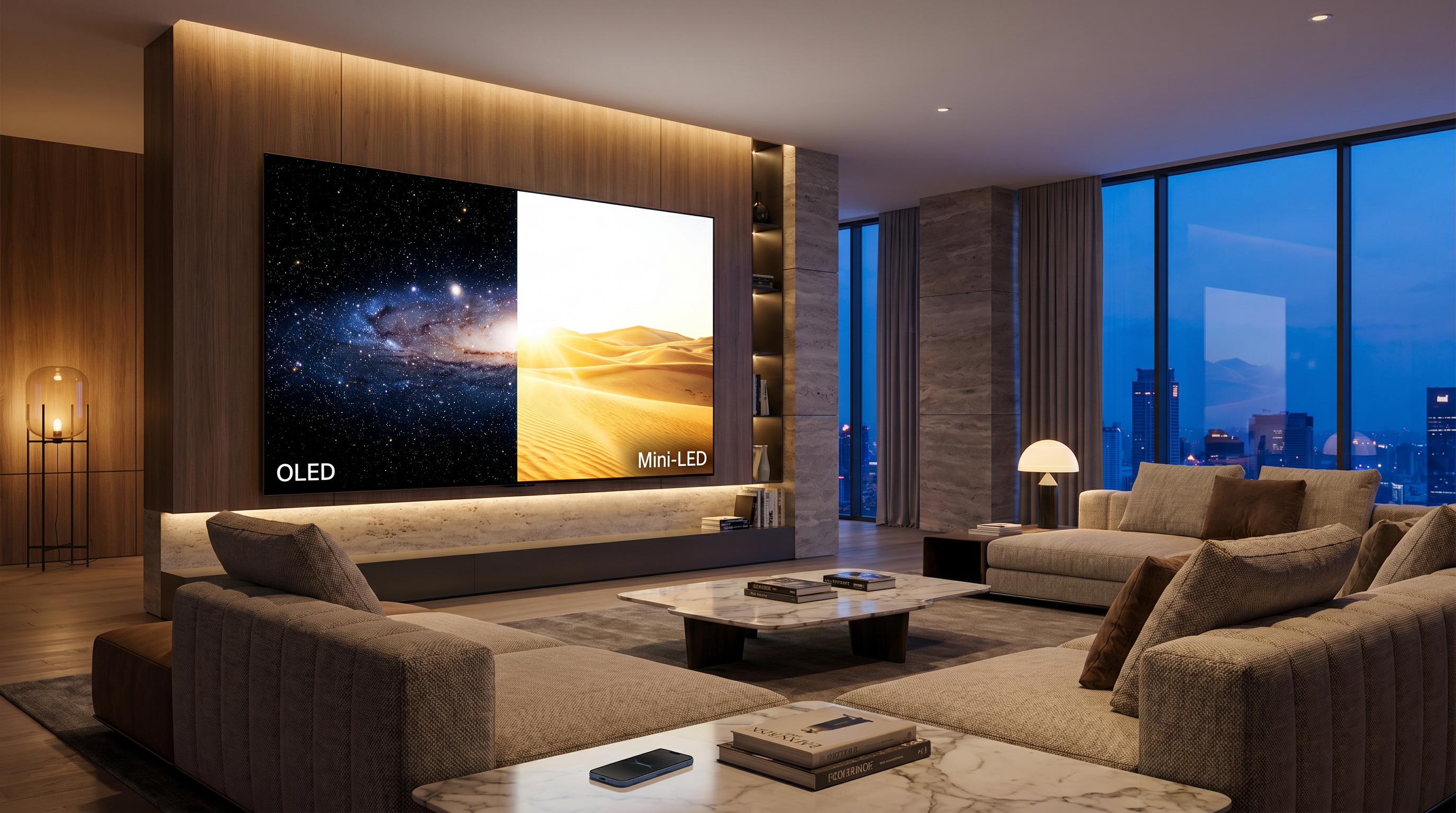
The case for OLED rests entirely on its unmatched contrast and pixel-level precision. Because an OLED television can turn off individual pixels completely, it achieves what the industry calls infinite contrast and absolute, perfect blacks. When a starship flies across a pitch-black galaxy on an OLED screen, the stars are piercingly bright, and the space around them emits zero light. This creates a deeply immersive, three-dimensional pop that home theater enthusiasts covet.[1][3]
The evidence supporting OLED's dominance in dark rooms is overwhelming. Testing by display analysts consistently shows that OLEDs deliver perfect black uniformity without any light bleeding into adjacent dark areas. Furthermore, OLED panels inherently offer exceptionally wide viewing angles. Whether a viewer is sitting dead-center on the couch or off to the side in an armchair, the color saturation and contrast remain perfectly accurate, making it an ideal choice for wide seating arrangements.[2][3]
However, the argument against OLED centers on two stubborn limitations: overall brightness and the risk of permanent burn-in. While 2026 advancements like Tandem OLED and Micro Lens Array technology have pushed OLED peak brightness higher than ever, they still cannot match the sheer output of a backlit television. Additionally, because the organic compounds in OLED pixels degrade over time, leaving static elements—like a news ticker, a sports score bug, or a video game heads-up display—on the screen for thousands of hours can cause those images to permanently burn into the panel.[4][6]
The case for Mini-LED is built on raw, unadulterated power and durability. By packing thousands of tiny diodes behind the screen, Mini-LED televisions can achieve blinding levels of brightness. Mid-range and high-end Mini-LED panels in 2026 easily reach 1,500 nits, with flagship models pushing well past 3,000 nits. This massive light output allows Mini-LEDs to effortlessly punch through the glare of a sun-drenched living room with floor-to-ceiling windows, ensuring the picture never looks washed out during a Sunday afternoon football game.[1][5]

The case for Mini-LED is built on raw, unadulterated power and durability.
The evidence for Mini-LED's practicality extends to its complete immunity to burn-in. Because the technology does not rely on organic self-emissive pixels, users can leave a static news channel running all day or use the screen as a massive computer monitor without any anxiety about permanently damaging the display. This peace of mind makes Mini-LED the default choice for hybrid workspaces, casual family rooms, and commercial environments where static interfaces are the norm.[4][6]
The primary argument against Mini-LED is a visual artifact known as blooming or haloing. Because Mini-LEDs control light in zones rather than at the individual pixel level, bright objects on dark backgrounds can cause light to spill over into adjacent dark zones. When watching a movie with subtitles in a dark room, a Mini-LED viewer might notice a faint, glowing cloud around the white text. While 2026 models have dramatically increased their zone counts—some massive sets now feature up to 40,000 dimming zones—the algorithms still cannot entirely eliminate this halo effect in high-contrast scenes.[2][3]
The pricing and sizing realities of 2026 also heavily influence the decision. Mini-LED technology has successfully scaled down to highly affordable mid-range prices, offering exceptional performance-per-dollar for budget-conscious buyers. Furthermore, Mini-LED scales up to massive sizes much more economically. Buyers looking for 85-inch, 98-inch, or even 115-inch televisions will find Mini-LED to be the only financially viable option, as OLED panels become prohibitively expensive beyond the 77-inch and 83-inch marks.[3][5]

For gamers, the trade-offs require careful consideration of play styles. OLED is widely considered the gold standard for competitive and cinematic gaming due to its near-instantaneous pixel response time, which eliminates motion blur during fast-paced action. However, gamers who play the same title for thousands of hours—leaving static health bars and minimaps on the screen—often pivot to Mini-LED to avoid burn-in anxiety, trading a fraction of motion clarity for absolute panel durability.[2][4]
Ultimately, OLED fits well when the television is placed in a light-controlled or dark room, such as a dedicated home theater or a basement. It is the definitive choice for cinephiles who prioritize perfect black levels, shadow detail, and infinite contrast. It also fits perfectly in living rooms with wide, spread-out seating arrangements where off-axis viewing angles are a priority, and for users who primarily consume varied content like movies and prestige television rather than static news broadcasts.[3][5]
Conversely, OLED does not fit well when the television faces direct sunlight or sits in a brilliantly lit room where its lower full-screen brightness will struggle to overcome glare. It is also a poor fit for households that leave the television running on the same news network all day, or for users who want a massive screen exceeding 85 inches without spending a small fortune.[1][6]

Mini-LED fits well when the television is the centerpiece of a bright, open-concept living room with abundant natural light. It is the ideal choice for daytime sports viewing, casual family use, and environments where the television might be left on for hours with static content. It also fits perfectly for buyers who want the absolute largest screen possible—pushing into the 100-inch territory—while maintaining excellent HDR impact and staying within a reasonable budget.[3][5]
Mini-LED does not fit well when the buyer is a home theater purist who watches sci-fi and horror movies in a pitch-black room. In these controlled environments, the blooming around bright highlights and the slightly raised black levels will be noticeable and potentially distracting. It is also less ideal for rooms where viewers are forced to sit at sharp angles to the screen, as the LCD panel technology inherently loses color accuracy and contrast when viewed off-center.[2][4]
How we got here
2013
First OLED TVs are released in the United States, introducing self-emissive pixel technology to consumers.
2021
Mini-LED technology goes mainstream, offering a high-brightness alternative to OLED with improved local dimming.
2024
OLED manufacturers introduce Tandem OLED and Micro Lens Array (MLA) to significantly boost peak brightness.
2026
Mini-LED zone counts reach up to 40,000 on flagship models, dramatically reducing blooming artifacts.
Viewpoints in depth
Home Theater Enthusiasts
Prioritizes absolute black levels and infinite contrast for cinematic viewing.
For cinephiles and home theater purists, the conversation begins and ends with OLED. This camp argues that peak brightness is a secondary concern compared to the ability to render perfect, absolute blacks. Because OLED pixels turn off completely, the contrast ratio is technically infinite, providing a three-dimensional depth to movies that backlit panels cannot replicate. They point to the complete absence of blooming around subtitles and stars as the ultimate proof of OLED's superiority in controlled, dark-room environments.
Everyday Bright-Room Viewers
Values high peak brightness and durability for casual, daytime viewing.
This perspective prioritizes practical, everyday usability over cinematic perfection. Bright-room viewers argue that most people do not watch television in pitch-black home theaters; they watch in living rooms with windows, lamps, and natural glare. For this camp, Mini-LED's ability to output 3,000+ nits of brightness is a game-changer, ensuring the picture never looks washed out during a Sunday afternoon football game. Furthermore, the complete immunity to burn-in provides peace of mind for families who leave news channels or static menus on screen for hours.
Creative Professionals & Gamers
Weighs motion clarity against the risks of static interface burn-in.
Gamers and creative professionals find themselves torn between the two technologies based on specific use cases. Competitive gamers often lean toward OLED for its near-instantaneous pixel response time, which eliminates motion blur during fast-paced action. However, professionals who use their screens for color grading, coding, or playing games with static heads-up displays often advocate for Mini-LED. They argue that the persistent risk of burn-in from static UI elements makes Mini-LED the safer, lower-friction choice for hybrid workspaces and marathon gaming sessions.
What we don't know
- Whether future MicroLED technology will eventually combine the benefits of both OLED and Mini-LED at an affordable price.
- Exactly how long Tandem OLED panels will last before showing signs of degradation under heavy daily use.
Key terms
- OLED
- Organic Light-Emitting Diode; a display technology where each pixel generates its own light and can turn off completely for perfect blacks.
- Mini-LED
- A display technology that uses thousands of microscopic LEDs behind an LCD panel to provide highly controlled, ultra-bright backlighting.
- Local Dimming Zones
- Clusters of backlights in a Mini-LED TV that can independently dim or brighten to improve contrast in different parts of the image.
- Nits
- A unit of measurement for brightness; the higher the number of nits, the brighter the television screen can get.
- Blooming
- A visual artifact where light from a bright object on a screen bleeds into surrounding dark areas, creating a halo effect.
- Burn-in
- Permanent image retention on a screen caused by leaving static elements like logos or news tickers displayed for extended periods.
Frequently asked
Does OLED still suffer from burn-in in 2026?
While modern OLEDs have built-in protections like pixel shifting and auto-dimming, the risk of permanent burn-in remains if static elements are left on screen for thousands of hours.
What is blooming or haloing on a Mini-LED TV?
Blooming occurs when the backlight zones behind bright objects spill light into adjacent dark areas, creating a faint glowing cloud around things like subtitles or stars.
Which TV is better for a bright living room?
Mini-LED is generally the better choice for bright rooms because it can achieve significantly higher peak brightness to cut through glare and sunlight.
Are Mini-LED TVs cheaper than OLEDs?
Yes, Mini-LEDs are typically more affordable, especially at larger screen sizes like 85 inches and above, where OLED prices become prohibitively expensive.
Sources
Source coverage
6 outlets
3 viewpoints surfaced






[1]Tom's GuideEveryday Bright-Room Viewers
OLED vs Mini-LED: What's the difference and is one actually better?
Read on Tom's Guide →[2]RTINGS.comHome Theater Enthusiasts
Mini LED vs. OLED TVs: Which One Is The Best?
Read on RTINGS.com →[3]What Hi-Fi?Home Theater Enthusiasts
Best Mini LED TV 2026: all the top, mid-range and affordable options fully reviewed
Read on What Hi-Fi? →[4]KTCCreative Professionals & Gamers
OLED vs. Mini-LED for 2026 Creative Pros: Which Panel Wins for Color Grading?
Read on KTC →[5]100% HomeEveryday Bright-Room Viewers
OLED TV vs Mini LED TV: Which One is Right for You?
Read on 100% Home →[6]CNETCreative Professionals & Gamers
The Best TVs of CES 2026 Are Thinner, Brighter, and Smarter
Read on CNET →

More in shopping
See all 43 stories →Display Tech
OLED vs. Mini-LED TVs: Which Premium Display Tech Wins in 2026?
6 sources
Smartphone Hardware
The 2026 Smartphone Buyer's Guide to On-Device AI: What You Actually Need
10 sources

Skincare Science
The Evidence on At-Home LED Face Masks: Do They Actually Work?
8 sources
Canine Nutrition
Fresh Dog Food vs. Kibble: Weighing the Costs, Convenience, and Canine Health Benefits
7 sources
Every angle. Every day.
Get shopping stories with full source coverage and perspective breakdowns delivered to your inbox.