
OLED vs. Mini-LED in 2026: The Ultimate Display Technology Comparison
The premium TV and monitor market is now a strict duopoly between OLED and Mini-LED, forcing buyers to choose between perfect contrast and unrestricted brightness.
By Factlen Editorial Team
- Cinematic Purists
- Values infinite contrast, perfect black levels, and near-instant response times for dark-room viewing.
- Bright-Room Power Users
- Prioritizes sheer luminance, lack of burn-in risk, and sustained brightness for daytime use and productivity.
- Pragmatic Buyers
- Focuses on matching the technology to the specific room environment, use case, and budget.
What's not represented
- · Budget-Conscious Buyers
- · Commercial Digital Signage Operators
Why this matters
Choosing the wrong premium TV technology can lead to thousands of dollars wasted on a screen that washes out in your bright living room or suffers permanent burn-in from your daily workflow. Understanding these specific trade-offs ensures you buy a display that actually matches your environment and habits.
Key points
- OLED and Mini-LED dominate the 2026 premium display market, utilizing fundamentally different engineering approaches.
- OLED features self-emissive pixels, delivering perfect black levels, infinite contrast, and near-instant response times.
- Mini-LED utilizes thousands of inorganic microscopic diodes, offering massive peak brightness and zero burn-in risk.
- OLED is the optimal choice for dark home theaters, cinematic movies, and fast-paced gaming.
- Mini-LED excels in sun-drenched rooms, daytime sports viewing, and heavy PC productivity.
- Mini-LED offers a significantly better price-per-inch ratio for massive 85-inch and 100-inch screens.
Buying a premium television or monitor in 2026 comes down to a heavyweight title fight between two mature, highly capable display technologies: OLED and Mini-LED. While older LCD and standard LED panels have largely been relegated to the budget aisle, the high-end market is now a strict duopoly. Both technologies promise stunning 4K and 8K resolutions, vibrant high-dynamic-range (HDR) color, and blistering refresh rates. Yet, despite their shared premium status, they achieve their visual fidelity through fundamentally opposite engineering philosophies, forcing buyers to make a definitive choice based on their specific viewing environment.[2][5]
The core difference lies in how the screens generate light. OLED, or Organic Light Emitting Diode, is a self-emissive technology where every single pixel produces its own light and color. When an OLED pixel needs to display black, it simply turns off completely. Mini-LED, conversely, is an evolution of traditional liquid crystal displays (LCD). It relies on a backlight made of thousands of microscopic, inorganic gallium nitride diodes. These diodes are grouped into thousands of "local dimming zones" that can dim or brighten independently behind the LCD color layer, allowing for massive light output without sacrificing too much dark-scene detail.[4][6]
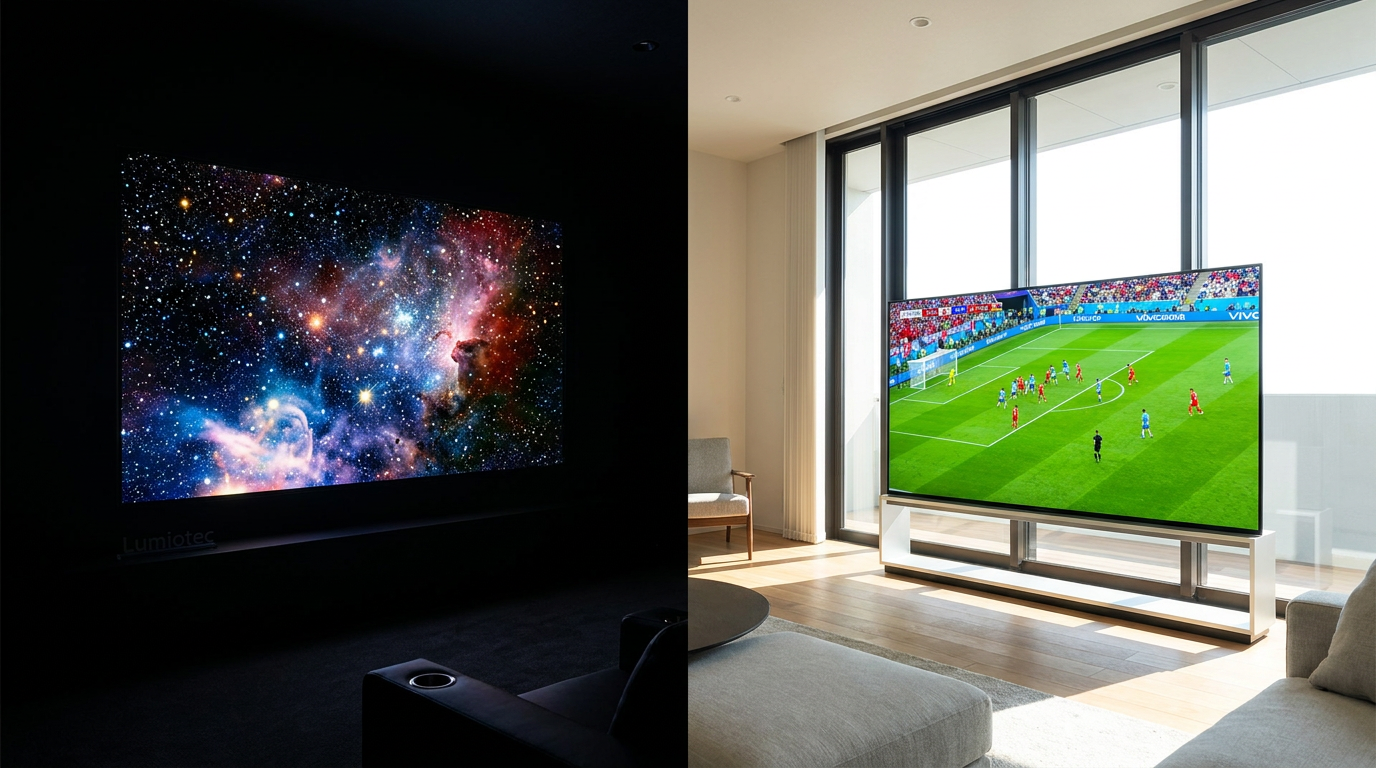
When evaluating OLED, the primary argument for the technology centers on absolute cinematic perfection and infinite contrast. Because each of its millions of pixels operates independently, an OLED panel can place a blindingly bright star directly next to the pitch-black vacuum of space without any light bleeding between the two. The evidence for this superiority is found in dark-room testing, where OLED consistently delivers contrast ratios exceeding 1,000,000:1. For home theater enthusiasts watching letterboxed movies, the black bars at the top and bottom of the screen remain perfectly invisible, creating a deeply immersive, three-dimensional pop that backlit screens struggle to replicate.[1][6]
The argument against OLED involves its inherent brightness limitations and the chemical reality of its organic materials. To prevent the panel from overheating and to mitigate the risk of permanent image retention—commonly known as burn-in—OLEDs employ an Auto Brightness Limiter (ABL). The evidence of this limitation appears during bright, full-screen scenes, such as a hockey game or a snowy documentary. If the screen detects too much white light for too long, the ABL aggressively dims the entire picture. While 2026 advancements like Micro Lens Array (MLA) and Tandem OLED have pushed peak highlight brightness to around 2,000 nits, full-screen sustained brightness still lags significantly behind the competition.[6][7]

When evaluating Mini-LED, the primary argument for the technology is sheer, unrestricted luminance and bulletproof durability. Because the backlight relies on robust inorganic materials, it does not suffer from organic degradation or burn-in. The evidence for Mini-LED's dominance is immediately apparent in sun-drenched living rooms. Current-generation flagship Mini-LEDs routinely achieve peak brightness levels between 2,500 and 3,000 nits, with sustained full-screen brightness hovering above 1,000 nits. They can hold a blindingly white screen indefinitely without dimming, easily overpowering the glare from massive windows or harsh overhead office lighting.[3][6]
When evaluating Mini-LED, the primary argument for the technology is sheer, unrestricted luminance and bulletproof durability.
The argument against Mini-LED centers on blooming and slightly compromised off-axis viewing. Because the backlight relies on zones rather than individual pixels, a bright object on a dark background—such as white subtitles on a black screen—can cause a faint halo of light to bleed into the surrounding dark areas. The evidence shows that while 2026 models have drastically reduced this effect by packing in upwards of 20,000 local dimming zones, the blooming artifact cannot be entirely eliminated by the laws of physics. Furthermore, because most Mini-LEDs utilize VA (Vertical Alignment) LCD panels, the color and contrast degrade slightly if the viewer sits off to the side of the screen.[1][2]
For gamers, the trade-off becomes a question of motion clarity versus peace of mind. The argument for OLED in gaming is its near-instantaneous 0.03-millisecond pixel response time, which virtually eliminates motion blur in fast-paced shooters and racing simulators. However, the evidence against using OLED for heavy gaming or PC productivity is the cumulative risk of burn-in from static elements like health bars, minimaps, or desktop taskbars over thousands of hours. Mini-LED, with a slightly slower response time of around 1 millisecond, offers the distinct advantage of zero burn-in risk, making it the undisputed choice for users who leave static interfaces on screen for 12 hours a day.[1][7]

Pricing and physical scaling also heavily influence the decision. The evidence from the 2026 market shows that while 55-inch and 65-inch models of both technologies are priced competitively, Mini-LED scales to massive sizes much more affordably. Buyers looking to fill a large wall with an 85-inch or 100-inch display will find that Mini-LED offers a vastly superior price-per-inch ratio, whereas OLED panels at those extreme dimensions remain cost-prohibitive for the average consumer.[2][5]
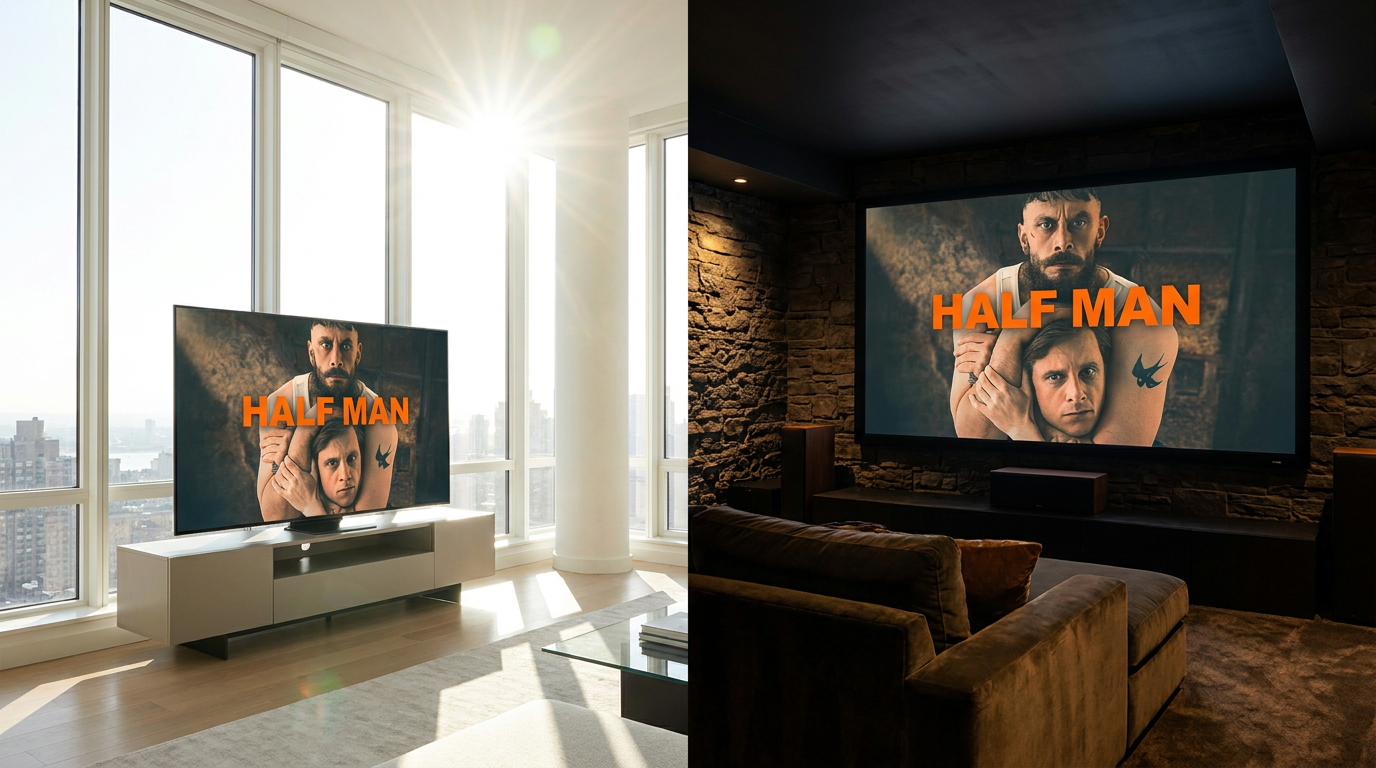
Ultimately, the choice requires matching the hardware to the specific environment. OLED fits well when the display is placed in a light-controlled room or a dedicated home theater. It is the optimal choice when the primary diet consists of cinematic movies, prestige television, or dark-mode gaming. It fits perfectly for the purist who prioritizes absolute pixel precision, perfect black levels, and zero-blur motion clarity over raw, room-filling luminance.[1][5]
Conversely, OLED does not fit when the display sits in a sun-drenched living room with uncontrolled ambient light. It is a poor choice for users who watch bright sports broadcasts for hours on end, or for PC power users who require a daily productivity monitor with static taskbars and bright white spreadsheet backgrounds, as the ABL dimming and burn-in risks will introduce constant workflow friction.[3][7]

Mini-LED fits well when the room features massive windows, skylights, or harsh overhead lighting. It is the ideal choice for mixed-use family rooms, daytime sports viewing, and heavy PC productivity or coding. It fits perfectly for the buyer who wants maximum HDR impact, vibrant color saturation, and a massive screen size without ever having to babysit the panel or worry about static image retention.[3][6]
However, Mini-LED does not fit when the buyer demands perfect off-axis viewing angles for a wide, horseshoe-shaped seating arrangement. It is not the right choice for the cinephile who obsesses over the inky black starfields in science fiction movies, or the competitive esports player who requires the absolute zero-blur motion clarity that only self-emissive pixels can provide.[1][7]
How we got here
2013
The first commercial OLED televisions launch, introducing self-emissive pixels to the consumer market.
2019
Mini-LED technology enters the consumer market, offering an inorganic, high-brightness alternative to OLED.
2023
OLED manufacturers introduce Micro Lens Array (MLA) technology to significantly boost peak brightness.
2026
Mini-LED zone counts surpass 20,000, while Tandem OLED panels hit the consumer market to further close the brightness gap.
Viewpoints in depth
Cinematic Purists
Advocates for perfect black levels and infinite contrast above all else.
For home theater enthusiasts and film purists, the conversation begins and ends with pixel-level light control. This camp argues that the foundation of a great image is its black level, as true blacks make colors appear richer and give the image a three-dimensional depth. They point to OLED's ability to turn off individual pixels as the ultimate trump card, arguing that even the most advanced Mini-LEDs with thousands of dimming zones still suffer from microscopic light bleed that compromises the director's original vision in dark, moody films.
Bright-Room Power Users
Prioritizes sheer luminance and durability for daytime viewing and productivity.
This perspective is championed by sports fans, PC power users, and anyone with a sun-drenched living room. They argue that perfect blacks are irrelevant if the screen is washed out by afternoon glare. This camp values Mini-LED's ability to sustain 1,000+ nits of full-screen brightness indefinitely without triggering an Auto Brightness Limiter. Furthermore, they cite the complete elimination of burn-in risk as a decisive victory, allowing them to leave news tickers, sports scores, or desktop taskbars on the screen all day without anxiety.
Value and Longevity Seekers
Focuses on the price-to-size ratio and the long-term hardware lifespan.
Pragmatic buyers and system integrators look past the spec-sheet wars to focus on total cost of ownership. This camp notes that while premium 55-inch models of both technologies are priced similarly, Mini-LED offers a massive advantage when scaling up to 85-inch or 100-inch sizes. They also point to the inorganic nature of gallium nitride LEDs, arguing that Mini-LED backlights are fundamentally more robust over a 10-year lifespan, whereas organic OLED compounds will inevitably degrade and shift in color accuracy over thousands of hours of heavy use.
What we don't know
- Whether Micro-LED, a future technology combining OLED's self-emissive pixels with Mini-LED's inorganic durability, will become affordable for average consumers before 2030.
- How the long-term degradation curve of 2026's new Tandem OLED panels will compare to traditional single-layer OLEDs after 10,000 hours of use.
Key terms
- ABL (Auto Brightness Limiter)
- A software feature in OLED displays that automatically dims the screen during bright, full-screen scenes to prevent overheating and protect the organic pixels.
- Blooming
- A visual artifact on Mini-LED and LCD screens where light from a bright object bleeds into the surrounding dark areas, creating a faint halo effect.
- Burn-in
- Permanent image retention on an OLED screen caused by uneven degradation of the organic pixels after displaying static elements for thousands of hours.
- Local Dimming Zones
- Specific clusters of LEDs behind an LCD screen that can independently dim or brighten to improve contrast and black levels.
- Nits
- A unit of measurement for screen brightness, representing the light of one candle per square meter.
Frequently asked
Does OLED still suffer from burn-in in 2026?
While 2026 OLEDs use advanced cooling and pixel-shifting software to dramatically reduce the risk, burn-in remains a fundamental possibility due to the organic materials. It is generally only a concern for users who display static elements, like news tickers or video game HUDs, for many hours every day.
Which technology is better for a bright living room?
Mini-LED is the superior choice for bright rooms. It can reach significantly higher peak brightness levels and sustain full-screen brightness without dimming, allowing it to easily overpower glare from large windows.
Is Mini-LED just a traditional LCD TV?
Yes, Mini-LED is an evolution of LCD technology. However, instead of a few large backlights, it uses thousands of microscopic LEDs divided into thousands of local dimming zones, resulting in vastly superior contrast and brightness compared to older LCDs.
Which panel is better for competitive gaming?
OLED is generally preferred for competitive gaming due to its near-instantaneous 0.03-millisecond response time, which eliminates motion blur. However, gamers who play the same game for 10+ hours a day may prefer Mini-LED to avoid static HUD burn-in.
Sources
Source coverage
7 outlets
3 viewpoints surfaced







[1]RTINGSCinematic Purists
OLED vs Mini LED: Which Panel Technology Is Better?
Read on RTINGS →[2]CNETCinematic Purists
OLED vs. Mini-LED TVs: Which Should You Buy?
Read on CNET →[3]PCWorldBright-Room Power Users
It's time to look beyond OLED to Mini-LED
Read on PCWorld →[4]BGRBright-Room Power Users
Is Burn-In A Risk With Mini LED TVs?
Read on BGR →[5]Data Wire SolutionsPragmatic Buyers
Best TVs for 2026: OLED and Mini-LED Picks by Room
Read on Data Wire Solutions →[6]SunulBright-Room Power Users
Mini LED vs OLED Display Technologies
Read on Sunul →[7]KTC PlayPragmatic Buyers
OLED vs Mini-LED in 2026 — The Truth They Don't Tell You
Read on KTC Play →
Every angle. Every day.
Get shopping stories with full source coverage and perspective breakdowns delivered to your inbox.