
Meta Quest 3 vs. Apple Vision Pro: Choosing the Right Spatial Computing Headset
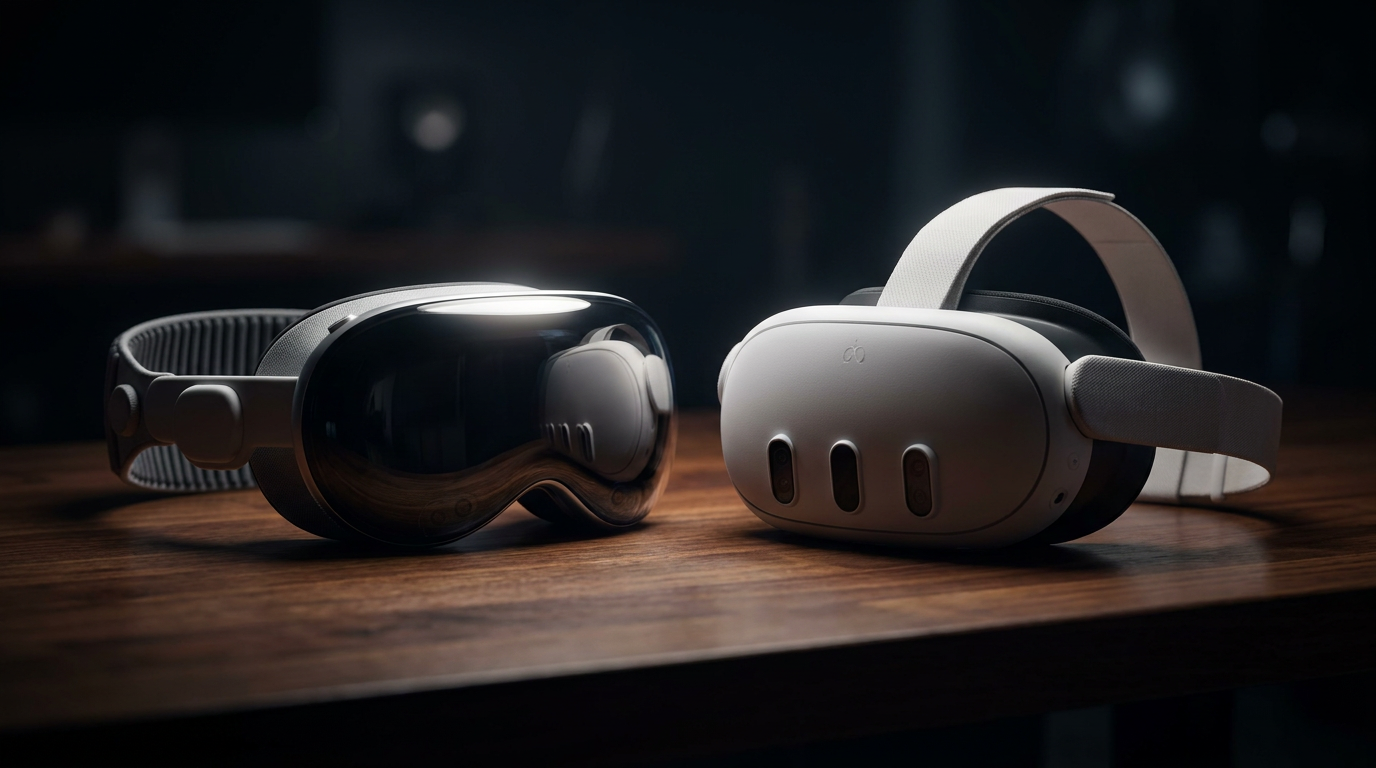
Apple’s $3,499 Vision Pro delivers unparalleled display clarity and ecosystem integration, while Meta’s $499 Quest 3 dominates in gaming, comfort, and sheer value. A side-by-side analysis reveals which mixed-reality approach fits different users.
By Factlen Editorial Team
- VR Gamers & Fitness Enthusiasts
- Users who prioritize tactile controllers, wireless freedom, and a vast library of native interactive experiences.
- Spatial Computing Professionals
- Professionals and early adopters who view headsets as the next evolution of the desktop monitor and value seamless ecosystem integration.
- Value-Conscious Consumers
- Buyers who argue that the Quest 3 delivers the vast majority of mixed-reality benefits for a fraction of the cost.
What's not represented
- · Enterprise IT managers deploying fleet headsets for corporate training.
- · Educators utilizing mixed reality for immersive classroom experiences.
Why this matters
As mixed reality transitions from a niche hobby to a mainstream computing platform, choosing the right headset dictates whether you are buying a high-end virtual monitor for work or a wireless console for gaming. Understanding the stark trade-offs between Apple's and Meta's approaches ensures you don't spend thousands of dollars on the wrong ecosystem.
Key points
- The Apple Vision Pro starts at $3,499, while the Meta Quest 3 is priced at $499.
- Vision Pro utilizes dual Micro-OLED displays with 23 million pixels for unmatched text clarity.
- Quest 3 relies on LCD panels with 9 million pixels, prioritizing fast refresh rates for gaming.
- Apple's headset relies entirely on eye and hand tracking, lacking physical controllers.
- Meta includes Touch Plus controllers, providing crucial haptic feedback for interactive VR applications.
- Vision Pro requires a tethered external battery, whereas Quest 3 features an integrated battery.
The mixed-reality landscape has crystallized around two fundamentally different philosophies, forcing consumers to choose between Apple’s ultra-premium spatial computing and Meta’s accessible virtual reality. As the hardware matures into 2026, the debate between the Apple Vision Pro and the Meta Quest 3 is no longer just about specifications; it is a referendum on how humans should interact with digital environments. Both headsets offer standalone experiences, pancake lenses, and color passthrough, but their approaches to design, control, and ecosystem integration could not be more distinct. Understanding these differences is crucial for anyone looking to invest in the next generation of computing.[4][6]
The most immediate trade-off in this comparison is the sheer cost of entry. The Apple Vision Pro starts at a staggering $3,499 for the 256GB model, positioning it as a luxury device for early adopters and enterprise professionals. In stark contrast, the Meta Quest 3 starts at $499 for the 128GB version, making it seven times less expensive. This massive price gulf dictates the expectations for each device. Buyers must weigh whether the Vision Pro’s cutting-edge hardware justifies a price tag that could otherwise fund an entire suite of traditional electronics, or if the Quest 3 delivers enough of the mixed-reality magic to satisfy the average user.[3][5]
When evaluating display technology, the argument for the Apple Vision Pro centers on its unparalleled visual fidelity. The evidence lies in its dual Micro-OLED displays, which pack a combined 23 million pixels—roughly a 4K resolution per eye. This allows for pristine text legibility, true blacks, and a dynamic range that mimics a high-end private cinema. The argument against this setup is purely financial, as these cutting-edge panels drive the headset's prohibitive cost. For users who need to read fine text or edit high-resolution video in virtual space, the Vision Pro’s display remains entirely unmatched in the consumer market.[2][5]

Conversely, the case for the Meta Quest 3’s display is anchored in its impressive value-to-performance ratio. The headset utilizes dual LCD panels delivering roughly 9 million pixels, which represents a massive 30 percent resolution bump over its predecessor. The evidence of its capability is clear in vibrant, fast-paced gaming environments where the 120Hz refresh rate shines. However, the argument against the Quest 3’s display highlights its LCD nature; it cannot produce the true blacks of OLED, and users may notice a slight pixel structure when viewing cinematic content or reading small text.[2][5]
The mixed-reality experience relies heavily on color passthrough—the ability to see the real world through the headset’s cameras. The Vision Pro excels here, offering a near-flawless, low-latency view of the physical environment that feels like looking through tinted glass. The Quest 3 also features full-color passthrough, which is a revelation compared to older headsets, but it exhibits noticeable trade-offs. Users frequently report slight warping around moving objects and a grainy texture in low-light conditions. While the Quest 3’s passthrough is more than sufficient for grabbing a drink or checking a phone, the Vision Pro provides a far more seamless blend of digital and physical realities.[2][4]
Control paradigms represent another massive divergence. The argument for the Vision Pro’s controller-free approach is its sheer intuition; the headset relies entirely on advanced eye-tracking and subtle hand gestures. The evidence of its success is a user interface that feels almost telepathic, allowing users to navigate menus simply by looking and pinching their fingers. The argument against this system is its lack of tactile feedback, which becomes a glaring omission in fast-paced interactive software. Without physical buttons or haptics, certain applications feel disconnected from the user's physical actions.[1][4]
The Meta Quest 3 takes the opposite approach, relying on its included Touch Plus controllers. The argument for these controllers is their precision and ergonomic design, which provide crucial haptic feedback. The evidence is found in the headset's dominance in the VR gaming space; titles requiring rhythmic inputs, swinging motions, or precise trigger pulls are infinitely more satisfying with physical hardware in hand. While the Quest 3 does offer hand-tracking capabilities, reviewers consistently note that it is less reliable and buggier than Apple’s implementation, making the controllers an absolute necessity for most tasks.[1][6]
For productivity and workflow integration, the Vision Pro leverages Apple’s M2 and R1 silicon to deliver laptop-class performance. The argument for using the Vision Pro as a primary work device is its seamless integration with the broader Apple ecosystem. Users can wirelessly connect a Mac, instantly expanding their workspace into multiple massive virtual monitors with near-zero latency. The evidence of its productivity prowess is its ability to handle heavy multitasking, run native apps like Safari and Keynote, and support seamless peripheral connections like the Magic Keyboard. For deep, focused work, it operates as a limitless digital office.[4][5]

For productivity and workflow integration, the Vision Pro leverages Apple’s M2 and R1 silicon to deliver laptop-class performance.
The Quest 3, powered by the Snapdragon XR2 Gen 2 chip, is highly capable but struggles to match Apple’s productivity ecosystem. The argument against the Quest 3 as a laptop replacement is its clunkier software interface and lower display resolution, which can cause eye strain during long reading sessions. While virtual desktop applications exist and allow users to mirror their PC screens, the experience lacks the frictionless, native integration found on visionOS. The Quest 3 is fundamentally an entertainment device first, with productivity bolted on as a secondary feature.[4][5]
When the focus shifts to gaming and fitness, the Meta Quest 3 reclaims the crown. The argument for the Quest 3 is its vast, mature library of native virtual reality games and high-intensity fitness applications. The evidence is a thriving ecosystem of titles like Beat Saber, Supernatural, and Walkabout Mini Golf, which demand high-movement, room-scale tracking. The headset’s internal battery and completely wireless design allow users to spin, duck, and sweat without fear of tangling cords or damaging expensive hardware, making it the undisputed choice for active users.[5][6]
The Vision Pro, by contrast, faces severe limitations in the gaming sector. The argument against Apple’s headset for gamers is its lack of motion controllers and its reliance on a tethered external battery pack. The evidence is the absence of popular VR titles on the visionOS platform; developers struggle to port games designed for physical controllers to a purely gesture-based system. While the Vision Pro excels at playing flat Apple Arcade games on a massive virtual screen, it cannot compete with the Quest 3 in immersive, active virtual reality.[1][6]
Build quality and comfort present a complex trade-off between premium materials and physical ergonomics. The argument for the Vision Pro’s design is its luxurious aesthetic, utilizing custom aluminum alloys and laminated glass to create a device that looks and feels like a piece of high-end jewelry. However, the evidence against this design is its substantial weight, coming in between 600 and 650 grams. Because Apple opted for premium metals over lightweight plastics, the headset is notoriously front-heavy, causing noticeable fatigue on the brow and cheeks during extended work sessions.[2][6]

The Meta Quest 3 opts for a largely plastic construction, which feels decidedly less premium but offers significant ergonomic advantages. The argument for the Quest 3’s build is its lighter 515-gram weight and balanced weight distribution. The evidence is its superior comfort during active, high-movement sessions. Furthermore, the Quest 3 supports a wide ecosystem of third-party head straps, many of which include built-in counterweight batteries, allowing users to customize the fit to their exact preferences.[2][6]
Battery life and power management further illustrate the differing philosophies. The Quest 3 features an integrated battery that delivers roughly two to three hours of standalone use, preserving a completely wireless experience. The Vision Pro matches this battery life but requires users to carry an external aluminum battery pack connected via a proprietary cable. This tethered approach removes weight from the headset itself but adds a layer of cumbersome wire management, forcing users to keep the battery in a pocket or resting on a desk while working.[1][3]
Ultimately, the Apple Vision Pro fits well when a user is deeply entrenched in the Apple ecosystem and requires pristine text legibility for virtual workspaces. It is the ideal choice for early adopters who want the absolute best cinematic media consumption experience, complete with spatial audio and Micro-OLED true blacks. It fits perfectly for developers, designers, and professionals who view spatial computing as the next frontier of desktop multitasking and have the financial budget to support a premium, first-generation luxury device.[3][5]
Conversely, the Apple Vision Pro does not fit when the primary goal is high-movement fitness, competitive VR gaming, or budget-conscious entertainment. It is a poor choice for users who require tactile controllers for interactive software, or those who find heavy, front-loaded headsets physically uncomfortable for long durations. Its tethered battery and fragile glass front also make it unsuitable for intense physical activity, travel in rugged environments, or shared use among young children who might accidentally drop the expensive hardware.[1][6]

The Meta Quest 3 fits well when the buyer wants a versatile, wireless gaming console with a massive library of native interactive content. It is the undisputed champion for fitness enthusiasts who need a lightweight, durable headset with precise motion controllers. At $499, it fits perfectly for value-conscious consumers who want to experience 80 percent of the mixed-reality magic for a fraction of the cost, making it the most accessible and practical entry point into the world of spatial computing.[3][6]
However, the Meta Quest 3 does not fit when the user expects a flawless, distortion-free mixed-reality passthrough or intends to replace their primary laptop for complex, text-heavy multitasking. It is not the right choice for videophiles demanding the absolute highest resolution and contrast ratios for movie viewing, nor is it ideal for professionals looking for seamless, native integration with macOS and iOS applications. For those specific high-end use cases, the Quest 3's hardware simply hits its ceiling.[2][4]
The choice between these two headsets is not simply a matter of identifying the best device, but rather identifying the right tool for the job. Meta has successfully democratized virtual reality with a highly capable, gaming-first headset that punches far above its weight class. Apple has planted a flag in the future of spatial computing, delivering a breathtaking but expensive glimpse into the post-smartphone era. As the software ecosystems for both platforms continue to evolve, consumers win by having two exceptionally strong, albeit entirely different, options on the market.[4][6]
How we got here
June 2023
Apple officially announces the Vision Pro at WWDC, introducing the concept of spatial computing.
October 2023
Meta releases the Quest 3, bringing full-color passthrough and pancake lenses to the mass market.
February 2024
The Apple Vision Pro officially launches in the United States at a starting price of $3,499.
Mid-2026
Both platforms mature with expansive app ecosystems, solidifying their distinct roles in the tech landscape.
Viewpoints in depth
Spatial Computing Professionals
Advocates for using headsets as primary productivity machines.
This camp argues that the Apple Vision Pro is not competing with gaming consoles, but rather with high-end laptops and multi-monitor setups. By leveraging the M2 chip and Micro-OLED displays, professionals can edit video, write code, and manage complex workflows in a limitless virtual environment. They view the $3,499 price tag as justifiable when compared to buying a MacBook Pro and several 4K monitors, emphasizing that seamless integration with macOS is the true killer app.
VR Gamers & Fitness Enthusiasts
Users focused on interactive, high-movement virtual reality.
For this demographic, a headset must be untethered and feature precise tactile inputs. They argue that Apple's controller-free approach fundamentally misunderstands how humans interact with virtual objects in fast-paced scenarios. The Meta Quest 3's Touch Plus controllers provide the haptic feedback necessary for competitive gaming and rhythmic fitness apps. Furthermore, they highlight that the Quest's lighter weight and lack of a tethered battery make it significantly safer and more comfortable for active movement.
Value-Conscious Adopters
Consumers weighing the price-to-performance ratio of mixed reality.
This perspective emphasizes the democratization of technology. While acknowledging that the Vision Pro possesses superior hardware, they argue that the Meta Quest 3 delivers 80 percent of the experience for 14 percent of the price. For the average consumer looking to watch 3D movies, browse the web in a floating window, or play casual games, the $499 Quest 3 is deemed the only logical choice, framing the Vision Pro as an overpriced prototype for the masses.
What we don't know
- Whether Apple will eventually release dedicated motion controllers for the Vision Pro to capture the gaming market.
- How quickly Meta can improve its native productivity software to compete with visionOS.
- When a more affordable, non-Pro version of the Apple Vision headset might hit the consumer market.
Key terms
- Mixed Reality (MR)
- A blend of physical and digital worlds where virtual objects anchor to and interact with the real environment.
- Color Passthrough
- A feature that uses exterior cameras to display the real world inside the headset in full color.
- Micro-OLED
- An advanced display technology that packs millions of pixels into a tiny screen, offering true blacks and extreme clarity.
- Pancake Lenses
- A type of optical lens that folds light multiple times, allowing VR headsets to be significantly thinner and lighter.
- Spatial Computing
- Apple's preferred term for mixed reality, emphasizing the use of the physical space around the user as a computer desktop.
Frequently asked
Can the Meta Quest 3 be used for work and productivity?
Yes, it supports virtual desktop applications and floating browser windows. However, its lower-resolution LCD screens can cause eye strain when reading small text for long periods, making it less ideal for heavy productivity than the Vision Pro.
Does the Apple Vision Pro have VR games?
The Vision Pro supports many flat Apple Arcade games on a virtual screen and a few native spatial titles. However, it lacks the massive library of immersive, controller-based VR games found on the Meta Quest 3.
Do I need an iPhone or Mac to use the Vision Pro?
While the Vision Pro is a standalone device that operates on its own, its true value unlocks when paired with the Apple ecosystem, such as mirroring a Mac display or syncing with iCloud.
Which headset is better for watching movies?
The Apple Vision Pro is significantly better for media consumption due to its Micro-OLED displays, which provide true blacks, higher resolution, and superior dynamic range compared to the Quest 3.
Sources
Source coverage
6 outlets
3 viewpoints surfaced






[1]MashableVR Gamers & Fitness Enthusiasts
Apple Vision Pro vs. Meta Quest 3: Which headset is right for you?
Read on Mashable →[2]Mark Ellis ReviewsVR Gamers & Fitness Enthusiasts
Apple Vision Pro vs Meta Quest 3: The Ultimate Comparison
Read on Mark Ellis Reviews →[3]AppleInsiderSpatial Computing Professionals
Apple Vision Pro versus Meta Quest 3 - What to buy
Read on AppleInsider →[4]UC TodaySpatial Computing Professionals
Apple Vision Pro vs Meta Quest 3: Which is the best headset?
Read on UC Today →[5]Tom's GuideValue-Conscious Consumers
Apple Vision Pro vs Meta Quest 3: What's the difference?
Read on Tom's Guide →[6]ZDNETValue-Conscious Consumers
Meta Quest 3 vs. Apple Vision Pro: How accurate was Zuckerberg's review?
Read on ZDNET →
Every angle. Every day.
Get meta stories with full source coverage and perspective breakdowns delivered to your inbox.