
Medical AI Crosses Clinical Thresholds: New Diagnostic Models Achieve 96% Accuracy and Slash Wait Times
A wave of specialized artificial intelligence models deployed in June 2026 is fundamentally transforming clinical diagnostics and drug discovery, moving from experimental labs into frontline patient care.
By Factlen Editorial Team
- Clinical Practitioners
- Value AI as a triage and diagnostic partner that reduces administrative burden and catches edge cases, but emphasize it cannot replace human clinical judgment.
- Biotech Innovators
- View AI as a massive accelerator that compresses years of manual compound screening into days, fundamentally changing the economics of drug discovery.
- Healthcare Administrators
- Focused on the operational efficiency, cost savings, and the ability to route patients more effectively amidst severe specialist shortages.
What's not represented
- · Patient Privacy Advocates
- · Medical Malpractice Insurers
Why this matters
For years, AI in healthcare was a promise of future potential; today, it is actively reducing the time patients wait for urgent cancer screenings from months to days. By automating complex genomic analysis and visual diagnostics, these tools are easing critical specialist shortages and sparing patients from unnecessary invasive procedures.
Key points
- New AI diagnostic algorithms have achieved 96% sensitivity in detecting melanoma.
- The technology is reducing urgent assessment wait times from months to days.
- Enhanced AI screening has led to a 27% reduction in unnecessary surgical biopsies.
- Generative AI is parsing health records with near 100% accuracy to recommend prostate cancer testing.
- A $6 million NIH-funded project is using AI to accelerate Alzheimer's drug discovery.
- Singapore launched a unified AI foundation model to interpret complex multi-omics data.
June 2026 marks a turning point in the evolution of healthcare technology, as artificial intelligence transitions from an experimental concept into a frontline clinical workhorse. Across multiple medical disciplines, a new generation of highly specialized AI models is crossing critical performance thresholds, proving capable of matching—and in some cases exceeding—traditional diagnostic methods.[7]
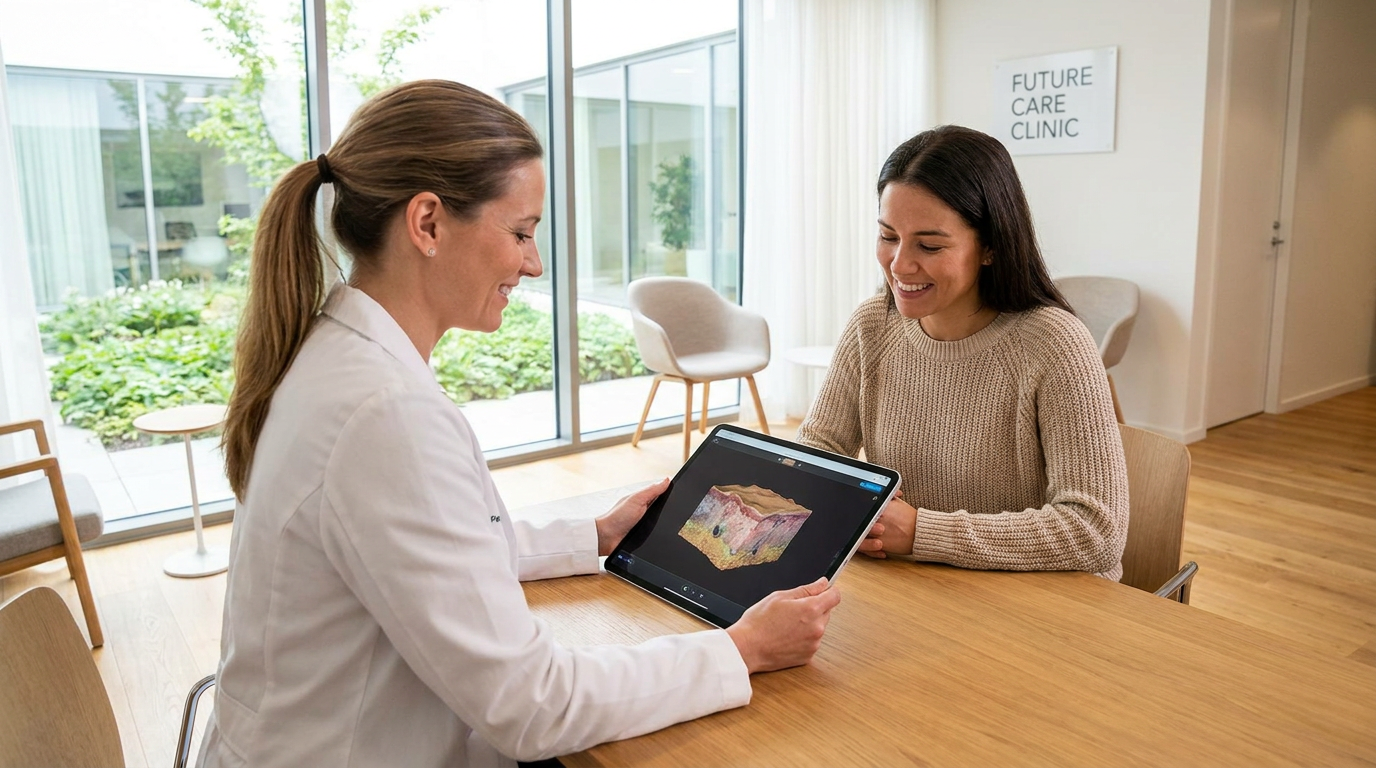
The most immediate impact is being felt in dermatology. According to a comprehensive market analysis released this week, a new wave of AI diagnostic algorithms has achieved a staggering 96% sensitivity in detecting melanoma, fundamentally altering how skin cancer is screened and triaged globally.[1][2]
This breakthrough arrives at a critical moment. Across Europe and North America, healthcare systems are grappling with severe shortages of dermatology specialists, leading to diagnostic wait times that can stretch for agonizing months for patients with potentially life-threatening lesions.[1][7]
By deploying these AI tools at the primary care level, clinics are reducing urgent assessment wait times from months to mere days. General practitioners can now photograph a suspicious lesion and receive an expert-level risk assessment instantly, ensuring that high-risk patients are fast-tracked to specialists.[1]

The financial and physical toll on patients is also dropping significantly. Enhanced AI screening has led to a 27% reduction in unnecessary surgical biopsies, sparing patients from invasive procedures for benign spots while saving healthcare systems millions of dollars in operational costs.[1][2]
Beyond visual diagnostics, AI is untangling the complex web of genomic data to improve precision oncology. At the recent ASCO 2026 conference, clinical researchers demonstrated how artificial intelligence is dramatically increasing the rates of genetic testing for prostate cancer patients.[5]
Historically, identifying which patients qualified for somatic or germline testing required doctors to manually comb through unstructured electronic health records. This process was highly prone to human error and oversight, resulting in less than a third of eligible men receiving the necessary genomic screening.[5]
Historically, identifying which patients qualified for somatic or germline testing required doctors to manually comb through unstructured electronic health records.
By integrating generative AI to parse patient histories and clinical notes, oncology networks have achieved near 100% accuracy in recommending appropriate somatic testing. This ensures that more men receive targeted, life-saving therapies tailored to the specific mutations driving their cancer.[5]
While diagnostic AI is saving lives today, generative models are working behind the scenes to invent the cures of tomorrow. In mid-June, Indiana University launched a $6 million, NIH-funded initiative to apply machine learning directly to Alzheimer's disease drug discovery.[3]
The project combines advanced computing with traditional chemistry to search for novel molecular structures capable of interacting with dementia-linked proteins, aiming to break a decades-long deadlock in Alzheimer's pharmacology.[3]

Traditionally, evaluating these chemical compounds manually would take human researchers years of expensive trial and error. AI models can simulate millions of molecular interactions in a fraction of the time, identifying promising drug candidates at unprecedented speeds and drastically lowering the barrier to entry for new treatments.[3][7]
This acceleration was a central theme at the BIO 2026 International Convention in San Diego, where biotech firms showcased AI-driven pipelines that handle everything from initial target discovery to clinical translation, with new models specifically targeting unmet needs in women's health.[6]
To push these capabilities even further, national governments are investing heavily in foundational infrastructure. Singapore recently launched "MultiOmicsFM," a unified AI foundation model designed to interpret DNA, RNA, and gene activity simultaneously as part of its national AI4S initiative.[4]

Unlike previous tools that analyzed these biological markers in isolation, MultiOmicsFM creates an integrated picture of an individual's genetic makeup. By leveraging multi-ethnic datasets, the project aims to improve disease risk prediction and optimize mRNA therapies on a global scale.[4]
As these disparate technologies converge—from the primary care doctor's tablet to the biochemist's supercomputer—the medical community is entering an era of augmented intelligence. The goal is no longer to replace the physician, but to equip them with tools that make the invisible visible, and the incurable, eventually, curable.[7]
How we got here
2023-2024
Early rule-based AI models demonstrate proof-of-concept in identifying patients for genetic testing.
2025
Generative AI begins parsing unstructured electronic health records to assist oncologists.
Early 2026
AI diagnostic algorithms for dermatology reach 96% sensitivity in clinical trials.
June 2026
Major funding and national initiatives, including Singapore's AI4S and the NIH Alzheimer's grant, signal widespread clinical deployment.
Viewpoints in depth
Clinical Practitioners
AI as a diagnostic partner, not a replacement.
Oncologists and dermatologists are rapidly integrating these tools into their daily workflows, but they draw a hard line at autonomous decision-making. While an AI achieving 96% sensitivity in melanoma detection is a monumental leap, the remaining margin of error and the nuances of holistic patient history require a human in the loop. Practitioners view the technology as "augmented intelligence"—a tireless assistant that flags high-risk cases and ensures no patient falls through the cracks of a busy clinic, allowing the doctor to focus entirely on treatment strategy and patient care.
Biotech Innovators
Compressing the drug discovery timeline.
From the pharmacological perspective, AI is solving a fundamental math problem. Finding a viable drug candidate traditionally requires years of expensive, manual trial and error in a wet lab. By utilizing machine learning models to simulate millions of molecular interactions overnight, researchers can bypass the initial bottleneck of compound screening. Innovators argue this will not only accelerate the delivery of treatments for complex diseases like Alzheimer's but also drastically lower the capital required to bring new drugs to clinical trials.
Health System Administrators
Solving the specialist bottleneck.
Hospital executives and public health officials are primarily focused on resource allocation. With severe shortages of specialists across Europe and rural America, administrators view AI as a vital operational triage tool. By empowering general practitioners to perform expert-level initial screenings using AI-backed devices, health systems can reserve highly constrained specialist time for patients who truly need urgent surgical intervention, simultaneously cutting costs and reducing agonizing wait times for patients.
What we don't know
- How legacy hospital IT systems will handle the massive data integration required by these new foundation models.
- The long-term regulatory framework for continuous-learning medical devices that update their algorithms over time.
Key terms
- Sensitivity
- In medical diagnostics, the ability of a test to correctly identify patients who actually have a specific disease.
- Somatic testing
- Genetic testing of a tumor itself to identify acquired mutations that can be targeted by specific cancer drugs.
- Multi-omics
- A biological analysis approach that combines data from multiple 'omes,' such as the genome (DNA), transcriptome (RNA), and proteome (proteins).
- Generative AI
- Artificial intelligence capable of generating text, images, or other data, increasingly used to parse unstructured medical records to find hidden patient risk factors.
Frequently asked
Will AI replace human doctors in diagnosing cancer?
No. AI is being deployed as a 'co-pilot' to flag high-risk cases and recommend testing, but human specialists make the final clinical decisions and treatment plans.
How does AI reduce unnecessary surgeries?
By providing highly accurate, non-invasive analysis of skin lesions, AI helps doctors confidently rule out benign spots that might otherwise have been surgically biopsied as a precaution.
What is a 'multi-omics' foundation model?
It is an AI system designed to analyze multiple biological data types simultaneously—such as DNA, RNA, and protein activity—to create a complete picture of a patient's genetic health.
Sources
Source coverage
7 outlets
3 viewpoints surfaced







[1]GlobeNewswireClinical Practitioners
AI Disruption in Dermatology Devices Accelerates with $43 Million Series B Funding Wave
Read on GlobeNewswire →[2]BCC ResearchHealthcare Administrators
AI Impact on Dermatology Devices - BCC Pulse Report
Read on BCC Research →[3]Drug Target ReviewBiotech Innovators
AI-powered $6M project targets new Alzheimer's treatments
Read on Drug Target Review →[4]National University of SingaporeBiotech Innovators
Singapore launches AI4S initiative to revolutionise scientific discovery
Read on National University of Singapore →[5]OncoDailyClinical Practitioners
The New AI Breakthrough in Genetic Testing | ASCO 2026
Read on OncoDaily →[6]News-MedicalBiotech Innovators
Insilico Medicine to showcase AI-driven drug breakthroughs at BIO 2026 International Convention
Read on News-Medical →[7]Factlen Editorial TeamHealthcare Administrators
Synthesis by Factlen editorial team
Read on Factlen Editorial Team →

Every angle. Every day.
Get ai stories with full source coverage and perspective breakdowns delivered to your inbox.