
Beyond the Barbell: How Adaptive Digital Weights are Changing Strength Training
By replacing static iron with electromagnetic motors, adaptive resistance machines are matching the human strength curve and rewriting the rules of home fitness.
By Factlen Editorial Team
- Biomechanics Researchers
- Focuses on the physiological benefits of matching resistance to the human strength curve.
- Connected Fitness Advocates
- Values the software-driven progression, space efficiency, and advanced lifting modes.
- Market Analysts
- Focuses on the cost-to-value ratio, subscription models, and industry trends.
What's not represented
- · Commercial Gym Operators
- · Physical Therapists
Why this matters
For decades, strength training has been limited by the danger of lifting heavy weights without a spotter and the joint stress of static barbells. Adaptive digital weights remove these barriers, allowing anyone to safely train to their maximum potential at home while minimizing the risk of injury.
Key points
- Adaptive resistance technology uses electromagnetic motors to generate digital weight instead of physical iron plates.
- Variable resistance dynamically adjusts the load to match the human strength curve, reducing joint stress at vulnerable angles.
- Digital spotter modes automatically drop the weight if a user fails a repetition, enabling safe solo training.
- Floor-based systems can now generate up to 440 pounds of resistance, accommodating heavy compound lifts like deadlifts.
- High upfront costs and mandatory monthly subscriptions remain the primary barriers to widespread consumer adoption.
For over a century, the fundamental rule of strength training has been dictated by gravity and iron. A 100-pound barbell weighs exactly 100 pounds at the bottom of a squat, in the middle of the ascent, and at the top of the movement. This static reality has long forced lifters into a biomechanical compromise: you can only lift as much weight as you can handle at your weakest point.[6]
This limitation is known in kinesiology as the "sticking point." Because human joints act as levers, our mechanical advantage changes throughout a range of motion. We are inherently weaker at the bottom of a bench press or squat, where the joints are fully flexed, and much stronger near the top as the limbs extend.[4]
Traditional static weights ignore this shifting strength curve. If a lifter loads a barbell with enough weight to truly challenge their muscles at the top of a repetition, they risk failing or injuring themselves at the bottom. Conversely, a weight that is safe at the bottom leaves the muscles under-stimulated at the top, leaving potential strength and hypertrophy gains on the table.[1][4]
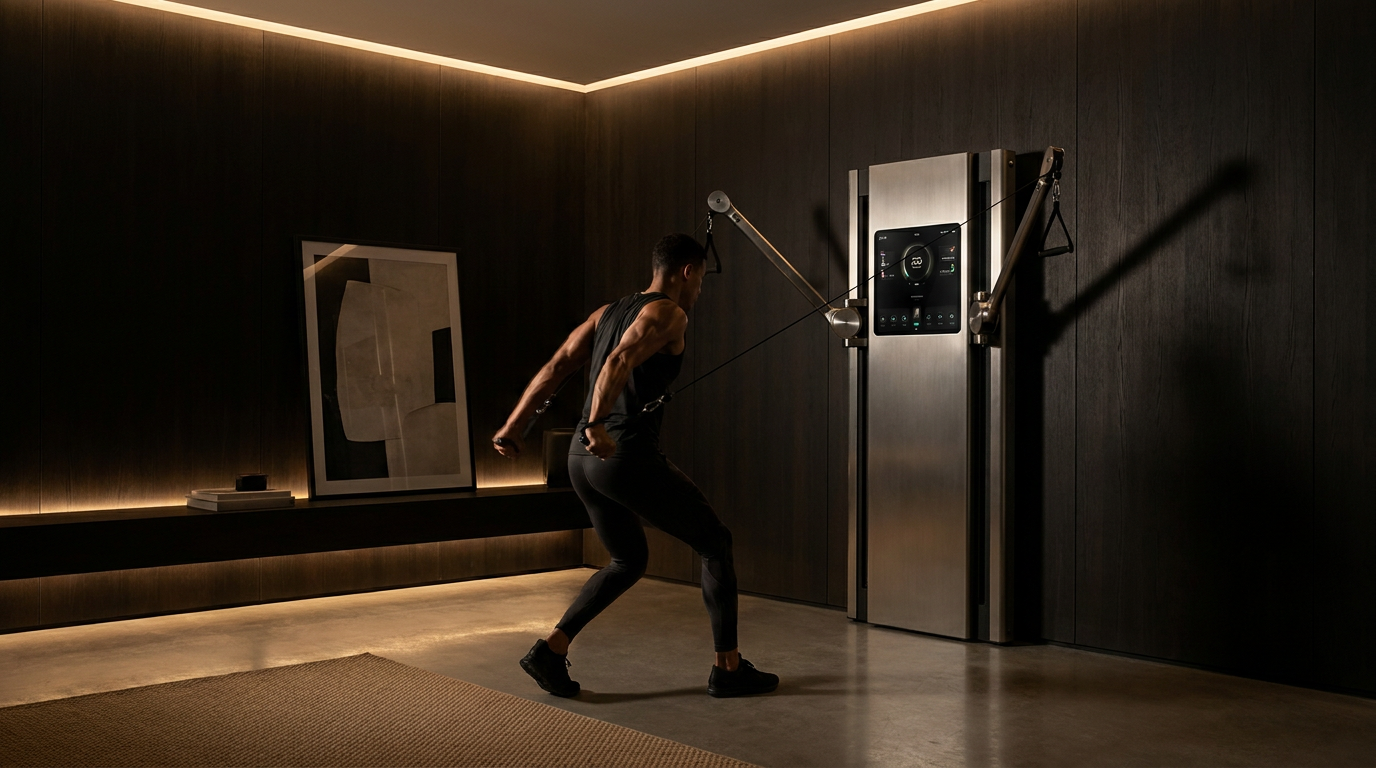
Enter adaptive resistance technology, a rapidly maturing category of digital fitness equipment that replaces physical iron with electromagnetic force. Machines like Tonal, Vitruvian, and Speediance use sophisticated motors and high-frequency algorithms to generate resistance that can change hundreds of times per second.[2][3]

By severing the tie between weight and gravity, these digital systems unlock a concept known as Variable Resistance Training (VRT). Instead of fighting a constant load, VRT dynamically matches the resistance to the user's natural force curve. The machine automatically lightens the load in biomechanically vulnerable positions and increases it where the lifter is strongest.[4][5]
The physiological benefits of this approach are substantial. Because there is no "easy part" of the lift where momentum takes over, the muscles are placed under constant, optimal tension from start to finish. This continuous engagement forces a greater number of muscle fibers to fire, driving superior neuromuscular adaptation and myofibrillar hypertrophy—the growth of actual contractile proteins.[4][7]
Beyond muscle growth, clinical biomechanists point to the joint-sparing nature of adaptive resistance. In a traditional squat, the knees and lower back endure the highest shear forces at the very bottom of the movement. By intelligently reducing the load at this exact point, digital weights allow for a safer descent while still delivering maximum stimulus as the lifter stands up.[4][5]
Beyond muscle growth, clinical biomechanists point to the joint-sparing nature of adaptive resistance.
The hardware powering this shift has evolved rapidly. Tonal, one of the pioneers in the space, utilizes a wall-mounted system with adjustable arms and electromagnetic motors that generate up to 200 pounds of total resistance. Its onboard artificial intelligence tracks user output in real-time, automatically bumping up the weight in one-pound increments as the lifter grows stronger, effectively automating the principle of progressive overload.[3]
For advanced lifters who require heavier loads, floor-based platforms have emerged to push the ceiling higher. The Vitruvian Trainer+ employs dual servo motors housed within a portable platform to generate up to 440 pounds of combined resistance. This capacity accommodates heavy compound movements like deadlifts and squats, bringing commercial-gym loading into a device the size of a yoga mat.[1]

Competitors like OxeFit and Speediance have introduced their own variations, blending robotics and digital cables to offer both strength and cardio modalities. Across the board, these machines share a common advantage: the ability to manipulate physics in ways that physical weights simply cannot.[2][3]
One of the most powerful features unlocked by digital weights is "eccentric overload." Muscles are naturally capable of lowering (the eccentric phase) significantly more weight than they can lift (the concentric phase). A digital machine can automatically add 20 percent more resistance the moment the user begins to lower the weight, maximizing muscle damage and growth without requiring a human spotter to help lift the bar back up.[1][3]
Safety features are also deeply integrated into the software. Digital spotter modes monitor the velocity of the cable during a set. If the algorithm detects that the cable is slowing down or stopping—indicating that the lifter is failing the repetition—it instantly drops the weight, allowing the user to finish the rep safely or exit the movement without being pinned under a heavy barbell.[3][6]
Despite the biomechanical advantages, the transition to digital weights is not without friction. The upfront cost of these systems ranges from $2,000 to over $4,000, placing them firmly in the premium fitness category. Furthermore, most platforms require an ongoing monthly subscription—often around $40—to access the AI coaching, data tracking, and advanced lifting modes that make the hardware valuable in the first place.[1][6]

Traditional strength purists also raise valid questions about the neurological differences between pulling a digital cable and balancing a free-floating barbell. Stabilizing a 300-pound iron bar on your back requires a complex symphony of micro-adjustments from the core and stabilizer muscles. While digital cables require some stabilization, the perfectly smooth, linear pull of a servo motor does not perfectly replicate the chaotic, real-world demands of free weights.[5][6]
Nevertheless, for the vast majority of recreational lifters, athletes recovering from injury, and home-gym enthusiasts short on space, adaptive resistance represents a paradigm shift. By matching the machine to the human body—rather than forcing the body to accommodate the static nature of iron—digital weights are transforming strength training into a safer, more precise, and highly personalized science.[1][4]
How we got here
Early 20th Century
Variable resistance is introduced via physical chains and elastic bands attached to traditional barbells.
1970s
Nautilus machines popularize cam-and-lever systems designed to mechanically alter resistance throughout a lift.
2015
Tonal is founded, pioneering the use of electromagnetic motors to create a compact, wall-mounted digital weight system.
2020
Vitruvian launches its floor-based platform, utilizing dual servo motors to bring heavy compound lifting to small spaces.
2026
Adaptive resistance technology matures, with advanced AI spotter modes and eccentric overload becoming standard features in premium home gyms.
Viewpoints in depth
Biomechanics Researchers
Focuses on the physiological benefits of matching resistance to the human strength curve.
Experts in kinesiology and biomechanics view adaptive resistance as a long-overdue solution to the limitations of static weights. By reducing the load at the most vulnerable joint angles—such as the bottom of a deep squat—and increasing it where the skeletal structure is strongest, these systems significantly decrease shear force on ligaments and cartilage. Researchers emphasize that this not only makes heavy lifting safer for older adults and injured athletes but also maximizes muscle fiber recruitment by eliminating the 'coasting' effect that occurs at the top of a traditional barbell lift.
Connected Fitness Advocates
Values the software-driven progression, space efficiency, and advanced lifting modes.
For fitness technologists and home-gym enthusiasts, the appeal lies in the software. This camp highlights how AI algorithms automate the complex science of progressive overload, removing the guesswork from strength training. Features like eccentric overload—which safely adds weight during the lowering phase of a lift—and digital spotter modes allow solo lifters to train to absolute failure safely. Furthermore, they argue that replacing an entire rack of dumbbells and plates with a single sleek device is a necessary evolution for modern, space-constrained living.
Traditional Strength Purists
Maintains skepticism regarding subscription models and the loss of free-weight stabilization.
Despite the technological advancements, a vocal contingent of traditional lifters and strength coaches remains cautious. They argue that balancing a free-floating barbell requires a complex symphony of micro-adjustments from the core and stabilizer muscles—a neurological demand that perfectly smooth, motor-driven cables cannot fully replicate. Additionally, this camp frequently criticizes the economic model of digital weights, pointing out that while a cast-iron kettlebell lasts a lifetime with zero ongoing costs, smart gyms require expensive monthly subscriptions to prevent the hardware from becoming a basic, 'dumb' cable machine.
What we don't know
- Whether long-term reliance on perfectly smooth digital cables under-develops the micro-stabilizer muscles required for real-world heavy lifting.
- How the secondary market for used digital weight machines will evolve given their heavy reliance on proprietary software subscriptions.
- If commercial big-box gyms will eventually adopt commercial-grade adaptive resistance machines at scale, or if the technology will remain primarily a home-fitness luxury.
Key terms
- Adaptive Resistance Technology
- A digital system that uses motors and algorithms to adjust the weight load in real-time based on the user's force output and position.
- Variable Resistance Training (VRT)
- A training method where the resistance changes throughout the range of motion, typically getting heavier as the user's mechanical advantage improves.
- Concentric Phase
- The lifting portion of an exercise where the muscle shortens, such as pushing the bar up during a bench press.
- Eccentric Phase
- The lowering portion of an exercise where the muscle lengthens under tension, which is a primary driver of muscle growth.
- Sticking Point
- The biomechanically weakest point in a range of motion where a lifter is most likely to fail a repetition.
- Myofibrillar Hypertrophy
- The growth of the actual contractile proteins within a muscle fiber, leading to denser, stronger muscles.
Frequently asked
Do digital weights feel heavier than traditional free weights?
Yes, many users report that digital weights feel significantly heavier. Because the motors eliminate momentum and provide constant tension throughout the entire movement, a 100-pound digital lift often feels equivalent to a 120-pound free weight lift.
Can adaptive resistance build as much muscle as a barbell?
Scientific evidence suggests it can build equal or greater muscle mass. By matching the resistance to the body's strength curve and increasing time under tension, digital weights highly stimulate myofibrillar hypertrophy.
Do these machines require professional installation?
It depends on the model. Wall-mounted systems like Tonal require professional installation into reinforced studs, while floor-based platforms like Vitruvian and Speediance arrive fully assembled and require no installation.
What happens if the power goes out during a heavy lift?
Digital weight systems are designed to fail safely. If power is lost, the electromagnetic or servo motors immediately disengage, and the cables go slack, completely removing the resistance.
Sources
Source coverage
7 outlets
3 viewpoints surfaced







[1]Healthcare DiscoveryConnected Fitness Advocates
Vitruvian Trainer+: Adaptive Resistance Technology and the Science of Progressive Overload at Home
Read on Healthcare Discovery →[2]Speediance AustraliaConnected Fitness Advocates
Variable Resistance Training: The Logical Evolution of Strength
Read on Speediance Australia →[3]Ralph's WayConnected Fitness Advocates
Tonal vs OxeFit: Comparing Smart Home Gyms
Read on Ralph's Way →[4]VimExciterBiomechanics Researchers
The VRT Advantage: A More Efficient Way to Muscle Growth in 2026
Read on VimExciter →[5]Creighton Physical TherapyBiomechanics Researchers
Benefits of Variable Resistance Training
Read on Creighton Physical Therapy →[6]Factlen Editorial TeamMarket Analysts
Synthesis by Factlen editorial team
Read on Factlen Editorial Team →[7]Sports MedicineBiomechanics Researchers
Adaptations to strength training
Read on Sports Medicine →
Every angle. Every day.
Get fitness stories with full source coverage and perspective breakdowns delivered to your inbox.