
Major Retailers Launch Unprecedented Summer Price Cuts to Combat Inflation Fatigue
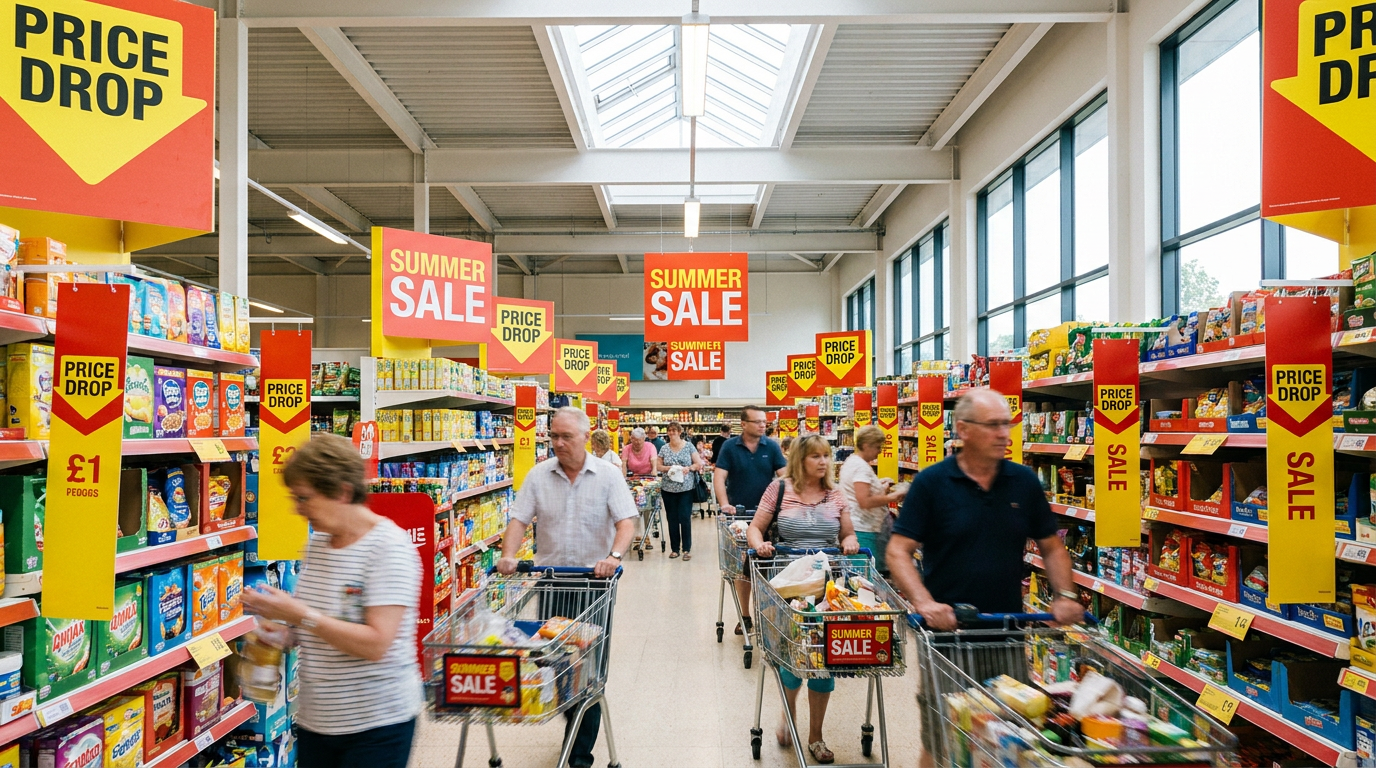
Walmart, Target, Amazon, and major grocery chains are slashing prices on thousands of items this June, sparking a summer retail war to win back budget-conscious shoppers.
By Factlen Editorial Team
- Value-Seeking Consumers
- Focused on stretching household budgets and finding immediate relief from inflation at the checkout counter.
- Retail Executives
- Focused on protecting market share and driving foot traffic by sacrificing short-term profit margins.
- Economic Analysts
- Pointing out that underlying supply chain and climate issues still threaten long-term food prices, making these cuts a strategic margin sacrifice.
What's not represented
- · Small independent retailers who cannot afford to match the margin sacrifices of corporate giants.
- · Agricultural producers facing higher operating costs despite retail price cuts.
Why this matters
After years of relentless inflation, this aggressive retail price war offers immediate, tangible relief to household budgets. Shoppers who strategically navigate these overlapping summer sales can significantly reduce their spending on everything from weekly groceries to major electronics.
Key points
- Major retailers including Walmart, Target, and Kroger have launched aggressive price cuts on thousands of items for summer 2026.
- Walmart leads the charge with price rollbacks on over 7,000 products, a 20% increase from last year.
- Amazon has moved its annual Prime Day event earlier, scheduling it for June 23–26.
- The discounts are driven by a 12% drop in consumer financial confidence, forcing retailers to sacrifice margins to keep shoppers.
- Despite the summer relief, economists warn that underlying food production costs are still projected to rise 3.4% this year.
The summer of 2026 is shaping up to be a buyer's market for everyday essentials, as America's largest retailers launch an aggressive wave of price cuts to win back inflation-weary shoppers.[1][5]
In a coordinated retreat from the steady price hikes of the past three years, giants like Walmart, Amazon, Target, and Kroger are slashing costs on thousands of items. The rollbacks span everything from backyard grilling staples to consumer electronics, offering tangible relief to household budgets just as the summer spending season begins.[1][2][5]
Walmart has taken the most aggressive stance, announcing it has already reduced prices on more than 7,000 items across its stores. This represents a 20% increase in promotional pricing compared to the same period last year, targeting everyday groceries and household necessities.[1][8]

Regional grocers and warehouse clubs are matching the momentum. Costco has lowered prices on its Kirkland Signature brand staples, while regional chains like H-E-B and Michigan-based VG's Grocery have implemented permanent price drops of 6% to 15% on summer essentials like hot dogs, charcoal, and condiments.[1][5][7]
The retail war extends beyond the grocery aisle. Amazon has officially moved its massive Prime Day event earlier in the calendar, scheduling the four-day sale for June 23 through June 26. In response, competitors like Target and Best Buy are pulling their own summer savings events forward to overlap, guaranteeing a week of steep discounts on tech and apparel.[2][3]
Amazon has officially moved its massive Prime Day event earlier in the calendar, scheduling the four-day sale for June 23 through June 26.
The driving force behind this sudden generosity is a stark shift in consumer behavior. A June 2026 survey by EY-Parthenon revealed that only one in four Americans feels "very confident" in their financial situation, with overall financial confidence dropping 12% over the last six months.[4]

Faced with rising transportation costs and depleted savings, shoppers have begun actively trading down—abandoning name brands for store labels, or migrating to deep discounters like Aldi and Dollar General.[1][5]
Retail executives have realized that protecting profit margins at the expense of foot traffic is a losing long-term strategy. Analysts at The Food Institute note that the industry "went a little too far" with cumulative price increases, and companies are now forced to reset their pricing to prevent permanent volume loss.[10]
"The basket has to come down," Kroger CEO Greg Foran acknowledged recently, highlighting that retailers must invest in across-the-board price cuts that pass the "commonsense test" for financially stressed consumers.[8]

However, economists caution that these retail rollbacks are strategic margin sacrifices rather than a sign of structural deflation. The U.S. Department of Agriculture still forecasts overall food prices to rise 3.4% in 2026, driven heavily by climate impacts and droughts affecting beef and fresh produce supplies.[6]
How we got here
2022–2025
Global supply chain disruptions and inflation drive grocery and retail prices to record highs.
Early 2026
Retailers report a noticeable drop in consumer foot traffic as shoppers migrate to deep-discount chains.
May 2026
Walmart, Target, and regional grocers begin quietly rolling back prices on thousands of everyday items.
June 2026
The retail price war becomes public, with Amazon moving Prime Day to June and competitors matching the aggressive summer discounts.
Viewpoints in depth
Retailers' Strategy
Retailers are sacrificing short-term profit margins to maintain foot traffic and market share.
After years of passing supply chain costs onto consumers, major chains have realized they hit a ceiling. Executives note that when shoppers migrate to deep-discount competitors like Aldi or Dollar General, winning them back is incredibly difficult. By initiating aggressive rollbacks now, companies like Walmart and Target are choosing to take a temporary hit to their profit margins in order to protect their long-term customer base and overall sales volume.
Economic Analysts
Economists warn that these price cuts are promotional band-aids masking deeper inflation.
While the discounts provide immediate relief, macroeconomic indicators suggest the underlying cost of food and goods is still rising. The USDA projects a 3.4% increase in overall food prices for 2026, driven by climate-related agricultural disruptions and sustained high transportation costs. Analysts argue that once the summer promotional period ends, retailers may be forced to quietly raise prices again if supply chain fundamentals do not improve.
Everyday Shoppers
Consumers are highly focused on immediate budget relief and maximizing value.
For households managing tight budgets, the macroeconomic debate is secondary to the immediate relief felt at the checkout counter. Shoppers are actively changing their habits—comparing prices across multiple stores, utilizing digital coupons, and waiting for major sales events like Prime Day to make necessary purchases. The summer price war offers a rare opportunity for consumers to stretch their dollars further after years of compounding inflation.
What we don't know
- It remains unclear if retailers will be able to maintain these lower prices into the fall and holiday shopping seasons.
- The exact impact of summer weather and droughts on late-2026 agricultural yields and subsequent food prices is still unknown.
Key terms
- Rollback
- A retail strategy where a store permanently or semi-permanently lowers the price of an item, rather than offering a temporary weekly sale.
- K-shaped consumer economy
- An economic situation where higher-income households continue to spend comfortably, while middle- and lower-income households face severe financial strain and cut back.
- Margin sacrifice
- When a company intentionally accepts a lower profit on the items it sells in order to keep prices low and maintain customer loyalty.
Frequently asked
Why are stores lowering prices right now?
Retailers are seeing a drop in consumer spending and foot traffic due to 'inflation fatigue.' To win back shoppers and prevent them from moving to deep-discount stores, major chains are sacrificing some profit margins to offer aggressive summer discounts.
When is Amazon Prime Day 2026?
Amazon has moved its Prime Day event earlier this year, scheduling the four-day sale for June 23 through June 26, 2026.
Are grocery prices actually going down long-term?
Not necessarily. While retailers are offering promotional price cuts this summer, the USDA still forecasts overall food prices to rise by 3.4% in 2026 due to climate impacts and supply chain costs.
Which stores have announced the biggest cuts?
Walmart has rolled back prices on over 7,000 items, while Target, Amazon Fresh, Costco, and regional grocers like Kroger and H-E-B have also announced thousands of price reductions.
Sources
Source coverage
10 outlets
3 viewpoints surfaced










[1]Click2HoustonValue-Seeking Consumers
Grocery relief? Walmart, Kroger and H-E-B announce major price cuts
Read on Click2Houston →[2]PCMagRetail Executives
Shop Amazon's Ultimate Summer Sale Early With the Best Prime Day 2026 Tech Deals
Read on PCMag →[3]SFGATERetail Executives
Amazon's Prime Day is happening in June — here's what we know so far
Read on SFGATE →[4]EYEconomic Analysts
EY-Parthenon Consumer Sentiment Survey finds Americans pulling back on summer travel and leisure spending
Read on EY →[5]NewsdayRetail Executives
Costco among retailers cutting grocery prices
Read on Newsday →[6]NewsweekEconomic Analysts
Grocery Prices Are Rising Again in 2026. It's Just The Start
Read on Newsweek →[7]SpartanNashRetail Executives
Shoppers Can Discover 'New Lower Prices' on Thousands of Products at VG's Grocery
Read on SpartanNash →[8]Coupons in the NewsEconomic Analysts
Retailers Plan Lower Prices - Until They Need To Raise Them Again
Read on Coupons in the News →[9]Davie County Enterprise RecordValue-Seeking Consumers
Tips for grocery savings
Read on Davie County Enterprise Record →[10]The Food InstituteEconomic Analysts
The Value Reset Is Here: What's Driving Food Prices Down in 2026
Read on The Food Institute →

More in shopping
See all 5 stories →Summer Sales
The 2026 Summer Deal Wars: Amazon, Target, and Walmart Shift Major Sales to June
0 sources

Used EV Market
The 2026 Used EV Market: Battery Health, Expired Tax Credits, and the Price Crash Explained
0 sources

On-Device AI
The Hidden Engine in Your Next Phone: Why On-Device AI is Changing How We Shop for Tech
0 sources

Every angle. Every day.
Get shopping stories with full source coverage and perspective breakdowns delivered to your inbox.