
Induction vs. Gas Ranges: The Complete 2026 Comparison
As induction technology matures and concerns over indoor air quality rise, the debate between gas and electric cooking has fundamentally shifted. Here is a definitive breakdown of the efficiency, health impacts, and culinary trade-offs of both platforms.
By Factlen Editorial Team
- Consumer Analysts
- Weigh the practical trade-offs of cost, speed, and infrastructure for everyday appliance buyers.
- Induction Advocates
- Prioritize the elimination of indoor combustion, maximum energy efficiency, and public health.
- Traditional Culinary Voices
- Emphasize tactile control, open flame versatility, and the freedom to use any cookware.
- Modern Professional Chefs
- Value the precision, speed, and cooler kitchen environment provided by advanced induction technology.
What's not represented
- · Electric Utility Providers
- · Natural Gas Industry Lobbyists
Why this matters
Choosing between induction and gas impacts more than just how fast your water boils—it directly affects your home's indoor air quality, your long-term energy bills, and the safety of your kitchen. Understanding the precise trade-offs ensures you don't spend thousands on an appliance that fights your cooking style or infrastructure.
Key points
- Induction cooktops use electromagnetic fields to heat pans directly, achieving 85-90% energy efficiency.
- Gas ranges rely on open-flame combustion, which offers visual control but loses up to 60% of its heat to the surrounding air.
- Studies show gas stoves emit indoor pollutants like nitrogen dioxide and benzene, prompting health concerns.
- Induction requires magnetic cookware (like cast iron) and often a dedicated 240-volt electrical circuit.
- Gas remains the preferred choice for traditional wok cooking, charring, and households with frequent power outages.
- Over a 15-year lifespan, the operational energy savings of induction can offset its slightly higher upfront installation costs.
The kitchen stove is undergoing a generational shift that is reshaping how we think about cooking at home. For decades, the debate between home cooks and culinary professionals centered almost exclusively on the merits of gas versus traditional electric radiant coils. Today, that conversation has fundamentally changed, driven by the rapid maturation of induction technology, fluctuating utility costs, and a growing awareness of indoor air quality. As homeowners look to upgrade their kitchens or build new houses in 2026, the choice between gas and induction has become the most consequential appliance decision they will make. It is no longer just a matter of culinary preference; it is a complex intersection of household infrastructure, environmental health, and long-term economics that requires a clear-eyed look at the trade-offs.[8]
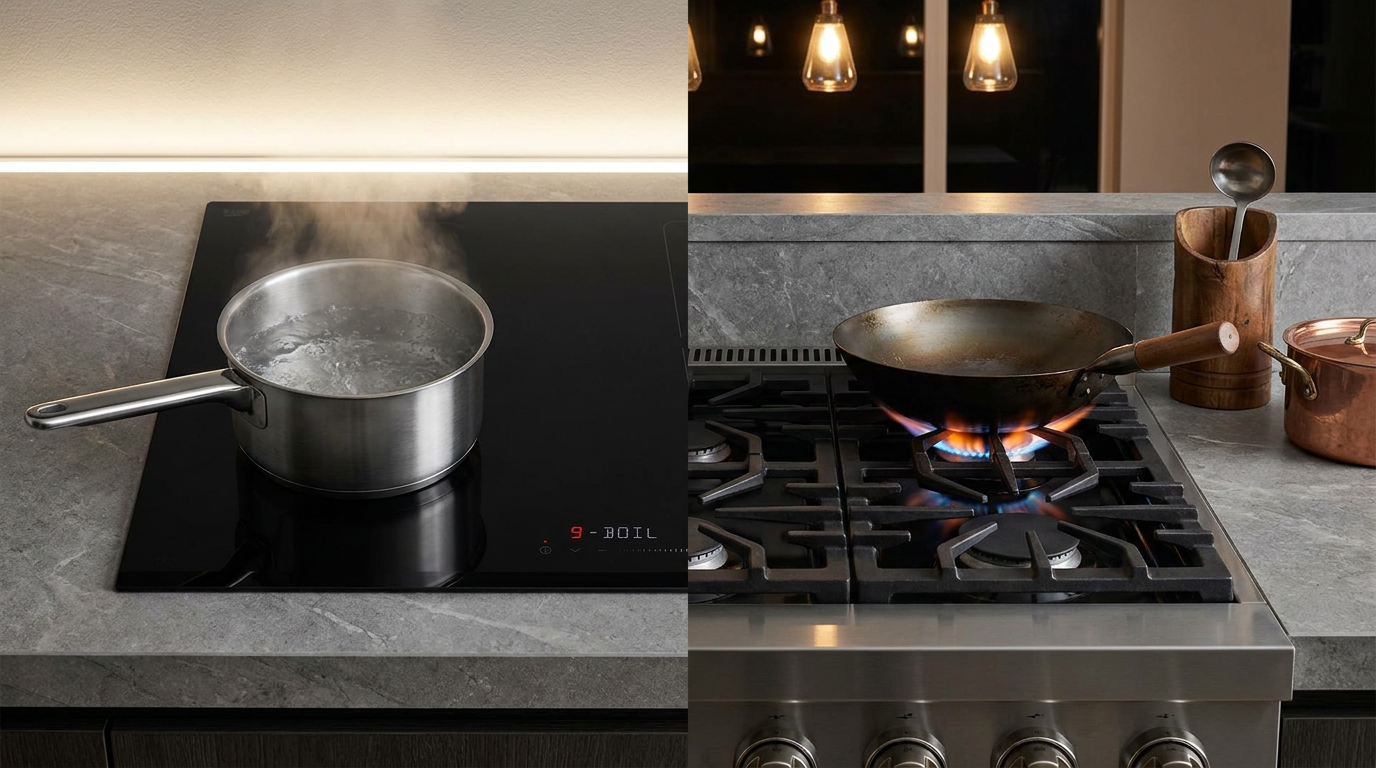
To understand the debate, it is essential to grasp the core mechanical difference in how heat is generated by each platform. Gas cooktops rely on traditional combustion, using an open flame to heat the ambient air around the cookware, which then transfers that thermal energy to the food inside. Induction, by contrast, bypasses the air entirely. It uses tightly wound copper coils beneath a smooth glass surface to create an oscillating electromagnetic field. When a compatible pot is placed on the burner, this field induces an electric current directly inside the metal of the cookware. The resistance of the metal turns the pot or pan itself into the primary heat source, while the glass surface beneath it remains relatively cool to the touch, only absorbing residual heat from the pan.[1][4]
The case for induction centers on its unprecedented efficiency, raw speed, and enhanced safety profile. Because the electromagnetic energy transfers directly to the metal vessel, very little heat escapes into the surrounding kitchen environment. This thermodynamic advantage makes the cooking process significantly faster and keeps the home noticeably cooler, which is a major benefit during sweltering summer months or in tight, poorly ventilated urban apartments. Furthermore, the absence of an open flame and the rapid cooling of the glass surface drastically reduce the risk of accidental burns or kitchen fires, making it an increasingly popular choice for households with young children or elderly residents who prioritize safety above all else.[2][7]
The evidence supporting induction's performance advantages is heavily quantified and widely recognized by appliance testers. According to data from the U.S. Department of Energy, induction appliances operate at up to 85 to 90 percent efficiency, meaning nearly all the electrical energy consumed goes directly into cooking the food. By comparison, gas stoves operate at roughly 32 to 55 percent efficiency, with the vast majority of the heat radiating uselessly into the room. In practical terms, Consumer Reports testing consistently demonstrates that induction cooktops can boil a large pot of water 20 to 40 percent faster than their highest-performing gas counterparts. This speed, combined with the ability to hold a steady, ultra-low simmer without scorching delicate sauces, gives induction a measurable edge in raw performance.[1][4][7]

However, the case against induction primarily involves upfront friction, infrastructure hurdles, and strict cookware compatibility limits. The underlying technology requires ferrous, magnetic cookware to function at all. While heavy cast iron and most high-quality stainless steel work perfectly, materials like aluminum, pure copper, and glass will not heat up unless they feature a specialized magnetic base bonded to the bottom. Additionally, homes with older electrical panels may face significant installation barriers. Upgrading to induction often requires an electrician to run a dedicated 240-volt, 50-amp circuit to the kitchen, a modification that can easily add hundreds or even thousands of dollars to the total installation cost, depending on the home's existing wiring and panel capacity.[1][2]
Conversely, the case for gas is deeply rooted in tactile control, culinary versatility, and mechanical simplicity. For generations of cooks, the visual feedback of a live blue flame has offered an intuitive, immediate way to gauge and adjust heat levels without relying on digital touchpads. Gas burners are inherently forgiving when it comes to cookware; they accommodate any type of pot or pan, regardless of its material composition or whether the bottom is perfectly flat. This makes gas the only viable option for traditional round-bottom woks, heavily warped vintage cast-iron skillets, or specialized clay pots that would fail to register on a perfectly flat, glass-topped induction surface.[6][7]
The evidence supporting gas highlights its rugged resilience, lower barrier to entry, and independence from the electrical grid. Gas ranges generally cost less upfront than premium induction models, though the price gap has narrowed significantly in recent years as induction manufacturing scales up. Furthermore, in regions prone to severe weather and frequent power outages, a gas stove offers a critical layer of household resilience. Because the flow of gas does not rely on the electrical grid, a gas burner can often still be ignited manually with a match during a blackout, providing a reliable method for boiling water and cooking hot meals when the rest of the house goes dark.[7]
The evidence supporting gas highlights its rugged resilience, lower barrier to entry, and independence from the electrical grid.
The case against gas, however, is increasingly focused on its environmental footprint and documented respiratory health impacts. A growing body of peer-reviewed research has quantified the indoor air pollution generated by residential combustion. Studies show that routine cooking on gas stoves emits nitrogen dioxide, carbon monoxide, and formaldehyde directly into the kitchen. Recent analyses have even found that gas burners can emit benzene, a known carcinogen, at levels comparable to secondhand tobacco smoke. These findings have prompted public health advocates to strongly recommend a transition away from indoor combustion, noting that homes with gas stoves often exceed outdoor air quality standards for pollutants unless they utilize powerful, externally vented range hoods.[2][3][4]

Interestingly, the professional culinary world—long considered the ultimate stronghold of gas cooking—is actively fracturing and shifting its allegiance. While many veteran chefs still prefer the open flame for aggressive pan-tossing, charring ingredients directly on the grates, and visual flair, a significant contingent of high-end commercial kitchens is adopting induction. Modern chefs cite the ability to hold ultra-precise temperatures during busy services, the ease of wiping down a flat glass surface between courses, and the drastic reduction in ambient kitchen heat as transformative benefits that improve both food consistency and the working conditions for their kitchen staff.[5][6]
When evaluating the long-term economics of the two platforms, the financial math depends heavily on local utility rates and usage patterns. While a gas range might save a homeowner money at the initial checkout counter, an induction cooktop uses roughly 50 to 60 percent less primary energy per meal cooked. Over a standard 15-year appliance lifespan, the operational energy savings of induction can completely offset the higher initial purchase price and any electrical upgrade costs. This is particularly true in regions where natural gas prices are rising or where homes are already equipped with solar panels that can offset the cost of electricity.[2]
Ultimately, induction fits well when a household prioritizes indoor air quality, maximum energy efficiency, and daily safety. It is the optimal choice for homes with young children or curious pets, as the lack of an open flame and the rapid cooling of the glass surface drastically reduce the likelihood of severe burns. It also excels for pragmatic cooks who value boiling speed, precise digital temperature control, and the effortless cleanup of a flat, seamless surface after a messy weeknight meal.[3][7][8]
On the other hand, induction does not fit well when a kitchen lacks the necessary high-voltage electrical infrastructure and the homeowner is unwilling or financially unable to pay for a comprehensive electrical panel upgrade. It is also a notably poor fit for culinary enthusiasts who rely heavily on non-magnetic specialty cookware, such as pure copper sugar pots, traditional aluminum calderos, or authentic round-bottom woks. For cooks who have spent years building a carefully curated collection of specialized kitchen tools, the requirement to replace their favorite pans simply to accommodate a new stove can be a dealbreaker.[1][8]

Conversely, gas fits well when a home is already plumbed with an active natural gas or propane line and the cook relies heavily on visual, intuitive heat adjustments. It remains the superior choice for specific, high-heat culinary techniques that require an open flame, such as charring poblano peppers directly on the cast-iron grate, flambéing desserts, or executing aggressive stir-fries where the pan is frequently lifted away from the heating surface. For these tactile cooks, the stove is an instrument, and the flame is an essential part of the process.[6][8]
However, gas does not fit well when a kitchen lacks adequate exterior ventilation. Operating a gas stove without a high-quality, externally vented range hood allows dangerous combustion byproducts to accumulate indoors, posing long-term respiratory risks to the occupants. It is also a less ideal choice for environmentally conscious households looking to fully decarbonize their footprint, or for those living in progressive jurisdictions that are beginning to phase out new residential gas hookups in an effort to combat climate change.[2][3][8]
In the end, there is no single, universal winner that applies perfectly to every home. The decision requires carefully weighing the tactile familiarity, cookware flexibility, and lower upfront cost of gas against the thermodynamic superiority, rapid speed, and undeniable health benefits of induction. By aligning the technology with their specific cooking habits, budget constraints, and existing home infrastructure, home chefs can make a highly informed investment that will serve their kitchen efficiently and safely for decades to come.[8]
How we got here
Early 1900s
Gas stoves become the dominant cooking technology in modern kitchens, replacing wood and coal.
1970s
The first consumer induction cooktops are introduced by Westinghouse, though high costs prevent widespread adoption.
2010s
Induction technology matures and drops in price, gaining massive popularity in Europe and professional kitchens.
2023
Major studies highlight the indoor air quality risks of gas stoves, sparking a national debate over cooking technology.
2026
Induction reaches near price-parity with premium gas ranges, accelerating the transition in residential remodels.
Viewpoints in depth
Health & Environmental Advocates
Prioritize the elimination of indoor combustion and greenhouse gas emissions.
This camp argues that the kitchen stove is a critical public health issue. Citing studies that link gas stoves to elevated levels of nitrogen dioxide and benzene, they view the transition to induction as a necessary step to protect respiratory health, particularly for children. They also emphasize that moving away from fossil fuels in the home is essential for broader climate decarbonization goals.
Traditional Culinary Purists
Value the tactile feedback, versatility, and heritage of open-flame cooking.
For these cooks, the stove is an instrument that requires intuition. They argue that the visual cue of a flame cannot be replicated by a digital display. This perspective champions the ability to use any pot or pan—from a warped vintage cast-iron skillet to a round-bottom carbon steel wok—and relies on the open flame for specific techniques like charring vegetables or flambéing.
Pragmatic Homeowners
Focus on the practical realities of cost, infrastructure, and daily convenience.
This group evaluates the debate through the lens of household logistics. While they acknowledge the speed and safety benefits of induction, they are highly sensitive to the friction of switching. The cost of hiring an electrician to run a 240-volt line, combined with the need to replace non-magnetic cookware, often makes them hesitant to abandon their existing gas infrastructure unless a remodel is already underway.
What we don't know
- How quickly the price of premium induction ranges will reach full parity with entry-level gas models.
- Whether more states will successfully implement or overturn bans on new residential gas hookups.
- How the long-term durability of digital induction touchboards will compare to the mechanical simplicity of gas valves over a 20-year span.
Key terms
- Electromagnetic Induction
- A process where a magnetic field generates an electric current directly inside ferrous cookware, heating the pan itself rather than the surface beneath it.
- Ferrous Cookware
- Pots and pans containing iron, such as cast iron or magnetic stainless steel, which are required for induction cooking to work.
- Nitrogen Dioxide (NO2)
- A gaseous air pollutant produced by combustion, including gas stoves, which can irritate airways and exacerbate respiratory conditions like asthma.
- Primary Energy
- The total raw energy consumed to perform a task, accounting for the efficiency of the appliance and the heat lost to the surrounding environment.
Frequently asked
Do I need to buy all new pots and pans for induction?
Not necessarily. Induction requires magnetic cookware, such as cast iron and most stainless steel. If a magnet sticks firmly to the bottom of your current pans, they will work on an induction cooktop.
Is induction cooking safe for people with pacemakers?
Induction cooktops generate electromagnetic fields, which can theoretically interfere with some pacemakers if the person is very close to the surface. Most manufacturers recommend consulting a cardiologist, though the risk is generally considered low at normal cooking distances.
Can I use an induction cooktop during a power outage?
No. Unlike gas stoves, which can often be lit manually with a match during a blackout, induction cooktops rely entirely on electricity and will not function without power.
Why are gas stoves facing bans in some cities?
Some municipalities are restricting new residential gas hookups due to concerns over indoor air pollution—specifically nitrogen dioxide and benzene emissions—as well as broader efforts to reduce greenhouse gas emissions from fossil fuels.
Sources
Source coverage
8 outlets
4 viewpoints surfaced








[1]Consumer ReportsConsumer Analysts
Induction vs. Gas Ranges: Which Is Right for You?
Read on Consumer Reports →[2]Energy SolutionsInduction Advocates
Induction vs Gas Cooktops: The Definitive Health, Efficiency & Economic Analysis
Read on Energy Solutions →[3]ForbesInduction Advocates
Bans On Gas Stoves Are Stirring An 'Induction Revolution'
Read on Forbes →[4]U.S. Department of EnergyInduction Advocates
Better for You, Better for the Environment: Induction Appliances
Read on U.S. Department of Energy →[5]EuroKeraModern Professional Chefs
Why Professional Chefs Are Switching to Induction
Read on EuroKera →[6]Mountain High ApplianceTraditional Culinary Voices
Why Do Professional Chefs Prefer Gas Stovetops?
Read on Mountain High Appliance →[7]Stahl KitchensConsumer Analysts
Induction vs Gas Cooktops: Which One Is the Better Choice in 2026?
Read on Stahl Kitchens →[8]Factlen Editorial TeamConsumer Analysts
Synthesis by Factlen editorial team
Read on Factlen Editorial Team →


Every angle. Every day.
Get shopping stories with full source coverage and perspective breakdowns delivered to your inbox.