
How Veterans Treatment Courts Are Transforming the Justice System
By replacing traditional incarceration with intensive, peer-supported medical and psychological treatment, specialized courts are drastically reducing veteran recidivism.
By Factlen Editorial Team
- Veterans Health & Advocacy
- Emphasizes that criminal behavior in veterans is often a clinical symptom of untreated trauma, requiring medical intervention rather than moral condemnation.
- Judicial & Law Enforcement
- Focuses on how specialized courts reduce docket congestion, lower jail populations, and improve public safety by addressing the root causes of repeat offenses.
- Justice Reformers
- Views these courts as a successful proof-of-concept for restorative justice, arguing that the model should be expanded to other vulnerable populations.
What's not represented
- · Victims of veteran-committed offenses
- · Rural county administrators lacking funding
Why this matters
Traditional courts often punish the symptoms of combat trauma, trapping veterans in a cycle of incarceration. This alternative model proves that treating the root causes of criminal behavior saves lives, reduces taxpayer burdens, and honors military service with a genuine second chance.
Key points
- Veterans Treatment Courts divert justice-involved veterans from prison into 12 to 24-month supervised recovery programs.
- The courts replace adversarial prosecution with a collaborative team of judges, VA health providers, and volunteer peer mentors.
- Participants show drastically lower recidivism rates (14%) compared to defendants in traditional courts (up to 46%).
- Despite bipartisan support and proven success, only 14% of U.S. counties currently operate a dedicated veterans court.
For decades, the American criminal justice system has treated the invisible wounds of war as standard criminal behavior. When military veterans return to civilian life carrying the heavy burdens of post-traumatic stress disorder (PTSD), traumatic brain injury (TBI), or severe depression, some attempt to self-medicate with drugs or alcohol. This coping mechanism frequently leads to encounters with law enforcement, arrests, and a downward spiral into the traditional penal system. Once incarcerated, these veterans are often stripped of their specialized support networks, exacerbating their underlying trauma and virtually guaranteeing a cycle of re-offending upon release. The traditional courtroom, inherently adversarial and focused strictly on punitive measures, is ill-equipped to address the root causes of veteran criminality, leaving a vulnerable population to navigate a system that punishes the symptoms of their military service rather than treating the cause.[3]
In response to this systemic failure, a quiet but profound revolution has taken root within the judiciary: the proliferation of Veterans Treatment Courts (VTCs). Born from the broader "problem-solving court" movement that began with drug and mental health dockets, VTCs represent a fundamental paradigm shift in how the state handles justice-involved veterans. Instead of focusing exclusively on the offense and the corresponding punishment, these specialized courts pivot toward rehabilitation, accountability, and targeted medical intervention. By recognizing that a veteran's criminal behavior may be inextricably linked to their service, VTCs offer a structured alternative to incarceration that honors their sacrifice while demanding rigorous personal accountability.[1][8]
The mechanics of a Veterans Treatment Court differ radically from a traditional criminal docket. Eligible veterans who voluntarily opt into the program are diverted from standard prosecution and placed into an intensive, court-supervised treatment regimen that typically lasts between 12 and 24 months. The environment is explicitly non-adversarial; prosecutors, defense attorneys, probation officers, and treatment providers abandon their traditional opposing roles to form a collaborative team. This interdisciplinary group works together to design and enforce a customized rehabilitation plan for each participant, focusing on sobriety, mental health stabilization, and social reintegration rather than simply marking time until a sentence is served.[2]

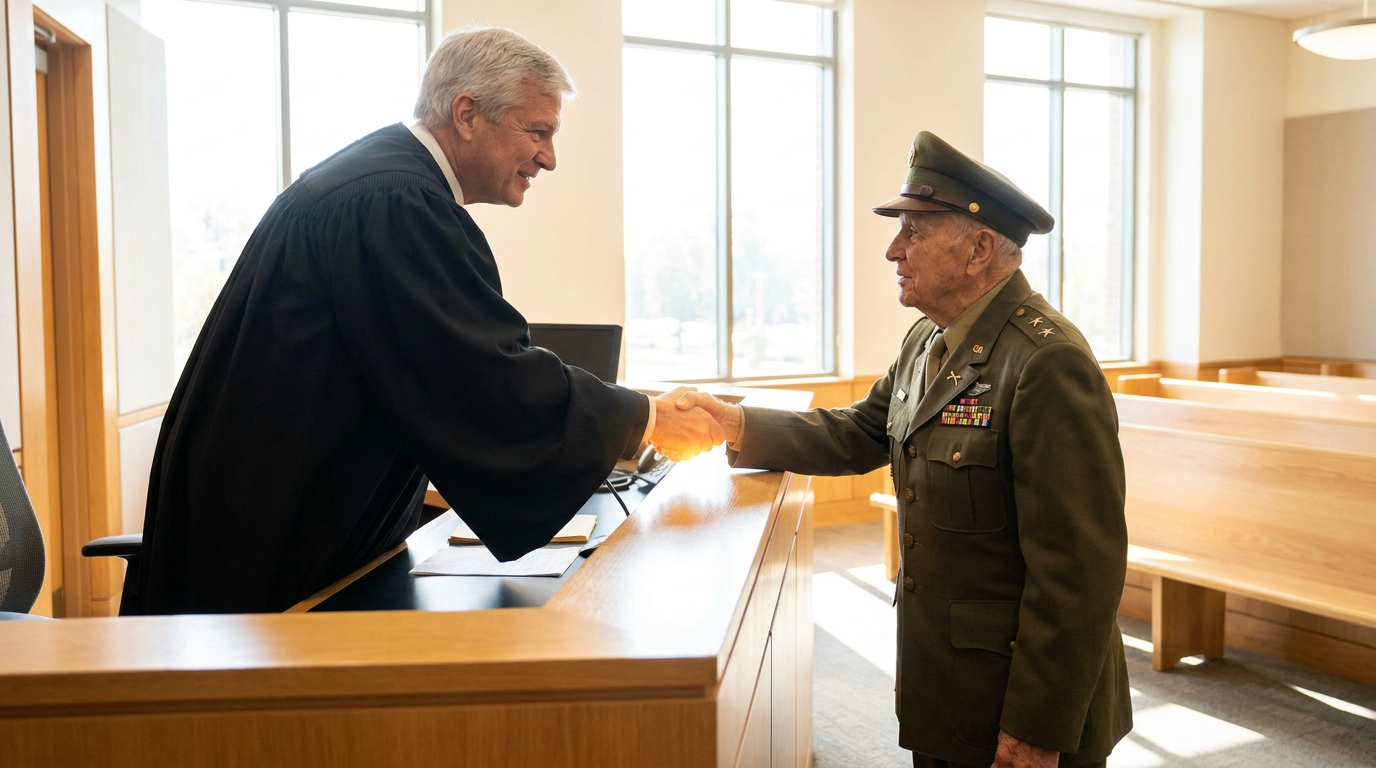
At the center of this collaborative model is the presiding judge, whose role transforms from an impartial arbiter of punishment into an active, motivating force in the veteran's recovery. Participants are required to appear in court frequently—often on a bi-weekly basis during the initial phases of the program—to report directly to the judge. During these status hearings, the judge reviews progress reports, drug test results, and treatment attendance. The interactions are highly structured but deeply personal; judges celebrate milestones like sobriety anniversaries with applause, while also imposing swift, graduated sanctions for infractions. This dynamic leverages the military conditioning of the participants, replacing the chaotic environment of the traditional justice system with the clear expectations and authoritative structure that veterans are accustomed to.[3]
Crucially, the judicial system does not attempt to provide the medical care itself. Instead, Veterans Treatment Courts serve as a centralized hub, seamlessly connecting participants with the vast resources of the Department of Veterans Affairs (VA) and local community providers. Veterans Justice Outreach specialists work directly within the courts to ensure that participants receive comprehensive, evidence-based care tailored to their specific needs. This includes specialized trauma therapies for PTSD, specialized care for military sexual trauma, psychiatric medication management, and intensive substance use disorder treatment. By integrating the VA directly into the legal process, the courts ensure that veterans are not left to navigate a labyrinthine healthcare bureaucracy on their own while simultaneously facing criminal charges.[4]
Perhaps the most distinctive and effective element of the VTC model is the integration of volunteer veteran peer mentors. Every participant is paired with a mentor who has successfully navigated the transition back to civilian life, and in many cases, has overcome their own struggles with addiction or the justice system. These mentors attend court sessions, provide a sympathetic ear, and offer practical advice that only a fellow service member can provide. This peer-to-peer connection breaks down the profound isolation and stigma that justice-involved veterans often feel. It fosters a sense of camaraderie and mutual accountability, echoing the "leave no one behind" ethos of the military and proving instrumental in keeping participants engaged when the grueling work of recovery becomes overwhelming.[6]
Perhaps the most distinctive and effective element of the VTC model is the integration of volunteer veteran peer mentors.
The empirical data supporting the efficacy of Veterans Treatment Courts is overwhelmingly positive, particularly regarding the primary metric of the justice system: recidivism. Traditional courts see high rates of re-offending, with studies indicating that between 23% and 46% of defendants will face new incarcerations. In stark contrast, veterans who participate in VTCs exhibit drastically lower recidivism rates, averaging around 14%. Some established courts report even more astonishing success; for instance, a comprehensive review of multiple jurisdictions found that among program graduates, the re-arrest rate frequently drops below 3%, with some courts achieving a functional 0% recidivism rate for those who complete the full treatment protocol.[4][6]

Beyond simply keeping veterans out of jail, the program fundamentally alters their life trajectories, yielding profound socioeconomic benefits. Graduates of problem-solving courts demonstrate massive improvements in social functioning, housing stability, and financial independence. A comprehensive report from the Michigan Supreme Court tracking the progress of these specialty dockets revealed that unemployment among Veterans Treatment Court graduates plummeted by an astounding 82%. By addressing the underlying trauma and addiction, the courts enable veterans to secure stable housing, reconnect with estranged family members, and re-enter the workforce as productive, tax-paying citizens, thereby transforming a public liability into a community asset.[5]
Recognizing these undeniable successes, state legislatures across the political spectrum are moving aggressively to expand access to VTCs and remove bureaucratic hurdles. In Florida, lawmakers recently passed House Bill 845 with a unanimous 114-0 vote, streamlining the process by which veterans enter the program. The legislation eliminated a major bottleneck by removing the requirement for state attorneys to pre-approve applications, granting judges the ultimate authority to admit veterans based on the recommendations of the interdisciplinary treatment team. Furthermore, the bill allows veterans to be admitted at any stage of the criminal proceedings, ensuring that life-saving interventions are not delayed by procedural technicalities.[7]

At the national level, organizations like the Council on Criminal Justice have launched dedicated initiatives, such as the Veterans Justice Commission, to advocate for the widespread adoption of these models. Chaired by former defense secretaries and top military leaders, the Commission has published comprehensive policy frameworks urging both state and federal governments to expand alternatives to incarceration. Their recommendations go beyond simply establishing more courts; they advocate for laws that would allow veterans who successfully complete these rigorous programs to have their criminal records fully expunged, ensuring that a past mistake driven by service-related trauma does not permanently derail their future employment and housing prospects.[1]
Despite the proven efficacy and bipartisan support, a significant geographic lottery still dictates whether a veteran receives treatment or a prison sentence. Currently, only about 14% of counties in the United States operate a dedicated Veterans Treatment Court. This patchwork availability means that a veteran arrested in a major metropolitan area might be diverted into a life-saving recovery program, while a veteran committing the exact same offense in a rural county is sent to a state penitentiary. Advocates argue that this disparity represents a fundamental failure of the nation's promise to care for those who have borne the battle, pushing for state-level mandates and federal funding to ensure universal access to specialized justice.[1]

The expansion of these courts also faces ongoing debates regarding eligibility criteria, particularly concerning violent offenses. Many jurisdictions strictly limit VTC participation to non-violent offenders, fearing public backlash if a participant commits a serious crime while under community supervision. However, clinical experts and justice reformers argue that the symptoms of severe PTSD and TBI often manifest as aggressive or volatile behavior. By categorically excluding veterans charged with violent offenses, the system risks denying treatment to the very individuals whose criminal behavior is most directly linked to their combat service, leaving the most traumatized veterans to languish in traditional prisons.[8]
Ultimately, the success of Veterans Treatment Courts offers a compelling blueprint for the broader future of the American criminal justice system. By proving that intensive, compassionate, and evidence-based treatment is vastly more effective at ensuring public safety than punitive incarceration, VTCs challenge the foundational assumptions of the traditional penal model. As these courts continue to expand and refine their methodologies, they not only save the lives of countless service members but also demonstrate that a justice system focused on healing rather than retribution can yield profound dividends for society as a whole.[8]
How we got here
1989
The first drug court is established in Florida, pioneering the problem-solving court model.
2008
The first dedicated Veterans Treatment Court is founded in Buffalo, New York, by Judge Robert Russell.
2010
The VA officially launches the Veterans Justice Outreach program to support the growing number of VTCs nationwide.
2022
The Council on Criminal Justice launches the Veterans Justice Commission to assess and expand alternatives to incarceration.
2025
States like Florida pass unanimous legislation to streamline VTC access and remove bureaucratic barriers for veterans.
Viewpoints in depth
Judicial & Law Enforcement Officials
Focuses on the systemic benefits of specialized courts for the broader legal system.
For judges and prosecutors, Veterans Treatment Courts offer a pragmatic solution to the revolving door of the criminal justice system. Traditional incarceration often fails to rehabilitate offenders struggling with addiction or mental illness, leading to high rates of re-arrest that clog court dockets and strain local jail budgets. By addressing the root causes of criminal behavior, VTCs significantly reduce recidivism, ultimately enhancing public safety and saving taxpayer dollars that would otherwise be spent on repeated incarcerations.
Veterans Health Providers
Emphasizes the clinical necessity of treating justice-involved veterans as patients rather than criminals.
Medical professionals and VA advocates argue that much of the criminal behavior exhibited by returning veterans is a direct clinical symptom of untreated combat trauma, such as PTSD or traumatic brain injuries. From this perspective, punishing a veteran for self-medicating is both ineffective and morally questionable. They champion the VTC model because it integrates evidence-based psychiatric care and addiction treatment directly into the accountability structure, treating the underlying wounds of war rather than merely penalizing the resulting behavior.
Criminal Justice Reformers
Views the success of veterans courts as a blueprint for broader systemic change.
Reform advocates see Veterans Treatment Courts as a highly successful proof-of-concept for restorative justice. They point to the staggering drops in recidivism and unemployment among VTC graduates as evidence that the traditional punitive model of the American justice system is fundamentally flawed. While they strongly support the expansion of veteran-specific dockets, reformers argue that the core principles of the model—compassion, interdisciplinary treatment, and peer mentorship—should be expanded to benefit other vulnerable populations currently languishing in the penal system.
What we don't know
- Whether federal funding will be allocated to mandate and support Veterans Treatment Courts in the 86% of counties that currently lack them.
- How recidivism rates might change if eligibility criteria are broadly expanded to include veterans charged with violent offenses.
Key terms
- Problem-Solving Courts
- Specialized judicial dockets, like drug or mental health courts, that focus on rehabilitating offenders through treatment rather than traditional punishment.
- Recidivism
- The tendency of a convicted criminal to re-offend and return to the justice system after being punished or receiving intervention.
- Veterans Justice Outreach (VJO)
- A VA program that provides specialists who work directly with local courts and jails to connect eligible veterans to healthcare services.
- Therapeutic Jurisprudence
- A legal philosophy that views the law as a social force that can produce therapeutic or anti-therapeutic consequences, focusing on the well-being of the people involved.
- Military Sexual Trauma (MST)
- Psychological trauma resulting from sexual assault or harassment experienced during military service, often a root cause of subsequent substance abuse.
Frequently asked
What is a Veterans Treatment Court?
A specialized court docket that diverts justice-involved veterans from prison into intensive, supervised treatment programs for mental health and substance abuse.
Who is eligible to participate?
Eligibility varies by county, but generally requires a veteran to have a clinical diagnosis like PTSD or addiction linked to their service. Many courts restrict access to non-violent offenders.
How long does the program take?
Most VTC programs require 12 to 24 months of rigorous participation, including frequent court appearances, drug testing, and therapy.
Do participants still get a criminal record?
In many jurisdictions, successful graduation results in reduced charges, dismissed cases, or full record expungement, allowing veterans to rebuild their lives.
Sources
Source coverage
8 outlets
3 viewpoints surfaced







[1]Council on Criminal JusticeJustice Reformers
Alternatives to Prosecution and Incarceration for Justice-Involved Veterans
Read on Council on Criminal Justice →[2]Unified Judicial System of PennsylvaniaJudicial & Law Enforcement
Veterans Treatment Courts | Operations
Read on Unified Judicial System of Pennsylvania →[3]Military.comVeterans Health & Advocacy
Veteran Treatment Courts
Read on Military.com →[4]American Addiction CentersVeterans Health & Advocacy
Veterans Treatment Court: Treatment & Alternatives to Prison
Read on American Addiction Centers →[5]Michigan CourtsJudicial & Law Enforcement
Veterans and Judges Attest to Success of Problem-Solving Courts as New Report is Released
Read on Michigan Courts →[6]National Institutes of HealthJustice Reformers
New Research on Veterans Treatment Courts: An Overview of the Community Participatory Research on Veterans in Specialized Programming Project
Read on National Institutes of Health →[7]Glover Luck LLPVeterans Health & Advocacy
Florida Improves Veterans Treatment Courts
Read on Glover Luck LLP →[8]Factlen Editorial TeamJustice Reformers
Synthesis by Factlen editorial team
Read on Factlen Editorial Team →
More in law justice
See all 9 stories →Record Clearing
How Automatic 'Clean Slate' Laws Are Clearing Millions of Criminal Records
7 sources

Legal Tech
How Algorithms Are Quietly Clearing Millions of Criminal Records
7 sources

Green Amendments
How 'Green Amendments' Are Rewriting Environmental Law in State Constitutions
7 sources

Dispute Resolution
The End of the Courtroom Drama: How Mediation and Collaborative Law Are Transforming Civil Justice
7 sources

Every angle. Every day.
Get law justice stories with full source coverage and perspective breakdowns delivered to your inbox.